


Global Hypodermic Needles Market
Market Size in USD Billion
CAGR :
% 
 USD
7.80 Billion
USD
14.76 Billion
2024
2032
USD
7.80 Billion
USD
14.76 Billion
2024
2032
 Forecast Period Forecast Period |
2025 –2032 |
 Market Size (Base Year) Market Size (Base Year) |
USD 7.80 Billion |
 Market Size (Forecast Year) Market Size (Forecast Year) |
USD 14.76 Billion |
 CAGR CAGR |
% |
| Major Markets Players |
|
Global Hypodermic Needles Market Size
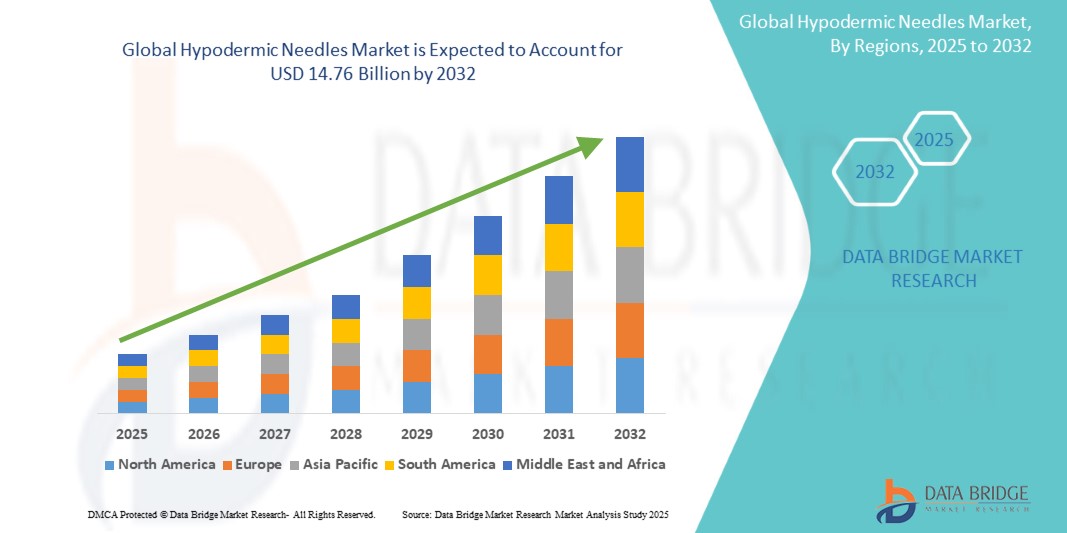
- The global Hypodermic Needles Market was valued at USD 7.8 billion in 2024 and is expected to reach USD 14.76 billion by 2032
- During the forecast period of 2025 to 2032 the market is likely to grow at a CAGR of 8.3%, primarily driven by the growing global healthcare structure
- This growth is driven by factors such as the growing home healthcare market, increasing medical and surgical procedure
Hypodermic Needles Market Analysis
- Hypodermic needles are essential medical tools used for the injection of medications, vaccines, and other treatments into the body. They play a critical role in various medical procedures, including vaccinations, insulin injections, and other therapeutic treatments for chronic diseases such as diabetes and cancer
- The demand for hypodermic needles is primarily driven by the increasing prevalence of chronic diseases, the rise in vaccination programs, and advancements in medical treatments. A significant portion of the global demand comes from diabetes management, with millions of people requiring daily insulin injections. In addition, the growing global vaccination initiatives, including those spurred by the COVID-19 pandemic, have further boosted the demand for hypodermic needles
- North America stands as one of the dominant regions for hypodermic needle usage, driven by its advanced healthcare infrastructure, high healthcare expenditure, and strong adoption of advanced medical technologies. In the U.S., the widespread prevalence of chronic diseases such as diabetes and the large-scale vaccination programs contribute significantly to the region's high demand for hypodermic needles. In addition, the North American market is also a leader in needle safety innovations and self-injection devices, which further drives growth
- For instance, the U.S. has seen a steady increase in the number of people living with diabetes, leading to greater demand for insulin pens and syringes. The introduction of smart syringes and safety needles to prevent needle-stick injuries has further propelled the market in North America
- Globally, hypodermic needles are considered one of the most critical tools in healthcare settings. They are vital for ensuring the effective delivery of injections and are ranked as the second-most crucial medical device after infusion pumps in many healthcare settings. Their role in precision drug delivery and ensuring patient safety during injections makes them indispensable in both hospital and home healthcare environments
Report Scope and Hypodermic Needles Market Segmentation
|
Attributes |
Hypodermic Needles Key Market Insights |
|
Segments Covered |
|
|
Countries Covered |
North America
Europe
Asia-Pacific
Middle East and Africa
South America
|
|
Key Market Players |
|
|
Market Opportunities |
|
|
Value Added Data Infosets |
In addition to the insights on market scenarios such as market value, growth rate, segmentation, geographical coverage, and major players, the market reports curated by the Data Bridge Market Research also include import export analysis, production capacity overview, production consumption analysis, price trend analysis, climate change scenario, supply chain analysis, value chain analysis, raw material/consumables overview, vendor selection criteria, PESTLE Analysis, Porter Analysis, and regulatory framework. |
Hypodermic Needles Market Trends
“Increasing Adoption of Smart Syringes and Digital Integration”
- One prominent trend in the global hypodermic needles market is the growing adoption of smart syringes and digital integration
- These advanced technologies enhance the precision and efficiency of drug delivery by providing real-time monitoring and tracking of dosage, improving patient safety, and ensuring adherence to prescribed medication schedules. Smart syringes often come with features such as dose tracking, auto-disable mechanisms, and data storage capabilities, which help to reduce medication errors and improve the overall quality of care
- For instance, smart syringes can be equipped with Bluetooth or RFID technology, allowing healthcare providers to monitor the exact dosage administered and track patient adherence to medication schedules remotely. This technology is especially beneficial for chronic disease management, such as diabetes, where precise and timely insulin delivery is critical
- Digital integration also allows for the seamless capture and sharing of patient data, enhancing the efficiency of healthcare systems and enabling more personalized treatment plans. This integration supports the growing trend of telemedicine and remote monitoring, making it easier for patients to manage their conditions from home
- This trend is revolutionizing the way hypodermic needles are used, improving patient outcomes and safety, while increasing the demand for technologically advanced needles and injection devices in the market
Hypodermic Needles Market Dynamics
Driver
“Increasing Demand Due to Rising Chronic Diseases and Vaccination Needs”
- The growing prevalence of chronic diseases such as diabetes, cardiovascular disorders, and cancer is significantly driving the demand for hypodermic needles, as these conditions often require injectable medications
- The global vaccination campaigns, including those for COVID-19, have further amplified the need for hypodermic needles to administer vaccines efficiently and safely
- Technological advancements in needle design, such as safety-engineered needles, are addressing concerns related to needlestick injuries, enhancing patient and healthcare worker safety
For instance:
- In 2024, according to a report by the World Health Organization, over 11 billion COVID-19 vaccine doses were administered globally, highlighting the critical role of hypodermic needles in vaccination efforts
- In 2023, the International Diabetes Federation reported that approximately 537 million adults worldwide were living with diabetes, emphasizing the growing need for injectable insulin and other therapeutic drugs
- In conclusion, the rising prevalence of chronic diseases and the global vaccination efforts, particularly in the wake of the COVID-19 pandemic, have created a sustained demand for hypodermic needles
Opportunity
“Advancing Needle Technology for Enhanced Safety and Comfort”
- The development of safety-engineered hypodermic needles is revolutionizing the market by minimizing needlestick injuries and improving patient comfort during injections
- Needle-free injection systems are emerging as a promising alternative, offering painless drug delivery and reducing the risk of cross-contamination
- Customization of needles for specific applications, such as smaller gauge needles for reduced discomfort, is creating new opportunities for market growth.
For instance:
- In 2025, Becton Dickinson launched its UltraSafe Plus Passive Needle Guard, designed to enhance safety during injections and reduce the risk of needlestick injuries
- In 2024, Terumo Corporation introduced its Smart Infusion System, integrating advanced needle technology for precise and comfortable drug delivery
- In conclusion, the continued innovation in safety-engineered needles, needle-free injection systems, and customizable designs is driving significant advancements in patient safety and comfort, fueling growth in the hypodermic needle market
Restraint/Challenge
“Environmental Concerns and High Costs Limiting Market Penetration”
- The disposal of hypodermic needles poses significant environmental challenges, as improper disposal can lead to contamination and health risks
- The high cost of advanced needle technologies, such as safety-engineered needles, can deter adoption in low-income regions and smaller healthcare facilities
- Stringent regulatory requirements for needle manufacturing and disposal further add to the operational costs, limiting market growth
For instance:
- In 2023, according to a report by the Environmental Protection Agency, improper disposal of medical sharps, including hypodermic needles, contributed to increased risks of environmental contamination and public health concerns
- In 2024, a study published in the Journal of Medical Devices highlighted the financial burden of adopting safety-engineered needles in developing countries, restricting their widespread use
In conclusion, while advancements in needle technology are improving safety and patient care, environmental concerns, high costs, and stringent regulations continue to pose challenges that limit the widespread adoption of these innovations, particularly in low-income regions
Hypodermic Needles Market Scope
The market is segmented on the basis of product type, application and end user.
|
Segmentation |
Sub-Segmentation |
|
By Product Type |
|
|
By Application |
|
|
By End User |
|
Hypodermic Needles Market Regional Analysis
“North America is the Dominant Region in the Hypodermic Needles Market”
- North America dominates the global hypodermic needles market, driven by its advanced healthcare infrastructure, high adoption of cutting-edge medical technologies, and the strong presence of key market players in the region
- U.S. holds a significant market share, driven by the increasing prevalence of chronic diseases such as diabetes, cardiovascular conditions, and cancer, which require frequent injections. The rising demand for self-injection devices (such as insulin pens and auto-injectors) and innovations in needle safety technology (including safety-engineered needles) are also contributing factors to market growth in the U.S.
- The availability of well-established reimbursement policies and a high level of healthcare spending further strengthens the market in North America. Moreover, government initiatives focusing on vaccination programs and healthcare accessibility also fuel the demand for hypodermic needles
- In addition, the growing number of surgeries (such as injections for anesthesia and drug delivery in surgery) and the rising trend of home healthcare contribute to expanding market opportunities across the region
“Asia-Pacific is Projected to Register the Highest Growth Rate”
- Asia-Pacific is expected to witness the highest growth rate in the hypodermic needles market, driven by rapid expansion in healthcare infrastructure, increasing awareness about chronic diseases, and rising medical device adoption
- Countries such as China, India, and Japan are emerging as key markets for hypodermic needles due to the growing aging population and the rising prevalence of diabetes and other chronic conditions. The need for insulin injections, vaccinations, and other drug delivery systems in these countries is driving the market
- China, with its large population and rising number of diabetic patients, is witnessing significant investments in modern healthcare infrastructure. The government’s focus on improving healthcare accessibility and the growing adoption of advanced medical technologies contribute to the increasing demand for hypodermic needles
- India is also seeing a rise in chronic disease cases, especially diabetes, along with a growing preference for self-injection devices. In addition, the increasing presence of global medical device manufacturers and improvements in the healthcare delivery system are helping drive the growth of the hypodermic needles market in the region
- Japan, with its advanced healthcare system and high level of technological adoption, continues to be an important market for advanced hypodermic needles, particularly in the surgical and diabetic care segments
Hypodermic Needles Market Share
The market competitive landscape provides details by competitor. Details included are company overview, company financials, revenue generated, market potential, investment in research and development, new market initiatives, global presence, production sites and facilities, production capacities, company strengths and weaknesses, product launch, product width and breadth, application dominance. The above data points provided are only related to the companies' focus related to market.
The Major Market Leaders Operating in the Market Are:
- Medtronic (Ireland)
- BD (U.S.)
- B. Braun SE (Germany)
- Stryker (U.S.)
- Johnson & Johnson Services, Inc. (U.S.)
- Boston Scientific Corporation (US)
- Terumo Corporation (Japan)
- Olympus Corporation (Japan)
- Merit Medical Systems (U.S.)
- Greiner AG (Austria)
- Merck KgaA (Germany)
- Hamilton Company (US)
- UNIMED (Switzerland)
- Argon Medical Devices Inc. (US)
- NIPRO (Japan)
- Smiths Group plc (US)
- Ultimed Inc. (US)
- HAKKO CO.,LTD. (Japan)
- TE Connectivity (Ireland)
- DTR Medical Ltd (U.K.)
- Rocket Medical plc. (U.K.)
Latest Developments in Global Hypodermic needle Market
- In February 2025, Becton Dickinson (BD) announced the launch of its advanced safety-engineered hypodermic needle, BD UltraSafe Plus, designed to minimize needlestick injuries and enhance patient comfort. This innovation integrates a passive needle guard for added safety and is expected to gain significant traction in global healthcare markets
- In November 2024, Terumo Corporation introduced its Smart Infusion System, which incorporates precision-engineered hypodermic needles for accurate and comfortable drug delivery. This system aims to improve patient outcomes and streamline medical procedures
- In October 2024, Smiths Medical unveiled its new hypodermic needle technology at the Medica Trade Fair. The product features ultra-thin wall needles for reduced patient discomfort and improved drug flow rates, catering to the growing demand for efficient and patient-friendly injection solutions
- In September 2024, Nipro Corporation launched its eco-friendly hypodermic needle line, which uses sustainable materials to reduce environmental impact while maintaining high performance and safety standards. This initiative aligns with the global push for greener healthcare solutions
SKU-
Get online access to the report on the World's First Market Intelligence Cloud

- Interactive Data Analysis Dashboard
- Company Analysis Dashboard for high growth potential opportunities
- Research Analyst Access for customization & queries
- Competitor Analysis with Interactive dashboard
- Latest News, Updates & Trend analysis
- Harness the Power of Benchmark Analysis for Comprehensive Competitor Tracking
Research Methodology
Data collection and base year analysis are done using data collection modules with large sample sizes. The stage includes obtaining market information or related data through various sources and strategies. It includes examining and planning all the data acquired from the past in advance. It likewise envelops the examination of information inconsistencies seen across different information sources. The market data is analysed and estimated using market statistical and coherent models. Also, market share analysis and key trend analysis are the major success factors in the market report. To know more, please request an analyst call or drop down your inquiry.
The key research methodology used by DBMR research team is data triangulation which involves data mining, analysis of the impact of data variables on the market and primary (industry expert) validation. Data models include Vendor Positioning Grid, Market Time Line Analysis, Market Overview and Guide, Company Positioning Grid, Patent Analysis, Pricing Analysis, Company Market Share Analysis, Standards of Measurement, Global versus Regional and Vendor Share Analysis. To know more about the research methodology, drop in an inquiry to speak to our industry experts.
Customization Available
Data Bridge Market Research is a leader in advanced formative research. We take pride in servicing our existing and new customers with data and analysis that match and suits their goal. The report can be customized to include price trend analysis of target brands understanding the market for additional countries (ask for the list of countries), clinical trial results data, literature review, refurbished market and product base analysis. Market analysis of target competitors can be analyzed from technology-based analysis to market portfolio strategies. We can add as many competitors that you require data about in the format and data style you are looking for. Our team of analysts can also provide you data in crude raw excel files pivot tables (Fact book) or can assist you in creating presentations from the data sets available in the report.












