




Global Image Processing Systems Market
Market Size in USD Billion

 USD
68.89 Billion
USD
333.68 Billion
2025
2033
USD
68.89 Billion
USD
333.68 Billion
2025
2033
 Forecast Period Forecast Period |
2026 - 2033 |
 Market Size (Base Year) Market Size (Base Year) |
USD 68.89 Billion |
 Market Size (Forecast Year) Market Size (Forecast Year) |
USD 333.68 Billion |
 CAGR CAGR |
% |
| Major Markets Players |
|
Image Processing Systems Market Overview
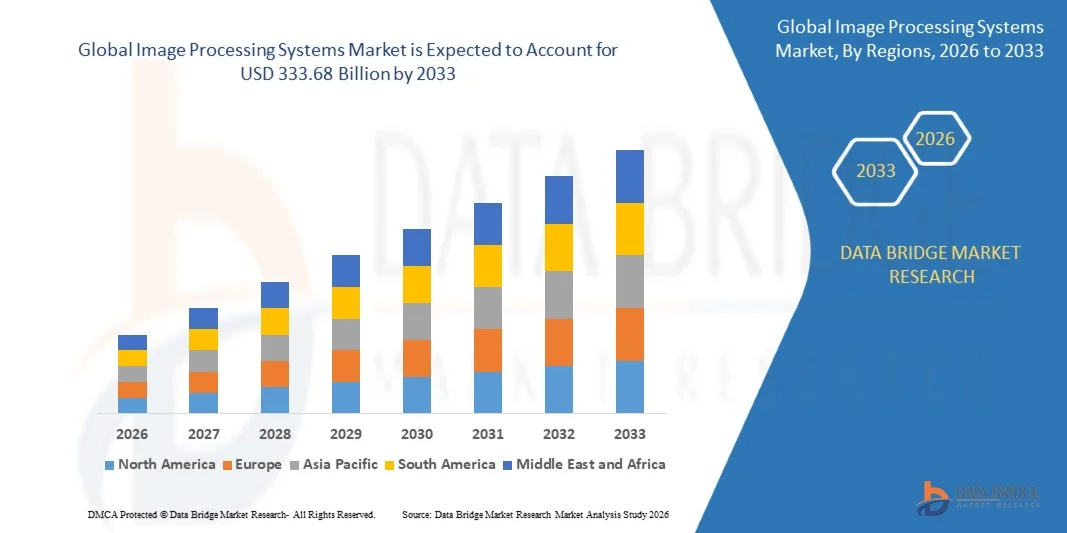
The global image processing systems market was valued at USD 68.89 billion in 2025 and is projected to reach USD 333.68 billion by 2033, growing at a CAGR of 21.8% from 2026 to 2033. The market is witnessing steady growth driven by increasing adoption of advanced imaging technologies across healthcare, industrial automation, security & surveillance, and consumer electronics sectors. Rising demand for high-speed and high-precision visual inspection systems, along with continuous improvements in artificial intelligence and machine vision capabilities, is further accelerating market expansion.
The growing need for accurate image analysis in medical diagnostics, automated manufacturing, and smart surveillance applications is encouraging organizations to invest in sophisticated image processing solutions. Industries are increasingly deploying AI-powered imaging systems, edge-based processing platforms, and real-time analytics tools to enhance operational efficiency, quality control, and decision-making. In addition, the integration of image processing technologies with robotics, autonomous systems, and cloud computing platforms is expanding their application scope, supporting broader adoption across commercial, industrial, and research environments.
Key Market Trends & Insights
- North America dominated the global image processing systems market with the largest revenue share of 35.12% in 2025, supported by strong adoption of machine vision technologies, advanced healthcare infrastructure, and significant investments in industrial automation and AI-based imaging solutions.
- The Digital segment led the market with a 68.42% share in 2025, driven by the increasing adoption of high-speed computing technologies, AI-enabled analytics, and advanced software-based image enhancement solutions across industries.
- Asia-Pacific is expected to be the fastest-growing region at a CAGR of 21.8% from 2026 to 2033, fueled by rapid industrialization, expanding electronics manufacturing, and rising adoption of smart factory technologies in China, Japan, South Korea, and India.
- Analog is the fastest-growing processing method, projected to register a CAGR of 5.8%, reflecting the surge in continued use in legacy imaging infrastructure, defense electronics, and cost-sensitive industrial applications
- The Two Dimensional segment dominated the image type category with a 52.37% revenue share in 2025, led by widespread deployment across medical imaging, machine vision, facial recognition, and industrial inspection applications.
- Single Instruction Multiple Data (SMID) accounted for 57.16% of the market, preferred by high processing efficiency, reduced computational complexity, and extensive use in real-time image analysis applications.
- The Three Dimensional segment is the fastest-growing image type category, with a CAGR of 7.4%, driven by rising demand for advanced visualization and depth-sensing technologies across healthcare, automotive, and AR/VR applications.
Market Size & Forecast
- Global Market Value (2025): USD 68.89 Billion
- Expected Market Value (2033): USD 333.68 Billion
- Forecast CAGR (2026–2033): 21.8%
- Leading Region in 2025: North America
- Fastest Growing Region: Asia Pacific
Report Scope and Global Image Processing Systems Market Segmentation
|
Attributes |
Image Processing Systems Key Market Insights |
|
Segments Covered |
|
|
Countries Covered |
North America · U.S. · Canada · Mexico Europe · Germany · France · U.K. · Netherlands · Switzerland · Belgium · Russia · Italy · Spain · Turkey · Rest of Europe Asia-Pacific · China · Japan · India · South Korea · Singapore · Malaysia · Australia · Thailand · Indonesia · Philippines · Rest of Asia-Pacific Middle East and Africa · Saudi Arabia · U.A.E. · South Africa · Egypt · Israel · Rest of Middle East and Africa South America · Brazil · Argentina · Rest of South America |
|
Key Market Players |
· Canon Inc. (Japan) · Ricoh Company, Ltd. (Japan) · FUJIFILM Corporation (Japan) · Konica Minolta, Inc. (Japan) · Nikon Corporation (Japan) · Olympus Corporation (Japan) · Sony Group Corporation (Japan) · Panasonic Holdings Corporation (Japan) · Toshiba Corporation (Japan) · Teledyne Technologies Incorporated (U.S.) · Cognex Corporation (U.S.) · Keyence Corporation (Japan) · Zebra Technologies Corp. (U.S.) · Basler AG (Germany) · Allied Vision Technologies GmbH (Germany) · Omron Corporation (Japan) · Intel Corporation (U.S.) · NVIDIA Corporation (U.S.) · Advantech Co., Ltd. (Taiwan) · National Instruments Corp. (U.S.) |
|
Market Opportunities |
· Growing adoption of AI-powered medical imaging systems · Rising deployment of machine vision and automated quality inspection systems · Increasing integration of image processing technologies in autonomous vehicles, intelligent surveillance, and robotics |
|
Value Added Data Infosets |
In addition to the market insights such as market value, growth rate, market segments, geographical coverage, market players, and market scenario, the market report curated by the Data Bridge Market Research team includes in-depth expert analysis, import/export analysis, pricing analysis, production consumption analysis, and pestle analysis. |
Global Image Processing Systems Market Trends
Trend: Rising Adoption of AI-Powered Machine Vision Systems
Industries are increasingly adopting AI-powered image processing systems to improve automated inspection, object recognition, and real-time decision-making across manufacturing, healthcare, and security applications. The integration of deep learning algorithms enables highly accurate defect detection, pattern analysis, and predictive monitoring while reducing manual intervention and operational errors. Smart factories and healthcare providers are similarly deploying advanced imaging platforms to enhance productivity, streamline diagnostics, and support data-driven workflows, while edge computing and cloud connectivity technologies create scalable environments that closely support real-time image processing operations.
Global Image Processing Systems Market Dynamics
Key Market Driver: Growing Demand for Automated Inspection and Medical Imaging Solutions
The rapid expansion of industrial automation and digital healthcare infrastructure has created substantial demand for advanced image processing systems that can improve inspection accuracy, diagnostic efficiency, and operational performance across multiple industries. Manufacturers, healthcare providers, and technology companies are deploying intelligent imaging platforms as a core component of their digital transformation strategies, reducing operational costs, accelerating analytical workflows, and improving process reliability.
For instance, the March 2024 launch of Zebra Technologies’ advanced machine vision solutions for automated inspection and warehouse operations demonstrates the increasing industry focus on AI-enabled imaging platforms, reflecting the broader growth of automation-driven image processing adoption worldwide.
Key Restraint/Challenge: High Implementation Cost of Advanced Imaging Infrastructure
A significant restraint in the global image processing systems market is the high upfront investment required for advanced imaging infrastructure. Modern systems integrate high-resolution cameras, AI-enabled analytics software, edge computing platforms, and complex data processing architectures, demanding substantial expenditure on procurement, deployment, and long-term maintenance. The total cost of ownership extends to software upgrades, cybersecurity integration, and technical workforce training, making adoption challenging for small enterprises, research laboratories, and cost-sensitive organizations.
For instance, the October 2024 expansion of Siemens’ industrial AI and machine vision portfolio highlighted the considerable infrastructure and integration costs associated with deploying enterprise-scale intelligent imaging systems, reflecting the broader financial barriers affecting adoption across developing and mid-sized industries.
Key Market Opportunity: Expansion of AI-Based Imaging and Edge Processing Platforms
The integration of artificial intelligence with edge-based image processing platforms presents a significant market opportunity. AI-enabled systems can deliver real-time analytics, adaptive image enhancement, and automated visual recognition while supporting scalable deployment across industrial, healthcare, automotive, and smart surveillance applications. The development of cloud-connected imaging ecosystems and embedded vision technologies is further expanding accessibility to advanced processing capabilities, opening growth opportunities across emerging markets in Asia-Pacific, Latin America, and the Middle East.
For instance, the February 2025 introduction of NVIDIA’s edge AI vision technologies for robotics and industrial automation demonstrated the growing commercial potential of intelligent image processing platforms, reflecting the broader expansion of AI-driven visual computing solutions globally.
Global Image Processing Systems Market Scope
The image processing systems market is segmented on the basis of processing method, image type, image processor technology, end-use, and application.
- By Processing Method
On the basis of processing method, the global image processing systems market is segmented into analog and digital. The Digital segment dominated the market with a 68.42% share in 2025, owing to the increasing adoption of high-speed computing technologies, AI-enabled analytics, and advanced software-based image enhancement solutions across industries. Digital image processing systems provide superior image accuracy, real-time analysis, and efficient data storage capabilities compared to analog systems. These solutions are extensively used in healthcare diagnostics, industrial automation, surveillance, and consumer electronics applications. Continuous improvements in cloud computing, edge analytics, and machine vision technologies are further strengthening segment growth. The growing need for automation and intelligent visual inspection is also accelerating adoption across manufacturing and smart infrastructure projects. Their scalability, flexibility, and integration capabilities continue to support market leadership globally.
The Analog segment is projected to witness steady growth at a CAGR of 5.8% from 2026 to 2033, driven by its continued use in legacy imaging infrastructure, defense electronics, and cost-sensitive industrial applications. Analog systems are valued for low latency, simplified hardware architecture, and reliability in specific real-time processing environments. These systems remain widely deployed in traditional broadcasting, industrial monitoring, and basic surveillance operations where digital transformation remains limited. Increasing modernization initiatives in developing economies are also supporting gradual replacement and integration opportunities. Hybrid imaging platforms combining analog input with digital analytics are further expanding operational relevance. Rising demand for affordable imaging solutions in small-scale applications is expected to sustain segment demand during the forecast period.
- By Image Type
On the basis of image type, the global image processing systems market is segmented into one dimensional, two dimensional, and three dimensional. The Two Dimensional segment dominated the market with a 52.37% share in 2025, driven by widespread deployment across medical imaging, machine vision, facial recognition, and industrial inspection applications. Two dimensional image processing systems offer efficient visualization, lower computational complexity, and cost-effective implementation compared to advanced three-dimensional platforms. These systems are highly preferred in surveillance cameras, smartphones, barcode scanners, and automated production environments. Increasing adoption of AI-powered analytics and computer vision software is further enhancing image interpretation capabilities. The segment also benefits from strong compatibility with existing imaging infrastructure and cloud-based processing platforms. Continuous demand from healthcare and consumer electronics industries continues to reinforce its dominant market position.
The Three Dimensional segment is expected to register the fastest growth at a CAGR of 7.4% from 2026 to 2033, fueled by rising demand for advanced visualization and depth-sensing technologies across healthcare, automotive, and AR/VR applications. Three dimensional imaging systems provide enhanced spatial analysis, object recognition, and real-time environment mapping capabilities. Growing adoption in autonomous vehicles, robotics, surgical imaging, and industrial automation is significantly accelerating segment expansion. Continuous advancements in LiDAR, 3D sensors, and AI-enabled rendering technologies are improving operational efficiency and imaging precision. Increasing investments in smart manufacturing and immersive digital environments are also supporting demand growth. The segment is further benefiting from rising adoption of metaverse technologies and intelligent spatial computing systems globally.
- By Image Processor Technology
On the basis of image processor technology, the global image processing systems market is segmented into Multiple Instruction Multiple Data (MMID) and Single Instruction Multiple Data (SMID). The Single Instruction Multiple Data (SMID) segment dominated the market with a 57.16% share in 2025, owing to its high processing efficiency, reduced computational complexity, and extensive use in real-time image analysis applications. SMID architectures enable simultaneous processing of multiple image data streams using a single instruction set, improving speed and operational consistency. These processors are widely deployed in smartphones, digital cameras, industrial automation systems, and medical imaging devices. Growing demand for low-power and high-performance computing platforms is further driving adoption across embedded vision applications. Advancements in AI acceleration and graphics processing technologies are also strengthening segment growth. Their cost-effectiveness and scalability continue to support strong market penetration globally.
The Multiple Instruction Multiple Data (MMID) segment is projected to witness the fastest growth at a CAGR of 7.1% from 2026 to 2033, driven by increasing demand for parallel computing and high-performance image analytics in complex processing environments. MMID architectures support simultaneous execution of multiple instruction streams across different datasets, enabling advanced image rendering and deep learning applications. These technologies are increasingly used in autonomous systems, defense imaging, scientific research, and hyperspectral image analysis. Rising adoption of AI-driven computing infrastructure and edge analytics platforms is significantly accelerating demand. Continuous advancements in GPU technology and high-speed processors are improving operational efficiency and scalability. Growing use of large-scale image datasets in healthcare diagnostics and industrial automation is further boosting segment expansion.
- By End-Use
On the basis of end-use, the global image processing systems market is segmented into camera device, AR/VR devices, mobile phones, smart phones, tablets, and others. The Smart Phones segment dominated the market with a 38.94% share in 2025, driven by rising consumer demand for advanced camera functionality, AI-based photography, and real-time image enhancement features. Smartphone manufacturers are heavily integrating image processing technologies to improve facial recognition, augmented reality experiences, and computational photography capabilities. Increasing penetration of multi-camera systems and high-resolution sensors is further strengthening segment growth. These devices also support advanced applications such as biometric authentication, mobile scanning, and intelligent visual search. Rapid expansion of 5G connectivity and AI-enabled mobile processors is improving image rendering and processing efficiency. Continuous innovation in mobile imaging technologies continues to maintain the segment’s leading position globally.
The AR/VR Devices segment is expected to witness the fastest growth at a CAGR of 7.6% from 2026 to 2033, fueled by increasing adoption of immersive digital experiences across gaming, healthcare, industrial training, and education sectors. AR/VR devices rely heavily on advanced image processing systems for real-time rendering, spatial mapping, and motion tracking applications. Growing investments in metaverse development and mixed reality platforms are significantly accelerating technology adoption. Continuous advancements in wearable displays, 3D imaging, and edge computing are enhancing user experience and operational performance. Increasing enterprise demand for virtual collaboration and simulation-based training is further supporting market expansion. The segment is also benefiting from rapid innovation in AI-powered immersive visualization technologies globally.
- By Application
On the basis of application, the global image processing systems market is segmented into medical, industrial, military, and others. The Medical segment dominated the market with a 39.84% share in 2025, owing to increasing adoption of image processing technologies in radiology, pathology, surgical imaging, and diagnostic analysis applications. Healthcare providers extensively use advanced imaging systems for accurate disease detection, treatment planning, and minimally invasive procedures. Rising prevalence of chronic diseases and growing demand for precision diagnostics are significantly driving market demand. Continuous advancements in AI-powered medical imaging and computer-assisted diagnostics are improving clinical efficiency and patient outcomes. Increasing investments in digital healthcare infrastructure and telemedicine platforms are also strengthening segment expansion. The segment continues to benefit from strong regulatory support and technological innovation in diagnostic imaging solutions globally.
The Industrial segment is projected to register the fastest growth at a CAGR of 7.3% from 2026 to 2033, driven by rising adoption of machine vision systems, automated inspection technologies, and smart manufacturing infrastructure. Industrial image processing solutions enable real-time quality control, defect detection, and predictive maintenance across production environments. Growing implementation of Industry 4.0 technologies and industrial robotics is significantly accelerating demand for intelligent imaging platforms. Continuous improvements in AI-based analytics, edge computing, and high-speed cameras are enhancing operational productivity and manufacturing precision. Increasing focus on reducing operational errors and improving production efficiency is further supporting market growth. The segment is also benefiting from expanding investments in factory automation and digital transformation initiatives worldwide.
Global Image Processing Systems Market Regional Analysis
North America dominated the global image processing systems market with the largest revenue share of 35.12% in 2025, supported by strong adoption of machine vision technologies, advanced healthcare infrastructure, and significant investments in industrial automation and AI-based imaging solutions. The region also benefits from increasing investments in industrial automation, widespread deployment of machine vision systems, and growing demand for advanced medical imaging and security surveillance applications. Rising integration of AI-powered analytics, cloud-based imaging platforms, and edge computing technologies across manufacturing, healthcare, defense, and consumer electronics sectors continues to accelerate market expansion. Increasing focus on smart manufacturing, autonomous systems, and real-time visual data processing continues to strengthen North America’s leadership position in the global market.
U.S. Image Processing Systems Market Insight
The U.S. image processing systems market is witnessing strong growth due to rising investments in artificial intelligence technologies, medical imaging infrastructure, and industrial automation solutions. The country’s mature semiconductor and software ecosystem, along with increasing adoption of AI-powered, cloud-connected, and machine vision-based imaging platforms, is driving demand across healthcare, manufacturing, defense, and consumer electronics applications. In addition, growing emphasis on precision diagnostics, automated inspection systems, and real-time visual analytics is accelerating image processing system adoption across enterprises and research institutions.
Europe Image Processing Systems Market Insight
The Europe image processing systems market remains a major contributor to global revenue, driven by strong industrial automation capabilities, technological innovation, and high demand for advanced imaging solutions. The widespread use of intelligent image processing systems in healthcare diagnostics, automotive manufacturing, industrial inspection, and smart surveillance applications is supporting market expansion across the region. Increasing investments in AI-enabled analytics technologies, coupled with strict quality control standards and advanced digital infrastructure, continue to enhance the adoption of image processing systems throughout Europe.
U.K. Image Processing Systems Market Insight
The U.K. image processing systems market is experiencing steady growth, supported by rising adoption of AI-based imaging technologies in healthcare, manufacturing, and security applications. Increasing investments in advanced imaging infrastructure and growing demand for accurate, automated, and real-time visual analysis solutions are contributing to market growth. Furthermore, integration of machine learning, cloud computing, and computer vision technologies is improving system efficiency and analytical performance, positioning the U.K. as a key innovation hub in the image processing systems industry.
Germany Image Processing Systems Market Insight
The Germany image processing systems market is expanding steadily due to the country’s strong industrial manufacturing base, advanced engineering capabilities, and increasing adoption of next-generation automation technologies. Manufacturing companies, healthcare providers, and research institutions are increasingly utilizing image processing systems for quality inspection, diagnostic imaging, and industrial automation activities. Continuous advancements in machine vision, AI integration, and edge computing technologies, along with strong government focus on Industry 4.0 and digital transformation, are further driving market growth in Germany.
Asia-Pacific Image Processing Systems Market Insight
The Asia-Pacific image processing systems market is expected to witness rapid growth, driven by increasing industrialization, expanding electronics manufacturing, and rising investments in smart automation infrastructure across countries such as China, India, Japan, and South Korea. Growing awareness regarding industrial efficiency, rising adoption of AI-enabled imaging technologies, and increasing demand for scalable and cost-effective visual inspection solutions are supporting regional market expansion. In addition, the growing presence of semiconductor manufacturing facilities and smart factory initiatives is accelerating image processing system adoption across industrial and commercial sectors.
Japan Image Processing Systems Market Insight
The Japan image processing systems market is witnessing consistent growth due to rising investments in robotics, industrial automation, and advanced healthcare imaging technologies. Electronics manufacturers, automotive companies, and research institutes are increasingly adopting high-performance image processing systems for precision manufacturing, diagnostic analysis, and intelligent automation purposes. Moreover, increasing integration of AI-based analytics and the country’s focus on advanced digital innovation and smart manufacturing solutions are further contributing to market growth.
China Image Processing Systems Market Insight
The China image processing systems market is growing rapidly, driven by increasing industrial automation, expanding semiconductor manufacturing, and rising government focus on smart manufacturing and AI innovation initiatives. Growing adoption of machine vision and AI-enabled imaging platforms across healthcare, industrial, automotive, and surveillance sectors is significantly boosting market demand. In addition, rising investments in electronics production, increasing demand for automated quality inspection systems, and rapid technological advancements are positioning China as one of the fastest-growing markets for image processing systems globally.
Global Image Processing Systems Market Share
The Image Processing Systems industry is primarily led by well-established companies, including:
- Canon Inc. (Japan)
- Ricoh Company, Ltd. (Japan)
- FUJIFILM Corporation (Japan)
- Konica Minolta, Inc. (Japan)
- Nikon Corporation (Japan)
- Olympus Corporation (Japan)
- Sony Group Corporation (Japan)
- Panasonic Holdings Corporation (Japan)
- Toshiba Corporation (Japan)
- Teledyne Technologies Incorporated (U.S.)
- Cognex Corporation (U.S.)
- Keyence Corporation (Japan)
- Zebra Technologies Corp. (U.S.)
- Basler AG (Germany)
- Allied Vision Technologies GmbH (Germany)
- Omron Corporation (Japan)
- Intel Corporation (U.S.)
- NVIDIA Corporation (U.S.)
- Advantech Co., Ltd. (Taiwan)
- National Instruments Corp. (U.S.)
Latest Developments in Global Image Processing Systems Market
- In July 2025, RealSense, a leading computer vision and depth-sensing technology company spun out from Intel, secured USD 50 million in funding to expand its AI-powered vision systems for robotics and industrial automation applications. The company announced plans to scale manufacturing capacity, strengthen AI software development, and enhance next-generation depth camera technologies for autonomous navigation and smart surveillance systems. This development highlights the growing demand for advanced 3D image processing and AI-based visual computing solutions across industrial and robotics sectors globally
- In November 2023, Zebra Technologies, a leading provider of machine vision and enterprise imaging solutions, announced the launch of its HC20 and HC50 healthcare-grade mobile computers designed to improve imaging workflows and patient care operations. The devices integrate advanced image capture, AI-enabled analytics, and healthcare-focused processing capabilities to support clinical documentation and operational efficiency. This launch reflects the increasing integration of intelligent image processing systems within digital healthcare infrastructure and medical imaging environments
- In June 2023, Zebra Technologies announced the launch of its TC22 and TC27 enterprise mobile computers equipped with advanced imaging, scanning, and real-time data processing capabilities for industrial and logistics applications. The devices were designed to support high-speed visual data capture, AI-enabled operational workflows, and enterprise-grade automation across retail, transportation, and warehousing sectors. This launch demonstrates the rising adoption of intelligent image processing technologies in industrial mobility and smart operational systems
- In April 2023, Zebra Technologies introduced new machine vision and sensor-based imaging solutions at the LogiMAT exhibition in Germany to strengthen industrial automation and warehouse intelligence capabilities. The company showcased advanced environmental sensors, machine vision software, and cloud-connected monitoring technologies designed to improve real-time inspection, tracking, and operational visibility. This development underscores the growing importance of AI-powered image processing systems in industrial automation and supply chain optimization
- In March 2022, Zebra Technologies announced its acquisition of Matrox Imaging to expand its portfolio of machine vision and industrial image processing technologies. The acquisition added advanced imaging software, smart cameras, 3D sensors, and vision controllers to Zebra’s automation and visual analytics offerings, enabling enhanced factory automation and industrial inspection capabilities. This strategic development reflects the increasing consolidation and technological advancement within the global image processing systems market
SKU-

- Interactive Data Analysis Dashboard
- Company Analysis Dashboard for high growth potential opportunities
- Research Analyst Access for customization & queries
- Competitor Analysis with Interactive dashboard
- Latest News, Updates & Trend analysis
- Harness the Power of Benchmark Analysis for Comprehensive Competitor Tracking
Data collection and base year analysis are done using data collection modules with large sample sizes. The stage includes obtaining market information or related data through various sources and strategies. It includes examining and planning all the data acquired from the past in advance. It likewise envelops the examination of information inconsistencies seen across different information sources. The market data is analysed and estimated using market statistical and coherent models. Also, market share analysis and key trend analysis are the major success factors in the market report. To know more, please request an analyst call or drop down your inquiry.
The key research methodology used by DBMR research team is data triangulation which involves data mining, analysis of the impact of data variables on the market and primary (industry expert) validation. Data models include Vendor Positioning Grid, Market Time Line Analysis, Market Overview and Guide, Company Positioning Grid, Patent Analysis, Pricing Analysis, Company Market Share Analysis, Standards of Measurement, Global versus Regional and Vendor Share Analysis. To know more about the research methodology, drop in an inquiry to speak to our industry experts.
Data Bridge Market Research is a leader in advanced formative research. We take pride in servicing our existing and new customers with data and analysis that match and suits their goal. The report can be customized to include price trend analysis of target brands understanding the market for additional countries (ask for the list of countries), clinical trial results data, literature review, refurbished market and product base analysis. Market analysis of target competitors can be analyzed from technology-based analysis to market portfolio strategies. We can add as many competitors that you require data about in the format and data style you are looking for. Our team of analysts can also provide you data in crude raw excel files pivot tables (Fact book) or can assist you in creating presentations from the data sets available in the report.












