


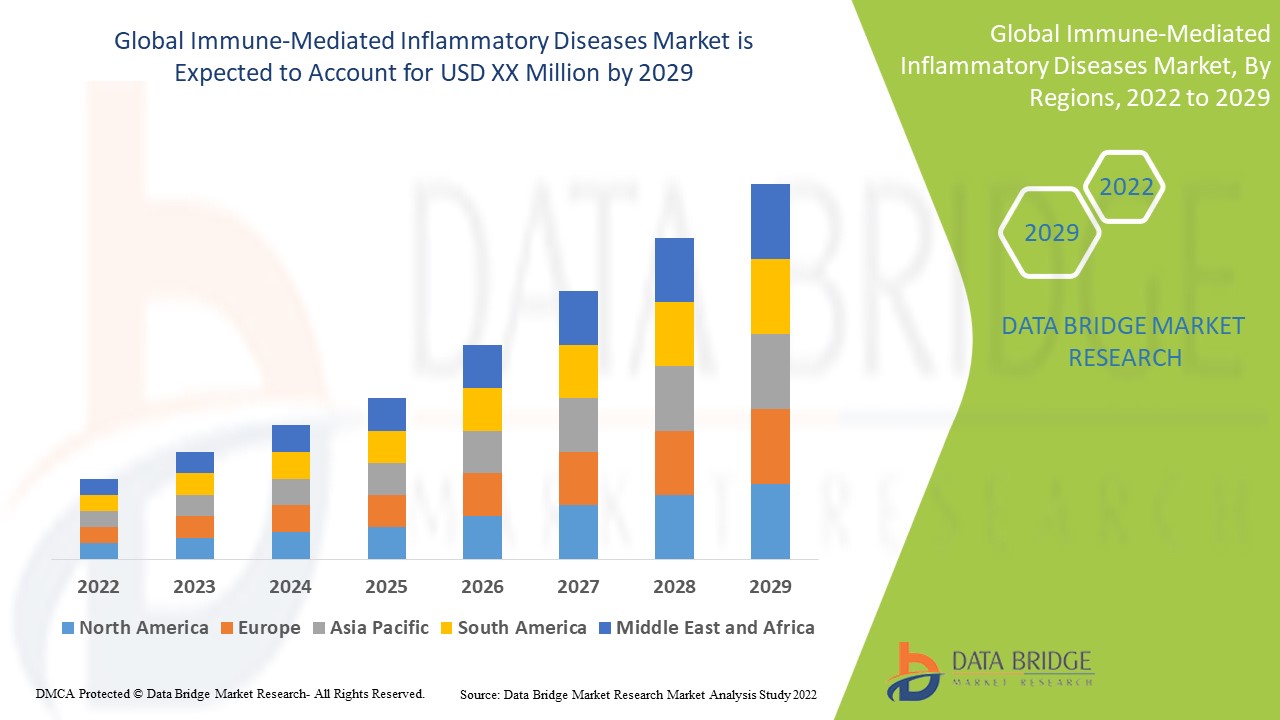
Immune-Mediated Inflammatory Diseases Market Analysis and Size
The global immune-mediated inflammatory diseases market is expected to witness significant growth during the forecast period. Wide availability of advanced treatment facilities at quite low prices in developing countries, such as India and China, as compared to that in the West is a primary factor boosting the immune-mediated inflammatory disease treatment market in Asia-Pacific. Cardiovascular and respiratory diseases have affected many individuals worldwide, and are the top cause of death among the global population. COVID-19 also had left a major impact on the population and the market growth.
Data Bridge Market Research analyses a growth rate in the global immune-mediated inflammatory diseases market in the forecast period 2022-2029. The expected CAGR of global immune-mediated inflammatory diseases market tend to be around 6.50% in the mentioned forecast period. In addition to the market insights such as market value, growth rate, market segments, geographical coverage, market players, and market scenario, the market report curated by the Data Bridge Market Research team also includes in-depth expert analysis, patient epidemiology, pipeline analysis, pricing analysis, and regulatory framework.
Market Definition
Immune-mediated inflammatory disease (IMID) is defined as a group of unrelated conditions which lack a definitive etiology, but share a common inflammatory pathway leading to inflammation. Immune-mediated diseases are conditions triggered by over-activity or abnormal activity of the body’s immune system. All immune-mediated inflammatory diseases (IMID) can cause organ damage, and are associated with increased morbidity and/or mortality.
Immune-Mediated Inflammatory Diseases Market Scope and Segmentation
|
Report Metric |
Details |
|
Forecast Period |
2022 to 2029 |
|
Base Year |
2021 |
|
Historic Years |
2020 (Customizable to 2014 - 2019) |
|
Quantitative Units |
Revenue in USD Million, Volumes in Units, Pricing in USD |
|
Segments Covered |
Treatment Type (Traditional Drugs, Biologic Therapies, Novel Therapies), Indication (Asthma, Chronic Obstructive Pulmonary Diseases (COPD), Inflammatory Bowel Disease (IBD), Systemic Lupus Erythematosus (SLE), Rheumatoid Arthritis (RA), Psoriasis, Others), End-Users (Hospitals, Specialty Clinics, Others), Distribution Channel (Hospital Pharmacy, Retail Pharmacy, Others) |
|
Countries Covered |
U.S., Canada and Mexico in North America, Germany, France, U.K., Netherlands, Switzerland, Belgium, Russia, Italy, Spain, Turkey, Rest of Europe in Europe, China, Japan, India, South Korea, Singapore, Malaysia, Australia, Thailand, Indonesia, Philippines, Rest of Asia-Pacific (APAC) in the Asia-Pacific (APAC), Saudi Arabia, U.A.E, South Africa, Egypt, Israel, Rest of Middle East and Africa (MEA) as a part of Middle East and Africa (MEA), Brazil, Argentina and Rest of South America as part of South America |
|
Market Players Covered |
Pfizer Inc. (U.S.), Abbvie Inc. (U.S.), Novartis AG (Switzerland), Amgen Inc. (U.S.), Boehringer Ingelheim International GmbH. (Germany), Merck & Co Inc. (U.S.), Sun Pharmaceutical Industries Ltd. (India), Teva Pharmaceuticals Industries Ltd. (Israel), AstraZeneca (U.K.), Ampio Pharmaceuticals Inc. (U.S.), Lilly (U.S.), Zydus Group (India), Akorn, Incorporated (U.S.), DAIICHI SANKYO COMPANY, LIMITED (Japan) |
|
Market Opportunities |
|
Global Immune-Mediated Inflammatory Diseases Market Dynamics
Drivers
- High Prevalence of Arthritis
Its been witnessed that more than 350 million people have arthritis all over the globe. In the U.S., 1 in 4 adults have been reported with arthritis in 2020. It’s estimated to be 78 million by the year 2040. This boosts the market growth.
- Rising Healthcare Expenditure
Since the last few decades, it has been witnessed that global per capita healthcare spending has improved considerably due to the rising rate of awareness associated with the availability of treatments and diagnostic methods for treating various diseases. More and more healthcare spending is likely to result in increasing demand for better diagnostic methods, which in turn, create high growth opportunities for market players operating in treating allergic and asthmatic conditions in the market.
Opportunities
- Increase in Elderly Population
Life expectancy is growing around the world, which has led to an increase in the aging population. This trend positively impacts the industry by increasing the incidence of the disease and creating per capita demand for its remedies.
- Rising Autoimmune Disorders
The number of people affected with autoimmune diseases is increasing steadily across the world. The primary cause of a number of these diseases can be traced to a lack of healthy lifestyle and dietary habits and genetics that can activate these diseases. An increase in these diseases boosts the global immune-mediated inflammatory disease market.
Restraints/Challenges
- Lack of skilled professionals
The lack of qualified personnel unable to perform the treatments could curb the growth of the global immune-mediated inflammatory disease market over a forecast period.
- Side-Effects of immune-mediated inflammatory disease drugs
The adverse side-effects associated with the treatment process hamper the market growth. Effects such as skin rash and also some immunosuppressive drugs can lead to autoimmune reactions.
This global immune-mediated inflammatory diseases market report provides details of new recent developments, trade regulations, import-export analysis, production analysis, value chain optimization, market share, impact of domestic and localized market players, analyses opportunities in terms of emerging revenue pockets, changes in market regulations, strategic market growth analysis, market size, category market growths, application niches and dominance, product approvals, product launches, geographic expansions, technological innovations in the market. To gain more info on the global immune-mediated inflammatory diseases market contact Data Bridge Market Research for an Analyst Brief, our team will help you take an informed market decision to achieve market growth.
COVID-19 Impact on Global Immune-Mediated Inflammatory Diseases Market
With the onset of COVID-19, several countries abandoned all non-emergency surgical procedures so that healthcare professionals only focus on patients with COVID-19. Thus, the market faced a huge loss during the pandemic. It has been witnessed that people with immune-mediated inflammatory diseases have a comparatively higher risk of COVID-19-related death, critical care admission or death, and hospital admissions than people without immune-mediated inflammatory diseases of the sex, deprivation level, same age, and smoking status. In addition to this, adults with inflammatory joint disease had a superior increase in risk of all outcomes than those with inflammatory skin or bowel disease. Thus, COVID-19 left a major impact on the market.
Global Immune-Mediated Inflammatory Diseases Market Scope
The global immune-mediated inflammatory diseases market is segmented on the basis of indication, treatment type, route of administration, end-user and distribution channel. The growth amongst these segments will help you analyze meagre growth segments in the industries and provide the users with a valuable market overview and market insights to help them make strategic decisions for identifying core market applications.
Indication
- Asthma, Chronic Obstructive Pulmonary Diseases (COPD)
- Inflammatory Bowel Disease (IBD)
- Systemic Lupus Erythematosus (SLE)
- Rheumatoid Arthritis (RA)
- Psoriasis
- Others
Treatment Type
- Traditional Drugs
- Biologic Therapies
- Novel Therapies
Route of Administration
- Oral
- Parenteral
- Others
End-Users
- Hospitals
- Specialty Clinics
- Others
Distribution Channel
- Hospital Pharmacy
- Retail Pharmacy
- Others
Global Immune-Mediated Inflammatory Diseases Market Regional Analysis/Insights
The global immune-mediated inflammatory diseases market is analyzed and market size insights and trends are provided by indication, treatment type, route of administration, end-user and distribution channel as referenced above.
The major countries covered in the global immune-mediated inflammatory diseases market report are the U.S., Canada and Mexico in North America, Germany, France, U.K., Netherlands, Switzerland, Belgium, Russia, Italy, Spain, Turkey, Rest of Europe in Europe, China, Japan, India, South Korea, Singapore, Malaysia, Australia, Thailand, Indonesia, Philippines, Rest of Asia-Pacific (APAC) in the Asia-Pacific (APAC), Saudi Arabia, U.A.E, South Africa, Egypt, Israel, Rest of Middle East and Africa (MEA) as a part of Middle East and Africa (MEA), Brazil, Argentina and Rest of South America as part of South America.
North America dominates the market due to rise in the prevalence of the disease, rise in the healthcare affordability.
Asia-Pacific is expected to account for the largest market due to the rise in the knowledge and awareness of this region.
The country section of the report also provides individual market impacting factors and changes in regulation in the market domestically that impacts the current and future trends of the market. Also, the presence and availability of global brands and their challenges faced due to large or scarce competition from local and domestic brands, impact of domestic tariffs and trade routes are considered while providing forecast analysis of the country data.
Competitive Landscape and Global Immune-Mediated Inflammatory Diseases Market Share Analysis
The global immune-mediated inflammatory diseases market competitive landscape provides details by competitor. Details included are company overview, company financials, revenue generated, market potential, investment in research and development, new market initiatives, global presence, production sites and facilities, production capacities, company strengths and weaknesses, product launch, product width and breadth, application dominance. The above data points provided are only related to the companies' focus related to global immune-mediated inflammatory diseases market
Key players operating in the global immune-mediated inflammatory diseases market include:
- Pfizer Inc. (U.S.)
- Abbvie Inc. (U.S.)
- Novartis AG (Switzerland)
- Amgen Inc. (U.S.)
- Boehringer Ingelheim International GmbH. (Germany)
- Merck & Co Inc. (U.S.)
- Sun Pharmaceutical Industries Ltd. (India)
- Teva Pharmaceuticals Industries Ltd. (Israel)
- AstraZeneca (U.K.)
- Ampio Pharmaceuticals Inc. (U.S.)
- Lilly (U.S)
- Zydus Group (India)
- Akorn, Incorporated (U.S.)
- DAIICHI SANKYO COMPANY, LIMITED (Japan)

- Interactive Data Analysis Dashboard
- Company Analysis Dashboard for high growth potential opportunities
- Research Analyst Access for customization & queries
- Competitor Analysis with Interactive dashboard
- Latest News, Updates & Trend analysis
- Harness the Power of Benchmark Analysis for Comprehensive Competitor Tracking
Table of Content
1. INTRODUCTION
1.1 OBJECTIVES OF THE STUDY
1.2 MARKET DEFINITION
1.3 OVERVIEW OF GLOBAL IMMUNE-MEDIATED INFLAMMATORY DISEASES MARKET
1.4 CURRENCY AND PRICING
1.5 LIMITATION
1.6 MARKETS COVERED
2. MARKET SEGMENTATION
2.1 KEY TAKEAWAYS
2.2 ARRIVING AT THE GLOBAL IMMUNE-MEDIATED INFLAMMATORY DISEASES MARKET SIZE
2.2.1 VENDOR POSITIONING GRID
2.2.2 TECHNOLOGY LIFE LINE CURVE
2.2.3 TRIPOD DATA VALIDATION MODEL
2.2.4 MARKET GUIDE
2.2.5 MULTIVARIATE MODELLING
2.2.6 TOP TO BOTTOM ANALYSIS
2.2.7 CHALLENGE MATRIX
2.2.8 APPLICATION COVERAGE GRID
2.2.9 STANDARDS OF MEASUREMENT
2.2.10 VENDOR SHARE ANALYSIS
2.2.11 SALES VOLUME
2.2.12 DATA POINTS FROM KEY PRIMARY INTERVIEWS
2.2.13 DATA POINTS FROM KEY SECONDARY DATABASES
2.3 GLOBAL IMMUNE-MEDIATED INFLAMMATORY DISEASES MARKET : RESEARCH SNAPSHOT
2.4 ASSUMPTIONS
3. MARKET OVERVIEW
3.1 DRIVERS
3.2 RESTRAINTS
3.3 OPPORTUNITIES
3.4 CHALLENGES
4. EXECUTIVE SUMMARY
5. PREMIUM INSIGHTS
6. EPIDEMIOLOGY
7. PIPELINE ANALYSIS
7.1 PHASE III CANDIDATES
7.2 PHASE II CANDIDATES
7.3 PHASE I CANDIDATES
7.4 OTHERS (PRE-CLINICAL AND RESEARCH)
8. INDUSTRY INSIGHTS
8.1 DEMOGRAPHIC TRENDS: IMPACTS ON ALL INCIDENCE RATES
8.2 KEY PRICING STRATEGIES
8.3 KEY PATIENT ENROLLMENT STRATEGIES
8.4 INTERVIEWS WITH ONCOLOGISTS
8.5 INTERVIEWS WITH INSTRUMENT MANUFACTURERS
8.6 OTHER KOL SNAPSHOTS
9. REGULATOTY FRAMEWORK
10. TECHNOOGY ADVNCEMTL
11. COMPETITION
12. GLOBAL IMMUNE-MEDIATED INFLAMMATORY DISEASES MARKET , BY TREATMENT TYPE
12.1 OVERVIEW
12.2 TRADITIONAL DRUGS
12.2.1 CORTICOSTEROIDS
12.2.1.1. FLUOROHYDROCORTISONE
12.2.1.1.1. MARKET VALUE (USD MILLION)
12.2.1.1.2. MARKET VOLUME (UNITS)
12.2.1.1.3. AVERAGE SELLING PRICE (USD)
12.2.1.2. PREDNISOLONE
12.2.1.2.1. MARKET VALUE (USD MILLION)
12.2.1.2.2. MARKET VOLUME (UNITS)
12.2.1.2.3. AVERAGE SELLING PRICE (USD)
12.2.1.3. METHYLPREDNISOLON
12.2.1.3.1. MARKET VALUE (USD MILLION)
12.2.1.3.2. MARKET VOLUME (UNITS)
12.2.1.3.3. AVERAGE SELLING PRICE (USD)
12.2.1.4. DEXAMETHASONE
12.2.1.4.1. MARKET VALUE (USD MILLION)
12.2.1.4.2. MARKET VOLUME (UNITS)
12.2.1.4.3. AVERAGE SELLING PRICE (USD)
12.2.1.5. BETAMETHASONE
12.2.1.5.1. MARKET VALUE (USD MILLION)
12.2.1.5.2. MARKET VOLUME (UNITS)
12.2.1.5.3. AVERAGE SELLING PRICE (USD)
12.2.1.6. OTHERS
12.2.2 NON-STEROIDAL ANTI-INFLAMMATORY DRUGS
12.2.2.1. IBUPROFEN
12.2.2.1.1. MARKET VALUE (USD MILLION)
12.2.2.1.2. MARKET VOLUME (UNITS)
12.2.2.1.3. AVERAGE SELLING PRICE (USD)
12.2.2.2. NAPROXEN
12.2.2.2.1. MARKET VALUE (USD MILLION)
12.2.2.2.2. MARKET VOLUME (UNITS)
12.2.2.2.3. AVERAGE SELLING PRICE (USD)
12.2.2.3. DICLOFENAC
12.2.2.3.1. MARKET VALUE (USD MILLION)
12.2.2.3.2. MARKET VOLUME (UNITS)
12.2.2.3.3. AVERAGE SELLING PRICE (USD)
12.2.2.4. CELECOXIB
12.2.2.4.1. MARKET VALUE (USD MILLION)
12.2.2.4.2. MARKET VOLUME (UNITS)
12.2.2.4.3. AVERAGE SELLING PRICE (USD)
12.2.2.5. MEFENAMIC ACID
12.2.2.5.1. MARKET VALUE (USD MILLION)
12.2.2.5.2. MARKET VOLUME (UNITS)
12.2.2.5.3. AVERAGE SELLING PRICE (USD)
12.2.2.6. ETORICOXIB
12.2.2.6.1. MARKET VALUE (USD MILLION)
12.2.2.6.2. MARKET VOLUME (UNITS)
12.2.2.6.3. AVERAGE SELLING PRICE (USD)
12.2.2.7. OTHERS
12.3 BIOLOGICS
12.3.1 INFLIXIMAB
12.3.1.1. MARKET VALUE (USD MILLION)
12.3.1.2. MARKET VOLUME (UNITS)
12.3.1.3. AVERAGE SELLING PRICE (USD)
12.3.2 ETANERCEPT
12.3.2.1. MARKET VALUE (USD MILLION)
12.3.2.2. MARKET VOLUME (UNITS)
12.3.2.3. AVERAGE SELLING PRICE (USD)
12.3.3 ADALIMUMAB
12.3.3.1. MARKET VALUE (USD MILLION)
12.3.3.2. MARKET VOLUME (UNITS)
12.3.3.3. AVERAGE SELLING PRICE (USD)
12.3.4 RITUXIMAB
12.3.4.1. MARKET VALUE (USD MILLION)
12.3.4.2. MARKET VOLUME (UNITS)
12.3.4.3. AVERAGE SELLING PRICE (USD)
12.3.5 ABATACEPT
12.3.5.1. MARKET VALUE (USD MILLION)
12.3.5.2. MARKET VOLUME (UNITS)
12.3.5.3. AVERAGE SELLING PRICE (USD)
12.3.6 EFALIZUMAB
12.3.6.1. MARKET VALUE (USD MILLION)
12.3.6.2. MARKET VOLUME (UNITS)
12.3.6.3. AVERAGE SELLING PRICE (USD)
12.3.7 OTHERS
12.4 NOVEL THERAPIES
12.4.1 (IL)-17
12.4.1.1. SECUKINUMAB
12.4.1.1.1. MARKET VALUE (USD MILLION)
12.4.1.1.2. MARKET VOLUME (UNITS)
12.4.1.1.3. AVERAGE SELLING PRICE (USD)
12.4.1.2. IXEKIZUMAB
12.4.1.2.1. MARKET VALUE (USD MILLION)
12.4.1.2.2. MARKET VOLUME (UNITS)
12.4.1.2.3. AVERAGE SELLING PRICE (USD)
12.4.1.3. BIMEKIZUMAB
12.4.1.3.1. MARKET VALUE (USD MILLION)
12.4.1.3.2. MARKET VOLUME (UNITS)
12.4.1.3.3. AVERAGE SELLING PRICE (USD)
12.4.2 IL-17R (BRODALUMAB)
12.4.2.1. MARKET VALUE (USD MILLION)
12.4.2.2. MARKET VOLUME (UNITS)
12.4.2.3. AVERAGE SELLING PRICE (USD)
12.4.3 IL-12/23P40
12.4.3.1. USTEKINUMAB
12.4.3.1.1. MARKET VALUE (USD MILLION)
12.4.3.1.2. MARKET VOLUME (UNITS)
12.4.3.1.3. AVERAGE SELLING PRICE (USD)
12.4.3.2. BRIAKINUMAB
12.4.3.2.1. MARKET VALUE (USD MILLION)
12.4.3.2.2. MARKET VOLUME (UNITS)
12.4.3.2.3. AVERAGE SELLING PRICE (USD)
12.4.4 IL-23P19
12.4.4.1. GUSELKUMAB
12.4.4.1.1. MARKET VALUE (USD MILLION)
12.4.4.1.2. MARKET VOLUME (UNITS)
12.4.4.1.3. AVERAGE SELLING PRICE (USD)
12.4.4.2. TILDRAKIZUMAB
12.4.4.2.1. MARKET VALUE (USD MILLION)
12.4.4.2.2. MARKET VOLUME (UNITS)
12.4.4.2.3. AVERAGE SELLING PRICE (USD)
12.4.4.3. BRAZIKUMAB
12.4.4.3.1. MARKET VALUE (USD MILLION)
12.4.4.3.2. MARKET VOLUME (UNITS)
12.4.4.3.3. AVERAGE SELLING PRICE (USD)
12.4.4.4. RISANKIZUMAB
12.4.4.4.1. MARKET VALUE (USD MILLION)
12.4.4.4.2. MARKET VOLUME (UNITS)
12.4.4.4.3. AVERAGE SELLING PRICE (USD)
12.4.4.5. MIRIKIZUMAB
12.4.4.5.1. MARKET VALUE (USD MILLION)
12.4.4.5.2. MARKET VOLUME (UNITS)
12.4.4.5.3. AVERAGE SELLING PRICE (USD)
12.4.4.6. OTHERS
13. GLOBAL IMMUNE-MEDIATED INFLAMMATORY DISEASES MARKET , BY INDICATION
13.1 OVERVIEW
13.2 ASTHMA
13.3 CHRONIC OBSTRUCTIVE PULMONARY DISEASES (COPD)
13.4 INFLAMMATORY BOWEL DISEASE (IBD)
13.5 SYSTEMIC LUPUS ERYTHEMATOSUS (SLE)
13.6 RHEUMATOID ARTHRITIS (RA)
13.7 ACUTE ANTERIOR UVEITIS (AAU)
13.8 INFLAMMATORY BOWEL DISEASE (IBD)
13.9 INCLUDING CROHN’S DISEASE (CD)
13.10 ULCERATIVE COLITIS
13.11 PSORIASIS
13.12 POLYMYOSITIS (PM)
13.13 DERMATOMYOSITIS (DMTIS)
13.14 THROMBOANGIITIS OBLITERANS (TAO)
13.15 BEHCET’S DISEASE (BD)
13.16 SARCOIDOSIS
13.17 PEMPHIGUS
13.18 VITILIGO
13.19 OTHERS
14. GLOBAL IMMUNE-MEDIATED INFLAMMATORY DISEASES MARKET , BY DRUG TYPE
14.1 OVERVIEW
14.2 BRANDED
14.2.1 MABTHERA
14.2.2 INFLIXIMAB
14.2.3 ADALIMUMAB
14.2.4 ETANERCEPT
14.2.5 ADALIMUMAB
14.2.6 RITUXIMAB
14.2.7 ABATACEPT
14.2.8 VEDOLIZUMAB
14.2.9 USTEKINUMAB
14.2.10 TOFACITINIB
14.2.11 OZANIMOD
14.2.12 UPADACITINIB
14.2.13 OTHERS
14.3 GENERIC
15. GLOBAL IMMUNE-MEDIATED INFLAMMATORY DISEASES MARKET , BY FORM
15.1 OVERVIEW
15.2 TABLET
15.3 CAPSULES
15.4 LIQUID
15.5 GEL
15.6 OTHERS
16. GLOBAL IMMUNE-MEDIATED INFLAMMATORY DISEASES MARKET , BY ROUTE OF ADMINISTRATION
16.1 OVERVIEW
16.2 ORAL
16.3 INTRAVENOUS
16.4 OTHERS
17. GLOBAL IMMUNE-MEDIATED INFLAMMATORY DISEASES MARKET , BY END USER
17.1 OVERVIEW
17.2 HOSPITALS
17.3 SPECIALTY CLINICS
17.4 OTHERS
18. GLOBAL IMMUNE-MEDIATED INFLAMMATORY DISEASES MARKET , BY DISTRIBUTION CHANNEL
18.1 OVERVIEW
18.2 HOSPITAL PHARMACY
18.3 RETAIL PHARMACY
18.4 ONLINE PHARMACY
18.5 OTHERS
19. GLOBAL IMMUNE-MEDIATED INFLAMMATORY DISEASES MARKET , BY REGION
GLOBAL IMMUNE-MEDIATED INFLAMMATORY DISEASES MARKET , (ALL SEGMENTATION PROVIDED ABOVE IS REPRESENTED IN THIS CHAPTER BY COUNTRY)
19.1 NORTH AMERICA
19.1.1 U.S.
19.1.2 CANADA
19.1.3 MEXICO
19.2 EUROPE
19.2.1 GERMANY
19.2.2 FRANCE
19.2.3 U.K.
19.2.4 ITALY
19.2.5 SPAIN
19.2.6 RUSSIA
19.2.7 TURKEY
19.2.8 BELGIUM
19.2.9 DENMARK
19.2.10 NETHERLANDS
19.2.11 SWITZERLAND
19.2.12 SWEDEN
19.2.13 POLAND
19.2.14 NORWAY
19.2.15 FINLAND
19.2.16 REST OF EUROPE
19.3 ASIA-PACIFIC
19.3.1 JAPAN
19.3.2 CHINA
19.3.3 SOUTH KOREA
19.3.4 INDIA
19.3.5 AUSTRALIA
19.3.6 NEW ZEALAND
19.3.7 SINGAPORE
19.3.8 THAILAND
19.3.9 MALAYSIA
19.3.10 VIETNAM
19.3.11 TAIWAN
19.3.12 INDONESIA
19.3.13 PHILIPPINES
19.3.14 REST OF ASIA-PACIFIC
19.4 SOUTH AMERICA
19.4.1 BRAZIL
19.4.2 ARGENTINA
19.4.3 REST OF SOUTH AMERICA
19.5 MIDDLE EAST AND AFRICA
19.5.1 SOUTH AFRICA
19.5.2 SAUDI ARABIA
19.5.3 BAHRAIN
19.5.4 UAE
19.5.5 KUWAIT
19.5.6 OMAN
19.5.7 QATAR
19.5.8 EGYPT
19.5.9 ISRAEL
19.5.10 REST OF MIDDLE EAST AND AFRICA
19.6 KEY PRIMARY INSIGHTS: BY MAJOR COUNTRIES
20. GLOBAL IMMUNE-MEDIATED INFLAMMATORY DISEASES MARKET ,COMPANY LANDSCAPE
20.1 COMPANY SHARE ANALYSIS: GLOBAL
20.2 COMPANY SHARE ANALYSIS: NORTH AMERICA
20.3 COMPANY SHARE ANALYSIS: EUROPE
20.4 COMPANY SHARE ANALYSIS: ASIA-PACIFIC
20.5 MERGERS & ACQUISITIONS
20.6 NEW PRODUCT DEVELOPMENT & APPROVALS
20.7 EXPANSIONS
20.8 REGULATORY CHANGES
20.9 PARTNERSHIP AND OTHER STRATEGIC DEVELOPMENTS
21. GLOBAL IMMUNE-MEDIATED INFLAMMATORY DISEASES MARKET , COMPANY PROFILE
21.1 AMGEN INC
21.1.1 COMPANY OVERVIEW
21.1.2 REVENUE ANALYSIS
21.1.3 GEOGRAPHIC PRESENCE
21.1.4 PRODUCT PORTFOLIO
21.1.5 RECENT DEVELOPMENTS
21.2 EPITOGENESIS, INC.
21.2.1 COMPANY OVERVIEW
21.2.2 REVENUE ANALYSIS
21.2.3 GEOGRAPHIC PRESENCE
21.2.4 PRODUCT PORTFOLIO
21.2.5 RECENT DEVELOPMENTS
21.3 JANSSEN BIOTECH, INC.
21.3.1 COMPANY OVERVIEW
21.3.2 REVENUE ANALYSIS
21.3.3 GEOGRAPHIC PRESENCE
21.3.4 PRODUCT PORTFOLIO
21.3.5 RECENT DEVELOPMENTS
21.4 ABBOTT
21.4.1 COMPANY OVERVIEW
21.4.2 REVENUE ANALYSIS
21.4.3 GEOGRAPHIC PRESENCE
21.4.4 PRODUCT PORTFOLIO
21.4.5 RECENT DEVELOPMENTS
21.5 F. HOFFMANN-LA ROCHE LTD
21.5.1 COMPANY OVERVIEW
21.5.2 REVENUE ANALYSIS
21.5.3 GEOGRAPHIC PRESENCE
21.5.4 PRODUCT PORTFOLIO
21.5.5 RECENT DEVELOPMENTS
21.6 BIOGEN
21.6.1 COMPANY OVERVIEW
21.6.2 REVENUE ANALYSIS
21.6.3 GEOGRAPHIC PRESENCE
21.6.4 PRODUCT PORTFOLIO
21.6.5 RECENT DEVELOPMENTS
21.7 BRISTOL-MYERS SQUIBB COMPANY.
21.7.1 COMPANY OVERVIEW
21.7.2 REVENUE ANALYSIS
21.7.3 GEOGRAPHIC PRESENCE
21.7.4 PRODUCT PORTFOLIO
21.7.5 RECENT DEVELOPMENTS
21.8 PFIZER INC
21.8.1 COMPANY OVERVIEW
21.8.2 REVENUE ANALYSIS
21.8.3 GEOGRAPHIC PRESENCE
21.8.4 PRODUCT PORTFOLIO
21.8.5 RECENT DEVELOPMENTS
21.9 ABBVIE INC
21.9.1 COMPANY OVERVIEW
21.9.2 REVENUE ANALYSIS
21.9.3 GEOGRAPHIC PRESENCE
21.9.4 PRODUCT PORTFOLIO
21.9.5 RECENT DEVELOPMENTS
21.10 NOVARTIS AG
21.10.1 COMPANY OVERVIEW
21.10.2 REVENUE ANALYSIS
21.10.3 GEOGRAPHIC PRESENCE
21.10.4 PRODUCT PORTFOLIO
21.10.5 RECENT DEVELOPMENTS
21.11 BOEHRINGER INGELHEIM INTERNATIONAL GMBH.
21.11.1 COMPANY OVERVIEW
21.11.2 REVENUE ANALYSIS
21.11.3 GEOGRAPHIC PRESENCE
21.11.4 PRODUCT PORTFOLIO
21.11.5 RECENT DEVELOPMENTS
21.12 MERCK & CO INC.
21.12.1 COMPANY OVERVIEW
21.12.2 REVENUE ANALYSIS
21.12.3 GEOGRAPHIC PRESENCE
21.12.4 PRODUCT PORTFOLIO
21.12.5 RECENT DEVELOPMENTS
21.13 SUN PHARMACEUTICAL INDUSTRIES LTD.
21.13.1 COMPANY OVERVIEW
21.13.2 REVENUE ANALYSIS
21.13.3 GEOGRAPHIC PRESENCE
21.13.4 PRODUCT PORTFOLIO
21.13.5 RECENT DEVELOPMENTS
21.14 TEVA PHARMACEUTICALS INDUSTRIES LTD
21.14.1 COMPANY OVERVIEW
21.14.2 REVENUE ANALYSIS
21.14.3 GEOGRAPHIC PRESENCE
21.14.4 PRODUCT PORTFOLIO
21.14.5 RECENT DEVELOPMENTS
21.15 ASTRAZENECA
21.15.1 COMPANY OVERVIEW
21.15.2 REVENUE ANALYSIS
21.15.3 GEOGRAPHIC PRESENCE
21.15.4 PRODUCT PORTFOLIO
21.15.5 RECENT DEVELOPMENTS
21.16 AMPIO PHARMACEUTICALS INC
21.16.1 COMPANY OVERVIEW
21.16.2 REVENUE ANALYSIS
21.16.3 GEOGRAPHIC PRESENCE
21.16.4 PRODUCT PORTFOLIO
21.16.5 RECENT DEVELOPMENTS
21.17 LILLY
21.17.1 COMPANY OVERVIEW
21.17.2 REVENUE ANALYSIS
21.17.3 GEOGRAPHIC PRESENCE
21.17.4 PRODUCT PORTFOLIO
21.17.5 RECENT DEVELOPMENTS
21.18 ZYDUS GROUP
21.18.1 COMPANY OVERVIEW
21.18.2 REVENUE ANALYSIS
21.18.3 GEOGRAPHIC PRESENCE
21.18.4 PRODUCT PORTFOLIO
21.18.5 RECENT DEVELOPMENTS
21.19 AKORN, INCORPORATED
21.19.1 COMPANY OVERVIEW
21.19.2 REVENUE ANALYSIS
21.19.3 GEOGRAPHIC PRESENCE
21.19.4 PRODUCT PORTFOLIO
21.19.5 RECENT DEVELOPMENTS
21.20 DAIICHI SANKYO COMPANY, LIMITED
21.20.1 COMPANY OVERVIEW
21.20.2 REVENUE ANALYSIS
21.20.3 GEOGRAPHIC PRESENCE
21.20.4 PRODUCT PORTFOLIO
21.20.5 RECENT DEVELOPMENTS
21.21 APOTEX INC
21.21.1 COMPANY OVERVIEW
21.21.2 REVENUE ANALYSIS
21.21.3 GEOGRAPHIC PRESENCE
21.21.4 PRODUCT PORTFOLIO
21.21.5 RECENT DEVELOPMENTS
21.22 ELAM PHARMA PVT. LTD.
21.22.1 COMPANY OVERVIEW
21.22.2 REVENUE ANALYSIS
21.22.3 GEOGRAPHIC PRESENCE
21.22.4 PRODUCT PORTFOLIO
21.22.5 RECENT DEVELOPMENTS
21.23 ADVACARE PHARMA
21.23.1 COMPANY OVERVIEW
21.23.2 REVENUE ANALYSIS
21.23.3 GEOGRAPHIC PRESENCE
21.23.4 PRODUCT PORTFOLIO
21.23.5 RECENT DEVELOPMENTS
21.24 ANANT PHARMACEUTICALS PVT. LTD.
21.24.1 COMPANY OVERVIEW
21.24.2 REVENUE ANALYSIS
21.24.3 GEOGRAPHIC PRESENCE
21.24.4 PRODUCT PORTFOLIO
21.24.5 RECENT DEVELOPMENTS
22. RELATED REPORTS
23. CONCLUSION
24. QUESTIONNAIRE
25. ABOUT DATA BRIDGE MARKET RESEARCH

Data collection and base year analysis are done using data collection modules with large sample sizes. The stage includes obtaining market information or related data through various sources and strategies. It includes examining and planning all the data acquired from the past in advance. It likewise envelops the examination of information inconsistencies seen across different information sources. The market data is analysed and estimated using market statistical and coherent models. Also, market share analysis and key trend analysis are the major success factors in the market report. To know more, please request an analyst call or drop down your inquiry.
The key research methodology used by DBMR research team is data triangulation which involves data mining, analysis of the impact of data variables on the market and primary (industry expert) validation. Data models include Vendor Positioning Grid, Market Time Line Analysis, Market Overview and Guide, Company Positioning Grid, Patent Analysis, Pricing Analysis, Company Market Share Analysis, Standards of Measurement, Global versus Regional and Vendor Share Analysis. To know more about the research methodology, drop in an inquiry to speak to our industry experts.
Data Bridge Market Research is a leader in advanced formative research. We take pride in servicing our existing and new customers with data and analysis that match and suits their goal. The report can be customized to include price trend analysis of target brands understanding the market for additional countries (ask for the list of countries), clinical trial results data, literature review, refurbished market and product base analysis. Market analysis of target competitors can be analyzed from technology-based analysis to market portfolio strategies. We can add as many competitors that you require data about in the format and data style you are looking for. Our team of analysts can also provide you data in crude raw excel files pivot tables (Fact book) or can assist you in creating presentations from the data sets available in the report.












