


What is the Implantable Loop Recorders Market Size and Overview ?
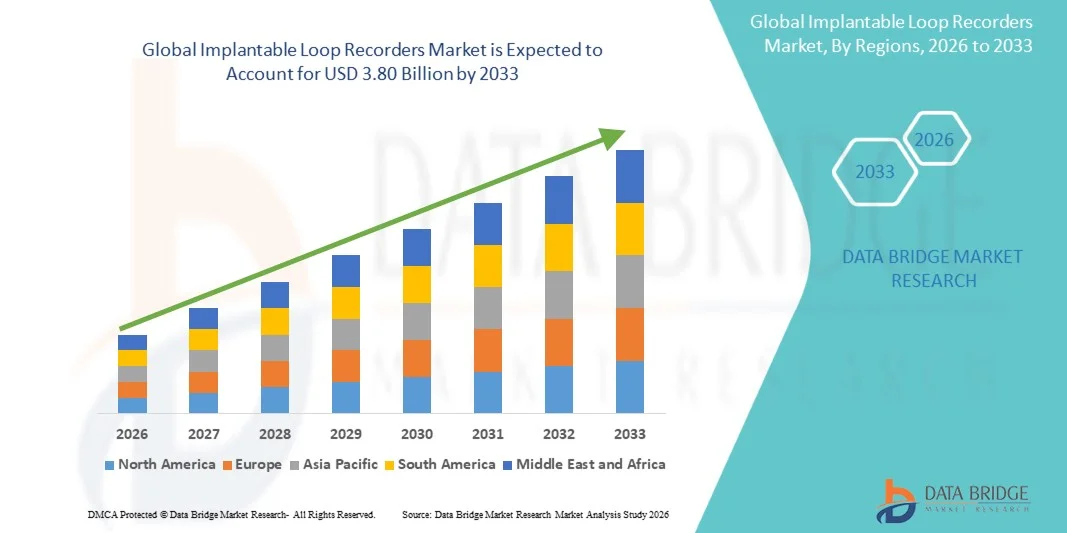
As per Data Bridge Market Research Analysis the Implantable Loop Recorders Market was valued at USD 1.80 billion in 2025 and is projected to reach USD 3.80 billion by 2033, growing at a CAGR of 9.81% from 2026 to 2033. The market is experiencing steady growth driven by the rising prevalence of cardiac arrhythmias and atrial fibrillation, increasing demand for long-term cardiac monitoring, and continuous technological advancements in miniaturized implantable cardiac monitoring devices.
The growing burden of cardiovascular diseases worldwide, coupled with the increasing need for early diagnosis of unexplained syncope and intermittent cardiac rhythm disorders, is encouraging healthcare providers to adopt implantable loop recorders for continuous monitoring. Advanced wireless-enabled and MRI-compatible devices are increasingly being utilized across hospitals and cardiac care centers, offering accurate remote patient monitoring, improved diagnostic yield, and enhanced clinical decision-making while supporting the shift toward personalized and preventive cardiac care.
Market Size & Forecast
- Global Market Value (2025): USD 1.80 Billion
- Expected Market Value (2033): USD 3.80 Billion
- Forecast CAGR (2026–2033): 9.81%
- Leading Region in 2025: North America
- Fastest Growing Region: Asia Pacific
What are the Major Takeaways of Implantable Loop Recorders Market?
- North America dominated the Implantable Loop Recorders Market with the largest revenue share of 39.82% in 2025, supported by a high prevalence of cardiac arrhythmias, advanced healthcare infrastructure, and favorable reimbursement policies.
- The Auto Recorders segment led the market with a 67.45% share in 2025, driven by wing to its ability to continuously monitor cardiac activity and automatically capture arrhythmic events without requiring patient intervention.
- Asia-Pacific is expected to be the fastest-growing region at a CAGR of 8.1% from 2026 to 2033, fueled by rising cardiovascular disease incidence, expanding healthcare access, and increasing adoption of advanced cardiac monitoring technologies in China, India, and Japan.
- Manual Recorders are the fastest-growing product type, projected to register a CAGR of 6.9%, reflecting the surge in adoption in cost-sensitive healthcare settings and among patients requiring targeted event recording.
- The Atrial Fibrillation segment dominated the application category with a 43.26% revenue share in 2025, led by the rising global prevalence of atrial fibrillation and the growing need for long-term rhythm monitoring.
- Direct Sales for 72.14% of the market, preferred by strong relationships between manufacturers, hospitals, and specialized cardiac centers.
- The Cardiac Syncope segment is the fastest-growing application category, with a CAGR of 7.8%, driven by increasing need to diagnose unexplained fainting episodes and transient loss of consciousness.
Report Scope and Implantable Loop Recorders Market Segmentation
|
Attributes |
Implantable Loop Recorders Key Market Insights |
|
Segments Covered |
|
|
Countries Covered |
North America
Europe
Asia-Pacific
Middle East and Africa
South America
|
|
Key Market Players |
|
|
Market Opportunities |
|
|
Value Added Data Infosets |
In addition to the insights on market scenarios such as market value, growth rate, segmentation, geographical coverage, and major players, the market reports curated by the Data Bridge Market Research also include in-depth expert analysis, patient epidemiology, pipeline analysis, pricing analysis, and regulatory framework. |
What is the Key Trend in the Implantable Loop Recorders Market?
Trend: Rising Adoption of Remote Cardiac Monitoring and Digital Health Integration
Healthcare providers are increasingly adopting implantable loop recorders to enable continuous long-term cardiac rhythm monitoring, improve early detection of arrhythmias, and support remote patient management without frequent hospital visits. The integration of wireless connectivity enables seamless transmission of cardiac data to clinicians for timely intervention and enhanced clinical decision-making. Hospitals and cardiac centers are similarly leveraging connected monitoring ecosystems to optimize diagnostic workflows through standardized, data-driven care pathways, while cloud-based platforms and mobile applications create integrated environments that closely support real-world patient monitoring requirements.
Implantable Loop Recorders Market Dynamics
Key Market Driver: Growing Prevalence of Cardiac Arrhythmias and Need for Early Diagnosis
The rising prevalence of cardiac arrhythmias and atrial fibrillation has created substantial demand for implantable loop recorders that can continuously monitor heart rhythms, detect intermittent abnormalities, and improve diagnostic accuracy in patients with unexplained symptoms. Healthcare providers, cardiology centers, and specialized clinics are deploying these devices as a core component of cardiac care pathways, reducing diagnostic delays, supporting timely treatment decisions, and improving long-term patient outcomes. For instance, in June 2023, Medtronic announced expanded clinical evidence supporting the use of its implantable cardiac monitoring technologies for earlier arrhythmia detection and long-term patient management.
Key Restraint/Challenge: High Device Costs and Limited Reimbursement in Emerging Markets
A significant restraint in the Implantable Loop Recorders Market is the high overall cost associated with device implantation, monitoring services, and long-term follow-up care. Modern systems incorporate miniaturized electronics, wireless communication capabilities, and advanced diagnostic algorithms, requiring considerable investment in device procurement, implantation procedures, and ongoing patient management. The total cost of care extends to remote monitoring infrastructure, periodic device assessments, and specialist consultations, making adoption difficult for cost-sensitive healthcare systems and underserved patient populations.
For instance, reimbursement limitations across several developing healthcare markets continue to restrict broader adoption of implantable cardiac monitoring technologies despite growing clinical demand.
Key Market Opportunity: Expansion of Remote Monitoring and Cryptogenic Stroke Detection Applications
The expansion of remote cardiac monitoring and cryptogenic stroke detection applications presents a significant market opportunity. Advanced implantable loop recorders can support continuous arrhythmia surveillance, provide real-time diagnostic insights, and enable earlier identification of asymptomatic atrial fibrillation episodes associated with stroke risk. The development of AI-enabled analytics platforms and integrated telecardiology ecosystems is further enhancing clinical value, opening growth opportunities across aging populations and cardiovascular care programs in Asia-Pacific, Latin America, and the Middle East. For instance, in August 2024, Abbott highlighted expanded digital health capabilities designed to strengthen remote cardiac monitoring and improve long-term patient management outcomes.
How is the Implantable Loop Recorders Market Segmented ?
The implantable loop recorders market is segmented on the basis of product, application, distribution channel, and end user.
- By Product
On the basis of product, the Implantable Loop Recorders Market is segmented into auto recorders and manual recorders. The Auto Recorders segment dominated the market with a 67.45% share in 2025, owing to its ability to continuously monitor cardiac activity and automatically capture arrhythmic events without requiring patient intervention. These devices offer superior diagnostic accuracy for detecting intermittent cardiac abnormalities that may otherwise go unnoticed. Their growing integration with remote monitoring platforms enables real-time data transmission and timely clinical assessment. Auto recorders are increasingly preferred for long-term monitoring of patients with unexplained syncope and atrial fibrillation. Technological advancements such as miniaturization, wireless connectivity, and extended battery life are further improving patient compliance and clinical outcomes. The segment continues to benefit from increasing physician preference for automated and data-driven cardiac monitoring solutions.
The Manual Recorders segment is projected to register the fastest growth at a CAGR of 6.9% from 2026 to 2033, driven by increasing adoption in cost-sensitive healthcare settings and among patients requiring targeted event recording. These devices allow users to manually activate recording during symptomatic episodes, making them useful for correlating symptoms with cardiac events. Their relatively lower acquisition cost compared to advanced automatic systems supports adoption in emerging markets. Continuous improvements in device usability and recording capabilities are enhancing diagnostic effectiveness. Growing awareness regarding cardiac monitoring and expanding healthcare access are also supporting demand. The segment is expected to witness increased utilization as healthcare providers seek affordable monitoring alternatives for selected patient populations.
- By Application
On the basis of application, the Implantable Loop Recorders Market is segmented into atrial fibrillation, cardiac arrhythmia, and cardiac syncope. The Atrial Fibrillation segment led the market with a 43.26% share in 2025, driven by the rising global prevalence of atrial fibrillation and the growing need for long-term rhythm monitoring. Implantable loop recorders play a critical role in identifying silent and intermittent AF episodes that are difficult to detect using conventional monitoring methods. Early diagnosis of atrial fibrillation is essential for stroke prevention and effective disease management. Increasing adoption of remote monitoring technologies is further enhancing the value of implantable loop recorders in AF detection. Healthcare providers are increasingly utilizing these devices to support personalized treatment decisions and improve patient outcomes. The segment continues to benefit from growing awareness of AF-related complications and preventive cardiac care initiatives.
The Cardiac Syncope segment is expected to witness the fastest growth at a CAGR of 7.8% from 2026 to 2033, supported by the increasing need to diagnose unexplained fainting episodes and transient loss of consciousness. Implantable loop recorders provide long-term monitoring capabilities that significantly improve diagnostic yield in syncope patients. These devices help clinicians identify underlying cardiac causes that may not be captured through short-term monitoring techniques. Rising healthcare expenditure and growing adoption of advanced cardiac diagnostics are contributing to segment growth. Increased emphasis on reducing hospital admissions and recurrent diagnostic testing is further encouraging device utilization. The segment is also benefiting from clinical guideline recommendations supporting long-term monitoring for unexplained syncope evaluation.
- By Distribution Channel
On the basis of distribution channel, the Implantable Loop Recorders Market is segmented into direct sales and distributor. The Direct Sales segment dominated the market with a 72.14% share in 2025, owing to strong relationships between manufacturers, hospitals, and specialized cardiac centers. Direct sales channels enable companies to provide technical support, clinical training, and customized service offerings to healthcare providers. Large healthcare institutions often prefer direct procurement to ensure product authenticity, service reliability, and regulatory compliance. Manufacturers also benefit from greater control over pricing strategies and customer engagement. The increasing complexity of cardiac monitoring technologies has strengthened the importance of direct manufacturer support. As a result, direct sales remain the preferred distribution model across major healthcare markets.
The Distributor segment is anticipated to register the fastest growth at a CAGR of 7.2% from 2026 to 2033, driven by expanding healthcare infrastructure and growing demand across emerging economies. Distributors play a crucial role in improving product accessibility in regions where manufacturers have limited direct presence. They facilitate efficient inventory management, local market penetration, and regulatory navigation. Increasing demand for advanced cardiac monitoring solutions in secondary and tertiary healthcare facilities is supporting channel expansion. Strategic partnerships between manufacturers and regional distributors are further accelerating market reach. The segment is expected to benefit from growing investments in healthcare modernization and broader access to cardiac diagnostic technologies.
- By End User
On the basis of end user, the Implantable Loop Recorders Market is segmented into hospitals, cardiac centers, and others. The Hospitals segment accounted for the largest market share of 61.37% in 2025, driven by the availability of specialized cardiology departments, advanced diagnostic infrastructure, and skilled healthcare professionals. Hospitals serve as primary centers for device implantation, patient monitoring, and long-term cardiac care management. The increasing number of cardiovascular disease cases is generating strong demand for comprehensive diagnostic services. Hospitals also benefit from established reimbursement systems and access to advanced medical technologies. Growing investments in cardiac care facilities are further strengthening segment growth. Their ability to provide integrated treatment and monitoring services continues to support market leadership.
The Cardiac Centers segment is projected to experience the fastest growth at a CAGR of 8.0% from 2026 to 2033, fueled by increasing specialization in cardiovascular diagnostics and treatment. These centers focus exclusively on cardiac care, enabling rapid diagnosis and management of arrhythmias and related disorders. The growing preference for specialized healthcare services is encouraging patients to seek treatment at dedicated cardiac facilities. Cardiac centers are increasingly adopting advanced implantable monitoring technologies to improve diagnostic efficiency and patient outcomes. Rising awareness of preventive cardiology and early disease detection is also contributing to demand. The segment is expected to benefit from continued expansion of specialized cardiovascular care networks across developed and emerging markets.
Which Region Holds the Largest Share of the Implantable Loop Recorders Market?
North America dominated the Implantable Loop Recorders Market with the largest revenue share of 39.82% in 2025, supported by a high prevalence of cardiac arrhythmias, advanced healthcare infrastructure, and favorable reimbursement policies. The region also benefits from favorable reimbursement policies, widespread availability of specialized cardiology services, and the presence of leading medical device manufacturers. Growing utilization of remote patient monitoring solutions, increasing awareness of atrial fibrillation detection, and expanding use of implantable cardiac monitoring devices across hospitals and cardiac centers continue to drive market growth. Rising focus on early diagnosis, preventive cardiovascular care, and digital health integration continues to strengthen North America’s leadership position in the global market.
U.S. Implantable Loop Recorders Market Insight
The U.S. implantable loop recorders market is witnessing strong growth due to rising prevalence of cardiac arrhythmias, increasing adoption of remote patient monitoring solutions, and growing demand for early cardiac disease detection technologies. The country’s advanced healthcare infrastructure, favorable reimbursement framework, and strong presence of leading medical device manufacturers are driving demand across hospitals, cardiac centers, and specialty clinics. In addition, growing emphasis on preventive cardiovascular care and improved diagnostic accuracy is accelerating implantable loop recorder adoption across healthcare providers and patient populations.
Europe Implantable Loop Recorders Market Insight
The Europe implantable loop recorders market remains a major contributor to global revenue, driven by strong healthcare systems, technological innovation, and high demand for advanced cardiac monitoring solutions. The widespread use of implantable cardiac monitoring devices in arrhythmia detection, syncope diagnosis, and atrial fibrillation management is supporting market expansion across the region. Increasing investments in digital healthcare technologies, coupled with favorable clinical guidelines and a highly developed cardiology network, continue to enhance the adoption of implantable loop recorders throughout Europe.
U.K. Implantable Loop Recorders Market Insight
The U.K. implantable loop recorders market is experiencing steady growth, supported by rising adoption of long-term cardiac monitoring technologies, expanding cardiovascular screening programs, and increasing awareness regarding arrhythmia diagnosis. Growing investments in advanced cardiac care infrastructure and rising demand for minimally invasive monitoring solutions are contributing to market growth. Furthermore, integration of remote monitoring platforms, digital health technologies, and data analytics capabilities is improving patient management and diagnostic efficiency, positioning the U.K. as a key innovation hub in the implantable cardiac monitoring industry.
Germany Implantable Loop Recorders Market Insight
The Germany implantable loop recorders market is expanding steadily due to the country’s advanced healthcare infrastructure, strong cardiology expertise, and increasing adoption of next-generation cardiac monitoring technologies. Hospitals, cardiac centers, and specialized healthcare providers are increasingly utilizing implantable loop recorders for arrhythmia detection, syncope evaluation, and long-term patient monitoring. Continuous advancements in wireless connectivity, device miniaturization, and remote monitoring capabilities, along with strong government focus on healthcare innovation and patient outcomes, are further driving market growth in Germany.
Asia-Pacific Implantable Loop Recorders Market Insight
The Asia-Pacific implantable loop recorders market is expected to witness rapid growth, driven by increasing cardiovascular disease prevalence, expanding healthcare infrastructure, and rising investments in cardiac care services across countries such as China, India, and Japan. Growing awareness regarding early diagnosis of arrhythmias, rising adoption of advanced monitoring technologies, and increasing demand for effective long-term cardiac surveillance solutions are supporting regional market expansion. In addition, the growing availability of specialized cardiac care facilities and healthcare modernization initiatives is accelerating implantable loop recorder adoption across the region.
Japan Implantable Loop Recorders Market Insight
The Japan implantable loop recorders market is witnessing consistent growth due to rising investments in advanced cardiac monitoring technologies, increasing prevalence of age-related cardiovascular disorders, and strong focus on preventive healthcare initiatives. Hospitals, cardiac specialists, and research institutions are increasingly adopting implantable loop recorders for long-term rhythm monitoring, early diagnosis, and patient management purposes. Moreover, increasing integration of wireless monitoring technologies and the country’s focus on efficient and high-quality healthcare delivery are further contributing to market growth.
China Implantable Loop Recorders Market Insight
The China implantable loop recorders market is growing rapidly, driven by increasing cardiovascular disease burden, expanding healthcare infrastructure, and rising government focus on improving cardiac care services. Growing adoption of remote monitoring technologies and advanced implantable cardiac devices across hospitals and specialty cardiac centers is significantly boosting market demand. In addition, rising healthcare expenditure, increasing awareness regarding arrhythmia diagnosis, and rapid technological advancements are positioning China as one of the fastest-growing markets for implantable loop recorders globally.
Which are the Top Companies in Implantable Loop Recorders Market?
The implantable loop recorders industry is primarily led by well-established companies, including:
- Medtronic (Ireland)
- Abbott (U.S.)
- BIOTRONIK SE & Co. KG (Germany)
- Boston Scientific Corporation (U.S.)
- Vectorious Medical Technologies Ltd. (Israel)
- Koninklijke Philips N.V. (Netherlands)
- GE HealthCare (U.S.)
- NIHON KOHDEN CORPORATION (Japan)
- MicroPort Scientific Corporation (China)
- ZOLL Medical Corporation (U.S.)
- Midmark Corporation (U.S.)
- SunTech Medical, Inc. (U.S.)
- OSI Systems, Inc. (U.S.)
- Fukuda Denshi Co., Ltd. (Japan)
- BPL Medical Technologies (India)
- Shree Pacetronix Ltd. (India)
- LivaNova PLC (U.K.)
- OSYPKA AG (Germany)
- Lepu Medical Technology Co., Ltd. (China)
- Integer Holdings Corporation (U.S.)
What are Latest Developments in Implantable Loop Recorders Market ?
- In April 2024, BIOTRONIK announced the CE approval and first European implant of its new BIOMONITOR IV Insertable Cardiac Monitor at EHRA Congress 2024. The device incorporates AI-powered SmartECG technology designed to reduce false-positive arrhythmia detections while maintaining high diagnostic accuracy. It also features PVC and PAC discrimination capabilities and enhanced remote monitoring performance. The launch reflects the growing integration of artificial intelligence into implantable cardiac monitoring solutions to improve workflow efficiency and patient management
- In September 2023, Abbott Cardiovascular reported new clinical evidence demonstrating that insertable cardiac monitors improved atrial fibrillation detection and increased oral anticoagulation initiation among patients with cryptogenic stroke compared with conventional monitoring approaches. The findings reinforced the clinical value of implantable loop recorders for long-term arrhythmia surveillance and stroke prevention strategies
- In June 2023, BIOTRONIK announced the first global implantation of its BIOMONITOR IV Implantable Cardiac Monitor at Montefiore Medical Center in New York. The device combines AI-enabled SmartECG technology with advanced arrhythmia detection capabilities, reducing false-positive alerts while preserving clinically relevant episodes. The milestone marked a significant advancement in long-term cardiac rhythm monitoring and remote patient management
- In May 2023, BIOTRONIK announced that its BIOMONITOR IV Implantable Cardiac Monitor received U.S. FDA approval and was introduced at the Heart Rhythm Society Congress 2023. The next-generation device includes an AI-powered SmartECG algorithm designed to improve arrhythmia detection accuracy and reduce clinician workload. The approval strengthened the company’s position in the implantable cardiac monitoring market and expanded access to advanced diagnostic capabilities
- In October 2021, Medtronic continued the commercial expansion of its LINQ II Insertable Cardiac Monitor across major healthcare markets. The device features enhanced remote monitoring functionality, improved arrhythmia detection algorithms, and streamlined data transmission capabilities for long-term cardiac rhythm surveillance. Its broader adoption supported the increasing use of connected implantable monitoring technologies for atrial fibrillation, cryptogenic stroke, and unexplained syncope management

- Interactive Data Analysis Dashboard
- Company Analysis Dashboard for high growth potential opportunities
- Research Analyst Access for customization & queries
- Competitor Analysis with Interactive dashboard
- Latest News, Updates & Trend analysis
- Harness the Power of Benchmark Analysis for Comprehensive Competitor Tracking
Data collection and base year analysis are done using data collection modules with large sample sizes. The stage includes obtaining market information or related data through various sources and strategies. It includes examining and planning all the data acquired from the past in advance. It likewise envelops the examination of information inconsistencies seen across different information sources. The market data is analysed and estimated using market statistical and coherent models. Also, market share analysis and key trend analysis are the major success factors in the market report. To know more, please request an analyst call or drop down your inquiry.
The key research methodology used by DBMR research team is data triangulation which involves data mining, analysis of the impact of data variables on the market and primary (industry expert) validation. Data models include Vendor Positioning Grid, Market Time Line Analysis, Market Overview and Guide, Company Positioning Grid, Patent Analysis, Pricing Analysis, Company Market Share Analysis, Standards of Measurement, Global versus Regional and Vendor Share Analysis. To know more about the research methodology, drop in an inquiry to speak to our industry experts.
Data Bridge Market Research is a leader in advanced formative research. We take pride in servicing our existing and new customers with data and analysis that match and suits their goal. The report can be customized to include price trend analysis of target brands understanding the market for additional countries (ask for the list of countries), clinical trial results data, literature review, refurbished market and product base analysis. Market analysis of target competitors can be analyzed from technology-based analysis to market portfolio strategies. We can add as many competitors that you require data about in the format and data style you are looking for. Our team of analysts can also provide you data in crude raw excel files pivot tables (Fact book) or can assist you in creating presentations from the data sets available in the report.













