


Global Industrial Radiography Market
Market Size in USD Million
CAGR :
% 
 USD
921.83 Million
USD
1,595.77 Million
2025
2033
USD
921.83 Million
USD
1,595.77 Million
2025
2033
 Forecast Period Forecast Period |
2026 –2033 |
 Market Size (Base Year) Market Size (Base Year) |
USD 921.83 Million |
 Market Size (Forecast Year) Market Size (Forecast Year) |
USD 1,595.77 Million |
 CAGR CAGR |
% |
| Major Markets Players |
|
Industrial Radiography Market Size
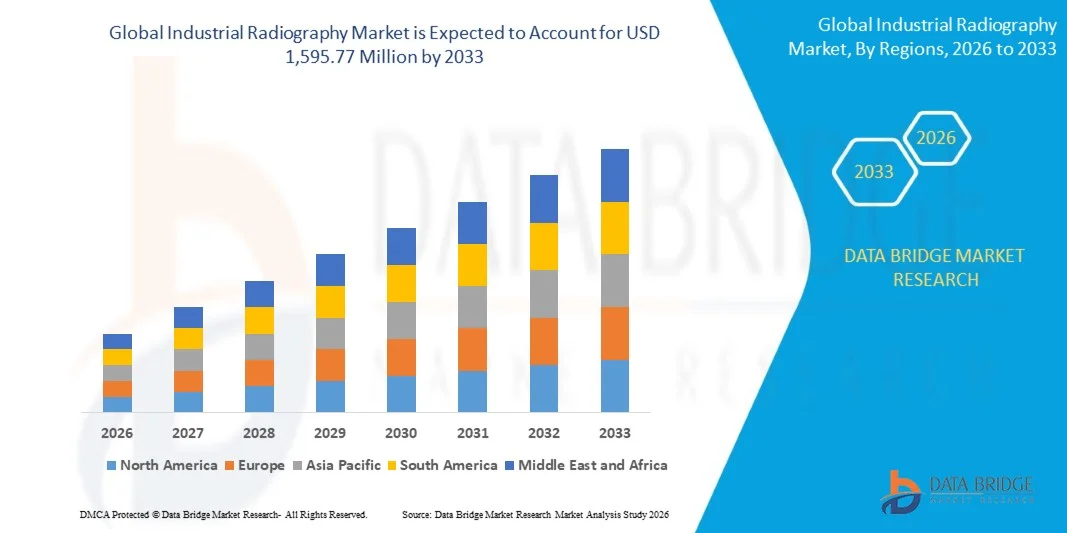
- The global industrial radiography market size was valued at USD 921.83 million in 2025 and is expected to reach USD 1,595.77 million by 2033, at a CAGR of 7.10% during the forecast period
- The market growth is largely fuelled by the increasing demand for non-destructive testing (NDT) techniques across industries such as oil and gas, aerospace, manufacturing, and construction to ensure structural integrity and safety compliance
- Rising investments in infrastructure development and energy projects are encouraging the adoption of industrial radiography solutions for inspection of pipelines, welds, and critical components
Industrial Radiography Market Analysis
- Increasing regulatory standards and safety requirements across industries are encouraging companies to adopt advanced radiographic inspection technologies for improved reliability and operational safety
- The shift from conventional film-based radiography to digital radiography systems is improving inspection speed, image quality, and data storage capabilities, supporting greater operational efficiency
- North America dominated the industrial radiography market with the largest revenue share in 2025, driven by the strong presence of advanced manufacturing industries and the rising demand for non-destructive testing across sectors such as aerospace, oil and gas, and automotive
- Asia-Pacific region is expected to witness the highest growth rate in the global industrial radiography market, driven by increasing industrial development, growing oil and gas exploration activities, rising infrastructure investments, and the expanding adoption of non-destructive testing technologies across emerging economies such as China and India
- The digital radiography segment held the largest market revenue share in 2025 driven by its ability to provide faster image acquisition, higher inspection accuracy, and improved data storage capabilities. Digital radiography systems enable real-time image processing and analysis, making them highly efficient for industrial inspections and quality assurance across critical infrastructure and manufacturing operations
Report Scope and Industrial Radiography Market Segmentation
|
Attributes |
Industrial Radiography Key Market Insights |
|
Segments Covered |
|
|
Countries Covered |
North America
Europe
Asia-Pacific
Middle East and Africa
South America
|
|
Key Market Players |
• IXAR (U.K.) |
|
Market Opportunities |
• Increasing Adoption Of Digital Radiography In Industrial Inspection |
|
Value Added Data Infosets |
In addition to the insights on market scenarios such as market value, growth rate, segmentation, geographical coverage, and major players, the market reports curated by the Data Bridge Market Research also include in-depth expert analysis, geographically represented company-wise production and capacity, network layouts of distributors and partners, detailed and updated price trend analysis and deficit analysis of supply chain and demand. |
Industrial Radiography Market Trends
“Increasing Adoption of Digital Radiography and Advanced Imaging Technologies”
• The growing transition from traditional film-based radiography to digital radiography systems is significantly shaping the industrial radiography market, as industries increasingly seek faster, more accurate, and efficient inspection solutions. Digital radiography technologies provide enhanced image quality, improved defect detection, and faster data processing capabilities. These advantages support better inspection outcomes across sectors such as oil and gas, aerospace, and manufacturing while reducing operational downtime and inspection costs
• Increasing emphasis on infrastructure safety and asset integrity management has accelerated the demand for advanced radiographic inspection systems in pipelines, pressure vessels, and structural components. Industrial radiography enables precise internal examination of materials without causing damage, making it essential for quality assurance and compliance with stringent industry standards. As infrastructure projects and energy developments expand globally, demand for reliable inspection technologies continues to increase
• Automation and digital integration trends are influencing industrial inspection practices, with companies incorporating advanced imaging software, cloud-based data storage, and automated analysis tools. These innovations help improve inspection efficiency, reduce manual errors, and support predictive maintenance strategies. Companies are increasingly investing in digital inspection ecosystems that allow real-time monitoring and remote evaluation of inspection data
• For instance, in 2024, GE Aerospace in the U.S. and Nikon Corporation in Japan expanded their digital radiography solutions for aerospace and industrial inspection applications. These systems were introduced to enhance imaging precision and streamline inspection workflows for complex components. The solutions were adopted by manufacturers and maintenance providers seeking faster and more accurate non-destructive testing capabilities, improving operational efficiency and safety compliance
• While demand for digital radiography solutions continues to rise, sustained market expansion depends on continuous technological innovation, cost optimization, and skilled workforce availability. Manufacturers are also focusing on improving imaging resolution, portability of inspection devices, and integration with advanced analytics platforms to support broader industrial adoption
Industrial Radiography Market Dynamics
Driver
“Growing Demand for Non-Destructive Testing in Critical Infrastructure and Energy Industries”
• Rising demand for reliable inspection methods across industries such as oil and gas, aerospace, construction, and manufacturing is a major driver for the industrial radiography market. Industrial radiography plays a vital role in detecting internal defects, cracks, and structural inconsistencies without damaging the inspected materials. This capability is essential for maintaining operational safety and ensuring compliance with stringent quality standards
• Expanding infrastructure development and energy exploration projects are significantly influencing market growth. Industrial radiography is widely used for pipeline inspection, weld evaluation, and equipment maintenance in critical energy infrastructure. The increasing complexity of industrial systems further strengthens the need for accurate and efficient non-destructive testing technologies
• Industrial operators are actively adopting advanced radiographic inspection technologies through equipment upgrades, digital imaging integration, and automation initiatives. These efforts are supported by regulatory requirements and industry safety guidelines that mandate regular inspection and maintenance of industrial assets. Partnerships between equipment manufacturers and inspection service providers are also contributing to technological advancements and improved service delivery
• For instance, in 2023, Baker Hughes in the U.S. and Mistras Group expanded their industrial inspection services by integrating advanced digital radiography systems for pipeline and energy infrastructure monitoring. The deployment of these systems followed increasing demand for high-precision inspection solutions in critical industrial operations. Both companies emphasized improved safety standards and operational reliability as key benefits of the upgraded inspection technologies
• Although increasing demand for non-destructive testing supports market growth, broader adoption depends on cost-effective technology deployment, skilled workforce training, and regulatory compliance. Continuous investment in inspection technology development and workforce training programs will be essential to meet global industrial inspection requirements
Restraint/Challenge
“High Equipment Costs and Strict Safety Regulations”
• The relatively high cost of industrial radiography equipment and inspection systems remains a key challenge, particularly for small and medium-sized inspection service providers. Advanced digital radiography systems require significant initial investment, including imaging devices, shielding equipment, and specialized software. These financial barriers may limit adoption in cost-sensitive markets
• Regulatory compliance and safety concerns also present challenges for industrial radiography operations. The use of radiation-based inspection methods requires strict adherence to safety regulations, licensing requirements, and monitoring procedures to protect workers and surrounding environments. These regulations often increase operational complexity and administrative responsibilities for inspection providers
• Operational challenges related to handling radioactive sources and maintaining specialized equipment further impact market growth. Organizations must implement strict safety protocols, employee training programs, and monitoring systems to ensure safe operations. In addition, the need for certified operators and radiation safety professionals increases operational costs and workforce requirements
• For instance, in 2024, inspection service providers in countries such as Malaysia and Indonesia reported operational delays due to regulatory compliance requirements and high costs associated with radiation safety equipment. Some industrial operators also preferred alternative non-destructive testing methods where feasible, which slightly affected demand for radiographic inspection services in certain applications
• Addressing these challenges will require continued investment in safer inspection technologies, improved regulatory frameworks, and workforce training initiatives. Advancements in digital radiography systems, along with the development of lower-radiation inspection methods, are expected to support long-term growth and improve operational safety across the industrial radiography market
Industrial Radiography Market Scope
The market is segmented on the basis of imaging technique and industry.
• By Imaging Technique
On the basis of imaging technique, the industrial radiography market is segmented into film-based radiography and digital radiography. The digital radiography segment held the largest market revenue share in 2025 driven by its ability to provide faster image acquisition, higher inspection accuracy, and improved data storage capabilities. Digital radiography systems enable real-time image processing and analysis, making them highly efficient for industrial inspections and quality assurance across critical infrastructure and manufacturing operations.
The film-based radiography segment is expected to witness steady demand from 2026 to 2033, driven by its continued use in certain traditional inspection environments and remote industrial locations where digital infrastructure may be limited. Film-based systems are valued for their proven reliability and high-resolution imaging capabilities, particularly in applications where established inspection protocols remain in place.
• By Industry
On the basis of industry, the industrial radiography market is segmented into petrochemical and gas, power generation, manufacturing, aerospace, automotive and transportation, and others. The petrochemical and gas segment held the largest market revenue share in 2025 driven by the increasing need for pipeline inspection, weld testing, and structural integrity monitoring in energy infrastructure. Industrial radiography plays a crucial role in ensuring safety and compliance with strict operational standards in oil and gas facilities.
The aerospace segment is expected to witness the fastest growth rate from 2026 to 2033, driven by the rising demand for advanced inspection technologies to detect structural defects in aircraft components and critical assemblies. Industrial radiography helps aerospace manufacturers maintain stringent safety standards while improving quality control during the production and maintenance of aircraft systems.
Industrial Radiography Market Regional Analysis
• North America dominated the industrial radiography market with the largest revenue share in 2025, driven by the strong presence of advanced manufacturing industries and the rising demand for non-destructive testing across sectors such as aerospace, oil and gas, and automotive
• Industries in the region prioritize safety, reliability, and strict quality control standards, which significantly increases the adoption of industrial radiography technologies for inspecting welds, pipelines, and structural components
• This widespread adoption is further supported by stringent regulatory frameworks, advanced technological infrastructure, and the presence of leading inspection service providers, establishing industrial radiography as a critical solution for industrial quality assurance
U.S. Industrial Radiography Market Insight
The U.S. industrial radiography market captured the largest revenue share in 2025 within North America, fueled by the rapid expansion of the aerospace, defense, and energy sectors. Companies are increasingly investing in advanced non-destructive testing methods to ensure structural integrity and compliance with strict safety standards. The growing focus on infrastructure modernization, pipeline inspection, and aircraft component testing further propels the industrial radiography market. In addition, the integration of digital radiography technologies and automated inspection solutions is significantly contributing to market growth.
Europe Industrial Radiography Market Insight
The Europe industrial radiography market is expected to witness the fastest growth rate from 2026 to 2033, primarily driven by strict industrial safety regulations and the strong presence of automotive and aerospace manufacturing. Increasing investments in infrastructure development and energy projects are encouraging the adoption of advanced inspection technologies. European industries are also emphasizing efficient and precise non-destructive testing solutions to maintain product reliability and operational safety. As a result, industrial radiography is gaining significant traction across multiple industrial applications in the region.
U.K. Industrial Radiography Market Insight
The U.K. industrial radiography market is expected to witness the fastest growth rate from 2026 to 2033, driven by increasing investments in energy infrastructure, aerospace manufacturing, and industrial maintenance activities. The country’s strong regulatory environment related to safety and equipment reliability is encouraging companies to adopt advanced radiographic inspection techniques. Furthermore, the growing demand for pipeline inspection and structural integrity assessment across various industries is expected to stimulate market expansion.
Germany Industrial Radiography Market Insight
The Germany industrial radiography market is expected to witness the fastest growth rate from 2026 to 2033, fueled by the country’s robust manufacturing sector and its leadership in automotive and engineering industries. Germany’s strong emphasis on precision engineering and quality control supports the growing adoption of industrial radiography for component inspection and defect detection. In addition, increasing adoption of digital radiography systems and automated inspection technologies is contributing to the expansion of the market in the country.
Asia-Pacific Industrial Radiography Market Insight
The Asia-Pacific industrial radiography market is expected to witness the fastest growth rate from 2026 to 2033, driven by rapid industrialization, expanding manufacturing activities, and increasing investments in infrastructure projects. Countries such as China, Japan, and India are witnessing rising demand for non-destructive testing solutions to ensure product safety and operational efficiency. The growth of the oil and gas, power generation, and construction industries is further accelerating the adoption of industrial radiography technologies across the region.
Japan Industrial Radiography Market Insight
The Japan industrial radiography market is expected to witness the fastest growth rate from 2026 to 2033 due to the country’s advanced manufacturing ecosystem and strong focus on technological innovation. Japan places significant importance on product quality and industrial safety, which drives the adoption of sophisticated non-destructive testing techniques. The increasing integration of digital radiography systems and automated inspection solutions across aerospace, electronics, and automotive industries is supporting market growth.
China Industrial Radiography Market Insight
The China industrial radiography market accounted for the largest market revenue share in Asia Pacific in 2025, attributed to the country’s rapid industrial expansion and strong manufacturing base. China has emerged as a major hub for automotive, construction, and energy industries, creating substantial demand for non-destructive testing solutions. The expansion of infrastructure projects, along with the presence of numerous domestic equipment manufacturers, is significantly driving the adoption of industrial radiography technologies across the country.
Industrial Radiography Market Share
The Industrial Radiography industry is primarily led by well-established companies, including:
• IXAR (U.K.)
• X-Ray Associates, LLC (U.S.)
• Teledyne Technologies Company (U.S.)
• Comet Holding AG (Switzerland)
• Anritsu Corporation (Japan)
• Mettler-Toledo International Inc. (U.S.)
• 3DX-Ray Ltd (U.K.)
• Bosello High Technology S.R.L. (Italy)
• General Electric (U.S.)
• Fujifilm Holdings Corporation (Japan)
• Nikon Corporation (Japan)
• Shimadzu Corporation (Japan)
• Nordson DAGE (U.K.)
• VJ Technologies (U.S.)
• Measurement Control (U.S.)
• Smiths Group Plc. (U.K.)
• CEIA (Italy)
• North Star Imaging Inc. (U.S.)
• PerkinElmer Inc. (U.S.)
Latest Developments in Global Industrial Radiography Market
- In September 2022, DÜRR NDT GmbH & Co. KG, Partnership, collaborated with JME Ltd. to develop an advanced X-ray inspection solution integrating the D-Tect X software with the DXB:1 system. This initiative is expected to enhance the inspection of circumferential welds in applications such as newly constructed pipelines. The collaboration aims to improve inspection accuracy, operational efficiency, and digital imaging capabilities in non-destructive testing. As a result, the development is likely to support more reliable infrastructure inspection processes and strengthen technological advancement in the industrial radiography market
- In July 2022, L3Harris Technologies, Partnership, collaborated with DÜRR NDT GmbH & Co. KG to utilize the ScanX Discover HC computed radiography scanner for capturing X-ray images electronically and projecting them digitally for evaluation. This solution enables faster and more precise image analysis compared to traditional radiography methods. The development is expected to enhance inspection efficiency and data accuracy across industrial testing environments. Such innovations are anticipated to accelerate the adoption of digital radiography technologies and contribute to the overall growth of the industrial radiography market
SKU-
Get online access to the report on the World's First Market Intelligence Cloud

- Interactive Data Analysis Dashboard
- Company Analysis Dashboard for high growth potential opportunities
- Research Analyst Access for customization & queries
- Competitor Analysis with Interactive dashboard
- Latest News, Updates & Trend analysis
- Harness the Power of Benchmark Analysis for Comprehensive Competitor Tracking
Global Industrial Radiography Market, Supply Chain Analysis and Ecosystem Framework
To support market growth and help clients navigate the impact of geopolitical shifts, DBMR has integrated in-depth supply chain analysis into its Global Industrial Radiography Market research reports. This addition empowers clients to respond effectively to global changes affecting their industries. The supply chain analysis section includes detailed insights such as Global Industrial Radiography Market consumption and production by country, price trend analysis, the impact of tariffs and geopolitical developments, and import and export trends by country and HSN code. It also highlights major suppliers with data on production capacity and company profiles, as well as key importers and exporters. In addition to research, DBMR offers specialized supply chain consulting services backed by over a decade of experience, providing solutions like supplier discovery, supplier risk assessment, price trend analysis, impact evaluation of inflation and trade route changes, and comprehensive market trend analysis.
Research Methodology
Data collection and base year analysis are done using data collection modules with large sample sizes. The stage includes obtaining market information or related data through various sources and strategies. It includes examining and planning all the data acquired from the past in advance. It likewise envelops the examination of information inconsistencies seen across different information sources. The market data is analysed and estimated using market statistical and coherent models. Also, market share analysis and key trend analysis are the major success factors in the market report. To know more, please request an analyst call or drop down your inquiry.
The key research methodology used by DBMR research team is data triangulation which involves data mining, analysis of the impact of data variables on the market and primary (industry expert) validation. Data models include Vendor Positioning Grid, Market Time Line Analysis, Market Overview and Guide, Company Positioning Grid, Patent Analysis, Pricing Analysis, Company Market Share Analysis, Standards of Measurement, Global versus Regional and Vendor Share Analysis. To know more about the research methodology, drop in an inquiry to speak to our industry experts.
Customization Available
Data Bridge Market Research is a leader in advanced formative research. We take pride in servicing our existing and new customers with data and analysis that match and suits their goal. The report can be customized to include price trend analysis of target brands understanding the market for additional countries (ask for the list of countries), clinical trial results data, literature review, refurbished market and product base analysis. Market analysis of target competitors can be analyzed from technology-based analysis to market portfolio strategies. We can add as many competitors that you require data about in the format and data style you are looking for. Our team of analysts can also provide you data in crude raw excel files pivot tables (Fact book) or can assist you in creating presentations from the data sets available in the report.












