




Global Industrial Rubber Market
Market Size in USD Billion
CAGR :
% 
 USD
39.06 Billion
USD
59.49 Billion
2025
2033
USD
39.06 Billion
USD
59.49 Billion
2025
2033
 Forecast Period Forecast Period |
2026 –2033 |
 Market Size (Base Year) Market Size (Base Year) |
USD 39.06 Billion |
 Market Size (Forecast Year) Market Size (Forecast Year) |
USD 59.49 Billion |
 CAGR CAGR |
% |
| Major Markets Players |
|
Industrial Rubber Market Size
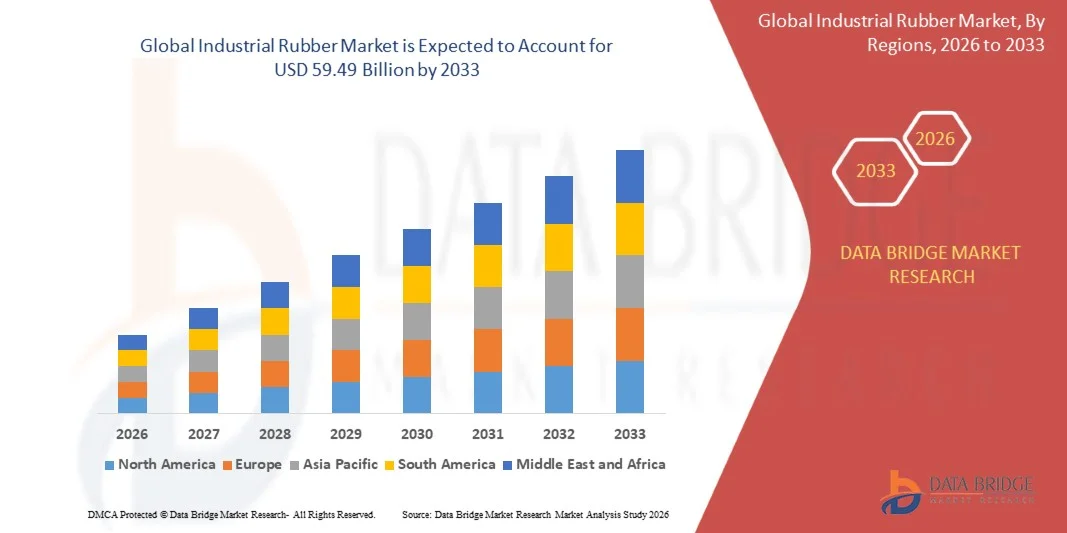
- The global industrial rubber market size was valued at USD 39.06 billion in 2025 and is expected to reach USD 59.49 billion by 2033, at a CAGR of 5.4% during the forecast period
- The market growth is largely fueled by the increasing demand for durable and high-performance materials across automotive, construction, and manufacturing industries, where industrial rubber is critical for vibration dampening, sealing, and insulation applications
- Furthermore, rising adoption of advanced synthetic rubbers by manufacturers such as LANXESS for specialty applications in automotive hoses, belts, and gaskets is driving higher consumption, boosting overall market expansion
Industrial Rubber Market Analysis
- Industrial rubber comprises both natural and synthetic elastomers used in a wide range of applications including tires, seals, gaskets, hoses, belts, and conveyor systems, providing essential properties such as elasticity, chemical resistance, and temperature stability
- The growing demand is primarily driven by the automotive sector’s expansion, increasing industrial machinery deployment, and rising infrastructure projects, which together elevate the need for reliable and versatile rubber materials in industrial applications
- Asia-Pacific dominated the industrial rubber market with a share of 59.59% in 2025, due to rapid industrialization, expanding automotive production, and strong manufacturing bases in key economies
- North America is expected to be the fastest growing region in the industrial rubber market during the forecast period due to rising automotive production, industrial manufacturing expansion, and demand for high-performance rubber products
- Synthetic rubber segment dominated the market with a market share of 62.5% in 2025, due to its superior performance in terms of heat resistance, chemical stability, and durability compared with natural rubber. Industries prefer synthetic rubber for applications requiring high tensile strength and long service life, such as automotive tires, conveyor belts, and industrial seals. The segment also benefits from ongoing technological innovations enhancing its elasticity and abrasion resistance
Report Scope and Industrial Rubber Market Segmentation
|
Attributes |
Industrial Rubber Key Market Insights |
|
Segments Covered |
|
|
Countries Covered |
North America
Europe
Asia-Pacific
Middle East and Africa
South America
|
|
Key Market Players |
|
|
Market Opportunities |
|
|
Value Added Data Infosets |
In addition to the insights on market scenarios such as market value, growth rate, segmentation, geographical coverage, and major players, the market reports curated by the Data Bridge Market Research also include import export analysis, production capacity overview, production consumption analysis, price trend analysis, climate change scenario, supply chain analysis, value chain analysis, raw material/consumables overview, vendor selection criteria, PESTLE Analysis, Porter Analysis, and regulatory framework. |
Industrial Rubber Market Trends
“Rising Demand for High-Performance and Sustainable Industrial Rubber”
- A significant trend in the industrial rubber market is the increasing demand for high-performance and sustainable elastomers across automotive, construction, and manufacturing sectors. These materials provide essential properties such as durability, chemical resistance, and temperature stability, making them indispensable for critical industrial applications
- For instance, LANXESS supplies specialty synthetic rubbers such as Buna and EPDM used in automotive seals, hoses, and gaskets, which are engineered to meet stringent performance and environmental standards. Such products support enhanced reliability and longevity in harsh operational environments
- The adoption of eco-friendly natural and synthetic rubbers is accelerating as manufacturers aim to reduce environmental impact while maintaining mechanical performance. This is encouraging the integration of recycled rubber and bio-based elastomers in tire production, conveyor belts, and industrial seals
- The automotive sector is driving higher uptake as industrial rubbers are essential for vibration dampening, fuel-efficient tires, and resilient engine components. Companies such as Bridgestone and Michelin incorporate advanced rubber compounds to improve wear resistance and energy efficiency in vehicles
- Expansion in industrial machinery and infrastructure projects is increasing the consumption of industrial rubber for conveyor belts, gaskets, and vibration isolators. These applications rely on high-performance rubbers to withstand mechanical stress, temperature fluctuations, and chemical exposure
- The market is witnessing strong growth in high-durability applications where industrial rubbers are replacing metals or plastics due to their flexibility and long service life. Rising industrial automation and energy-efficient machinery further reinforce the adoption of specialized rubber materials
Industrial Rubber Market Dynamics
Driver
“Growing Use in Automotive and Manufacturing Sectors”
- The rising production of automobiles and industrial machinery is driving the demand for industrial rubber as manufacturers require high-performance materials for seals, hoses, gaskets, and vibration-dampening components. Industrial rubbers provide the reliability and flexibility needed to operate under diverse environmental conditions
- For instance, JSR Corporation supplies synthetic rubbers for automotive tire sidewalls and conveyor belts in manufacturing plants, supporting both durability and energy efficiency. Such solutions enhance product lifespan and reduce maintenance needs across industrial operations
- Increasing industrialization in emerging economies is boosting the deployment of machinery and equipment that rely on rubber components for safe and efficient operation. The materials’ resistance to heat, chemicals, and mechanical wear is essential for sustaining long-term industrial performance
- The shift toward electric vehicles is encouraging the use of advanced rubbers for battery seals, cable insulation, and vibration mitigation. Companies such as Goodyear are developing specialized compounds to meet the performance requirements of EV components
- Growing demand for sustainable materials in manufacturing and construction is reinforcing the use of bio-based and recycled rubbers. These materials help companies achieve environmental compliance and reduce carbon footprints, aligning with global sustainability targets
Restraint/Challenge
“Stringent Environmental and Safety Regulations”
- The industrial rubber market faces challenges from strict environmental regulations that govern chemical use, emissions, and waste disposal. Compliance requires manufacturers to adopt greener production methods and invest in eco-friendly materials, which can increase operational costs
- For instance, BASF adheres to REACH regulations and implements controlled chemical processes for EPDM and nitrile rubbers, ensuring safe handling and reduced environmental impact. Such compliance measures add complexity to manufacturing workflows and elevate production expenses
- Handling hazardous chemicals in synthetic rubber production demands stringent safety protocols to protect workers and surrounding environments. These protocols increase labor, training, and operational requirements for rubber manufacturing facilities
- The regulatory focus on reducing volatile organic compound (VOC) emissions and promoting recycling in industrial rubber products adds constraints on material formulation. Manufacturers must balance regulatory compliance with product performance, impacting flexibility in innovation
- Scaling production while maintaining adherence to environmental and safety standards is a persistent challenge. Companies face pressure to optimize processes, lower costs, and sustain high-quality output in response to evolving global regulatory landscapes
Industrial Rubber Market Scope
The market is segmented on the basis of type, product, and application.
• By Type
On the basis of type, the industrial rubber market is segmented into synthetic rubber and natural rubber. The synthetic rubber segment dominated the largest market revenue share of 62.5% in 2025, driven by its superior performance in terms of heat resistance, chemical stability, and durability compared with natural rubber. Industries prefer synthetic rubber for applications requiring high tensile strength and long service life, such as automotive tires, conveyor belts, and industrial seals. The segment also benefits from ongoing technological innovations enhancing its elasticity and abrasion resistance. Synthetic rubber’s compatibility with a wide range of compounding materials and its ability to meet strict industrial standards further strengthen its market position.
The natural rubber segment is anticipated to witness the fastest growth rate from 2026 to 2033, fueled by increasing demand in eco-friendly and sustainable products. For instance, companies such as Hancook Rubber are focusing on sourcing natural rubber for tires and industrial applications due to its biodegradability and renewable nature. The growth is also supported by rising applications in medical devices, footwear, and eco-conscious consumer products. Natural rubber offers excellent flexibility, tensile strength, and resilience, making it suitable for diverse industrial uses. Its increasing adoption is further encouraged by government initiatives promoting sustainable materials.
• By Product
On the basis of product, the industrial rubber market is segmented into mechanical rubber goods, rubber hose, rubber belt, rubber roofing, and others. The mechanical rubber goods segment held the largest market revenue share in 2025, owing to its critical role in vibration isolation, sealing, and protection in industrial machinery. Products such as gaskets, O-rings, and mounts are essential for ensuring operational efficiency and reducing equipment wear and tear. Manufacturers prioritize mechanical rubber goods due to their high demand across automotive, manufacturing, and construction industries. Enhanced durability, chemical resistance, and temperature stability of these products further drive their adoption.
The rubber hose segment is expected to witness the fastest growth rate from 2026 to 2033, driven by expanding industrial and automotive applications requiring flexible, durable fluid transfer solutions. For instance, companies such as Goodyear Rubber Products are developing high-performance hoses for chemicals, fuels, and hydraulic systems. Rising demand in agricultural, construction, and oil & gas sectors also fuels growth. Rubber hoses offer versatility, resistance to abrasion, and adaptability to varying pressures, making them a preferred choice. The trend toward efficient and leak-proof industrial systems further strengthens market expansion.
• By Application
On the basis of application, the industrial rubber market is segmented into automotive, building and construction, industrial manufacturing, polymer modification, wire and cable, electrical and electronics, and bitumen modification. The automotive segment dominated the largest market revenue share in 2025, driven by the high demand for tires, seals, gaskets, belts, and hoses across passenger and commercial vehicles. Industrial rubber’s durability, heat resistance, and flexibility make it critical for automotive safety and performance components. Manufacturers increasingly rely on rubber materials to enhance fuel efficiency, reduce vibration, and improve overall vehicle lifespan. The segment benefits from rising automotive production in emerging economies and technological advancements in electric vehicles.
The building and construction segment is projected to witness the fastest growth rate from 2026 to 2033, fueled by increased demand for rubber-based waterproofing, roofing, insulation, and sealing solutions. For instance, Sika AG provides rubber roofing membranes and sealants for sustainable building projects. The growth is further supported by urbanization, infrastructure development, and green building initiatives. Rubber’s resilience, weather resistance, and acoustic insulation properties make it ideal for modern construction requirements. Rising adoption in commercial and residential projects accelerates market expansion.
Industrial Rubber Market Regional Analysis
- Asia-Pacific dominated the industrial rubber market with the largest revenue share of 59.59% in 2025, driven by rapid industrialization, expanding automotive production, and strong manufacturing bases in key economies
- The region’s cost-effective manufacturing landscape, rising investments in rubber processing facilities, and growing exports of automotive and industrial rubber products are accelerating market expansion
- Availability of skilled labor, favorable government policies, and increasing adoption of sustainable and high-performance rubber materials are contributing to higher consumption across automotive, construction, and manufacturing sectors
China Industrial Rubber Market Insight
China held the largest share in the Asia-Pacific industrial rubber market in 2025, owing to its leadership in automotive manufacturing, industrial equipment production, and rubber processing capabilities. The country’s robust industrial base, government support for manufacturing expansion, and extensive export network for rubber products are major growth drivers. Demand is also boosted by ongoing investments in synthetic rubber production and advanced compounding technologies for automotive tires, belts, and mechanical goods.
India Industrial Rubber Market Insight
India is witnessing the fastest growth in the Asia-Pacific region, fueled by increasing automotive production, rising infrastructure projects, and expansion of the industrial manufacturing sector. Government initiatives promoting Make in India and self-reliance in industrial materials are strengthening demand for both synthetic and natural rubber. In addition, growing exports of rubber-based products, expansion of polymer modification facilities, and rising adoption in construction and automotive applications are contributing to rapid market growth.
Europe Industrial Rubber Market Insight
The Europe industrial rubber market is expanding steadily, supported by stringent environmental regulations, growing demand for high-performance and eco-friendly rubber products, and investments in sustainable manufacturing practices. The region emphasizes quality, durability, and compliance, particularly in automotive, industrial machinery, and construction applications. Adoption of specialty synthetic rubbers and innovations in polymer modification are further enhancing market growth.
Germany Industrial Rubber Market Insight
Germany’s industrial rubber market is driven by its leadership in automotive manufacturing, advanced machinery production, and focus on high-precision industrial applications. The country benefits from strong R&D networks, industry-academia collaboration, and continuous innovation in rubber compounding and performance enhancement. Demand is particularly high for mechanical rubber goods, automotive components, and specialized industrial products.
U.K. Industrial Rubber Market Insight
The U.K. market is supported by a mature automotive and construction sector, growing emphasis on sustainable materials, and increasing demand for high-quality industrial rubber products. With rising focus on innovation, advanced manufacturing, and compliance with environmental standards, the U.K. continues to play a significant role in specialty rubber applications. Investments in lab-scale compounding and testing facilities further strengthen the market.
North America Industrial Rubber Market Insight
North America is projected to grow at the fastest CAGR from 2026 to 2033, driven by rising automotive production, industrial manufacturing expansion, and demand for high-performance rubber products. Growth is also supported by technological advancements in synthetic rubber, increasing adoption of eco-friendly materials, and reshoring of manufacturing operations. Collaboration between automotive OEMs and rubber manufacturers is accelerating innovation in mechanical goods, hoses, and belts.
U.S. Industrial Rubber Market Insight
The U.S. accounted for the largest share in the North America market in 2025, underpinned by its advanced automotive industry, industrial equipment manufacturing, and strong R&D capabilities. Focus on innovation, environmental compliance, and performance-driven rubber products is encouraging adoption of high-quality synthetic and natural rubbers. Presence of key market players, mature supply chains, and increasing use in automotive, construction, and industrial applications solidify the country’s leading position in the region.
Industrial Rubber Market Share
The industrial rubber industry is primarily led by well-established companies, including:
- LANXESS (Germany)
- U.S. Rubber (U.S.)
- TSRC Corporation (Taiwan)
- Nizhnekamskneftekhim (Russia)
- JSR Corporation (Japan)
- LG Chem (South Korea)
- Versalis S.p.A. (Italy)
- ZEON Corporation (Japan)
- Ansell Ltd (Australia)
- Asahi Kasei Advance Corporation (Japan)
- Sri Trang Agro-Industry Plc. (Thailand)
- Dow (U.S.)
- Cooper Standard (U.S.)
- NISHIKAWA RUBBER CO., LTD. (Japan)
- Continental AG (Germany)
- THAI RUBBER LATEX CORPORATION (Thailand)
- Trinseo (Switzerland)
- Bridgestone Corporation (Japan)
- Exxon Mobil Corporation (U.S.)
- MICHELIN (France)
- Freudenberg Group (Germany)
- The Goodyear Tire and Rubber Company (U.S.)
- HEXPOL AB (Sweden)
- Gates Corporation (U.S.)
- NOK CORPORATION (Japan)
Latest Developments in Global Industrial Rubber Market
- In September 2025, Polycorp acquired Burke Industries from Mannington Mills, significantly strengthening its manufacturing capabilities and technical expertise in engineered elastomer solutions. This acquisition allows Polycorp to expand its product portfolio across mechanical rubber goods, hoses, and specialty industrial components. The integration of Burke Industries’ advanced compounding technologies enhances Polycorp’s ability to serve automotive, construction, and industrial sectors more efficiently. The move also positions the company to respond quickly to rising demand for high-performance and custom rubber solutions, reinforcing its competitive edge in North America and global markets
- In August 2025, American Rheinmetall expanded its industrial rubber product portfolio following the acquisition of Loc Performance, broadening its offerings in high-performance rubber components for agriculture, defense, construction, and industrial machinery. This expansion strengthens Rheinmetall’s capacity to provide vertically integrated solutions, from compounding to finished products, meeting diverse OEM and industrial requirements. It also accelerates market penetration in the U.S. and global markets by leveraging Loc Performance’s established manufacturing expertise. The acquisition supports the company’s strategy to offer durable, high-quality rubber components that address evolving industry standards and performance expectations
- In April 2025, Danfoss Power Solutions launched the Synflex by Danfoss 3TMH thermoplastic hydraulic hose, a product offering exceptional flexibility, abrasion resistance, and high-pressure tolerance for industrial and mobile hydraulic applications. This launch enhances the availability of advanced rubber-based solutions in material handling and heavy machinery sectors, reducing operational downtime and maintenance costs for end-users. The innovation also demonstrates the growing trend of performance-driven rubber products that combine durability with energy efficiency, which is driving adoption in automotive, construction, and industrial manufacturing industries
- In March 2025, Rheinmetall strengthened its U.S. industrial rubber operations through the acquisition of Loc Performance, integrating precision rubber mixing and compounding expertise into its production network. This strategic move expands Rheinmetall’s manufacturing footprint, increases production capacity, and enhances its ability to deliver high-quality rubber components for industrial machinery, defense equipment, and automotive applications. The acquisition also supports faster response times to customer requirements and facilitates innovation in specialized rubber solutions, making the company more competitive in high-demand industrial markets
- In May 2023, AFC Industries, a U.S.-based industrial solutions provider, acquired EAP International Limited for an undisclosed sum. This acquisition enables AFC Industries to strengthen its service capabilities in the U.K., expand its market footprint, and offer local access to high-quality rubber sealing products for manufacturers. EAP International, headquartered in the U.K., is recognized for its expertise in producing rubber sealing products for the industrial sector
SKU-
Get online access to the report on the World's First Market Intelligence Cloud

- Interactive Data Analysis Dashboard
- Company Analysis Dashboard for high growth potential opportunities
- Research Analyst Access for customization & queries
- Competitor Analysis with Interactive dashboard
- Latest News, Updates & Trend analysis
- Harness the Power of Benchmark Analysis for Comprehensive Competitor Tracking
Global Industrial Rubber Market, Supply Chain Analysis and Ecosystem Framework
To support market growth and help clients navigate the impact of geopolitical shifts, DBMR has integrated in-depth supply chain analysis into its Global Industrial Rubber Market research reports. This addition empowers clients to respond effectively to global changes affecting their industries. The supply chain analysis section includes detailed insights such as Global Industrial Rubber Market consumption and production by country, price trend analysis, the impact of tariffs and geopolitical developments, and import and export trends by country and HSN code. It also highlights major suppliers with data on production capacity and company profiles, as well as key importers and exporters. In addition to research, DBMR offers specialized supply chain consulting services backed by over a decade of experience, providing solutions like supplier discovery, supplier risk assessment, price trend analysis, impact evaluation of inflation and trade route changes, and comprehensive market trend analysis.
Research Methodology
Data collection and base year analysis are done using data collection modules with large sample sizes. The stage includes obtaining market information or related data through various sources and strategies. It includes examining and planning all the data acquired from the past in advance. It likewise envelops the examination of information inconsistencies seen across different information sources. The market data is analysed and estimated using market statistical and coherent models. Also, market share analysis and key trend analysis are the major success factors in the market report. To know more, please request an analyst call or drop down your inquiry.
The key research methodology used by DBMR research team is data triangulation which involves data mining, analysis of the impact of data variables on the market and primary (industry expert) validation. Data models include Vendor Positioning Grid, Market Time Line Analysis, Market Overview and Guide, Company Positioning Grid, Patent Analysis, Pricing Analysis, Company Market Share Analysis, Standards of Measurement, Global versus Regional and Vendor Share Analysis. To know more about the research methodology, drop in an inquiry to speak to our industry experts.
Customization Available
Data Bridge Market Research is a leader in advanced formative research. We take pride in servicing our existing and new customers with data and analysis that match and suits their goal. The report can be customized to include price trend analysis of target brands understanding the market for additional countries (ask for the list of countries), clinical trial results data, literature review, refurbished market and product base analysis. Market analysis of target competitors can be analyzed from technology-based analysis to market portfolio strategies. We can add as many competitors that you require data about in the format and data style you are looking for. Our team of analysts can also provide you data in crude raw excel files pivot tables (Fact book) or can assist you in creating presentations from the data sets available in the report.












