


What is the Inertial Navigation System Market Size and Growth Rate?
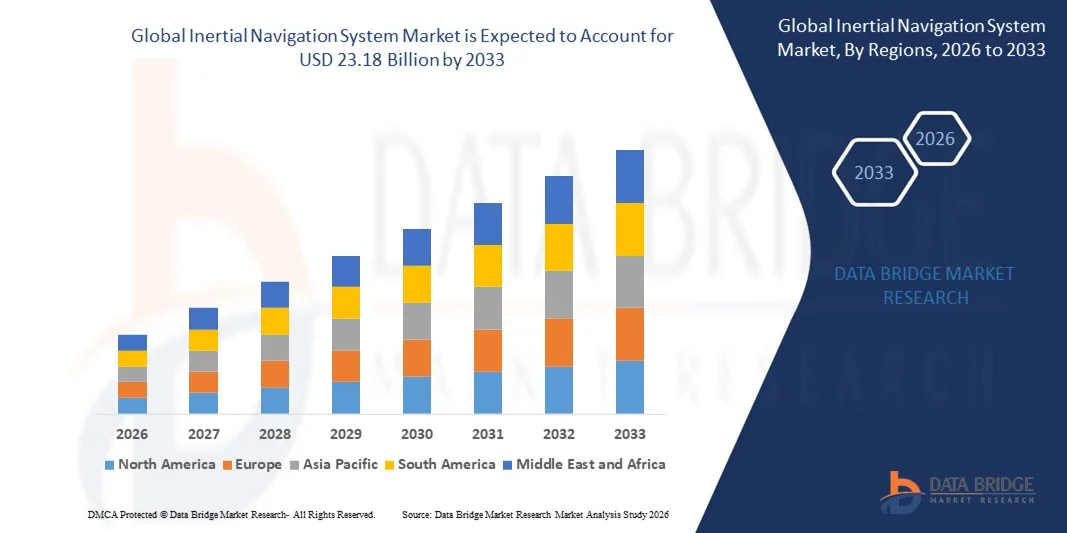
- As per Data Bridge Market Research Analysis the global inertial navigation system market size was valued at USD 14.58 billion in 2025 and is expected to reach USD 23.18 billion by 2033, at a CAGR of 5.97% during the forecast period
- The market growth is largely fueled by the increasing adoption of advanced aerospace, defense, and autonomous platforms, coupled with rapid technological advancements in inertial navigation systems. Continuous innovations in MEMS, fiber optic, and ring laser gyros are enhancing navigation accuracy, reliability, and GPS-independent operations, driving demand across military, aerospace, and commercial applications
- Furthermore, rising investments in autonomous vehicles, UAVs, and marine navigation solutions are creating a strong requirement for precise, resilient, and compact INS units. These converging factors are accelerating the deployment of inertial navigation technologies, thereby significantly boosting the overall market growth
Market Size & Forecast
- Global Market Value (2025): USD 14.58 billion
- Expected Market Value (2033): USD 23.18 billion
- Forecast CAGR (2026–2033): 5.97%
Inertial Navigation System Market Analysis
- Inertial navigation systems, providing precise positioning, velocity, and orientation information without reliance on external signals, are increasingly critical for aircraft, missiles, naval vessels, unmanned platforms, and autonomous vehicles. The integration of INS with GPS, AI, and other advanced navigation technologies enhances operational reliability in GPS-denied or contested environments
- The escalating demand for INS is primarily fueled by defense modernization programs, expansion of aerospace and maritime operations, and the growing deployment of autonomous systems. Increasing emphasis on mission-critical navigation accuracy and resilient guidance systems further drives the adoption of inertial navigation solutions across multiple sectors
- North America dominated the inertial navigation system market with a share of 31.60% in 2025, due to extensive aerospace and defense operations, as well as high adoption of advanced navigation technologies
- Asia-Pacific is expected to be the fastest growing region in the inertial navigation system market during the forecast period due to rising defense spending, aerospace expansion, and technological advancements in countries such as China, India, and Japan
- Ring laser gyro segment dominated the market with a market share of 42.6% in 2025, due to its high accuracy, durability, and minimal drift over time. Ring laser gyros are widely used in aircraft, missiles, and naval vessels where long-term navigation precision is critical. These systems offer advantages such as low maintenance requirements and resistance to mechanical wear, making them suitable for both military and commercial applications
Report Scope and Inertial Navigation System Market Segmentation
|
Attributes |
Inertial Navigation System Key Market Insights |
|
Segments Covered |
|
|
Countries Covered |
North America
Europe
Asia-Pacific
Middle East and Africa
South America
|
|
Key Market Players |
|
|
Market Opportunities |
|
|
Value Added Data Infosets |
In addition to the market insights such as market value, growth rate, market segments, geographical coverage, market players, and market scenario, the market report curated by the Data Bridge Market Research team includes in-depth expert analysis, import/export analysis, pricing analysis, production consumption analysis, and pestle analysis. |
What is the Key Trend in the Inertial Navigation System Market?
Increasing Adoption of Autonomous and Unmanned Platforms
- A key trend in the inertial navigation system market is the growing adoption of autonomous and unmanned platforms across aerospace, defense, and marine sectors, driven by the need for precise navigation in GPS-denied or remote environments. This trend is reinforcing the strategic importance of INS technologies as core enablers for vehicles that require high reliability, accuracy, and resilience in challenging operational conditions
- For instance, Honeywell Aerospace provides advanced INS solutions integrated into unmanned aerial vehicles (UAVs) and autonomous aircraft, supporting precise navigation and stability in complex airspace and remote missions. Such implementations enhance mission efficiency and enable safe operation without dependency on external navigation signals
- The increasing use of autonomous underwater vehicles (AUVs) and drones in exploration, defense, and industrial surveying is driving demand for INS that deliver consistent positioning and orientation data. These applications rely on high-precision sensors to maintain operational continuity where satellite signals are unavailable
- Commercial aviation is leveraging INS technologies in conjunction with GPS and other navigation aids to improve route optimization, flight safety, and operational efficiency. This integration is positioning INS as a critical component in modern avionics systems
- Defense applications are emphasizing INS for missile guidance, naval navigation, and tactical vehicle operations, where accurate positioning under all conditions is crucial. The adoption of INS is supporting mission-critical operations that require uncompromised reliability
- The market is witnessing growth in high-performance navigation systems for land-based autonomous vehicles, where inertial sensors complement GPS to deliver uninterrupted navigation in urban canyons and tunnels. This trend is reinforcing INS as an essential technology for next-generation autonomous mobility platforms
Inertial Navigation System Market Dynamics
Driver
Rising Demand for GPS-Independent Precision Navigation
- The demand for GPS-independent precision navigation is a major driver in the INS market, as industries and defense agencies seek reliable systems capable of functioning in GPS-denied environments, including urban areas, underwater, and contested zones. These requirements are elevating the adoption of INS that provide accurate position, velocity, and orientation data without external signal dependency
- For instance, Northrop Grumman supplies high-precision INS for military aircraft and naval vessels, ensuring mission continuity in GPS-compromised environments. These solutions allow operators to maintain accurate navigation and control during critical operations
- The expansion of unmanned systems, such as autonomous drones and robotic vehicles, is fueling investment in INS that can deliver continuous, real-time navigation data. This is enhancing operational autonomy and reducing vulnerability to signal jamming or loss
- Aviation and aerospace industries are increasingly integrating INS with other navigation aids to improve route efficiency, reduce reliance on ground-based systems, and enhance flight safety. This trend supports both commercial and defense operations in complex airspace
- Emerging applications in mining, oil and gas exploration, and maritime surveying are driving the need for robust INS that can operate independently in remote or hazardous locations. These systems enable precise positioning and improve operational planning, efficiency, and safety
Restraint/Challenge
High Cost and Complexity of Advanced INS Technologies
- The inertial navigation system market faces challenges due to the high cost and technical complexity of advanced inertial navigation system solutions, which require precision sensors, sophisticated algorithms, and robust integration with other navigation systems. These factors limit accessibility for smaller commercial operators and increase deployment expenses
- For instance, KVH Industries manufactures fiber-optic and MEMS-based INS that involve intricate calibration and integration procedures, raising the cost and time required for deployment. Such complexities create barriers to widespread adoption despite the performance advantages
- Developing inertial navigation system with high accuracy over extended periods requires continuous compensation for drift, temperature variations, and mechanical stresses, which adds engineering challenges and increases system complexity
- Production of inertial navigation system involves specialized materials, high-precision manufacturing, and rigorous quality assurance to meet demanding operational standards, contributing to elevated costs
- The market continues to face constraints in balancing affordability with performance, especially for applications in commercial UAVs, autonomous vehicles, and marine platforms. These challenges highlight the need for innovation to reduce costs while maintaining system reliability and accuracy
Inertial Navigation System Market Scope
The market is segmented on the basis of application, technology, grade, and component.
- By Application
On the basis of application, the inertial navigation system market is segmented into aircraft, missiles, space launch vehicles, marine, military armored vehicles, unmanned aerial vehicles, unmanned ground vehicles, and unmanned marine vehicles. The aircraft segment dominated the market with the largest market revenue share in 2025, driven by the critical need for precise navigation and flight stability in both commercial and military aviation. Aircraft INS solutions offer high accuracy and reliability in GPS-denied environments, which is essential for flight safety and mission-critical operations. Airlines and defense operators prioritize INS integration to enhance route optimization, reduce fuel consumption, and maintain precise positional awareness during long-haul flights. The adoption of advanced aircraft navigation systems also supports compliance with international aviation safety standards, further reinforcing demand.
The unmanned aerial vehicle (UAV) segment is anticipated to witness the fastest growth rate from 2026 to 2033, fueled by the rising use of drones in surveillance, logistics, agriculture, and defense applications. UAVs require compact, lightweight, and highly precise INS units to enable autonomous navigation and stable flight control under varying environmental conditions. Companies providing UAV systems increasingly integrate MEMS and fiber optics-based INS for enhanced maneuverability and situational awareness. The growing deployment of UAVs in civilian and military sectors drives demand for rapid, reliable, and low-power navigation solutions, supporting market expansion in this segment.
- By Technology
On the basis of technology, the inertial navigation system market is segmented into mechanical gyro, ring laser gyro, fiber optics gyro, MEMS, and others. The ring laser gyro segment dominated the market with the largest market revenue share of 42.6% in 2025, owing to its high accuracy, durability, and minimal drift over time. Ring laser gyros are widely used in aircraft, missiles, and naval vessels where long-term navigation precision is critical. These systems offer advantages such as low maintenance requirements and resistance to mechanical wear, making them suitable for both military and commercial applications. The established reliability and adoption in aerospace and defense projects drive steady demand for ring laser gyro-based INS.
The MEMS segment is expected to witness the fastest CAGR from 2026 to 2033, driven by its compact size, low cost, and scalability across applications including UAVs, automotive, and consumer electronics. MEMS INS technology provides adequate accuracy for a wide range of applications while enabling lightweight, energy-efficient solutions suitable for portable and unmanned systems. Manufacturers increasingly favor MEMS due to ease of integration with GPS, IoT platforms, and autonomous control systems. Rising adoption in emerging markets and civilian applications further accelerates growth in this segment.
- By Grade
On the basis of grade, the inertial navigation system market is segmented into marine grade, navigation grade, tactical grade, space grade, and commercial grade. The navigation grade segment dominated the market with the largest market revenue share in 2025, supported by its balance of high accuracy and moderate cost, making it suitable for commercial aviation, maritime, and industrial applications. Navigation grade INS provides reliable positional data for complex operations where GPS signals may be intermittent, ensuring uninterrupted navigation. Organizations prefer navigation grade systems for their stability, precision, and ease of integration with other navigation aids and flight control systems. Regulatory compliance and operational efficiency further drive the adoption of navigation grade INS across industries.
The tactical grade segment is anticipated to witness the fastest growth rate from 2026 to 2033, fueled by increasing defense modernization programs and the deployment of advanced armored vehicles and UAVs. Tactical grade INS offers superior precision, low drift, and resilience under extreme conditions, making them essential for mission-critical military applications. The rising emphasis on defense readiness and autonomous systems adoption drives investment in high-performance tactical navigation solutions. Manufacturers focus on developing compact, ruggedized systems capable of rapid deployment across multiple platforms, accelerating growth in this segment.
- By Component
On the basis of component, the inertial navigation system market is segmented into accelerometers, gyroscopes, algorithms, and processors and wireless. The gyroscope segment dominated the market with the largest market revenue share in 2025, driven by its central role in determining angular velocity and maintaining accurate orientation in navigation systems. High-performance gyroscopes are critical in aerospace, maritime, and defense applications to achieve precise navigation even under GPS-denied conditions. The development of advanced gyroscopes with low drift, high sensitivity, and long-term reliability supports the growing demand for accurate INS across commercial and military sectors. Continuous technological improvements enhance the performance and lifespan of gyroscope components, ensuring their dominant market presence.
The algorithms segment is expected to witness the fastest CAGR from 2026 to 2033, fueled by the need for sophisticated data processing and sensor fusion techniques to improve navigation accuracy and system reliability. Advanced algorithms integrate data from multiple sensors, correct errors, and optimize positional computations in real time, supporting autonomous and unmanned platforms. Companies are increasingly investing in AI-enabled INS algorithms for predictive navigation and enhanced situational awareness. The rising reliance on automated and intelligent systems across aerospace, defense, and maritime sectors propels demand for algorithmic components in INS solutions.
Inertial Navigation System Market Regional Analysis
- North America dominated the inertial navigation system market with the largest revenue share of 31.60% in 2025, driven by extensive aerospace and defense operations, as well as high adoption of advanced navigation technologies
- Aerospace and defense companies in the region heavily invest in INS solutions for aircraft, UAVs, and naval vessels to ensure precise navigation and operational reliability in GPS-denied environments
- The region’s strong focus on R&D, technological innovation, and military modernization programs further accelerates demand, establishing North America as a key hub for high-performance navigation systems
U.S. Inertial Navigation System Market Insight
The U.S. inertial navigation system market captured the largest revenue share in 2025 within North America, fueled by widespread defense modernization and commercial aviation growth. Companies prioritize highly accurate, low-drift INS for mission-critical applications in aircraft, missiles, and unmanned systems. Rising investments in autonomous technologies and UAV operations enhance demand, while integration with GPS and advanced avionics systems supports market expansion. Moreover, strong government support and contracts for defense navigation systems continue to propel the U.S. market.
Europe Inertial Navigation System Market Insight
The Europe inertial navigation system market is projected to expand at a substantial CAGR during the forecast period, driven by stringent defense regulations, increased aerospace activities, and a growing need for precision navigation across marine and aviation sectors. European countries are investing in technologically advanced, high-accuracy INS solutions to enhance national security and operational efficiency. The region also emphasizes integration with autonomous vehicles, UAVs, and maritime platforms, boosting demand. Collaborative programs among defense agencies and local manufacturers further stimulate growth in Europe.
U.K. Inertial Navigation System Market Insight
The U.K. inertial navigation system market is anticipated to grow at a noteworthy CAGR, supported by expanding defense modernization and increasing adoption of UAVs and autonomous vehicles. The government’s focus on military readiness and research in advanced navigation technologies drives procurement of high-precision INS solutions. In addition, strong aerospace and maritime sectors in the U.K. promote adoption of INS across various platforms, including aircraft, naval vessels, and armored vehicles. Partnerships between technology providers and defense contractors enhance market penetration and innovation.
Germany Inertial Navigation System Market Insight
The Germany inertial navigation system market is expected to expand at a considerable CAGR, fueled by increasing investments in aerospace, defense, and industrial navigation solutions. Germany’s emphasis on engineering excellence, technological innovation, and precision manufacturing promotes the adoption of advanced inertial navigation system for aircraft, UAVs, and maritime platforms. Integration with autonomous and smart defense systems is becoming prevalent, with a strong focus on reliability, accuracy, and long-term performance. The local demand for navigation solutions aligned with European safety and regulatory standards further supports growth.
Asia-Pacific Inertial Navigation System Market Insight
The Asia-Pacific inertial navigation system market is poised to grow at the fastest CAGR during the forecast period of 2026 to 2033, driven by rising defense spending, aerospace expansion, and technological advancements in countries such as China, India, and Japan. Increasing urbanization and development of autonomous vehicles and UAVs are accelerating adoption of inertial navigation system solutions. The region is also emerging as a manufacturing hub for inertial navigation system components, improving affordability and accessibility. Government initiatives for smart infrastructure and defense modernization further propel market growth in APAC.
Japan Inertial Navigation System Market Insight
The Japan inertial navigation system market is gaining momentum due to advanced aerospace programs, rapid technological adoption, and strong defense initiatives. Japanese companies prioritize high-precision inertial navigation system for aircraft, naval vessels, and UAVs to ensure operational safety and autonomy. Integration with IoT-enabled systems, robotics, and unmanned platforms enhances demand. Moreover, Japan’s aging workforce and need for automated navigation solutions in commercial and defense applications further drive market adoption.
China Inertial Navigation System Market Insight
The China inertial navigation system market accounted for the largest revenue share in Asia-Pacific in 2025, attributed to the country’s rapidly expanding aerospace and defense sectors. China is heavily investing in UAVs, missiles, and naval navigation systems requiring high-accuracy inertial navigation system solutions. The push for smart cities, autonomous vehicles, and domestic technological advancement accelerates adoption. Availability of competitive local manufacturers and government-backed defense projects further propels the inertial navigation system market in China.
Which are the Top Companies in Inertial Navigation System Market?
The inertial navigation system industry is primarily led by well-established companies, including:
- Honeywell International Inc. (U.S.)
- Thales Group (France)
- Northrop Grumman (U.S.)
- Safran (France)
- Raytheon Technologies Corporation (U.S.)
- GENERAL ELECTRIC COMPANY (U.S.)
- Collins Aerospace (U.S.)
- Teledyne Technologies (U.S.)
- VectorNav Technologies, LLC (U.S.)
- Parker-Hannifin Corporation (U.S.)
- Trimble Inc. (U.S.)
- Gladiator Technologies (U.S.)
- iXblue SAS (France)
- INERTIAL SENSE (U.S.)
- Tersus GNSS Inc. (U.S.)
- KVH Industries, Inc. (U.S.)
- EMCORE Corporation (U.S.)
- L3Harris Technologies, Inc. (U.S.)
- TASC Systems (U.S.)
Latest Developments in Global Inertial Navigation System Market
- In February 2026, Safran Electronics & Defense delivered its 2,500th Geonyx inertial navigation system, marking a major milestone in high‑precision navigation deployments for military land platforms. This achievement reinforces the company’s leadership in GNSS‑denied and contested environments, boosting confidence in the reliability of INS solutions. The milestone also signals strong global demand for resilient, mission-critical navigation technologies, further driving innovation and adoption across defense and aerospace applications
- In January 2026, Inertial Labs launched the IRINS LEO‑aided inertial navigation system, which integrates INS with low Earth orbit (LEO) positioning. This development allows continuous, highly accurate positioning even in GPS‑denied environments, enhancing operational capabilities for autonomous vehicles, UAVs, and maritime platforms. The system’s introduction demonstrates the market shift toward hybrid navigation solutions that combine traditional INS with emerging satellite technologies, expanding INS applications in both commercial and defense sectors
- In November 2025, Raytheon Technologies announced a strategic partnership with a leading AI firm to develop next-generation inertial navigation systems integrating machine learning capabilities. This collaboration is expected to significantly influence the INS market by setting a new benchmark for AI-enabled navigation performance, enhancing system accuracy and reliability in complex operational environments. By leveraging AI-driven data analysis and predictive correction algorithms, Raytheon is likely to capture growing demand from defense and aerospace clients seeking cutting-edge, autonomous navigation solutions, thereby strengthening its market leadership and driving broader adoption of intelligent INS technologies
- In October 2025, Lockheed Martin unveiled a new line of inertial navigation systems specifically designed for unmanned aerial vehicles (UAVs). This product launch is poised to impact the UAV navigation segment of the INS market by addressing the unique requirements of autonomous and remotely piloted platforms, including weight constraints, extended operational range, and precision positioning. Lockheed Martin’s focus on tailored solutions is likely to accelerate the adoption of advanced INS in commercial and defense UAV applications, enabling the company to expand its market share in this high-growth niche and reinforce its competitive positioning against other global players
- In September 2025, Thales Group completed the acquisition of a specialized tech firm focused on advanced sensor technologies. This strategic move is set to influence the INS market by enhancing Thales’s technological capabilities, allowing it to offer more sophisticated and high-precision navigation systems for both civilian and military applications. By integrating advanced sensors into its product portfolio, Thales can better meet increasing market demand for reliable and accurate INS solutions, supporting growth in sectors requiring GPS-independent navigation and strengthening its overall market presence in high-performance navigation systems

- Interactive Data Analysis Dashboard
- Company Analysis Dashboard for high growth potential opportunities
- Research Analyst Access for customization & queries
- Competitor Analysis with Interactive dashboard
- Latest News, Updates & Trend analysis
- Harness the Power of Benchmark Analysis for Comprehensive Competitor Tracking
Data collection and base year analysis are done using data collection modules with large sample sizes. The stage includes obtaining market information or related data through various sources and strategies. It includes examining and planning all the data acquired from the past in advance. It likewise envelops the examination of information inconsistencies seen across different information sources. The market data is analysed and estimated using market statistical and coherent models. Also, market share analysis and key trend analysis are the major success factors in the market report. To know more, please request an analyst call or drop down your inquiry.
The key research methodology used by DBMR research team is data triangulation which involves data mining, analysis of the impact of data variables on the market and primary (industry expert) validation. Data models include Vendor Positioning Grid, Market Time Line Analysis, Market Overview and Guide, Company Positioning Grid, Patent Analysis, Pricing Analysis, Company Market Share Analysis, Standards of Measurement, Global versus Regional and Vendor Share Analysis. To know more about the research methodology, drop in an inquiry to speak to our industry experts.
Data Bridge Market Research is a leader in advanced formative research. We take pride in servicing our existing and new customers with data and analysis that match and suits their goal. The report can be customized to include price trend analysis of target brands understanding the market for additional countries (ask for the list of countries), clinical trial results data, literature review, refurbished market and product base analysis. Market analysis of target competitors can be analyzed from technology-based analysis to market portfolio strategies. We can add as many competitors that you require data about in the format and data style you are looking for. Our team of analysts can also provide you data in crude raw excel files pivot tables (Fact book) or can assist you in creating presentations from the data sets available in the report.













