


What is the Inertial Sensor Market Size and Overview?
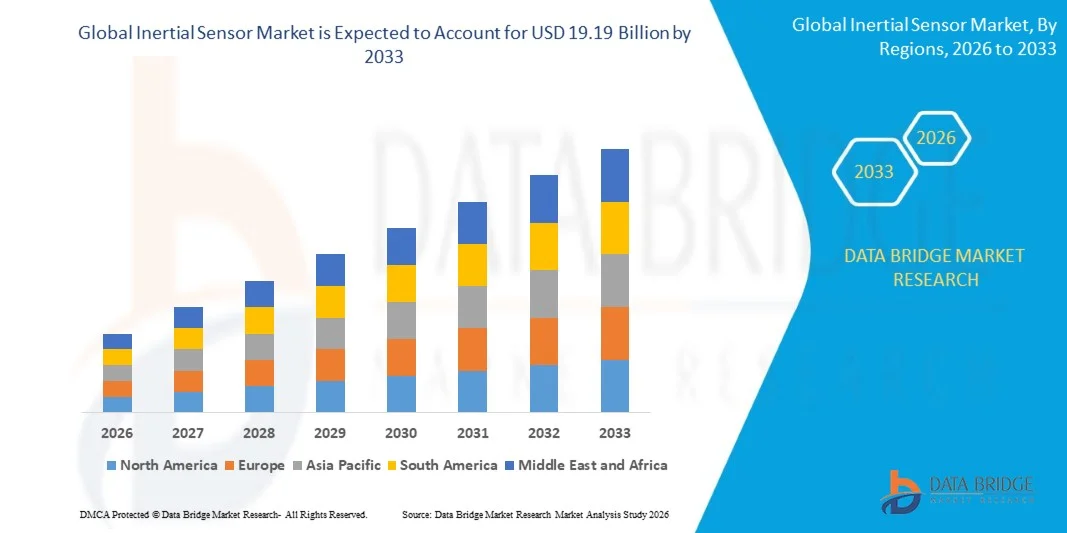
As per Data Bridge Market Research analysis, the inertial sensor market was valued at USD 12.60 billion in 2025 and is projected to reach USD 19.19 billion by 2033, growing at a CAGR of 5.41% from 2026 to 2033. The market is witnessing steady growth driven by increasing adoption of MEMS-based sensing technologies, rising demand for precision navigation and motion tracking systems, and expanding applications across automotive, aerospace, industrial automation, and consumer electronics.
The growing deployment of advanced driver assistance systems (ADAS), autonomous vehicles, unmanned aerial vehicles (UAVs), and connected industrial equipment is accelerating demand for highly accurate inertial sensors. In addition, continuous advancements in sensor miniaturization, low-power designs, and improved performance are enabling broader integration into wearable devices, robotics, medical equipment, and Internet of Things (IoT) applications, supporting sustained market expansion worldwide.
Market Size & Forecast
- Market Value (2025): USD 12.60 Billion
- Expected Market Value (2033): USD 19.19 Billion
- Forecast CAGR (2026–2033): 5.41%
- Leading Region in 2025: North America
- Fastest Growing Region: Asia-Pacific
Key Market Trends & Insights
- North America dominated the inertial sensor market with the largest revenue share in 2025, supported by strong demand from the aerospace, defense, automotive, and industrial automation sectors. The region benefits from significant investments in advanced navigation technologies, autonomous systems, and precision-guided defense equipment.
- Asia-Pacific inertial sensor market is expected to witness the fastest growth rate from 2026 to 2033, supported by rapid industrialization, expanding consumer electronics production, rising vehicle manufacturing, and increasing investments in aerospace and defense across China, Japan, South Korea, and India.
- The inertial measurement units (IMUs) segment accounted for the largest market revenue share in 2025, driven by their widespread deployment across automotive, aerospace, industrial automation, robotics, consumer electronics, and unmanned systems. IMUs integrate accelerometers and gyroscopes into a compact sensing unit, enabling accurate motion tracking, stabilization, and navigation for advanced driver assistance systems (ADAS), drones, wearable devices, and industrial machinery.
- The inertial navigation systems/inertial navigation Units (INUs) segment is projected to register the fastest CAGR from 2026 to 2033, driven by increasing investments in autonomous vehicles, defense modernization, commercial aviation, and GPS-denied navigation applications. Growing demand for high-precision navigation systems in military platforms, unmanned aerial vehicles (UAVs), and marine vessels is accelerating segment growth.
- The accelerometers segment accounted for the largest market revenue share in 2025 owing to their extensive use in smartphones, wearable devices, automotive safety systems, industrial monitoring equipment, and medical devices. Rising adoption of MEMS accelerometers for motion sensing, vibration monitoring, and condition-based maintenance continues to strengthen the segment's market position.
- The gyroscopes segment is anticipated to witness the fastest CAGR from 2026 to 2033, driven by growing demand for precision angular motion sensing across autonomous vehicles, aerospace navigation, robotics, defense equipment, and advanced industrial automation. Continuous technological advancements in MEMS gyroscope performance and sensor fusion capabilities are further supporting segment expansion.
Report Scope and Inertial Sensor Market Segmentation
|
Attributes |
Inertial Sensor Key Market Insights |
|
Segments Covered |
|
|
Countries Covered |
North America
Europe
Asia-Pacific
Middle East and Africa
South America
|
|
Key Market Players |
|
|
Market Opportunities |
|
|
Value Added Data Infosets |
In addition to the insights on market scenarios such as market value, growth rate, segmentation, geographical coverage, and major players, the market reports curated by the Data Bridge Market Research also include in-depth expert analysis, geographically represented company-wise production and capacity, network layouts of distributors and partners, detailed and updated price trend analysis and deficit analysis of supply chain and demand. |
What is the Key Trend in the Inertial Sensor Market?
Trend: Growing Adoption Of MEMS-Based Inertial Sensors Across Autonomous And Smart Connected Systems
The increasing deployment of autonomous vehicles, industrial automation, robotics, drones, and advanced navigation platforms is accelerating the adoption of MEMS-based inertial sensors worldwide. Manufacturers are focusing on compact, lightweight, and energy-efficient accelerometers and gyroscopes capable of delivering highly accurate motion sensing, stabilization, and positioning for increasingly connected applications. Continuous advancements in sensor fusion and AI-assisted navigation are further enhancing inertial sensor performance across automotive, aerospace, industrial, and defense sectors.
The rapid expansion of GPS-denied navigation applications, autonomous mobility, and unmanned systems is creating sustained demand for high-performance inertial measurement units (IMUs). For instance, in June 2025, Honeywell introduced the HG3900 Inertial Measurement Unit (IMU), a next-generation tactical-grade MEMS IMU designed for autonomous vehicles, defense platforms, robotics, and precision navigation. The HG3900 delivers significantly higher accuracy while reducing size, weight, and power consumption, reflecting the industry's continued investment in advanced MEMS inertial sensing technologies.
The growing adoption of advanced MEMS inertial sensing technologies and continued investments in autonomous navigation systems are expected to reinforce long-term demand for inertial sensors across multiple high-growth industries.
Inertial Sensor Market Dynamics
Key Market Driver: Increasing Deployment Of ADAS, Autonomous Systems, And Industrial Automation
The shift toward autonomous mobility, intelligent manufacturing, connected infrastructure, and advanced robotics is significantly increasing demand for inertial sensors capable of delivering precise motion detection, stabilization, and navigation. Automotive manufacturers, aerospace companies, industrial equipment suppliers, and robotics developers are increasingly integrating inertial sensors into advanced driver assistance systems (ADAS), drones, industrial robots, and smart machinery to improve positioning accuracy, operational safety, and system reliability.
For instance, in January 2025, Bosch Sensortec launched the BMI323 inertial measurement unit, combining a high-performance accelerometer and gyroscope for wearable devices, industrial IoT equipment, navigation systems, and robotics. The new sensor offers improved motion tracking, low power consumption, and enhanced reliability, supporting the growing deployment of intelligent motion sensing technologies across industrial and consumer applications.
As autonomous technologies, smart manufacturing, and intelligent navigation systems continue expanding, inertial sensor manufacturers are expected to benefit from sustained demand driven by higher accuracy requirements, increasing automation, and widespread digital transformation.
Key Restraint/Challenge: High Design Complexity And Performance Requirements In Harsh Operating Environments
Manufacturers of inertial sensors continue to face challenges associated with maintaining high accuracy under vibration, extreme temperatures, electromagnetic interference, and long operating cycles. Aerospace, defense, industrial automation, and autonomous vehicle applications require inertial sensors capable of delivering exceptional stability, minimal drift, and reliable long-term calibration, increasing research, development, testing, and manufacturing costs.
For instance, in July 2025, STMicroelectronics announced an agreement to acquire NXP Semiconductors' MEMS sensor business for up to US$950 million. The acquisition is intended to strengthen STMicroelectronics' automotive, industrial, and consumer MEMS sensor portfolio while expanding manufacturing capabilities. The transaction reflects the increasing investment and technological complexity required to remain competitive in the MEMS and inertial sensor industry, where companies are pursuing acquisitions to strengthen product portfolios and achieve economies of scale.
Despite robust market demand, stringent performance requirements, high development costs, and the technical complexities associated with ensuring long-term accuracy and reliability are expected to remain significant restraints, posing challenges to widespread deployment across mission-critical applications throughout the forecast period.
Key Market Opportunity: Expansion Of Autonomous Mobility, Robotics, And GPS-Resilient Navigation Systems
Governments, defense organizations, and technology companies are accelerating investments in autonomous transportation, unmanned systems, industrial robotics, and resilient navigation technologies, creating significant long-term opportunities for inertial sensor manufacturers. As GPS jamming and spoofing become increasingly important operational concerns, demand is growing for high-performance MEMS inertial sensors capable of maintaining accurate positioning and navigation independently of satellite signals.
For instance, in February 2025, Safran Electronics & Defense introduced the Geonyx M inertial navigation system, a compact navigation solution designed for land defense platforms and autonomous systems operating in GNSS-denied environments.
The launch strengthens the industry's focus on resilient navigation technologies and creates new opportunities for advanced inertial sensing solutions across military and autonomous mobility applications.
How is the Inertial Sensor Market Segmented?
The market is segmented on the basis of type, component, and application.
- By Type
On the basis of type, the inertial sensor market is segmented into attitude heading and reference systems (AHRS), inertial navigation systems/inertial navigation units (INUs), and inertial measurement units (IMUs). The inertial measurement units (IMUs) segment accounted for the largest market revenue share in 2025, driven by their widespread deployment across automotive, aerospace, industrial automation, robotics, consumer electronics, and unmanned systems. IMUs integrate accelerometers and gyroscopes into a compact sensing unit, enabling accurate motion tracking, stabilization, and navigation for advanced driver assistance systems (ADAS), drones, wearable devices, and industrial machinery.
The inertial navigation systems/inertial navigation units (INUs) segment is projected to register the fastest CAGR from 2026 to 2033, driven by increasing investments in autonomous vehicles, defense modernization, commercial aviation, and GPS-denied navigation applications. Growing demand for high-precision navigation systems in military platforms, unmanned aerial vehicles (UAVs), and marine vessels is accelerating segment growth.
- By Component
On the basis of component, the inertial sensor market is segmented into Accelerometers, Gyroscopes, encoders, magnetic sensor, and GPS. The Accelerometers segment accounted for the largest market revenue share in 2025 owing to their extensive use in smartphones, wearable devices, automotive safety systems, industrial monitoring equipment, and medical devices. Rising adoption of MEMS accelerometers for motion sensing, vibration monitoring, and condition-based maintenance continues to strengthen the segment's market position.
The gyroscopes segment is anticipated to witness the fastest CAGR from 2026 to 2033, driven by growing demand for precision angular motion sensing across autonomous vehicles, aerospace navigation, robotics, defense equipment, and advanced industrial automation. Continuous technological advancements in MEMS gyroscope performance and sensor fusion capabilities are further supporting segment expansion.
- By Application
On the basis of application, the inertial sensor market is segmented into transport, agriculture, healthcare, devices & machinery, air force, navy & military, and aerospace. The Transport segment accounted for the largest market revenue share in 2025, driven by increasing integration of inertial sensors into passenger vehicles, commercial vehicles, rail transportation, and autonomous mobility platforms. Growing adoption of ADAS, electronic stability control (ESC), navigation systems, and vehicle safety technologies continues to support strong demand across the transportation sector.
The aerospace segment is expected to register the fastest CAGR from 2026 to 2033, supported by rising investments in commercial aircraft, satellites, space exploration missions, unmanned aerial vehicles (UAVs), and advanced defense navigation systems. Increasing demand for highly accurate inertial navigation and flight control systems is expected to drive significant market growth throughout the forecast period.
Which Region Holds the Largest Share of the Inertial Sensor Market?
North America Inertial Sensor Market Insight
North America dominated the inertial sensor market with the largest revenue share in 2025, supported by strong demand from the aerospace, defense, automotive, and industrial automation sectors. The region benefits from significant investments in advanced navigation technologies, autonomous systems, and precision-guided defense equipment. The presence of leading MEMS sensor manufacturers, increasing deployment of advanced driver assistance systems (ADAS), and continued government spending on military modernization further strengthen North America's leadership in the inertial sensor market.
U.S. Inertial Sensor Market Insight
The U.S. inertial sensor market captured the largest revenue share in 2025 within North America, fueled by growing adoption of autonomous vehicles, unmanned aerial vehicles (UAVs), commercial aviation, and defense navigation systems. Rising investments in robotics, industrial automation, and space exploration, coupled with the presence of major semiconductor and aerospace companies, continue to accelerate demand for high-performance inertial sensors. Increasing deployment of MEMS-based accelerometers and gyroscopes across automotive safety and intelligent manufacturing applications further supports market expansion.
Europe Inertial Sensor Market Insight
The Europe inertial sensor market is expected to witness a significant growth rate from 2026 to 2033, primarily driven by increasing investments in automotive electrification, industrial automation, aerospace innovation, and defense modernization. The region's strong manufacturing base, combined with growing adoption of Industry 4.0 technologies and autonomous mobility solutions, is accelerating demand for precision inertial sensing technologies. Rising research and development activities across navigation, robotics, and advanced manufacturing further contribute to regional market growth.
U.K. Inertial Sensor Market Insight
The U.K. inertial sensor market is expected to witness a significant growth rate from 2026 to 2033, driven by increasing investments in aerospace engineering, defense technologies, and autonomous mobility solutions. Growing deployment of unmanned systems, advanced navigation equipment, and intelligent transportation infrastructure is supporting demand for high-precision inertial sensors. Continued government support for innovation in robotics and space technologies is also expected to contribute to market expansion.
Germany Inertial Sensor Market Insight
The Germany inertial sensor market is expected to witness a significant growth rate from 2026 to 2033, fueled by the country's strong automotive manufacturing sector and leadership in industrial automation. Increasing integration of inertial sensors into electric vehicles, ADAS platforms, robotics, and smart factory equipment is driving market growth. Germany's continued focus on engineering excellence, precision manufacturing, and Industry 4.0 initiatives further supports adoption of advanced MEMS inertial sensing technologies.
Asia-Pacific Inertial Sensor Market Insight
The Asia-Pacific inertial sensor market is expected to witness the fastest growth rate from 2026 to 2033, supported by rapid industrialization, expanding consumer electronics production, rising vehicle manufacturing, and increasing investments in aerospace and defense across China, Japan, South Korea, and India. The region's leadership in semiconductor manufacturing, growing robotics industry, and accelerating deployment of autonomous technologies are creating strong demand for inertial sensors across multiple end-use industries.
Japan Inertial Sensor Market Insight
The Japan inertial sensor market is expected to witness a significant growth rate from 2026 to 2033 due to the country's leadership in robotics, precision manufacturing, and advanced automotive technologies. Increasing adoption of industrial robots, autonomous vehicles, medical devices, and consumer electronics is driving demand for high-performance MEMS inertial sensors. Strong innovation in semiconductor technologies and continued investments in smart manufacturing are expected to further strengthen market growth.
China Inertial Sensor Market Insight
The China inertial sensor market accounted for the largest market revenue share in Asia-Pacific in 2025, attributed to the country's extensive electronics manufacturing ecosystem, expanding automotive production, and growing investments in autonomous driving, aerospace, and industrial automation. China continues to strengthen domestic semiconductor manufacturing while rapidly expanding applications of inertial sensors across smartphones, drones, electric vehicles, robotics, and intelligent manufacturing systems. Government support for high-end manufacturing and smart industrial development further accelerates market growth.
Which are the Top Companies in the Inertial Sensor Market?
The inertial sensor industry is primarily led by well-established companies, including:
- Honeywell International Inc. (U.S.)
- Analog Devices, Inc. (U.S.)
- STMicroelectronics N.V. (Switzerland)
- Bosch Sensortec GmbH (Germany)
- TDK Corporation (Japan)
- TE Connectivity Ltd. (Switzerland)
- Murata Manufacturing Co., Ltd. (Japan)
- Panasonic Holdings Corporation (Japan)
- Texas Instruments Incorporated (U.S.)
- Safran Electronics & Defense (France)
- Northrop Grumman Corporation (U.S.)
- KVH Industries, Inc. (U.S.)
- Collins Aerospace (U.S.)
- RTX Corporation (U.S.)
- Exail SAS (France)
What are Latest Developments in the Inertial Sensor Market?
- July 2025, STMicroelectronics announced the acquisition of part of NXP Semiconductors' MEMS sensor business for up to US$950 million to strengthen its portfolio of MEMS-based sensors for automotive safety, industrial monitoring, and consumer applications. The acquisition expands STMicroelectronics' manufacturing capabilities and product offerings, enabling the company to address growing demand for advanced inertial sensing technologies while strengthening competition and innovation in the inertial sensor market.
- June 2024, STMicroelectronics launched the ISM330BX, an energy-efficient 6-axis inertial measurement unit (IMU) designed for industrial automation, robotics, and machine condition monitoring. The new IMU integrates edge AI processing, low-noise sensing, and long-term product support, enabling more accurate vibration analysis and predictive maintenance while supporting the growing adoption of intelligent industrial equipment and Industry 4.0 applications.
- May 2024, STMicroelectronics introduced the ASM330LHBG1 automotive-grade inertial module with functional safety support for advanced driver assistance systems (ADAS), vehicle navigation, and automated driving applications. The solution delivers high accuracy and reliability for safety-critical automotive systems, helping vehicle manufacturers accelerate the deployment of next-generation mobility technologies and increasing demand for automotive inertial sensors.
- November 2023, STMicroelectronics introduced the ASM330LHHXG1, an AI-enabled automotive inertial measurement unit designed for telematics, navigation assistance, theft prevention, and motion-activated vehicle functions. The new low-power IMU improves sensing accuracy and enables always-on vehicle awareness, supporting the increasing integration of intelligent motion sensing technologies in connected and autonomous vehicles.
- November 2022, STMicroelectronics launched the LSM6DSV16X, a next-generation 6-axis inertial measurement unit featuring embedded sensor fusion, artificial intelligence, and adaptive power optimization. The device enhances motion tracking, gesture recognition, and always-on activity monitoring for smartphones, XR headsets, laptops, and consumer electronics while extending battery life, reinforcing the growing adoption of intelligent MEMS inertial sensors across consumer devices.

- Interactive Data Analysis Dashboard
- Company Analysis Dashboard for high growth potential opportunities
- Research Analyst Access for customization & queries
- Competitor Analysis with Interactive dashboard
- Latest News, Updates & Trend analysis
- Harness the Power of Benchmark Analysis for Comprehensive Competitor Tracking
Global Inertial Sensor Market, Supply Chain Analysis and Ecosystem Framework
To support market growth and help clients navigate the impact of geopolitical shifts, DBMR has integrated in-depth supply chain analysis into its Global Inertial Sensor Market research reports. This addition empowers clients to respond effectively to global changes affecting their industries. The supply chain analysis section includes detailed insights such as Global Inertial Sensor Market consumption and production by country, price trend analysis, the impact of tariffs and geopolitical developments, and import and export trends by country and HSN code. It also highlights major suppliers with data on production capacity and company profiles, as well as key importers and exporters. In addition to research, DBMR offers specialized supply chain consulting services backed by over a decade of experience, providing solutions like supplier discovery, supplier risk assessment, price trend analysis, impact evaluation of inflation and trade route changes, and comprehensive market trend analysis.
Data collection and base year analysis are done using data collection modules with large sample sizes. The stage includes obtaining market information or related data through various sources and strategies. It includes examining and planning all the data acquired from the past in advance. It likewise envelops the examination of information inconsistencies seen across different information sources. The market data is analysed and estimated using market statistical and coherent models. Also, market share analysis and key trend analysis are the major success factors in the market report. To know more, please request an analyst call or drop down your inquiry.
The key research methodology used by DBMR research team is data triangulation which involves data mining, analysis of the impact of data variables on the market and primary (industry expert) validation. Data models include Vendor Positioning Grid, Market Time Line Analysis, Market Overview and Guide, Company Positioning Grid, Patent Analysis, Pricing Analysis, Company Market Share Analysis, Standards of Measurement, Global versus Regional and Vendor Share Analysis. To know more about the research methodology, drop in an inquiry to speak to our industry experts.
Data Bridge Market Research is a leader in advanced formative research. We take pride in servicing our existing and new customers with data and analysis that match and suits their goal. The report can be customized to include price trend analysis of target brands understanding the market for additional countries (ask for the list of countries), clinical trial results data, literature review, refurbished market and product base analysis. Market analysis of target competitors can be analyzed from technology-based analysis to market portfolio strategies. We can add as many competitors that you require data about in the format and data style you are looking for. Our team of analysts can also provide you data in crude raw excel files pivot tables (Fact book) or can assist you in creating presentations from the data sets available in the report.













