




Global Influenza Diagnostics Market
Market Size in USD Million
CAGR :
% 
 USD
971.75 Million
USD
1,631.33 Million
2025
2033
USD
971.75 Million
USD
1,631.33 Million
2025
2033
 Forecast Period Forecast Period |
2026 - 2033 |
 Market Size (Base Year) Market Size (Base Year) |
USD 971.75 Million |
 Market Size (Forecast Year) Market Size (Forecast Year) |
USD 1,631.33 Million |
 CAGR CAGR |
% |
| Major Markets Players |
|
Influenza Diagnostics Market Overview
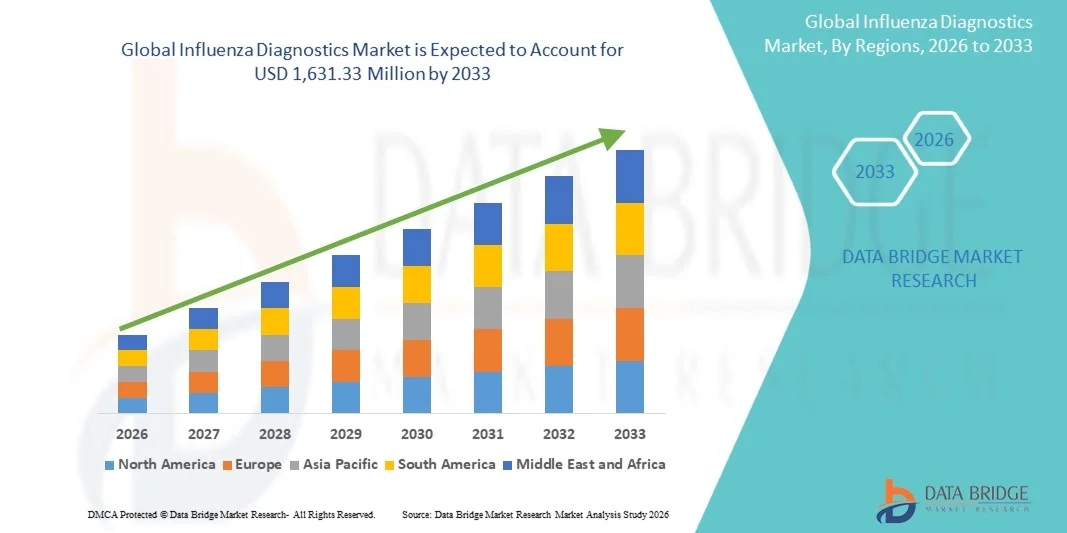
The Influenza Diagnostics Market was valued at USD 971.75 million in 2025 and is projected to reach USD 1,631.33 million by 2033, growing at a CAGR of 6.69% from 2026 to 2033. The market is witnessing steady growth driven by the rising prevalence of seasonal influenza infections, increasing awareness regarding early disease detection, and continuous advancements in rapid molecular diagnostic technologies.
The growing burden of respiratory infectious diseases worldwide, coupled with government-led surveillance programs and expanding vaccination initiatives, is encouraging hospitals, diagnostic laboratories, and point-of-care centers to adopt advanced influenza testing solutions. Rapid antigen tests, RT-PCR assays, and multiplex molecular diagnostics are increasingly replacing conventional laboratory methods in several healthcare settings, offering faster, accurate, and cost-effective detection for timely clinical decision-making and outbreak management.
Key Market Trends & Insights
- North America dominated the Influenza Diagnostics Market with the largest revenue share of 38.26% in 2025, supported by advanced healthcare infrastructure, strong disease surveillance systems, and high adoption of molecular diagnostic technologies.
- The Test Kits segment led the market with a 62.48% share in 2025, driven by the widespread use of rapid influenza diagnostic tests and molecular assay kits across hospitals, clinics, and laboratories.
- Asia-Pacific is expected to be the fastest-growing region at a CAGR of 7.4% from 2026 to 2033, fueled by rising healthcare expenditure, growing awareness regarding infectious disease management, and expanding diagnostic access across China, India, and Southeast Asia.
- Instruments are the fastest-growing product type, projected to register a CAGR of 7.1%, reflecting the surge in adoption of automated molecular diagnostic systems and high-throughput analyzers.
- The Molecular Diagnostic Tests segment dominated the test category with a 48.37% revenue share in 2025, led by superior sensitivity, specificity, and faster detection capabilities compared to conventional diagnostic methods.
- Type A Flu accounted for 56.84% of the market, preferred by the higher prevalence and greater clinical severity associated with influenza A infections globally.
- The INAAT-NASBAT segment is the fastest-growing molecular category, with a CAGR of 7.0%, driven by increasing demand for rapid isothermal amplification technologies in decentralized diagnostic settings.
Market Size & Forecast
- Global Market Value (2025): USD 971.75 Million
- Expected Market Value (2033): USD 1,631.33 Million
- Forecast CAGR (2026–2033): 6.69%
- Leading Region in 2025: North America
- Fastest Growing Region: Asia Pacific
Report Scope and Influenza Diagnostics Market Segmentation
|
Attributes |
Influenza Diagnostics Key Market Insights |
|
Segments Covered |
|
|
Countries Covered |
North America · U.S. · Canada · Mexico Europe · Germany · France · U.K. · Netherlands · Switzerland · Belgium · Russia · Italy · Spain · Turkey · Rest of Europe Asia-Pacific · China · Japan · India · South Korea · Singapore · Malaysia · Australia · Thailand · Indonesia · Philippines · Rest of Asia-Pacific Middle East and Africa · Saudi Arabia · U.A.E. · South Africa · Egypt · Israel · Rest of Middle East and Africa South America · Brazil · Argentina · Rest of South America |
|
Key Market Players |
· F. Hoffmann-La Roche Ltd (Switzerland) · Abbott (U.S.) · QIAGEN (Netherlands) · BIOMÉRIEUX (France) · BD (U.S.) · Siemens Healthineers AG (Germany) · Thermo Fisher Scientific Inc. (U.S.) · Danaher Corporation (U.S.) · QuidelOrtho Corporation (U.S.) · Hologic, Inc. (U.S.) · Sekisui Diagnostics, LLC (U.S.) · DiaSorin S.p.A. (Italy) · SD BIOSENSOR, INC. (South Korea) · Sysmex Corporation (Japan) · Trinity Biotech plc (Ireland) · Werfen (Spain) · OraSure Technologies, Inc. (U.S.) · GenMark Diagnostics, Inc. (U.S.) · Luminex Corporation (U.S.) · Seegene Inc. (South Korea) |
|
Market Opportunities |
· Expanding adoption of multiplex respiratory panels in hospitals and diagnostic laboratories · Growing demand for rapid point-of-care influenza testing · Increasing government investments in pandemic preparedness and infectious disease surveillance |
|
Value Added Data Infosets |
In addition to the insights on market scenarios such as market value, growth rate, segmentation, geographical coverage, and major players, the market reports curated by the Data Bridge Market Research also include in-depth expert analysis, patient epidemiology, pipeline analysis, pricing analysis, and regulatory framework. |
Influenza Diagnostics Market Trends
Trend: Rising Adoption of Rapid Point-of-Care Molecular Testing
Healthcare providers are increasingly adopting rapid point-of-care influenza diagnostic solutions to improve early disease detection, reduce hospital burden, and enable timely treatment decisions without dependence on centralized laboratory infrastructure. The integration of portable molecular platforms and AI-assisted diagnostic interpretation enables faster clinical workflows and improves testing accessibility across emergency departments, retail clinics, and remote healthcare settings. Hospitals and public health agencies are similarly utilizing multiplex respiratory panels to simultaneously identify influenza and other viral infections through standardized, high-accuracy diagnostic protocols, while connected digital health systems support real-time epidemiological monitoring and outbreak response coordination. For instance, in January 2025, Roche expanded its molecular point-of-care respiratory testing portfolio with enhanced influenza and RSV detection capabilities designed for decentralized healthcare environments.
Influenza Diagnostics Market Dynamics
Key Market Driver: Increasing Demand for Early and Accurate Infectious Disease Detection
The rising prevalence of seasonal influenza outbreaks and respiratory infections has created substantial demand for advanced influenza diagnostics that can deliver rapid, accurate, and scalable disease identification across hospitals and decentralized care settings. Healthcare providers, diagnostic laboratories, and public health organizations are deploying molecular and antigen-based testing platforms as a critical component of infectious disease management strategies, improving patient outcomes, reducing transmission risks, and supporting efficient clinical decision-making. For instance, in September 2024, Abbott strengthened its rapid diagnostics portfolio by introducing expanded respiratory testing capabilities supporting faster influenza detection in point-of-care healthcare facilities.
Key Restraint/Challenge: High Cost of Advanced Molecular Diagnostic Technologies
A significant restraint in the Influenza Diagnostics Market is the high implementation cost associated with advanced molecular diagnostic systems. Modern testing platforms integrate automated analyzers, multiplex assay technologies, and digital reporting systems, requiring considerable investment in procurement, laboratory integration, and continuous operational maintenance. The total cost burden further extends to consumables, software upgrades, regulatory compliance, and skilled workforce training, limiting adoption among smaller healthcare facilities and resource-constrained regions.
For instance, in November 2024, bioMérieux highlighted increased operational investments linked to expanding high-throughput molecular diagnostic infrastructure for respiratory infection surveillance programs.
Key Market Opportunity: Expansion of Multiplex and AI-Enabled Diagnostic Platforms
The integration of artificial intelligence and multiplex molecular diagnostics in influenza testing presents a significant market opportunity. AI-enabled platforms can support automated result interpretation, predictive outbreak analysis, and optimized clinical workflows, while multiplex technologies enable simultaneous detection of influenza and multiple respiratory pathogens through a single testing process. The development of portable molecular systems and cloud-connected diagnostic networks is further expanding testing accessibility, creating growth opportunities across underserved healthcare markets in Asia-Pacific, Latin America, and the Middle East. For instance, in March 2025, QIAGEN advanced its syndromic testing portfolio with AI-supported respiratory diagnostic solutions designed for integrated influenza and infectious disease management applications.
Influenza Diagnostics Market Scope
The influenza diagnostics market is segmented on the basis of product, test, type, molecular technology, and end-use.
- By Product
On the basis of product, the Influenza Diagnostics Market is segmented into test kits and instruments. The Test Kits segment dominated the market with a 62.48% share in 2025, owing to the widespread use of rapid influenza diagnostic tests and molecular assay kits across hospitals, clinics, and laboratories. These kits provide faster turnaround times and support early disease detection, which is critical for effective treatment and infection control. Increasing prevalence of seasonal influenza outbreaks and rising awareness regarding timely diagnosis are significantly supporting segment growth. Test kits are also highly preferred due to their portability, ease of use, and compatibility with point-of-care settings. Continuous product innovation and regulatory approvals for advanced multiplex testing kits are further strengthening market demand. Their cost-effectiveness and large-scale applicability continue to make them the leading product category globally.
The Instruments segment is projected to witness the fastest growth at a CAGR of 7.1% from 2026 to 2033, driven by increasing adoption of automated molecular diagnostic systems and high-throughput analyzers. These instruments improve testing efficiency, reduce manual errors, and support accurate large-volume influenza screening. Growing investments in laboratory automation and infectious disease surveillance programs are accelerating adoption across healthcare facilities. Technological advancements in PCR platforms and integrated diagnostic systems are further enhancing operational capabilities. Rising demand for centralized laboratory testing and multiplex respiratory pathogen detection is also contributing to segment expansion. Increasing healthcare infrastructure modernization across emerging economies is expected to further support long-term growth.
- By Test
On the basis of test, the Influenza Diagnostics Market is segmented into traditional diagnostic test, molecular diagnostic tests, and other molecular test. The Molecular Diagnostic Tests segment dominated the market with a 48.37% share in 2025, driven by superior sensitivity, specificity, and faster detection capabilities compared to conventional diagnostic methods. These tests are extensively used for accurate identification of influenza viruses in hospitals, public health laboratories, and diagnostic centers. Increasing demand for rapid and reliable infectious disease diagnosis is significantly boosting adoption. Molecular tests also support early treatment decisions and outbreak containment strategies. Continuous advancements in RT-PCR and multiplex assay technologies are improving testing accuracy and workflow efficiency. Their growing role in pandemic preparedness and respiratory disease surveillance continues to strengthen market dominance.
The Other Molecular Test segment is expected to register the fastest growth at a CAGR of 7.3% from 2026 to 2033, fueled by increasing development of innovative nucleic acid amplification technologies and portable molecular platforms. These advanced testing approaches provide rapid results with improved operational flexibility in decentralized healthcare environments. Rising focus on point-of-care molecular diagnostics and home-based testing solutions is driving demand across healthcare systems. Technological progress in miniaturized diagnostic devices is further enhancing accessibility and adoption. Expanding use in remote and resource-limited settings is also contributing to market growth. Increasing investment in next-generation diagnostic research is expected to accelerate future expansion of this segment.
- By Type
On the basis of type, the Influenza Diagnostics Market is segmented into type A flu, type B flu, and type C flu. The Type A Flu segment dominated the market with a 56.84% share in 2025, owing to the higher prevalence and greater clinical severity associated with influenza A infections globally. Type A viruses are responsible for most seasonal influenza outbreaks and pandemic events, leading to significantly higher testing demand. Healthcare providers prioritize early detection of influenza A due to its rapid transmission and elevated hospitalization risk. Increasing surveillance initiatives and vaccination monitoring programs are further strengthening diagnostic demand for this segment. Molecular and rapid antigen tests specifically targeting influenza A are widely available across healthcare facilities. The segment continues to benefit from ongoing public health focus on epidemic preparedness and respiratory infection management.
The Type B Flu segment is projected to witness the fastest growth at a CAGR of 6.9% from 2026 to 2033, driven by increasing recognition of its seasonal disease burden and expanding testing inclusion within multiplex respiratory panels. Rising awareness regarding influenza B complications among pediatric and elderly populations is supporting higher diagnostic adoption. Healthcare systems are increasingly emphasizing comprehensive influenza screening during seasonal outbreaks. Advancements in dual-detection assays capable of identifying both influenza A and B viruses are further boosting segment growth. Expanding surveillance programs and broader access to point-of-care testing are also accelerating adoption. Growing focus on accurate strain differentiation for effective treatment decisions is expected to support long-term market expansion.
- By Molecular
On the basis of molecular technology, the Influenza Diagnostics Market is segmented into PCR, INAAT-NASBAT, and TMABAS. The PCR segment dominated the market with a 51.26% share in 2025, driven by its high diagnostic accuracy, rapid processing capability, and widespread clinical acceptance for influenza detection. PCR-based assays are extensively utilized in hospitals, reference laboratories, and public health institutions for confirmatory testing and respiratory disease surveillance. These technologies offer superior sensitivity and specificity compared to conventional testing methods. Increasing demand for multiplex PCR platforms capable of detecting multiple respiratory pathogens simultaneously is further supporting market growth. Continuous innovation in automated PCR systems and portable analyzers is enhancing testing efficiency. Strong regulatory approvals and established laboratory infrastructure continue to maintain the segment’s dominant position globally.
The INAAT-NASBAT segment is anticipated to register the fastest growth at a CAGR of 7.0% from 2026 to 2033, owing to increasing demand for rapid isothermal amplification technologies in decentralized diagnostic settings. These methods provide faster turnaround times without requiring complex thermal cycling equipment, improving accessibility in point-of-care environments. Rising adoption in emergency care units, rural healthcare centers, and mobile diagnostic applications is driving segment expansion. Technological advancements in compact molecular platforms are also improving ease of use and operational efficiency. Growing need for affordable and portable influenza testing solutions is further accelerating demand. Expanding research activities focused on next-generation nucleic acid amplification technologies are expected to support future growth.
- By End-Use
On the basis of end-use, the Influenza Diagnostics Market is segmented into hospitals, clinical laboratories, research and academic institutes, and contract research organizations. The Hospitals segment dominated the market with a 44.63% share in 2025, owing to the high volume of influenza-related patient admissions and widespread availability of advanced diagnostic infrastructure. Hospitals serve as primary centers for influenza screening, emergency testing, and infectious disease management during seasonal outbreaks. Increasing adoption of rapid molecular testing platforms within hospital laboratories is improving diagnostic efficiency and patient care outcomes. Government initiatives supporting early disease detection and infection control are also strengthening segment demand. Hospitals In addition benefit from integrated healthcare systems capable of supporting large-scale respiratory testing programs. Their central role in clinical decision-making and outbreak response continues to drive market leadership.
The Contract Research Organizations segment is projected to witness the fastest growth at a CAGR of 6.8% from 2026 to 2033, driven by increasing outsourcing of diagnostic research, assay development, and clinical validation activities by pharmaceutical and biotechnology companies. CROs provide specialized expertise and scalable infrastructure for infectious disease testing and influenza-related clinical studies. Rising investment in vaccine development and antiviral research programs is significantly supporting demand for outsourced diagnostic services. Growing collaborations between healthcare companies and research organizations are further accelerating segment expansion. Technological advancements in molecular diagnostics and biomarker analysis are improving research capabilities within CROs. Increasing focus on pandemic preparedness and global infectious disease monitoring is expected to sustain strong future growth.
Influenza Diagnostics Market Regional Analysis
North America dominated the Influenza Diagnostics Market with the largest revenue share of 38.26% in 2025, supported by advanced healthcare infrastructure, strong disease surveillance systems, and high adoption of molecular diagnostic technologies. The region also benefits from high adoption of molecular diagnostic platforms, increasing government investments in pandemic preparedness, and growing use of rapid influenza testing across hospitals, laboratories, and point-of-care settings. Rising awareness regarding early disease detection and continuous advancements in multiplex and AI-enabled diagnostic technologies continue to strengthen North America’s leadership position in the global market.
U.S. Influenza Diagnostics Market Insight
The U.S. influenza diagnostics market is witnessing strong growth due to rising investments in infectious disease surveillance programs, advanced molecular diagnostic technologies, and rapid point-of-care testing solutions. The country’s well-established healthcare infrastructure, along with increasing adoption of PCR-based, AI-enabled, and multiplex diagnostic platforms, is driving demand across hospitals, laboratories, and decentralized healthcare settings. In addition, growing emphasis on early disease detection and outbreak preparedness is accelerating influenza diagnostic adoption across healthcare providers and public health agencies.
Europe Influenza Diagnostics Market Insight
The Europe influenza diagnostics market remains a major contributor to global revenue, driven by strong government support, technological innovation, and high demand for advanced respiratory testing solutions. The widespread use of molecular diagnostics in hospitals, clinical laboratories, and public health surveillance programs is supporting market expansion across the region. Increasing investments in rapid diagnostic technologies, coupled with strict infectious disease monitoring regulations and advanced healthcare systems, continue to enhance the adoption of influenza diagnostics throughout Europe.
U.K. Influenza Diagnostics Market Insight
The U.K. influenza diagnostics market is experiencing steady growth, supported by rising adoption of rapid molecular testing technologies in hospitals, laboratories, and community healthcare settings. Increasing investments in diagnostic infrastructure and growing demand for accurate, cost-effective, and decentralized testing solutions are contributing to market growth. Furthermore, integration of AI-assisted diagnostic tools and multiplex respiratory testing platforms is improving testing efficiency and clinical decision-making, positioning the U.K. as a key innovation hub in the influenza diagnostics industry.
Germany Influenza Diagnostics Market Insight
The Germany influenza diagnostics market is expanding steadily due to the country’s advanced healthcare infrastructure, strong diagnostic research capabilities, and increasing adoption of next-generation molecular testing technologies. Healthcare providers, laboratories, and research institutes are increasingly utilizing influenza diagnostics for disease surveillance, outbreak management, and clinical decision-making activities. Continuous advancements in PCR systems, automated analyzers, and multiplex testing technologies, along with strong government focus on public health preparedness, are further driving market growth in Germany.
Asia-Pacific Influenza Diagnostics Market Insight
The Asia-Pacific influenza diagnostics market is expected to witness rapid growth, driven by increasing healthcare expenditure, expanding diagnostic infrastructure, and rising investments in infectious disease management across countries such as China, India, and Japan. Growing awareness regarding early influenza detection, rising adoption of rapid molecular testing technologies, and increasing demand for scalable and affordable diagnostic solutions are supporting regional market expansion. In addition, the growing presence of diagnostic manufacturing companies and public health surveillance initiatives is accelerating influenza diagnostic adoption across healthcare and research sectors.
Japan Influenza Diagnostics Market Insight
The Japan influenza diagnostics market is witnessing consistent growth due to rising investments in advanced molecular diagnostic technologies, infectious disease surveillance, and public healthcare initiatives. Healthcare providers, diagnostic laboratories, and research institutes are increasingly adopting rapid influenza testing solutions for disease detection, outbreak control, and clinical management purposes. Moreover, increasing integration of automated diagnostic platforms and the country’s focus on efficient and preventive healthcare systems are further contributing to market growth.
China Influenza Diagnostics Market Insight
The China influenza diagnostics market is growing rapidly, driven by increasing urbanization, expanding healthcare infrastructure, and rising government focus on infectious disease monitoring and public health preparedness. Growing adoption of AI-enabled and rapid molecular diagnostic platforms across hospitals, laboratories, and community healthcare centers is significantly boosting market demand. In addition, rising investments in biotechnology research, increasing awareness regarding respiratory infection management, and continuous technological advancements are positioning China as one of the fastest-growing markets for influenza diagnostics globally.
Influenza Diagnostics Market Share
The influenza diagnostics industry is primarily led by well-established companies, including:
- Hoffmann-La Roche Ltd (Switzerland)
- Abbott (U.S.)
- QIAGEN (Netherlands)
- BIOMÉRIEUX (France)
- BD (U.S.)
- Siemens Healthineers AG (Germany)
- Thermo Fisher Scientific Inc. (U.S.)
- Danaher Corporation (U.S.)
- QuidelOrtho Corporation (U.S.)
- Hologic, Inc. (U.S.)
- Sekisui Diagnostics, LLC (U.S.)
- DiaSorin S.p.A. (Italy)
- SD BIOSENSOR, INC. (South Korea)
- Sysmex Corporation (Japan)
- Trinity Biotech plc (Ireland)
- Werfen (Spain)
- OraSure Technologies, Inc. (U.S.)
- GenMark Diagnostics, Inc. (U.S.)
- Luminex Corporation (U.S.)
- Seegene Inc. (South Korea)
Latest Developments in Influenza Diagnostics Market
- In August 2025, Roche announced that its cobas Respiratory 4-flex assay received U.S. FDA clearance for simultaneous detection of SARS-CoV-2, Influenza A, Influenza B, and RSV using TAGS technology. The solution was designed for use with cobas 5800, 6800, and 8800 systems, enabling laboratories to improve respiratory testing efficiency and streamline multiplex molecular diagnostics workflows
- In November 2024, Alveo Technologies entered into an agreement with the U.S. CDC to develop a rapid point-of-need molecular diagnostic test capable of detecting Influenza A, Influenza B, and avian Influenza A(H5) infections in humans. The initiative was aimed at strengthening pandemic preparedness and expanding decentralized influenza diagnostic capabilities in emergency healthcare environments
- In October 2023, researchers involved in the Pan-India Influenza-Like Illness and Severe Acute Respiratory Infection surveillance program published a large-scale epidemiological and genomic analysis focused on influenza and respiratory pathogen monitoring across India. The initiative strengthened integrated influenza surveillance, molecular diagnostics adoption, and genomic tracking capabilities for respiratory infectious diseases nationwide
- In August 2023, BD received FDA 510(k) clearance for its BD Respiratory Viral Panel for the BD MAX System, enabling simultaneous molecular detection of SARS-CoV-2, Influenza A, Influenza B, and RSV from a single patient sample. The development strengthened the company’s multiplex respiratory diagnostics portfolio and improved rapid infectious disease testing capabilities for healthcare provider
- In February 2023, BD announced that the U.S. FDA granted Emergency Use Authorization for its molecular combination test designed to identify SARS-CoV-2, Influenza A/B, and RSV using the BD MAX molecular diagnostic platform. The launch supported faster respiratory infection differentiation and enhanced preparedness during seasonal influenza outbreaks and respiratory virus surges
SKU-
Get online access to the report on the World's First Market Intelligence Cloud

- Interactive Data Analysis Dashboard
- Company Analysis Dashboard for high growth potential opportunities
- Research Analyst Access for customization & queries
- Competitor Analysis with Interactive dashboard
- Latest News, Updates & Trend analysis
- Harness the Power of Benchmark Analysis for Comprehensive Competitor Tracking
Research Methodology
Data collection and base year analysis are done using data collection modules with large sample sizes. The stage includes obtaining market information or related data through various sources and strategies. It includes examining and planning all the data acquired from the past in advance. It likewise envelops the examination of information inconsistencies seen across different information sources. The market data is analysed and estimated using market statistical and coherent models. Also, market share analysis and key trend analysis are the major success factors in the market report. To know more, please request an analyst call or drop down your inquiry.
The key research methodology used by DBMR research team is data triangulation which involves data mining, analysis of the impact of data variables on the market and primary (industry expert) validation. Data models include Vendor Positioning Grid, Market Time Line Analysis, Market Overview and Guide, Company Positioning Grid, Patent Analysis, Pricing Analysis, Company Market Share Analysis, Standards of Measurement, Global versus Regional and Vendor Share Analysis. To know more about the research methodology, drop in an inquiry to speak to our industry experts.
Customization Available
Data Bridge Market Research is a leader in advanced formative research. We take pride in servicing our existing and new customers with data and analysis that match and suits their goal. The report can be customized to include price trend analysis of target brands understanding the market for additional countries (ask for the list of countries), clinical trial results data, literature review, refurbished market and product base analysis. Market analysis of target competitors can be analyzed from technology-based analysis to market portfolio strategies. We can add as many competitors that you require data about in the format and data style you are looking for. Our team of analysts can also provide you data in crude raw excel files pivot tables (Fact book) or can assist you in creating presentations from the data sets available in the report.












