




Global Ink Solvent Market
Market Size in USD Billion
CAGR :
% 
 USD
1.29 Billion
USD
2.05 Billion
2025
2033
USD
1.29 Billion
USD
2.05 Billion
2025
2033
 Forecast Period Forecast Period |
2026 –2033 |
 Market Size (Base Year) Market Size (Base Year) |
USD 1.29 Billion |
 Market Size (Forecast Year) Market Size (Forecast Year) |
USD 2.05 Billion |
 CAGR CAGR |
% |
| Major Markets Players |
|
What is the Global Ink Solvent Market Size and Growth Rate?
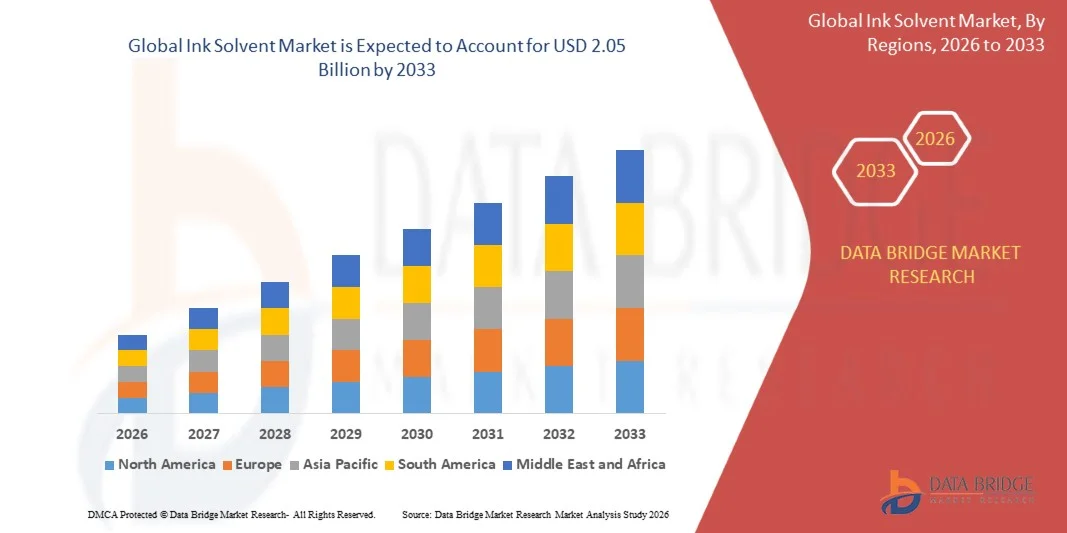
- The global ink solvent market size was valued at USD 1.29 billion in 2025 and is expected to reach USD 2.05 billion by 2033, at a CAGR of 5.91% during the forecast period
- The growth in the printing industry in the developing countries and rapid digitalization and rise in demand for versatile, durable and fast drying inks for commercial printing, packaging, publications and consumer specific printing needs will further carve the way for the growth of market
What are the Major Takeaways of Ink Solvent Market?
- High growth of digital media in the recent years and fluctuation of price of crude oil will affect raw material prices such as esters, aromatic, alcohols impede the growth of the ink solvent market
- The growing demand for bio-degradable solvents are estimated to generate numerous opportunities for the market. On the flip side, the negative effects of COVID-19 pandemic pose as a major challenge to the growth of the ink solvent market
- Asia-Pacific dominated the ink solvent market with a 43.70% revenue share in 2025, driven by rapid expansion of packaging, printing, and publishing industries across countries such as China, India, Japan, and South Korea
- North America is projected to register the fastest CAGR of 9.85% from 2026 to 2033, driven by increasing adoption of sustainable and bio-based solvents, advanced printing technologies, and growing demand for high-quality packaging solutions across the U.S. and Canada
- The Alcohol segment dominated the market with a 38.6% share in 2025, owing to its widespread use in flexographic and gravure printing due to fast drying properties, low toxicity, and excellent solvency for inks
Report Scope and Ink Solvent Market Segmentation
|
Attributes |
Ink Solvent Key Market Insights |
|
Segments Covered |
|
|
Countries Covered |
North America
Europe
Asia-Pacific
Middle East and Africa
South America
|
|
Key Market Players |
|
|
Market Opportunities |
|
|
Value Added Data Infosets |
In addition to the insights on market scenarios such as market value, growth rate, segmentation, geographical coverage, and major players, the market reports curated by the Data Bridge Market Research also include in-depth expert analysis, pricing analysis, brand share analysis, consumer survey, demography analysis, supply chain analysis, value chain analysis, raw material/consumables overview, vendor selection criteria, PESTLE Analysis, Porter Analysis, and regulatory framework. |
What is the Key Trend in the Ink Solvent Market?
“Rising Shift Toward Eco-Friendly and Low-VOC Ink Solvents”
- The ink solvent market is witnessing strong adoption of eco-friendly, low-VoC (volatile organic compound), and bio-based solvents driven by increasing environmental regulations and sustainability goals
- Manufacturers are focusing on developing water-based, alcohol-based, and green solvent formulations that reduce environmental impact while maintaining high print quality and performance
- Growing demand for sustainable packaging, digital printing, and flexible printing technologies is accelerating the transition toward environmentally compliant ink solvents
- For instance, companies such as BASF SE, Dow, Eastman Chemical Company, and Evonik Industries AG are investing in green solvent technologies and sustainable product portfolios
- Increasing regulatory pressure across Europe and North America regarding VOC emissions is encouraging industries to shift toward safer and compliant solvent alternatives
- As sustainability becomes a key focus across printing and packaging industries, eco-friendly ink solvents will play a crucial role in long-term market development
What are the Key Drivers of Ink Solvent Market?
- Rising demand from packaging, publishing, and commercial printing industries is significantly driving the consumption of ink solvents globally
- For instance, in 2025, leading companies such as BASF SE, Celanese Corporation, and LyondellBasell Industries Holdings B.V. expanded their solvent product lines to support high-performance printing applications
- Growing adoption of flexible packaging and labeling solutions in food & beverage, pharmaceuticals, and consumer goods sectors is boosting solvent demand
- Increasing use of digital and industrial printing technologies is enhancing the need for high-quality, fast-drying, and durable ink solvents
- Rapid industrialization and expansion of the packaging sector in Asia-Pacific are further accelerating market growth
- Supported by continuous advancements in printing technologies and rising global demand for packaging materials, the Ink Solvent market is expected to witness steady long-term growth
Which Factor is Challenging the Growth of the Ink Solvent Market?
- Stringent environmental regulations regarding VOC emissions and hazardous chemicals are limiting the use of traditional solvent-based inks
- For instance, during 2024–2025, regulatory authorities across regions such as Europe and North America imposed stricter compliance standards on solvent emissions, increasing operational costs for manufacturers
- Volatility in raw material prices derived from petrochemicals impacts production costs and profit margins
- Health and safety concerns related to exposure to solvent fumes create challenges in workplace environments
- Increasing shift toward water-based and UV-curable inks reduces dependency on conventional solvent-based solutions
- To address these challenges, companies are focusing on sustainable formulations, regulatory compliance, and innovation in eco-friendly solvent technologies to enhance global adoption of ink solvents
How is the Ink Solvent Market Segmented?
The market is segmented on the basis of chemistry type, ink type, product type, process, and application.
• By Chemistry Type
On the basis of chemistry type, the Ink Solvent market is segmented into Alcohol, Acetate, Hydrocarbon, and Others. The Alcohol segment dominated the market with a 38.6% share in 2025, owing to its widespread use in flexographic and gravure printing due to fast drying properties, low toxicity, and excellent solvency for inks. Alcohol-based solvents are preferred in packaging and publication printing as they ensure high print clarity, quick evaporation, and compatibility with various substrates. Increasing demand for high-speed printing and cost-effective solutions further strengthens segment growth.
The Hydrocarbon segment is expected to grow at the fastest CAGR from 2026 to 2033, driven by rising use in industrial printing applications requiring higher durability, resistance, and performance stability. Growing adoption in flexible packaging and specialty inks, along with advancements in solvent formulations, is accelerating demand.
• By Ink Type
On the basis of ink type, the market is segmented into Oil Based, Solvent Based, and Water Based. The Solvent Based segment dominated the market with a 41.2% share in 2025, supported by its superior adhesion, durability, and ability to print on non-porous substrates such as plastics and films. These inks are widely used in flexible packaging, labels, and industrial printing due to their resistance to moisture, chemicals, and abrasion. Their compatibility with high-speed printing processes further enhances adoption across commercial and industrial sectors.
The Water Based segment is projected to grow at the fastest CAGR from 2026 to 2033, driven by increasing environmental regulations, rising demand for low-VOC emissions, and growing preference for eco-friendly printing solutions. Expanding adoption in packaging and paper printing applications is further supporting growth.
• By Product Type
On the basis of product type, the market is segmented into Conventional and Green Bio-Based. The Conventional segment dominated the market with a 64.5% share in 2025, attributed to its established performance, cost-effectiveness, and wide availability across multiple industries. Conventional solvents offer consistent print quality, fast drying times, and compatibility with a broad range of ink formulations, making them the preferred choice in large-scale commercial printing operations.
The Green Bio-Based segment is expected to grow at the fastest CAGR from 2026 to 2033, driven by increasing sustainability initiatives, stringent environmental regulations, and growing consumer awareness regarding eco-friendly products. Innovations in bio-based solvent formulations and rising demand for sustainable packaging solutions are accelerating segment expansion.
• By Process
On the basis of process, the Ink Solvent market is segmented into Flexographic, Gravure, and Others. The Flexographic segment dominated the market with a 44.8% share in 2025, driven by its extensive use in packaging printing, including labels, corrugated boxes, and flexible packaging. Flexographic printing offers high-speed production, cost efficiency, and compatibility with a wide range of substrates, making it highly suitable for large-volume applications.
The Gravure segment is expected to grow at the fastest CAGR from 2026 to 2033, supported by increasing demand for high-quality image reproduction, especially in premium packaging and publication printing. Advancements in printing technology and growing use in decorative and specialty applications are further boosting growth.
• By Application
On the basis of application, the market is segmented into Flexible Packaging, Corrugated Cardboard and Folding Cartons, Publication, and Others. The Flexible Packaging segment dominated the market with a 46.3% share in 2025, driven by rising demand for packaged food, beverages, pharmaceuticals, and personal care products. Ink solvents play a critical role in ensuring high-quality printing, durability, and resistance for flexible packaging materials. Growth in e-commerce and changing consumer lifestyles are further fueling demand.
The Corrugated Cardboard and Folding Cartons segment is projected to grow at the fastest CAGR from 2026 to 2033, driven by increasing demand for sustainable packaging solutions, rising online retail shipments, and growing emphasis on recyclable packaging materials. Expanding industrial and logistics sectors are further accelerating segment growth.
Which Region Holds the Largest Share of the Ink Solvent Market?
- Asia-Pacific dominated the ink solvent market with a 43.70% revenue share in 2025, driven by rapid expansion of packaging, printing, and publishing industries across countries such as China, India, Japan, and South Korea. Strong growth in flexible packaging, rising demand for consumer goods, and increasing industrial production are fueling the consumption of ink solvents across commercial and industrial printing applications. High-volume manufacturing of packaging materials, labels, and corrugated boxes continues to support large-scale solvent utilization across the region
- Leading companies in Asia-Pacific are focusing on cost-efficient production, eco-friendly solvent formulations, and high-performance ink solutions, strengthening the region’s competitive advantage. Increasing investments in packaging innovation, e-commerce logistics, and sustainable printing technologies are further accelerating market growth
- Availability of low-cost raw materials, strong manufacturing infrastructure, and expanding export-oriented industries further reinforce Asia-Pacific’s dominance in the global Ink Solvent market
China Ink Solvent Market Insight
China is the largest contributor in Asia-Pacific, supported by its massive packaging industry, strong chemical manufacturing base, and high demand for printed materials across food, beverage, electronics, and e-commerce sectors. Increasing adoption of flexible packaging, labels, and industrial printing solutions is driving demand for ink solvents. Government support for manufacturing expansion and rising domestic consumption further strengthen market growth. Competitive pricing and large-scale production capabilities enhance China’s position in both domestic and export markets.
Japan Ink Solvent Market Insight
Japan shows steady growth driven by advanced printing technologies, high-quality packaging standards, and strong demand for precision printing in electronics and industrial applications. The country’s focus on innovation, sustainability, and low-VOC solvent solutions is boosting adoption of eco-friendly ink solvents. Increasing demand for high-performance inks in specialty packaging and publication printing further supports market expansion.
India Ink Solvent Market Insight
India is emerging as a major growth hub due to expanding packaging and labeling industries, rising demand for FMCG products, and rapid growth in e-commerce. Increasing adoption of flexible packaging and corrugated solutions is driving demand for ink solvents. Government initiatives supporting manufacturing and printing industries, along with rising investments in packaging infrastructure, are accelerating market penetration across the country.
South Korea Ink Solvent Market Insight
South Korea contributes significantly to regional growth, driven by strong demand for high-quality printing in electronics, cosmetics, and consumer goods packaging. Advanced manufacturing capabilities, innovation in printing technologies, and increasing focus on sustainable packaging solutions are boosting adoption of advanced ink solvents. Growth in export-oriented industries further strengthens market demand.
North America Ink Solvent Market
North America is projected to register the fastest CAGR of 9.85% from 2026 to 2033, driven by increasing adoption of sustainable and bio-based solvents, advanced printing technologies, and growing demand for high-quality packaging solutions across the U.S. and Canada. Rising environmental regulations and emphasis on reducing VOC emissions are accelerating the transition toward eco-friendly ink solvents. Growth in digital printing, flexible packaging, and specialty applications is further driving market expansion
U.S. Ink Solvent Market Insight
The U.S. is the largest contributor in North America, supported by strong demand for advanced packaging, labeling, and commercial printing solutions. Increasing adoption of green solvents, technological advancements in printing processes, and strong presence of major packaging companies are fueling market growth. Rising demand for high-performance inks in food packaging, pharmaceuticals, and industrial applications further boosts solvent consumption.
Canada Ink Solvent Market Insight
Canada contributes significantly to regional growth, driven by increasing demand for sustainable packaging, expansion of printing and publishing industries, and rising adoption of environmentally friendly solvent solutions. Government regulations promoting low-emission products, along with growing investment in green technologies, are encouraging the use of bio-based ink solvents. Expanding industrial and packaging sectors further support long-term market growth.
Which are the Top Companies in Ink Solvent Market?
The ink solvent industry is primarily led by well-established companies, including:
- BASF SE (Germany)
- Dow (U.S.)
- Eastman Chemical Company (U.S.)
- Arkema S.A (France)
- Ashland Inc. (U.S.)
- Celanese Corporation (U.S.)
- Evonik Industries AG (Germany)
- INEOS (U.K.)
- OMNOVA Solutions Inc. (U.S.)
- Shell (U.K.)
- Solvay (Belgium)
- Permaset Aqua (Australia)
- Cargill, Incorporated (U.S.)
- Archer Daniels Midland Company (ADM) (U.S.)
- Vertec Biosolvents Inc. (U.S.)
- Yip’s Chemical Holdings Limited (Hong Kong)
- Exxon Mobil Corporation (U.S.)
- Royal Dutch Shell Plc (U.K.)
- LyondellBasell Industries Holdings B.V. (Netherlands)
What are the Recent Developments in Global Ink Solvent Market?
- In October 2024, LyondellBasell announced that it became the full owner of APK AG in Merseburg, Germany, integrating the company to advance its solvent-based recycling technology for low-density polyethylene and support development of high-purity materials for flexible packaging applications, thereby strengthening its sustainability and circular economy strategy
- In August 2024, Eastman introduced a new electronic-grade isopropyl alcohol under its EastaPure product line to provide high-quality, reliable, and domestically produced solvents for U.S. semiconductor manufacturers, thereby enhancing supply chain reliability and supporting advanced electronics production
- In May 2024, INEOS completed the acquisition of LyondellBasell’s Ethylene Oxide and Derivatives business and its Bayport, Texas facility to expand its global chemical production capabilities, thereby reinforcing its position in supplying key raw materials used across industries including solvents, packaging, and pharmaceuticals
- In April 2024, BASF launched Efka PX 4360, a solvent-based dispersing agent developed using Controlled Free Radical Polymerisation technology to improve pigment compatibility and color performance in industrial coatings, thereby enhancing product efficiency and expanding its advanced coatings portfolio
- In September 2023, ExxonMobil Marketing Thailand Limited announced its commitment to delivering innovative lubricant and chemical solutions under the Mobil brand to serve consumers and businesses in Thailand, thereby strengthening its regional market presence and customer engagement
SKU-
Get online access to the report on the World's First Market Intelligence Cloud

- Interactive Data Analysis Dashboard
- Company Analysis Dashboard for high growth potential opportunities
- Research Analyst Access for customization & queries
- Competitor Analysis with Interactive dashboard
- Latest News, Updates & Trend analysis
- Harness the Power of Benchmark Analysis for Comprehensive Competitor Tracking
Global Ink Solvent Market, Supply Chain Analysis and Ecosystem Framework
To support market growth and help clients navigate the impact of geopolitical shifts, DBMR has integrated in-depth supply chain analysis into its Global Ink Solvent Market research reports. This addition empowers clients to respond effectively to global changes affecting their industries. The supply chain analysis section includes detailed insights such as Global Ink Solvent Market consumption and production by country, price trend analysis, the impact of tariffs and geopolitical developments, and import and export trends by country and HSN code. It also highlights major suppliers with data on production capacity and company profiles, as well as key importers and exporters. In addition to research, DBMR offers specialized supply chain consulting services backed by over a decade of experience, providing solutions like supplier discovery, supplier risk assessment, price trend analysis, impact evaluation of inflation and trade route changes, and comprehensive market trend analysis.
Research Methodology
Data collection and base year analysis are done using data collection modules with large sample sizes. The stage includes obtaining market information or related data through various sources and strategies. It includes examining and planning all the data acquired from the past in advance. It likewise envelops the examination of information inconsistencies seen across different information sources. The market data is analysed and estimated using market statistical and coherent models. Also, market share analysis and key trend analysis are the major success factors in the market report. To know more, please request an analyst call or drop down your inquiry.
The key research methodology used by DBMR research team is data triangulation which involves data mining, analysis of the impact of data variables on the market and primary (industry expert) validation. Data models include Vendor Positioning Grid, Market Time Line Analysis, Market Overview and Guide, Company Positioning Grid, Patent Analysis, Pricing Analysis, Company Market Share Analysis, Standards of Measurement, Global versus Regional and Vendor Share Analysis. To know more about the research methodology, drop in an inquiry to speak to our industry experts.
Customization Available
Data Bridge Market Research is a leader in advanced formative research. We take pride in servicing our existing and new customers with data and analysis that match and suits their goal. The report can be customized to include price trend analysis of target brands understanding the market for additional countries (ask for the list of countries), clinical trial results data, literature review, refurbished market and product base analysis. Market analysis of target competitors can be analyzed from technology-based analysis to market portfolio strategies. We can add as many competitors that you require data about in the format and data style you are looking for. Our team of analysts can also provide you data in crude raw excel files pivot tables (Fact book) or can assist you in creating presentations from the data sets available in the report.












