




Global Inspection Machines Market
Market Size in USD Million
CAGR :
% 
 USD
986.16 Million
USD
1,496.31 Million
2025
2033
USD
986.16 Million
USD
1,496.31 Million
2025
2033
 Forecast Period Forecast Period |
2026 –2033 |
 Market Size (Base Year) Market Size (Base Year) |
USD 986.16 Million |
 Market Size (Forecast Year) Market Size (Forecast Year) |
USD 1,496.31 Million |
 CAGR CAGR |
% |
| Major Markets Players |
|
Inspection Machines Market Size
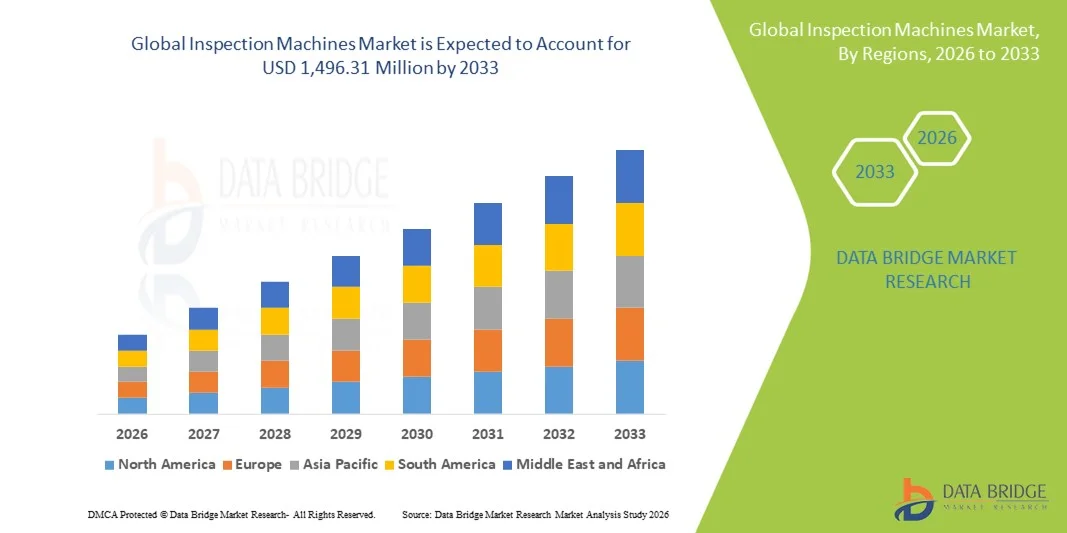
- The global inspection machines market size was valued at USD 986.16 million in 2025 and is expected to reach USD 1,496.31 million by 2033, at a CAGR of 5.35% during the forecast period
- The market growth is primarily driven by the increasing emphasis on quality assurance, stringent regulatory requirements, and the growing adoption of automated inspection systems across industries such as pharmaceuticals, food & beverages, and manufacturing
- In addition, rising demand for high-speed production lines, enhanced product safety standards, and the integration of advanced technologies such as machine vision, artificial intelligence, and IoT-enabled monitoring systems are positioning inspection machines as critical components in modern industrial operations, thereby significantly accelerating overall market expansion
Inspection Machines Market Analysis
- Inspection machines, designed to examine products for defects, contamination, and packaging integrity, are increasingly essential components of modern manufacturing and quality control systems across industries such as pharmaceuticals, food & beverages, cosmetics, and automotive due to their ability to ensure compliance, enhance product safety, and maintain high production standards
- The rising demand for inspection machines is primarily driven by stringent regulatory requirements, growing focus on product quality and brand protection, and the increasing adoption of automation and Industry 4.0 technologies across global manufacturing facilities
- North America dominated the inspection machines market with the largest revenue share of 39.28% in 2025, supported by advanced manufacturing infrastructure, strict regulatory frameworks from agencies such as the U.S. Food and Drug Administration, and significant investments in automated inspection technologies, with the U.S. witnessing strong adoption particularly in pharmaceutical and food processing sectors
- Asia-Pacific is expected to be the fastest growing region in the inspection machines market during the forecast period owing to rapid industrialization, expansion of pharmaceutical manufacturing hubs, and increasing export-oriented production in countries such as China and India
- Vision inspection systems segment dominated the inspection machines market with a market share of 42.7% in 2025, driven by their high accuracy, real-time defect detection capabilities, and seamless integration with high-speed automated production lines
Report Scope and Inspection Machines Market Segmentation
|
Attributes |
Inspection Machines Key Market Insights |
|
Segments Covered |
|
|
Countries Covered |
North America
Europe
Asia-Pacific
Middle East and Africa
South America
|
|
Key Market Players |
|
|
Market Opportunities |
|
|
Value Added Data Infosets |
In addition to the insights on market scenarios such as market value, growth rate, segmentation, geographical coverage, and major players, the market reports curated by the Data Bridge Market Research also include in-depth expert analysis, patient epidemiology, pipeline analysis, pricing analysis, and regulatory framework |
Inspection Machines Market Trends
Increasing Adoption of AI-Driven Automated Visual Inspection Systems
- A significant and accelerating trend in the global inspection machines market is the growing integration of artificial intelligence (AI), machine vision, and advanced analytics into automated inspection platforms across manufacturing industries. This convergence of technologies is substantially improving inspection accuracy, operational efficiency, and real-time quality assurance capabilities
- For instance, advanced vision inspection machines deployed in pharmaceutical production lines enable automated detection of cosmetic defects, particulate contamination, and packaging inconsistencies with minimal human intervention. Similarly, automated X-ray inspection systems are increasingly utilized in food processing facilities to identify foreign contaminants and ensure product safety compliance
- AI integration in inspection machines enables capabilities such as adaptive defect recognition, continuous learning from production data, and predictive quality monitoring to reduce operational downtime. For instance, modern inspection platforms utilize deep learning algorithms to enhance anomaly detection accuracy and generate intelligent alerts when deviations from quality standards are identified. Furthermore, automated inspection technologies allow manufacturers to conduct high-speed inspections without interrupting production workflows
- The seamless integration of inspection machines with digital manufacturing ecosystems and Industrial Internet of Things (IIoT) platforms enables centralized monitoring and control of production quality processes. Through unified dashboards, manufacturers can manage inspection performance alongside equipment efficiency, traceability systems, and compliance documentation, supporting fully connected smart factory environments
- This trend toward intelligent, automated, and data-driven inspection solutions is fundamentally transforming quality control strategies across global industries. Consequently, companies such as Mettler-Toledo International Inc. are developing AI-enabled inspection systems featuring automated rejection mechanisms, real-time analytics, and integration with high-speed production environments
- The demand for inspection machines offering advanced automation and intelligent defect detection capabilities is expanding rapidly across pharmaceutical, food, and consumer goods sectors, as manufacturers increasingly prioritize regulatory compliance, operational efficiency, and consistent product quality
- The growing shift toward sustainable manufacturing practices is also encouraging the adoption of inspection machines that minimize material waste, optimize resource utilization, and reduce product recalls through early-stage defect identification
Inspection Machines Market Dynamics
Driver
Growing Need Due to Stringent Quality Regulations and Manufacturing Automation
- The increasing enforcement of product safety regulations across industries, combined with accelerating adoption of automated manufacturing systems, is a major driver supporting the rising demand for inspection machines globally
- For instance, in March 2025, Thermo Fisher Scientific Inc. expanded automated inspection solutions designed to improve contamination detection and packaging verification within pharmaceutical manufacturing environments. Such strategic developments by leading companies are expected to drive inspection machines market growth during the forecast period
- As manufacturers strive to minimize product recalls and ensure compliance with regulatory standards, inspection machines provide reliable solutions including automated defect detection, fill-level verification, leak testing, and labeling accuracy assessment across production lines
- Furthermore, the increasing adoption of Industry 4.0 practices and smart factory initiatives is positioning inspection machines as essential components within automated production ecosystems, enabling continuous monitoring and data-driven decision-making
- The capability to conduct non-destructive, high-speed inspection while maintaining production efficiency is significantly accelerating adoption across pharmaceutical, food & beverage, and electronics industries. The expansion of global manufacturing output and increasing demand for standardized product quality further contribute to sustained market growth
- Rising global export activities and cross-border trade regulations are compelling manufacturers to implement standardized inspection systems to comply with international quality benchmarks and certification requirements
- Increasing investments in pharmaceutical biologics, injectable drugs, and high-value food products are further driving the need for precise, contamination-free inspection processes across specialized production environments
Restraint/Challenge
High Implementation Costs and Technical Integration Complexity
- Concerns associated with high initial investment requirements and complex integration processes represent a significant challenge to widespread adoption of inspection machines, particularly among small and medium-scale manufacturers
- For instance, integration of advanced vision or X-ray inspection equipment into existing production lines often requires infrastructure upgrades and specialized technical expertise, increasing deployment time and operational costs
- Addressing these challenges requires substantial capital expenditure for equipment acquisition, system calibration, and workforce training to ensure optimal inspection performance. Companies such as Cognex Corporation focus on developing user-friendly inspection platforms and scalable automation solutions to simplify implementation processes. In addition, maintenance costs and periodic system validation requirements may create operational burdens for manufacturers with limited technical resources
- While technological advancements continue to improve inspection efficiency, the perceived cost-to-benefit ratio can discourage adoption among price-sensitive industries or facilities operating with legacy manufacturing systems
- Overcoming these challenges through modular inspection solutions, reduced equipment costs, simplified integration frameworks, and enhanced operator training programs will remain essential to support long-term inspection machines market expansion
- Limited availability of skilled professionals capable of managing AI-enabled inspection systems may slow adoption in developing manufacturing markets
- Data security and system interoperability concerns within connected smart factory environments can also create hesitation among manufacturers considering fully integrated inspection platforms
Inspection Machines Market Scope
The market is segmented on the basis of product, type, application, and end user.
- By Product
On the basis of product, the inspection machines market is segmented into software, metal detectors, vision inspection systems, X-ray inspection systems, checkweighers, leak detection systems, combination systems, and other inspection systems. The vision inspection systems segment dominated the market with the largest revenue share of 42.7% in 2025, driven by its high accuracy, real-time defect detection capabilities, and adaptability across pharmaceutical, food, and medical device industries. These systems are widely utilized for label verification, fill-level inspection, packaging integrity checks, and cosmetic defect detection. The increasing deployment of AI-powered cameras and deep learning algorithms has significantly improved defect recognition precision. In addition, vision systems are highly compatible with high-speed automated production lines, enabling continuous inspection without disrupting throughput. Their scalability and ability to integrate into Industry 4.0 ecosystems further reinforce their dominant market position.
The X-ray inspection systems segment is anticipated to witness the fastest growth rate from 2026 to 2033, fueled by rising demand for non-destructive testing and enhanced contamination detection. X-ray systems are increasingly adopted in food processing to detect foreign materials such as metal, glass, and plastic fragments. In pharmaceutical production, they are used for fill-level verification and identification of internal packaging defects that are not visible externally. Growing regulatory scrutiny regarding product safety and contamination control is accelerating adoption. Technological advancements have improved image resolution while reducing radiation exposure and operational costs. As manufacturers prioritize safety assurance and compliance, X-ray inspection systems are expected to record robust expansion during the forecast period.
- By Type
On the basis of type, the inspection machines market is segmented into fully automated inspection machines, semi-automated inspection machines, and manual inspection machines. The fully automated inspection machines segment dominated the market in 2025, attributed to the increasing shift toward automated manufacturing and smart factory environments. These systems enable high-speed inspection with minimal human intervention, significantly reducing error rates and labor costs. Fully automated machines are particularly favored in pharmaceutical and food industries where precision and compliance are critical. Their integration with robotic handling systems and centralized monitoring platforms enhances operational efficiency. Moreover, automation ensures consistent inspection performance across large production volumes. As manufacturers scale operations, fully automated systems continue to gain strong traction globally.
The semi-automated inspection machines segment is expected to witness the fastest CAGR from 2026 to 2033, driven by their cost-effectiveness and flexibility for mid-sized manufacturers. Semi-automated systems combine human oversight with machine-based detection, offering a balanced approach to quality control. They are especially suitable for facilities transitioning from manual to fully automated processes. Lower capital investment requirements make them attractive to developing markets and small-scale enterprises. In addition, these machines can be customized for specific inspection tasks without requiring complete production line redesign. Their adaptability and affordability are key factors supporting accelerated growth in this segment.
- By Application
On the basis of application, the inspection machines market is segmented into glass, blisters, ampoules & vials, bottles, syringes, and others. The ampoules & vials segment dominated the market in 2025, driven by the expanding production of injectable drugs, biologics, and vaccines. Inspection machines are extensively used to detect particulate contamination, cracks, sealing defects, and fill-level inconsistencies in these containers. Stringent pharmaceutical regulations mandate 100% inspection of injectable products, strengthening demand. Automated systems ensure compliance with quality standards while maintaining production efficiency. The rise in biologics and specialty drug manufacturing has further intensified inspection requirements. Consequently, ampoules and vials remain the leading application area.
The syringes segment is projected to witness the fastest growth from 2026 to 2033, fueled by increasing demand for prefilled syringes and self-administration drug delivery systems. Growing prevalence of chronic diseases and expansion of vaccination programs are contributing to higher syringe production volumes. Inspection machines play a vital role in verifying needle placement, plunger integrity, and dosage accuracy. Enhanced focus on patient safety and sterile packaging further drives adoption. Technological advancements enabling high-speed syringe inspection lines are supporting scalability. As healthcare systems prioritize ready-to-use injectable formats, this segment is expected to expand rapidly.
- By End User
On the basis of end user, the inspection machines market is segmented into pharmaceutical & biotechnology companies, food processing & packaging companies, medical device manufacturers, and others. The pharmaceutical & biotechnology companies segment dominated the market in 2025 due to stringent regulatory frameworks and mandatory quality inspection requirements. These companies rely heavily on inspection systems to ensure compliance with global standards and prevent costly recalls. Increasing investments in biologics, sterile injectables, and high-value therapeutics have amplified inspection needs. Automated inspection machines enable precise defect detection while maintaining production throughput. In addition, regulatory audits and validation protocols reinforce continuous system upgrades. This strong compliance-driven demand secures the segment’s leading position.
The food processing & packaging companies segment is anticipated to witness the fastest growth rate from 2026 to 2033, driven by heightened food safety awareness and contamination prevention measures. Rising global food trade and stricter safety standards are compelling manufacturers to adopt advanced inspection technologies. Inspection machines such as metal detectors and X-ray systems help identify foreign materials and ensure packaging integrity. Consumer demand for high-quality, safe packaged foods further accelerates adoption. Automation in food production lines enhances consistency and reduces recall risks. As food safety regulations intensify worldwide, this segment is poised for substantial expansion.
Inspection Machines Market Regional Analysis
- North America dominated the inspection machines market with the largest revenue share of 39.28% in 2025, supported by advanced manufacturing infrastructure, strict regulatory frameworks from agencies such as the U.S. Food and Drug Administration, and significant investments in automated inspection technologies
- Manufacturers in the region highly prioritize product safety, compliance assurance, and operational efficiency, leading to widespread adoption of inspection machines such as vision systems, metal detectors, and X-ray technologies across high-speed production lines
- This strong market position is further supported by advanced industrial infrastructure, high technology adoption rates, and continuous innovation by leading companies such as Thermo Fisher Scientific Inc. and Mettler-Toledo International Inc., establishing inspection machines as essential components within modern manufacturing and smart factory environments
U.S. Inspection Machines Market Insight
The U.S. inspection machines market captured the largest revenue share within North America in 2025, fueled by strict regulatory oversight, advanced manufacturing capabilities, and high adoption of automated quality control systems. Manufacturers are increasingly prioritizing compliance with safety standards and minimizing product recalls through precision-based inspection technologies. The growing demand for pharmaceutical injectables, packaged food safety, and medical device quality assurance further propels the inspection machines industry. Moreover, the integration of AI-powered vision systems and automated X-ray inspection technologies by companies such as Thermo Fisher Scientific Inc. is significantly contributing to market expansion.
Europe Inspection Machines Market Insight
The Europe inspection machines market is projected to expand at a substantial CAGR throughout the forecast period, primarily driven by stringent regulatory frameworks and strong emphasis on product quality across pharmaceutical and food industries. The increase in industrial automation, coupled with demand for high-precision manufacturing, is fostering adoption of advanced inspection systems. European manufacturers are also focused on sustainability and waste reduction, encouraging early-stage defect detection technologies. The region is witnessing notable growth across pharmaceutical production lines, food processing plants, and medical device manufacturing facilities, with inspection machines increasingly integrated into both new and upgraded automated production setups.
U.K. Inspection Machines Market Insight
The U.K. inspection machines market is anticipated to grow at a noteworthy CAGR during the forecast period, driven by increasing investments in pharmaceutical manufacturing and food safety compliance. In addition, concerns regarding contamination control and regulatory inspections are encouraging companies to adopt automated inspection technologies. The U.K.’s strong research ecosystem and industrial automation initiatives are expected to continue stimulating market growth. Adoption of intelligent vision systems and leak detection technologies is rising across sterile manufacturing and high-value packaged goods sectors.
Germany Inspection Machines Market Insight
The Germany inspection machines market is expected to expand at a considerable CAGR during the forecast period, fueled by the country’s strong industrial base and emphasis on precision engineering. Germany’s well-developed manufacturing infrastructure, combined with its leadership in Industry 4.0 adoption, promotes widespread deployment of automated inspection systems. The demand for high-quality pharmaceutical packaging and export-oriented food production supports consistent system upgrades. Integration of inspection machines with smart factory platforms and robotics is becoming increasingly prevalent, aligning with Germany’s focus on innovation, efficiency, and quality assurance excellence.
Asia-Pacific Inspection Machines Market Insight
The Asia-Pacific inspection machines market is poised to grow at the fastest CAGR during the forecast period of 2026 to 2033, driven by rapid industrialization, expansion of pharmaceutical manufacturing hubs, and increasing food safety awareness in countries such as China, Japan, and India. The region's growing adoption of automated production technologies, supported by government initiatives promoting domestic manufacturing, is accelerating inspection machine deployment. Furthermore, as APAC strengthens its position as a global manufacturing center, demand for advanced quality control systems is expanding across diverse industries.
Japan Inspection Machines Market Insight
The Japan inspection machines market is gaining momentum due to the country’s advanced technological ecosystem, high-quality manufacturing standards, and strong pharmaceutical sector presence. The Japanese market places significant emphasis on precision and zero-defect production processes, encouraging adoption of sophisticated inspection technologies. Integration of machine vision systems with robotics and automated assembly lines is fueling growth. Moreover, Japan’s focus on high-value electronics and medical device production is further stimulating demand for reliable, high-speed inspection solutions in both domestic and export markets.
India Inspection Machines Market Insight
The India inspection machines market accounted for a significant revenue share in Asia Pacific in 2025, attributed to expanding pharmaceutical exports, rapid industrialization, and increasing compliance with international quality standards. India stands as a major global supplier of generic medicines, driving strong demand for automated vial, ampoule, and syringe inspection systems. Growth in packaged food production and medical device manufacturing further supports market expansion. Government initiatives encouraging domestic manufacturing and modernization of production facilities are key factors propelling inspection machine adoption across the country.
Inspection Machines Market Share
The Inspection Machines industry is primarily led by well-established companies, including:
- Viscom SE (Germany)
- ViTrox Corporation Berhad (Malaysia)
- Cognex Corporation (U.S.)
- Mettler-Toledo International Inc. (U.S.)
- OMRON Corporation (Japan)
- KEYENCE CORPORATION (Japan)
- Siemens AG (Germany)
- Rockwell Automation, Inc. (U.S.)
- Panasonic Corporation (Japan)
- NIKON Corporation (Japan)
- KLA Corporation (U.S.)
- ASMPT Limited (Hong Kong)
- Nordson Corporation (U.S.)
- SICK AG (Germany)
- Teledyne Technologies Incorporated (U.S.)
- Key Technology, Inc. (U.S.)
- Loma Systems (U.K.)
- Thermo Fisher Scientific Inc. (U.S.)
- Shimadzu Corporation (Japan)
- Ishida Co., Ltd. (Japan)
What are the Recent Developments in Global Inspection Machines Market?
- In September 2025, EyeC GmbH introduced AI-powered defect classification technology integrated into its inline inspection systems, enabling automatic categorization of defects such as material flaws and streaks to significantly reduce false positives and improve inspection accuracy. This innovation shifts quality control from simple defect detection to intelligent content classification, supporting better process decisions and compliance with sustainability regulations
- In April 2025, Mettler-Toledo Product Inspection unveiled the X52 Dual Energy X-ray inspection system, enhancing detection versatility and accuracy for challenging product applications, expanding quality control capabilities in food and packaging inspection. The dual-energy technology improves identification of contaminants, addressing industry demands for higher safety
- In March 2025, Sonair launched global early access to breakthrough 3D ultrasonic sensor technology for industrial automation and inspection applications, aiming to transform spatial sensing capabilities for automated systems with significantly improved detection and safety performance. This innovation is poised to influence future inspection integrations with robotics and automation
- In March 2025, Anritsu Corporation introduced the XR76 series of AI-enhanced X-ray inspection machines designed to reduce false positives, improve sensitivity by up to 40%, and simplify operation for high-speed food production line inspection. This launch reflects advanced AI integration into inspection hardware
- In September 2024, OMRON Corporation launched the VT-X950 line of high-speed CT-type automatic X-ray inspection systems for semiconductor manufacturing, addressing stringent quality requirements and supporting advanced component inspection. These systems help meet evolving demands in electronics quality control
SKU-
Get online access to the report on the World's First Market Intelligence Cloud

- Interactive Data Analysis Dashboard
- Company Analysis Dashboard for high growth potential opportunities
- Research Analyst Access for customization & queries
- Competitor Analysis with Interactive dashboard
- Latest News, Updates & Trend analysis
- Harness the Power of Benchmark Analysis for Comprehensive Competitor Tracking
Research Methodology
Data collection and base year analysis are done using data collection modules with large sample sizes. The stage includes obtaining market information or related data through various sources and strategies. It includes examining and planning all the data acquired from the past in advance. It likewise envelops the examination of information inconsistencies seen across different information sources. The market data is analysed and estimated using market statistical and coherent models. Also, market share analysis and key trend analysis are the major success factors in the market report. To know more, please request an analyst call or drop down your inquiry.
The key research methodology used by DBMR research team is data triangulation which involves data mining, analysis of the impact of data variables on the market and primary (industry expert) validation. Data models include Vendor Positioning Grid, Market Time Line Analysis, Market Overview and Guide, Company Positioning Grid, Patent Analysis, Pricing Analysis, Company Market Share Analysis, Standards of Measurement, Global versus Regional and Vendor Share Analysis. To know more about the research methodology, drop in an inquiry to speak to our industry experts.
Customization Available
Data Bridge Market Research is a leader in advanced formative research. We take pride in servicing our existing and new customers with data and analysis that match and suits their goal. The report can be customized to include price trend analysis of target brands understanding the market for additional countries (ask for the list of countries), clinical trial results data, literature review, refurbished market and product base analysis. Market analysis of target competitors can be analyzed from technology-based analysis to market portfolio strategies. We can add as many competitors that you require data about in the format and data style you are looking for. Our team of analysts can also provide you data in crude raw excel files pivot tables (Fact book) or can assist you in creating presentations from the data sets available in the report.












