Global Inter Integrated Circuit I2c Bus Market
Market Size in USD Billion
CAGR :
% 
 USD
6.47 Billion
USD
9.57 Billion
2025
2033
USD
6.47 Billion
USD
9.57 Billion
2025
2033
 Forecast Period Forecast Period |
2026 –2033 |
 Market Size (Base Year) Market Size (Base Year) |
USD 6.47 Billion |
 Market Size (Forecast Year) Market Size (Forecast Year) |
USD 9.57 Billion |
 CAGR CAGR |
% |
| Major Markets Players |
|
What is the Global Inter-Integrated Circuit (I2C) Bus Market Size and Growth Rate?
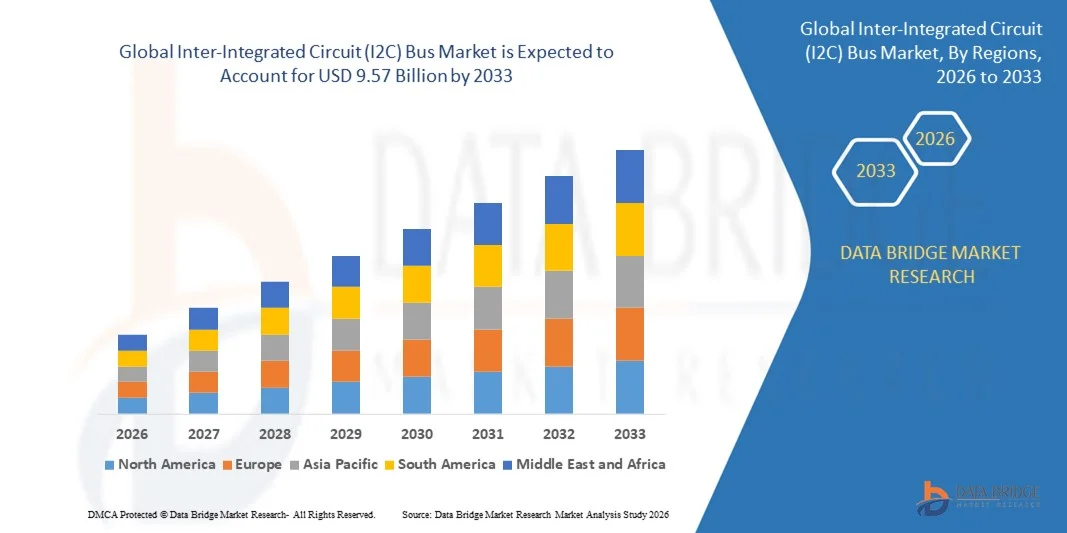
- The global Inter-Integrated Circuit (I2C) Bus market size was valued at USD 6.47 billion in 2025 and is expected to reach USD 9.57 billion by 2033, at a CAGR of5.00% during the forecast period
- Major factors that are expected to boost the growth of the inter-integrated circuit (I2C) bus market in the forecast period are the rise in the industries such as consumer electronics, telecommunications and industrial electronics
- Furthermore, the similarities between superficially unrelated designs such as intelligent control, generally a single-chip microcontroller, to receive advantages from the similarities I2C bus are utilized is further anticipated to propel the growth of the inter-integrated circuit (I2C) bus market
What are the Major Takeaways of Inter-Integrated Circuit (I2C) Bus Market?
- The I2C bus also is also known to be less costly because it reduces the demand for an address decoders and other glue logic which will further provide potential opportunities for the growth of the inter-integrated circuit (I2C) bus market in the coming years
- However, the I2C bus operates where it requires protocol overhead which lessens its throughput which might further challenge the growth of the I2C bus in the near future
- North America dominated the Inter-Integrated Circuit (I2C) Bus market with a 40.88% revenue share in 2025, driven by strong semiconductor innovation, advanced embedded system development, and rapid expansion of AI, IoT, and automotive electronics across the U.S. and Canada
- Asia-Pacific is projected to register the fastest CAGR of 10.74% from 2026 to 2033, driven by rapid semiconductor manufacturing expansion, strong consumer electronics production, and increasing adoption of embedded systems across China, Japan, India, South Korea, and Southeast Asia
- The Fast-Mode segment dominated the market with a 34.6% share in 2025, as it offers an optimal balance between speed, power efficiency, and signal reliability for mainstream embedded systems, sensors, and consumer electronics
Report Scope and Inter-Integrated Circuit (I2C) Bus Market Segmentation
|
Attributes |
Inter-Integrated Circuit (I2C) Bus Key Market Insights |
|
Segments Covered |
|
|
Countries Covered |
North America
Europe
Asia-Pacific
Middle East and Africa
South America
|
|
Key Market Players |
|
|
Market Opportunities |
|
|
Value Added Data Infosets |
In addition to the insights on market scenarios such as market value, growth rate, segmentation, geographical coverage, and major players, the market reports curated by the Data Bridge Market Research also include in-depth expert analysis, pricing analysis, brand share analysis, consumer survey, demography analysis, supply chain analysis, value chain analysis, raw material/consumables overview, vendor selection criteria, PESTLE Analysis, Porter Analysis, and regulatory framework. |
What is the Key Trend in the Inter-Integrated Circuit (I2C) Bus Market?
Increasing Shift Toward High-Speed, Low-Power, and Multi-Device Inter-Integrated Circuit (I2C) Bus Architectures
- The Inter-Integrated Circuit (I2C) Bus market is witnessing strong adoption of high-speed modes such as Fast-mode Plus (Fm+) and High-speed (Hs) mode to support advanced embedded systems, AI-enabled devices, and industrial automation platforms
- Semiconductor manufacturers are integrating I2C interfaces with enhanced noise immunity, lower power consumption, and multi-master capabilities to improve communication reliability across compact electronic designs
- Growing demand for space-efficient board layouts in IoT modules, wearable devices, automotive ECUs, and consumer electronics is driving preference for simplified two-wire serial communication protocols
- For instance, leading companies such as NXP Semiconductors, Texas Instruments, STMicroelectronics, and Microchip Technology are introducing upgraded microcontrollers and sensors with advanced I2C support and improved clock synchronization
- Increasing need for seamless sensor integration, real-time data exchange, and low-latency peripheral communication is accelerating I2C deployment across smart devices
- As electronics become more compact and power-efficient, Inter-Integrated Circuit (I2C) Bus architectures will remain essential for reliable short-distance chip-to-chip communication
What are the Key Drivers of Inter-Integrated Circuit (I2C) Bus Market?
- Rising demand for low-cost, simple, and scalable communication interfaces in microcontrollers, sensors, EEPROMs, ADCs, and power management ICs
- For instance, in 2025, major semiconductor companies such as Renesas Electronics, Analog Devices, and Infineon Technologies expanded their embedded portfolios with enhanced multi-speed I2C compatibility
- Growing adoption of IoT devices, smart home systems, EV electronics, industrial control modules, and medical monitoring devices is significantly boosting I2C interface integration
- Advancements in low-power semiconductor design, miniaturized PCBs, and multi-sensor architectures have strengthened the relevance of compact serial communication buses
- Rising deployment of AI-enabled edge devices and multi-sensor fusion systems is increasing demand for reliable peripheral communication protocols
- Supported by expanding semiconductor manufacturing and embedded system innovation, the Inter-Integrated Circuit (I2C) Bus market is expected to witness sustained long-term growth
Which Factor is Challenging the Growth of the Inter-Integrated Circuit (I2C) Bus Market?
- Limited data transfer speed compared to SPI and high-speed serial interfaces restricts I2C adoption in bandwidth-intensive applications
- For instance, during 2024–2025, growing deployment of high-performance processors and real-time communication systems led some developers to prefer faster alternatives for complex data exchange
- Signal integrity issues over longer trace lengths and susceptibility to noise in high-frequency environments pose design challenges
- Increasing integration of alternative protocols such as SPI, UART, and CAN in multi-bus architectures reduces standalone dependence on I2C
- Complex debugging requirements in multi-master configurations and clock-stretching scenarios demand skilled engineering expertise
- To address these challenges, companies are focusing on improved shielding techniques, enhanced error detection, optimized firmware support, and hybrid bus architectures to strengthen global adoption of inter-integrated circuit (I2C) bus solutions
How is the Inter-Integrated Circuit (I2C) Bus Market Segmented?
The market is segmented on the basis of mode, type, and application.
- By Mode
On the basis of mode, the Inter-Integrated Circuit (I2C) Bus market is segmented into Standard-Mode (up to 100 kbit/s), Fast-Mode (up to 400 kbit/s), Fast-Mode Plus (up to 1 Mbit/s), High-Speed Mode (up to 3.4 Mbit/s), and Ultra-Fast Mode (up to 5 Mbit/s). The Fast-Mode segment dominated the market with a 34.6% share in 2025, as it offers an optimal balance between speed, power efficiency, and signal reliability for mainstream embedded systems, sensors, and consumer electronics. Fast-Mode is widely adopted in microcontrollers, IoT devices, and industrial control modules due to its stable performance and compatibility with legacy systems.
The High-Speed Mode segment is expected to grow at the fastest CAGR from 2026 to 2033, driven by rising demand for faster data exchange in automotive electronics, AI-enabled devices, advanced processors, and multi-sensor fusion systems. Increasing integration of complex SoCs and high-performance embedded architectures is accelerating adoption of higher bit-rate I2C communication modes.
- By Type
On the basis of type, the Inter-Integrated Circuit (I2C) Bus market is segmented into Bidirectional Bus and Unidirectional Bus. The Bidirectional Bus segment dominated the market with a 71.2% share in 2025, owing to its inherent two-way communication capability between master and slave devices. Bidirectional communication enables efficient command transmission, acknowledgment signaling, and real-time data exchange across sensors, EEPROMs, ADCs, and peripheral devices. Its flexibility and scalability make it the preferred architecture in embedded systems, consumer electronics, and automotive control modules.
The Unidirectional Bus segment is projected to grow at the fastest CAGR from 2026 to 2033, supported by increasing deployment in simplified, low-cost applications where one-way communication is sufficient, such as display modules and basic monitoring systems. Growth in minimalistic IoT devices and cost-sensitive industrial electronics is further contributing to segment expansion.
- By Application
On the basis of application, the market is segmented into System Management Bus (SMBus), Power Management Bus (PMBus), Intelligent Platform Management Interface (IPMI), Display Data Channel (DDC), and Advanced Telecom Computing Architecture (ATCA). The System Management Bus (SMBus) segment dominated the market with a 32.8% share in 2025, driven by extensive use in PC motherboards, servers, battery management systems, and embedded controllers. SMBus ensures efficient power monitoring, temperature sensing, and device communication in computing and industrial systems.
The Power Management Bus (PMBus) segment is expected to grow at the fastest CAGR from 2026 to 2033, fueled by increasing demand for intelligent power control in EV systems, AI servers, telecom infrastructure, and industrial automation. Rising need for precise voltage regulation, digital power monitoring, and energy optimization is accelerating PMBus integration across advanced electronic architectures.
Which Region Holds the Largest Share of the Inter-Integrated Circuit (I2C) Bus Market?
- North America dominated the Inter-Integrated Circuit (I2C) Bus market with a 40.88% revenue share in 2025, driven by strong semiconductor innovation, advanced embedded system development, and rapid expansion of AI, IoT, and automotive electronics across the U.S. and Canada. High adoption of microcontrollers, sensors, power management ICs, and FPGA-based systems continues to fuel integration of I2C interfaces across computing, aerospace, defence, and industrial automation sectors
- Leading semiconductor companies in North America are integrating advanced multi-speed I2C controllers with improved noise immunity, clock synchronization, and low-power capabilities, strengthening the region’s technological edge. Continuous investments in AI accelerators, EV electronics, and high-performance computing further support sustained market expansion
- Strong R&D ecosystems, presence of major fabless semiconductor firms, and high concentration of embedded engineering talent reinforce North America’s regional leadership in I2C Bus adoption
U.S. Inter-Integrated Circuit (I2C) Bus Market Insight
The U.S. is the largest contributor within North America, supported by robust semiconductor R&D, rapid adoption of smart devices, and widespread use of embedded controllers across automotive, aerospace, telecom, healthcare, and industrial automation sectors. Increasing development of AI processors, advanced driver-assistance systems (ADAS), EV battery management modules, and industrial IoT platforms intensifies demand for reliable I2C communication architectures. Strong presence of leading chip designers, innovation-driven startups, and advanced electronics manufacturing facilities continues to drive sustained market growth.
Canada Inter-Integrated Circuit (I2C) Bus Market Insight
Canada contributes significantly due to expanding embedded design clusters, telecom infrastructure modernization, and rising investments in automotive electronics and smart manufacturing. Universities and R&D centres increasingly deploy I2C-enabled development platforms for sensor integration, robotics, and IoT prototyping. Skilled workforce availability and government-supported semiconductor initiatives further enhance domestic adoption.
Asia-Pacific Inter-Integrated Circuit (I2C) Bus Market
Asia-Pacific is projected to register the fastest CAGR of 10.74% from 2026 to 2033, driven by rapid semiconductor manufacturing expansion, strong consumer electronics production, and increasing adoption of embedded systems across China, Japan, India, South Korea, and Southeast Asia. High-volume production of smartphones, automotive ECUs, industrial controllers, and smart appliances significantly boosts I2C interface integration. Rising deployment of 5G infrastructure, AI-enabled devices, and industrial automation systems continues to accelerate demand for scalable, low-power serial communication protocols across regional manufacturing hubs.
China Inter-Integrated Circuit (I2C) Bus Market Insight
China is the largest contributor in Asia-Pacific due to large-scale semiconductor investments and world-leading electronics manufacturing capacity. Growing production of consumer electronics, EV systems, and industrial IoT devices drives strong demand for I2C-enabled microcontrollers and sensor interfaces.
Japan Inter-Integrated Circuit (I2C) Bus Market Insight
Japan demonstrates steady growth supported by precision electronics manufacturing and continuous modernization of automotive and industrial control technologies. Strong emphasis on reliability and compact embedded design strengthens I2C integration across high-performance applications.
India Inter-Integrated Circuit (I2C) Bus Market Insight
India is emerging rapidly due to expanding semiconductor design centres, startup-driven innovation, and government-backed electronics manufacturing programs. Rising demand for IoT devices, automotive electronics, and telecom infrastructure supports increasing I2C Bus adoption.
South Korea Inter-Integrated Circuit (I2C) Bus Market Insight
South Korea contributes significantly due to advanced memory manufacturing, 5G systems, and high-performance consumer electronics production. Growth in AI servers, automotive electronics, and smart devices further accelerates I2C interface integration across embedded platforms.
Which are the Top Companies in Inter-Integrated Circuit (I2C) Bus Market?
The Inter-Integrated Circuit (I2C) Bus industry is primarily led by well-established companies, including:
- Intel Corporation (U.S.)
- STMicroelectronics (Switzerland)
- Texas Instruments Incorporated (U.S.)
- Maxim Integrated (U.S.)
- Renesas Electronics Corporation (Japan)
- NXP Semiconductors (Netherlands)
- NEC Corporation (Japan)
- Nordic Semiconductor (Norway)
- Soliton Technologies (India)
- Analog Devices, Inc. (U.S.)
- Microchip Technology Inc. (U.S.)
- TDK Corporation (Japan)
- Panasonic Corporation (Japan)
- Semiconductor Components Industries, LLC (U.S.)
- ORing Industrial Networking Corp. (Taiwan)
- Silicon Laboratories. (U.S.)
- Infineon Technologies AG (Germany)
- Sixth Sensor Technology Pvt Ltd (India)
- InnoSenT - Innovative Radar Sensor Technology (Germany)
- DENSO CORPORATION (Japan)
SKU-
Get online access to the report on the World's First Market Intelligence Cloud

- Interactive Data Analysis Dashboard
- Company Analysis Dashboard for high growth potential opportunities
- Research Analyst Access for customization & queries
- Competitor Analysis with Interactive dashboard
- Latest News, Updates & Trend analysis
- Harness the Power of Benchmark Analysis for Comprehensive Competitor Tracking
Research Methodology
Data collection and base year analysis are done using data collection modules with large sample sizes. The stage includes obtaining market information or related data through various sources and strategies. It includes examining and planning all the data acquired from the past in advance. It likewise envelops the examination of information inconsistencies seen across different information sources. The market data is analysed and estimated using market statistical and coherent models. Also, market share analysis and key trend analysis are the major success factors in the market report. To know more, please request an analyst call or drop down your inquiry.
The key research methodology used by DBMR research team is data triangulation which involves data mining, analysis of the impact of data variables on the market and primary (industry expert) validation. Data models include Vendor Positioning Grid, Market Time Line Analysis, Market Overview and Guide, Company Positioning Grid, Patent Analysis, Pricing Analysis, Company Market Share Analysis, Standards of Measurement, Global versus Regional and Vendor Share Analysis. To know more about the research methodology, drop in an inquiry to speak to our industry experts.
Customization Available
Data Bridge Market Research is a leader in advanced formative research. We take pride in servicing our existing and new customers with data and analysis that match and suits their goal. The report can be customized to include price trend analysis of target brands understanding the market for additional countries (ask for the list of countries), clinical trial results data, literature review, refurbished market and product base analysis. Market analysis of target competitors can be analyzed from technology-based analysis to market portfolio strategies. We can add as many competitors that you require data about in the format and data style you are looking for. Our team of analysts can also provide you data in crude raw excel files pivot tables (Fact book) or can assist you in creating presentations from the data sets available in the report.