




Global Intermediary Oriented Business To Business B2b E Commerce Market
Market Size in USD Billion
CAGR :
% 
 USD
4,026.47 Billion
USD
14,333.30 Billion
2025
2033
USD
4,026.47 Billion
USD
14,333.30 Billion
2025
2033
 Forecast Period Forecast Period |
2026 –2033 |
 Market Size (Base Year) Market Size (Base Year) |
USD 4,026.47 Billion |
 Market Size (Forecast Year) Market Size (Forecast Year) |
USD 14,333.30 Billion |
 CAGR CAGR |
% |
| Major Markets Players |
|
Intermediary Oriented Business-to-Business (B2B) E- Commerce Market Size
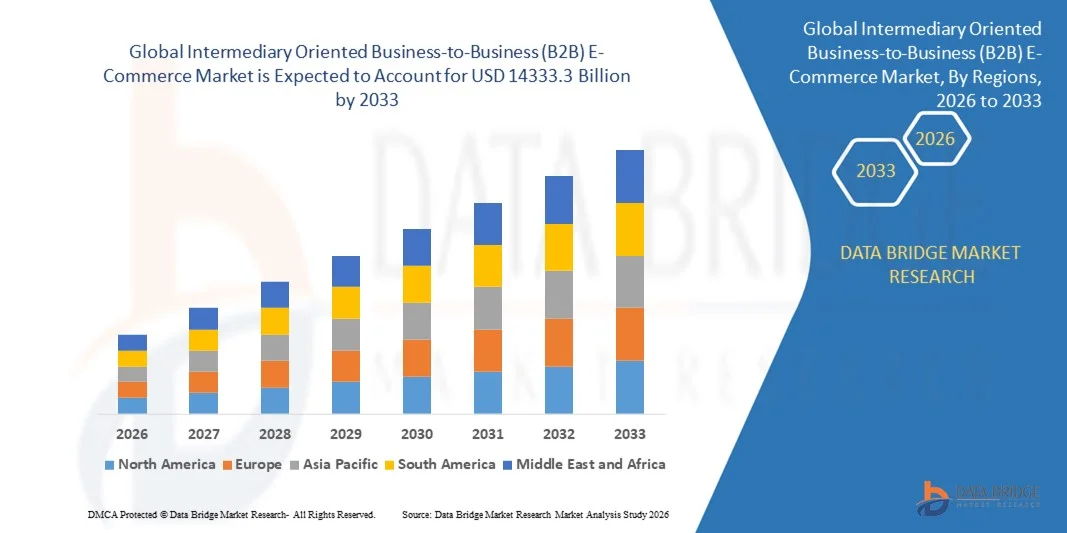
- The global intermediary oriented Business-to-Business (B2B) e- commerce market size was valued at USD 4026.47 billion in 2025 and is expected to reach USD 14333.3 billion by 2033, at a CAGR of 17.20% during the forecast period
- The market growth is largely fueled by the rapid digitalization of procurement processes and increasing adoption of online marketplaces by businesses seeking efficient supplier discovery, pricing transparency, and streamlined bulk purchasing across global supply chains
- Furthermore, the rising demand for cost-efficient procurement solutions, expansion of cross-border trade, and increasing participation of small and medium enterprises in digital commerce platforms are establishing intermediary oriented B2B e-commerce platforms as essential channels for modern business transactions, thereby significantly boosting the industry's growth
Intermediary Oriented Business-to-Business (B2B) E- Commerce Market Analysis
- Intermediary oriented B2B e-commerce platforms, which connect buyers and suppliers through digital marketplaces, are becoming critical components of modern supply chain ecosystems as they enable businesses to efficiently manage procurement, supplier networks, product catalogs, and large-scale transactions through centralized online platforms
- The growing demand for these platforms is primarily driven by the increasing shift toward digital procurement systems, rising global trade activities, expansion of cloud-based commerce technologies, and the need for businesses to improve operational efficiency and supply chain transparency in competitive global markets
- Asia-Pacific dominated the intermediary oriented Business-to-Business (B2B) e- commerce market in 2025, due to the rapid expansion of digital trade platforms, strong growth of online procurement activities, and increasing participation of small and medium enterprises in digital marketplaces
- North America is expected to be the fastest growing region in the intermediary oriented Business-to-Business (B2B) e- commerce market during the forecast period due to strong enterprise adoption of digital procurement systems and the presence of advanced e-commerce technology providers
- Cloud segment dominated the market with a market share of 61.9% in 2025, due to the growing demand for scalable, flexible, and cost-efficient digital commerce platforms. Cloud-based B2B marketplaces allow companies to manage supplier networks, product catalogs, and transaction data without heavy upfront infrastructure investments. Businesses increasingly adopt cloud platforms due to their ability to support remote accessibility, seamless software updates, and integration with enterprise systems such as ERP and CRM solutions
Report Scope and Intermediary Oriented Business-to-Business (B2B) E- Commerce Market Segmentation
|
Attributes |
Intermediary Oriented Business-to-Business (B2B) E- Commerce Key Market Insights |
|
Segments Covered |
|
|
Countries Covered |
North America
Europe
Asia-Pacific
Middle East and Africa
South America
|
|
Key Market Players |
|
|
Market Opportunities |
|
|
Value Added Data Infosets |
In addition to the market insights such as market value, growth rate, market segments, geographical coverage, market players, and market scenario, the market report curated by the Data Bridge Market Research team includes in-depth expert analysis, import/export analysis, pricing analysis, production consumption analysis, and pestle analysis. |
Intermediary Oriented Business-to-Business (B2B) E- Commerce Market Trends
Growing Adoption of Cloud-Based B2B E-Commerce Platforms
- A significant trend in the intermediary oriented B2B e-commerce market is the increasing adoption of cloud-based platforms that streamline procurement, sales, and inventory management. Cloud solutions are enabling intermediaries to manage complex supply chains efficiently, reduce operational overheads, and improve scalability across different business partners
- For instance, companies such as Shopify Plus and SAP Ariba offer cloud-based B2B e-commerce platforms that integrate procurement, order management, and supplier collaboration. These platforms enhance real-time visibility and facilitate seamless transactions across multiple partners, improving overall supply chain responsiveness
- The demand for personalized B2B buying experiences is driving platform providers to incorporate AI and analytics into their cloud solutions. Such integrations enable predictive ordering, dynamic pricing, and tailored recommendations, positioning B2B e-commerce platforms as essential tools for competitive differentiation
- Intermediaries are increasingly leveraging omnichannel capabilities, connecting online portals with offline sales and distribution networks. This trend is strengthening platform adoption by allowing seamless interactions with suppliers and customers while maintaining centralized operational oversight
- B2B e-commerce platforms are expanding their global reach to accommodate cross-border trade, providing features such as multi-currency support, localized content, and compliance management. This is accelerating digital adoption among intermediaries seeking to optimize international transactions and improve market penetration
- The growth of mobile-enabled B2B platforms is increasing as intermediaries seek real-time access to orders, inventory, and analytics. This trend is reinforcing the importance of cloud-based solutions that support operational flexibility, faster decision-making, and enhanced collaboration across geographically dispersed partners
Intermediary Oriented Business-to-Business (B2B) E- Commerce Market Dynamics
Driver
Rising Digitalization of Procurement and Supply Chain Operations
- The increasing shift toward digital procurement and supply chain management is driving the adoption of intermediary oriented B2B e-commerce solutions. Digitalization enables companies to automate workflows, enhance supplier coordination, and reduce manual errors, improving efficiency across the supply chain
- For instance, IBM’s Sterling Supply Chain solutions support enterprises in digitalizing procurement processes, offering real-time tracking, supplier collaboration, and automated order fulfillment. These capabilities reduce lead times and optimize inventory management across complex networks
- The need for faster order processing and integrated supplier communication is boosting platform adoption, as intermediaries prioritize seamless digital interactions. This enhances operational visibility, improves accuracy, and reduces processing costs for B2B transactions
- Data-driven analytics and reporting tools are increasingly incorporated to monitor supplier performance, identify inefficiencies, and support strategic decision-making. This adoption is strengthening the role of cloud-based B2B platforms in facilitating evidence-based supply chain improvements
- Enterprises are expanding investments in digital supply networks to handle growing transaction volumes and complex distribution channels. This sustained digitalization is positioning cloud-based B2B platforms as central enablers of operational efficiency, competitive advantage, and business growth
Restraint/Challenge
Data Security and Privacy Concerns in Online Transactions
- Security and privacy issues continue to challenge the growth of intermediary oriented B2B e-commerce, as sensitive corporate data is exchanged across digital platforms. Cybersecurity breaches, data leaks, and compliance risks pose potential threats that intermediaries must actively mitigate
- For instance, Walmart Connect has emphasized robust cybersecurity protocols for its B2B digital platforms to protect supplier and transactional data. Despite these measures, concerns over unauthorized access and information misuse can limit platform adoption
- The complexity of securing multi-tenant cloud environments increases vulnerability, requiring continuous monitoring, encryption, and compliance with data protection regulations such as GDPR. These security demands elevate operational costs and require specialized expertise
- Trust issues among suppliers and buyers regarding digital transactions can slow the adoption of cloud-based platforms. Ensuring data integrity and building confidence in secure transaction mechanisms remain critical challenges for platform providers
- Balancing accessibility with stringent security measures is a persistent constraint, as intermediaries need seamless operations without compromising data protection. Addressing these challenges is essential to sustain market growth while maintaining user trust and regulatory compliance
Intermediary Oriented Business-to-Business (B2B) E- Commerce Market Scope
The market is segmented on the basis of payment method, platform type, and application.
- By Payment Method
On the basis of payment method, the intermediary oriented business-to-business (B2B) e-commerce market is segmented into net banking, credit card, debit card, e-wallet, and others. The e-wallet segment dominated the market with the largest market revenue share in 2025, driven by the rapid digitalization of payments and the convenience of instant transaction processing in online B2B trade. Businesses increasingly prefer e-wallets as they enable faster settlements, simplified reconciliation, and seamless integration with digital marketplaces and mobile platforms. The widespread adoption of digital payment infrastructure and increasing use of mobile-based financial services among small and medium enterprises further supports this dominance. In addition, e-wallet platforms often provide enhanced security features, transaction tracking, and loyalty benefits, improving payment efficiency for frequent B2B purchases. The growing preference for cashless transactions across global trade ecosystems continues to strengthen the role of e-wallets in intermediary-based B2B commerce platforms.
The net banking segment is anticipated to witness the fastest growth rate from 2026 to 2033, fueled by the increasing reliance of enterprises on secure bank-to-bank digital transactions for large-value purchases. Businesses often prefer net banking due to its direct connectivity with corporate bank accounts, enabling reliable payment authorization and real-time fund transfers for procurement activities. Many B2B marketplaces integrate net banking gateways to facilitate smooth high-value transactions while maintaining strong financial verification processes. The rising adoption of online banking platforms among enterprises and the expansion of secure banking APIs further support this growth. As companies continue to shift procurement activities to digital platforms, net banking is expected to gain traction as a trusted payment option for large-scale B2B transactions.
- By Platform Type
On the basis of platform type, the intermediary oriented business-to-business (B2B) e-commerce market is segmented into cloud and on-premise. The cloud segment dominated the market with the largest market revenue share of 61.9% in 2025, driven by the growing demand for scalable, flexible, and cost-efficient digital commerce platforms. Cloud-based B2B marketplaces allow companies to manage supplier networks, product catalogs, and transaction data without heavy upfront infrastructure investments. Businesses increasingly adopt cloud platforms due to their ability to support remote accessibility, seamless software updates, and integration with enterprise systems such as ERP and CRM solutions. The cloud model also enables intermediary platforms to efficiently handle large transaction volumes while ensuring system reliability and data security. As digital procurement ecosystems continue to expand globally, cloud deployment remains the preferred choice for most B2B e-commerce intermediaries.
The on-premise segment is expected to witness the fastest growth rate from 2026 to 2033, driven by the increasing demand from large enterprises seeking higher levels of data control, customization, and regulatory compliance. Certain industries, particularly manufacturing, healthcare, and government procurement, require strict data governance policies that favor internally hosted digital commerce platforms. On-premise systems allow organizations to customize platform functionalities, integrate deeply with internal IT infrastructure, and maintain complete ownership of sensitive business data. Companies with complex procurement workflows often prefer on-premise solutions to achieve tailored operational control and advanced security management. The need for industry-specific customization and strict data protection requirements is expected to accelerate adoption of on-premise B2B commerce platforms.
- By Application
On the basis of application, the intermediary oriented business-to-business (B2B) e-commerce market is segmented into home and kitchen, consumer electronics, industrial and science, healthcare, clothing, beauty and personal care, sports apparels, books & stationary, automotive, and others. The industrial and science segment dominated the market with the largest market revenue share in 2025, driven by the extensive procurement requirements of manufacturing companies, laboratories, and engineering enterprises. Businesses frequently purchase specialized equipment, machinery components, tools, and industrial supplies through intermediary B2B platforms to streamline procurement processes. These platforms offer bulk purchasing capabilities, supplier comparisons, and efficient order management systems that support industrial supply chain operations. The growing digitalization of industrial procurement and the increasing reliance on online sourcing channels further contribute to the dominance of this segment. As industries continue to prioritize operational efficiency and supply chain transparency, demand for B2B intermediary platforms within the industrial and science category remains strong.
The consumer electronics segment is anticipated to witness the fastest growth rate from 2026 to 2033, fueled by rising global demand for electronic devices and the expansion of digital distribution networks. Businesses, retailers, and wholesalers increasingly rely on B2B e-commerce intermediaries to source smartphones, computers, accessories, and smart devices from multiple suppliers. Online intermediary platforms provide streamlined inventory management, price comparison, and large-scale procurement capabilities for electronics distributors. The rapid pace of technological innovation and shorter product life cycles in the electronics industry further encourage businesses to use digital marketplaces for efficient sourcing. As global electronics demand continues to expand, B2B intermediary platforms are expected to play a critical role in facilitating large-scale electronic product distribution.
Intermediary Oriented Business-to-Business (B2B) E- Commerce Market Regional Analysis
- Asia-Pacific dominated the intermediary oriented Business-to-Business (B2B) e- commerce market with the largest revenue share in 2025, driven by the rapid expansion of digital trade platforms, strong growth of online procurement activities, and increasing participation of small and medium enterprises in digital marketplaces
- The region’s expanding internet penetration, rapid adoption of mobile-based business platforms, and strong growth of cross-border digital trade networks are accelerating market expansion
- Increasing government initiatives promoting digital commerce, growing investments in e-commerce infrastructure, and rapid industrialization across developing economies are further supporting the adoption of intermediary-oriented B2B e-commerce platforms
China Intermediary Oriented Business-to-Business (B2B) E-Commerce Market Insight
China held the largest share in the Asia-Pacific intermediary oriented Business-to-Business (B2B) e- commerce market in 2025, owing to its extensive manufacturing ecosystem and well-developed digital commerce infrastructure. The country hosts several large-scale B2B marketplace platforms that facilitate global trade, supplier discovery, and bulk product procurement. Strong export-oriented manufacturing, advanced logistics capabilities, and widespread digital payment adoption continue to drive the growth of intermediary-based B2B commerce in the country.
India Intermediary Oriented Business-to-Business (B2B) E-Commerce Market Insight
India is witnessing the fastest growth in the Asia-Pacific region, fueled by rapid digitalization of business operations and increasing adoption of online procurement platforms among small and medium enterprises. Government initiatives supporting digital trade, expansion of internet connectivity, and growth of digital payment systems are strengthening the development of B2B marketplaces. Rising startup activity and increasing enterprise adoption of cloud-based commerce platforms are further contributing to strong market expansion.
Europe Intermediary Oriented Business-to-Business (B2B) E-Commerce Market Insight
The Europe intermediary oriented Business-to-Business (B2B) e- commerce market is expanding steadily, supported by strong digital infrastructure, increasing adoption of enterprise e-commerce platforms, and growing focus on supply chain efficiency. Businesses across the region are increasingly shifting procurement and supplier management processes to intermediary digital platforms to improve operational transparency. Strong regulatory frameworks and rising investments in digital commerce technologies are further supporting market development.
Germany Intermediary Oriented Business-to-Business (B2B) E-Commerce Market Insight
Germany’s intermediary oriented Business-to-Business (B2B) e- commerce market is driven by its strong industrial base, advanced logistics infrastructure, and increasing digitalization of procurement operations across manufacturing enterprises. Businesses in the country are actively adopting B2B marketplaces to streamline supplier sourcing, bulk purchasing, and supply chain coordination. Continuous investments in digital trade platforms and Industry 4.0 technologies further strengthen Germany’s role in the regional market.
U.K. Intermediary Oriented Business-to-Business (B2B) E-Commerce Market Insight
The U.K. market is supported by a mature digital economy, strong enterprise adoption of cloud-based commerce platforms, and growing demand for automated procurement solutions. Businesses across retail, manufacturing, and service sectors increasingly rely on intermediary B2B marketplaces to enhance purchasing efficiency and supplier management. Increasing digital transformation initiatives and cross-border e-commerce activities are further contributing to market expansion.
North America Intermediary Oriented Business-to-Business (B2B) E-Commerce Market Insight
North America is projected to grow at the fastest CAGR from 2026 to 2033, driven by strong enterprise adoption of digital procurement systems and the presence of advanced e-commerce technology providers. The region benefits from highly developed cloud infrastructure, widespread enterprise digitalization, and increasing use of AI-driven procurement platforms. Growing investments in digital supply chain management and expansion of B2B online marketplaces are further supporting market growth.
U.S. Intermediary Oriented Business-to-Business (B2B) E-Commerce Market Insight
The U.S. accounted for the largest share in the North America market in 2025, supported by its advanced digital commerce infrastructure and strong presence of global B2B marketplace providers. Businesses in the country widely adopt intermediary platforms to streamline procurement, manage supplier networks, and improve transaction efficiency. Strong innovation in e-commerce technology, extensive logistics networks, and widespread cloud adoption continue to strengthen the country’s leading position in the regional market.
Intermediary Oriented Business-to-Business (B2B) E- Commerce Market Share
The intermediary oriented Business-to-Business (B2B) e- commerce industry is primarily led by well-established companies, including:
- Amazon.com, Inc. (U.S.)
- eBay Inc. (U.S.)
- Flipkart (India)
- IndiaMART InterMESH Ltd. (India)
- ChinaAseanTrade (China)
- KOMPASS (France)
- DIYTrade.com (China)
- KellySearch (U.K.)
- Rakuten Group, Inc. (U.S.)
- DHgate (China)
- ECPlaza Network Inc. (South Korea)
- Focus Technology Co., Ltd. (China)
Latest Developments in Global Intermediary Oriented Business-to-Business (B2B) E- Commerce Market
- In February 2024, Alibaba Group expanded its global B2B platform initiatives by strengthening cross-border trade capabilities and introducing enhanced digital sourcing and supplier verification tools on Alibaba.com. This development improved trust, transaction transparency, and supplier discovery for international buyers, enabling businesses to conduct large-scale procurement through digital channels. The initiative strengthened the adoption of intermediary B2B marketplaces by facilitating smoother global trade operations and accelerating digital transformation in international procurement networks
- In January 2024, Shopify introduced advanced B2B commerce capabilities within its platform to help wholesalers, distributors, and manufacturers manage bulk purchasing and business-specific pricing through a unified digital storefront. The new features enabled companies to create customized purchasing experiences, automate procurement workflows, and integrate with enterprise systems. This development supported the expansion of intermediary-driven B2B digital commerce by making it easier for enterprises to transition from traditional wholesale operations to scalable online marketplaces
- In November 2023, Amazon.com, Inc. and West Bengal Industrial Development Corporation signed a Memorandum of Understanding to strengthen export opportunities for businesses in the state of West Bengal. Through this collaboration, companies in the region gained access to Amazon’s global marketplace infrastructure to expand international sales and reach new customers. The partnership contributed to the growth of intermediary-oriented B2B e-commerce by enabling local manufacturers and exporters to participate more actively in cross-border digital trade
- In October 2023, Flipkart launched Flipkart Commerce Cloud, a retail intelligence platform designed to provide global retailers and e-commerce companies with AI-driven insights and technology solutions. The platform offers tools for inventory optimization, demand forecasting, and digital marketplace management, helping businesses enhance their operational efficiency. This initiative strengthened the intermediary B2B e-commerce ecosystem by providing technology infrastructure that supports large-scale online retail and wholesale operations
- In June 2023, Techstars partnered with eBay Inc. to launch the “Techstars Future of Ecommerce powered by eBay” accelerator program. The initiative focuses on supporting emerging startups developing technologies for digital commerce, logistics, and marketplace innovation. By providing mentorship, investment opportunities, and industry expertise, the program contributes to the advancement of intermediary-based e-commerce platforms and fosters innovation across the global B2B digital trade ecosystem
SKU-
Get online access to the report on the World's First Market Intelligence Cloud

- Interactive Data Analysis Dashboard
- Company Analysis Dashboard for high growth potential opportunities
- Research Analyst Access for customization & queries
- Competitor Analysis with Interactive dashboard
- Latest News, Updates & Trend analysis
- Harness the Power of Benchmark Analysis for Comprehensive Competitor Tracking
Research Methodology
Data collection and base year analysis are done using data collection modules with large sample sizes. The stage includes obtaining market information or related data through various sources and strategies. It includes examining and planning all the data acquired from the past in advance. It likewise envelops the examination of information inconsistencies seen across different information sources. The market data is analysed and estimated using market statistical and coherent models. Also, market share analysis and key trend analysis are the major success factors in the market report. To know more, please request an analyst call or drop down your inquiry.
The key research methodology used by DBMR research team is data triangulation which involves data mining, analysis of the impact of data variables on the market and primary (industry expert) validation. Data models include Vendor Positioning Grid, Market Time Line Analysis, Market Overview and Guide, Company Positioning Grid, Patent Analysis, Pricing Analysis, Company Market Share Analysis, Standards of Measurement, Global versus Regional and Vendor Share Analysis. To know more about the research methodology, drop in an inquiry to speak to our industry experts.
Customization Available
Data Bridge Market Research is a leader in advanced formative research. We take pride in servicing our existing and new customers with data and analysis that match and suits their goal. The report can be customized to include price trend analysis of target brands understanding the market for additional countries (ask for the list of countries), clinical trial results data, literature review, refurbished market and product base analysis. Market analysis of target competitors can be analyzed from technology-based analysis to market portfolio strategies. We can add as many competitors that you require data about in the format and data style you are looking for. Our team of analysts can also provide you data in crude raw excel files pivot tables (Fact book) or can assist you in creating presentations from the data sets available in the report.












