




Global Intraoperative Neurophysiological Monitoring Market
Market Size in USD Billion
CAGR :
% 
 USD
2.31 Billion
USD
4.48 Billion
2025
2033
USD
2.31 Billion
USD
4.48 Billion
2025
2033
 Forecast Period Forecast Period |
2026 –2033 |
 Market Size (Base Year) Market Size (Base Year) |
USD 2.31 Billion |
 Market Size (Forecast Year) Market Size (Forecast Year) |
USD 4.48 Billion |
 CAGR CAGR |
% |
| Major Markets Players |
|
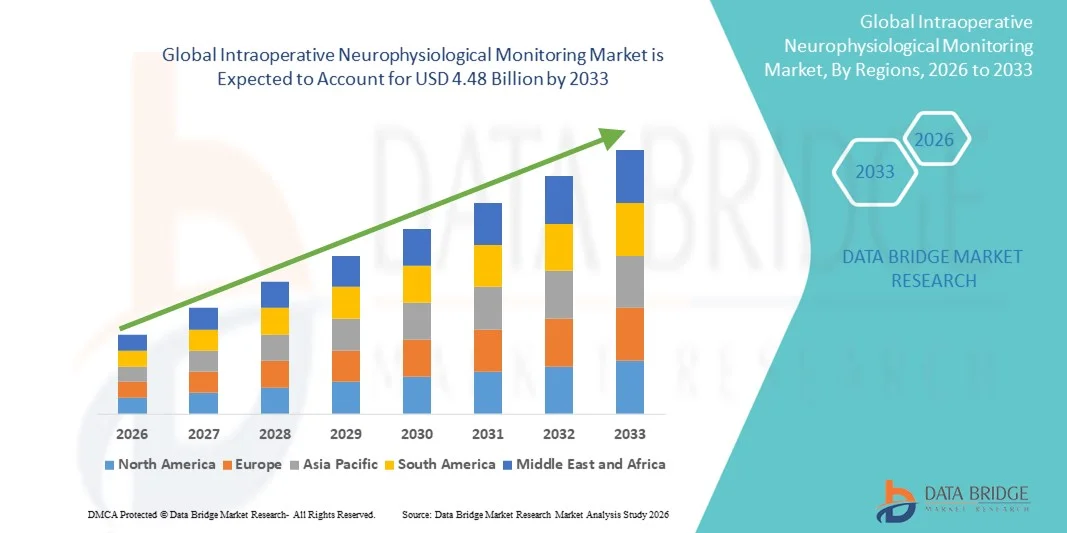
Intraoperative Neurophysiological Monitoring Market Size
- The global intraoperative neurophysiological monitoring market size was valued at USD 2.31 billion in 2025 and is expected to reach USD 4.48 billion by 2033, at a CAGR of 8.61% during the forecast period
- The market growth is largely fueled by the rising adoption of advanced surgical procedures and increasing awareness of patient safety during complex surgeries, leading to higher demand for real-time neurophysiological monitoring in operating rooms
- Furthermore, growing preference for minimally invasive surgeries, technological advancements in monitoring devices, and the integration of AI and machine learning in surgical workflows are establishing intraoperative neurophysiological monitoring as a critical component of modern surgical practice. These converging factors are accelerating the adoption of IONM solutions, thereby significantly boosting the industry's growth
Intraoperative Neurophysiological Monitoring Market Analysis
- Intraoperative neurophysiological monitoring (IONM), providing real-time assessment of neural pathways during surgeries, is increasingly vital in both neurosurgical and orthopedic procedures due to its ability to enhance patient safety, minimize postoperative complications, and support precision in complex surgical interventions
- The escalating demand for intraoperative neurophysiological monitoring is primarily fueled by the rising volume of complex surgeries, increasing awareness among surgeons and patients regarding neurological safety, and technological advancements in monitoring modalities such as EMG, EEG, and SSEP
- North America dominated the intraoperative neurophysiological monitoring market with the largest revenue share of 40.2% in 2025, characterized by high adoption of advanced surgical procedures, strong healthcare infrastructure, and a robust presence of leading IONM service providers and device manufacturers, with the U.S. witnessing substantial growth in IONM utilization across neurosurgeries, spinal surgeries, and minimally invasive procedures
- Asia-Pacific is expected to be the fastest growing region in the intraoperative neurophysiological monitoring market during the forecast period due to rising healthcare expenditures, increasing number of surgical procedures, and growing awareness of patient safety during surgeries
- Spinal segment dominated the intraoperative neurophysiological monitoring market with a market share of 44.7% in 2025, driven by the critical need for real-time neural monitoring to prevent nerve damage and improve surgical outcomes
Report Scope and Intraoperative Neurophysiological Monitoring Market Segmentation
|
Attributes |
Intraoperative Neurophysiological Monitoring Key Market Insights |
|
Segments Covered |
|
|
Countries Covered |
North America
Europe
Asia-Pacific
Middle East and Africa
South America
|
|
Key Market Players |
|
|
Market Opportunities |
|
|
Value Added Data Infosets |
In addition to the insights on market scenarios such as market value, growth rate, segmentation, geographical coverage, and major players, the market reports curated by the Data Bridge Market Research also include in-depth expert analysis, patient epidemiology, pipeline analysis, pricing analysis, and regulatory framework |
Intraoperative Neurophysiological Monitoring Market Trends
Integration of AI and Remote Monitoring Solutions
- A significant and accelerating trend in the global IONM market is the integration of artificial intelligence (AI) and remote monitoring platforms, enabling real-time neural monitoring and predictive analytics during surgeries
- For instance, NuVasive Clinical Services offers remote IONM capabilities that allow expert neurophysiologists to monitor complex spinal procedures from offsite locations, ensuring timely interventions
- AI integration in IONM systems enables features such as automated detection of neural signal anomalies, predictive alerts for potential complications, and workflow optimization in the operating room. For instance, some Medtronic and Natus devices utilize AI to enhance signal interpretation accuracy and provide real-time risk assessments
- Remote monitoring capabilities allow hospitals to access specialized IONM expertise without geographic constraints, ensuring high-quality neural surveillance even in smaller or resource-limited surgical centers
- This trend towards more intelligent, connected, and predictive monitoring systems is reshaping surgical protocols, with companies such as Axon Monitoring developing AI-enabled IONM platforms that integrate with electronic health records and provide remote expert oversight
- The demand for IONM systems featuring AI and remote monitoring is growing rapidly across both developed and emerging markets, as hospitals increasingly prioritize patient safety and operational efficiency during complex surgeries
- Increasing integration of multimodal monitoring techniques, such as EMG, SSEP, and EEG, into single platforms is improving surgical precision and workflow efficiency
- Adoption of wireless and portable IONM devices is enabling more flexible setups in operating rooms and expanding usage across smaller surgical centers
Intraoperative Neurophysiological Monitoring Market Dynamics
Driver
Rising Demand Due to Increasing Complex Surgeries and Patient Safety Awareness
- The increasing number of complex neurosurgeries, spinal surgeries, and orthopedic procedures, coupled with rising awareness of intraoperative patient safety, is a significant driver for the heightened demand for IONM
- For instance, in March 2025, NuVasive Clinical Services expanded its remote monitoring network to support high-volume spinal procedures, enhancing access to expert neurophysiologists
- As surgeons and healthcare facilities prioritize minimizing postoperative complications, IONM offers advanced real-time neural monitoring, improving surgical precision and outcomes
- Furthermore, the growing adoption of minimally invasive surgical techniques, along with regulatory emphasis on patient safety, is making IONM an integral component of surgical workflows
- The ability to monitor neural function continuously during surgery, provide immediate alerts for potential damage, and improve long-term patient outcomes is key to the increasing adoption of IONM solutions across hospitals and surgical centers
- Rising investments in healthcare infrastructure, especially in emerging economies, are supporting broader deployment of advanced surgical monitoring technologies
- Strategic collaborations between hospitals and IONM service providers are expanding access to specialized monitoring services, particularly in regions with limited in-house neurophysiology expertise
Restraint/Challenge
High Costs and Skilled Workforce Requirement
- The relatively high cost of IONM devices and services, along with the need for specialized neurophysiologists to interpret intraoperative data, poses a significant challenge to wider market penetration
- For instance, smaller hospitals or clinics in emerging markets often face difficulties in acquiring advanced monitoring systems or hiring trained personnel for continuous intraoperative monitoring
- Addressing these challenges requires training programs for neurophysiologists, adoption of cost-effective IONM solutions, and development of AI-assisted interpretation tools to reduce reliance on manual expertise
- In addition, regulatory requirements for medical device certification, data privacy, and clinical validation can slow the adoption of IONM technologies, particularly in regions with stringent healthcare regulations
- While costs are gradually decreasing and AI-assisted platforms are emerging, the perceived premium and resource-intensive setup can still hinder widespread adoption, especially in budget-constrained hospitals or for low-volume surgical centers
- Overcoming these barriers through affordable solutions, workforce training, and streamlined regulatory approvals will be vital for sustained market growth in the global IONM industry
- Limited awareness among surgeons and healthcare administrators about the benefits of IONM can slow adoption in emerging markets
- Maintenance, calibration, and software update requirements for advanced IONM systems can increase operational complexity, deterring smaller hospitals from investing in such technologies
Intraoperative Neurophysiological Monitoring Market Scope
The market is segmented on the basis of type, methods, source, procedure, end user, and services.
- By Type
On the basis of type, the IONM market is segmented into EEG, EMG, and Evoked Potentials (EP). The Evoked Potentials (EP) segment dominated the market with the largest market revenue share in 2025, driven by its critical role in monitoring sensory and motor pathways during complex neurosurgeries and spinal procedures. EP monitoring, including somatosensory (SSEP), motor (MEP), and visual (VEP) potentials, helps detect neural injury in real time, improving surgical outcomes. Hospitals and surgical centers prioritize EP monitoring for high-risk procedures due to its proven reliability and ability to prevent postoperative deficits. The segment also benefits from increasing awareness among surgeons and healthcare providers about patient safety and regulatory emphasis on intraoperative monitoring. The integration of EP monitoring with AI-assisted analytics and multimodal IONM systems further enhances its precision and clinical utility. Growing investments in advanced surgical procedures and postoperative care are also contributing to the segment’s dominance.
The EEG segment is expected to witness the fastest growth rate from 2026 to 2033, fueled by rising adoption in neurovascular and minimally invasive surgeries. EEG monitoring offers non-invasive, continuous assessment of cortical activity, enabling early detection of ischemic events or seizure activity. Its portability, ease of setup, and integration with tele-health and remote monitoring platforms make it increasingly attractive for hospitals expanding neurosurgical capabilities. Rising awareness of neurological safety and the increasing number of neurological procedures globally are driving demand for EEG-based IONM solutions. Technological advancements, such as AI-assisted EEG signal interpretation, are improving the accuracy and clinical value of EEG monitoring. In addition, government initiatives and hospital investments in digital health are further accelerating growth in this segment.
- By Methods
On the basis of methods, the IONM market is segmented into invasive, non-invasive, and minimally invasive techniques. The minimally invasive segment dominated the market in 2025 due to the increasing preference for minimally invasive surgeries that reduce operative trauma and recovery times. Minimally invasive IONM methods, such as percutaneous EMG and SSEP, provide accurate real-time neural monitoring without significantly increasing surgical complexity. Hospitals favor these techniques for their lower risk of complications and ability to integrate with advanced surgical navigation systems. Surgeons benefit from minimally invasive monitoring due to reduced interference with surgical workflows and enhanced procedural precision. Regulatory guidelines promoting safer surgical interventions also contribute to the segment's dominance. In addition, patient preference for shorter recovery times and less invasive procedures supports the continued adoption of minimally invasive IONM methods.
The non-invasive segment is expected to witness the fastest growth rate from 2026 to 2033, driven by rising demand for safe and cost-effective monitoring in smaller hospitals and outpatient surgical centers. Non-invasive methods, such as scalp EEG and surface EMG, eliminate the need for direct neural access while providing reliable intraoperative feedback. Tele-health IONM services further boost adoption by allowing remote expert monitoring. Non-invasive techniques are also preferred in pediatric and geriatric surgeries due to safety considerations. Growing awareness among surgeons and patients about non-invasive monitoring benefits is encouraging broader adoption. The segment benefits from continuous innovation in wearable and wireless monitoring technologies.
- By Source
On the basis of source, the IONM market is segmented into in-house, outsource, and tele-health. The in-house segment dominated the market in 2025, supported by hospitals with established neurophysiology departments that prefer direct control over monitoring processes for high-risk surgeries. In-house IONM allows surgical teams to collaborate closely with neurophysiologists, ensuring immediate response to intraoperative neural alerts. Larger hospitals and academic medical centers favor in-house setups due to the availability of trained personnel, integrated infrastructure, and established protocols. Hospitals with high surgical volumes benefit from maintaining in-house IONM teams for better coordination and patient outcomes. The segment also benefits from regulatory emphasis on institutional accountability and compliance. Investment in training programs and advanced infrastructure further strengthens the dominance of the in-house model.
The tele-health segment is expected to witness the fastest growth rate from 2026 to 2033, fueled by the rising demand for remote IONM services, particularly in emerging markets and rural regions. Tele-health IONM enables expert neurophysiologists to monitor surgeries across geographies in real time, reducing the dependence on local specialists. Hospitals and surgical centers can access specialized monitoring without investing in full-time staff. Cloud-based platforms and AI-assisted analysis enhance the efficiency and reliability of remote monitoring. The segment also benefits from growing internet penetration and digital health initiatives. Cost-effectiveness and flexibility in scaling IONM services further drive growth in the tele-health segment.
- By Procedure
On the basis of procedure, the IONM market is segmented into spinal, neurovascular, orthopedic, otolaryngology, and urology surgeries. The spinal surgery segment dominated the market in 2025 with a market share of 44.7%, driven by the critical need for continuous neural monitoring to prevent nerve damage and paralysis during complex spinal procedures. Spinal IONM, including MEP and SSEP, is widely adopted due to its ability to provide real-time alerts for surgical adjustments. Growing prevalence of spinal deformities, trauma cases, and degenerative spine conditions is driving the segment. Hospitals rely on spinal monitoring to improve surgical precision and patient safety. The segment benefits from strong clinical evidence supporting reduced postoperative complications. Rising investments in spine surgery centers further contribute to segment growth.
The neurovascular surgery segment is expected to witness the fastest growth rate from 2026 to 2033, fueled by the increasing number of aneurysm repairs, AVM surgeries, and carotid procedures requiring precise cortical monitoring. Minimally invasive neurovascular techniques are further driving demand for advanced IONM systems. Neurovascular IONM improves early detection of ischemic events and neurological deficits. Hospitals are increasingly integrating AI-assisted monitoring into neurovascular procedures. Awareness campaigns and regulatory emphasis on patient safety accelerate adoption. Expansion of specialized neurovascular centers in emerging regions supports rapid segment growth.
- By End User
On the basis of end user, the IONM market is segmented into hospitals and ambulatory surgical centers (ASCs). The hospitals segment dominated the market in 2025 due to their higher surgical volumes, availability of specialized neurosurgeons and neurophysiologists, and robust infrastructure supporting multimodal IONM systems. Hospitals prefer in-house monitoring for high-risk procedures, ensuring patient safety and regulatory compliance. Hospitals also benefit from advanced training programs for neurophysiologists and integrated electronic health records. Rising patient awareness and hospital initiatives to minimize complications contribute to the segment’s dominance. Larger hospitals invest in multimodal IONM systems for improved surgical outcomes. Regulatory requirements and accreditation standards further support adoption in hospitals.
The ambulatory surgical centers (ASCs) segment is expected to witness the fastest growth rate from 2026 to 2033, fueled by the increasing number of outpatient surgeries and minimally invasive procedures. ASCs are increasingly integrating portable and tele-health IONM solutions to provide cost-effective, real-time neural monitoring. The flexibility and lower overhead of ASCs allow rapid adoption of modern IONM technologies. Growth is supported by increasing patient demand for outpatient procedures with faster recovery. Tele-health platforms enable ASCs to access expert neurophysiologists remotely. Partnerships with IONM service providers further accelerate adoption in ASCs.
- By Services
On the basis of services, the IONM market is segmented into systems, accessories, and services. The services segment dominated the market in 2025, driven by the growing reliance on trained neurophysiologists for intraoperative monitoring and interpretation of complex neural signals. Service providers offer both on-site and remote monitoring, providing hospitals flexibility and expertise. Increasing surgical volumes and complexity, along with rising outsourcing in emerging markets, support service segment growth. Hospitals benefit from services to manage staffing, training, and compliance requirements. Continuous support and AI-assisted interpretation further enhance the value of service offerings. Rising awareness of improved surgical outcomes drives strong adoption of IONM services.
The systems segment is expected to witness the fastest growth rate from 2026 to 2033, fueled by advancements in multimodal IONM devices, AI integration, and portable systems. Hospitals and ASCs are investing in modern IONM platforms to improve procedural efficiency and patient safety. Growth is supported by integration with tele-health and cloud-based monitoring solutions. Continuous product innovation, such as AI-assisted alerts and compact devices, drives adoption. Increasing hospital budgets for advanced surgical technologies further boost segment growth. Government initiatives promoting digital health infrastructure accelerate the deployment of IONM systems globally.
Intraoperative Neurophysiological Monitoring Market Regional Analysis
- North America dominated the intraoperative neurophysiological monitoring market with the largest revenue share of 40.2% in 2025, characterized by high adoption of advanced surgical procedures, strong healthcare infrastructure, and a robust presence of leading IONM service providers and device manufacturers, with the U.S. witnessing substantial growth in IONM utilization across neurosurgeries, spinal surgeries, and minimally invasive procedures
- Hospitals and surgical centers in the region highly prioritize patient safety and intraoperative neural monitoring, supporting widespread adoption of advanced IONM systems and multimodal monitoring techniques
- This dominance is further supported by strong healthcare infrastructure, high adoption of minimally invasive and technologically advanced surgical procedures, and a robust presence of key IONM service providers and device manufacturers
U.S. Intraoperative Neurophysiological Monitoring Market Insight
The U.S. intraoperative neurophysiological monitoring market captured the largest revenue share of 40% in 2025, fueled by the increasing number of complex neurosurgeries, spinal procedures, and orthopedic interventions. Hospitals are prioritizing patient safety and precision surgery through advanced, real-time intraoperative neurophysiological monitoring. The growing adoption of minimally invasive surgeries, AI-assisted monitoring, and tele-health intraoperative neurophysiological monitoring services further propels the market. In addition, strong healthcare infrastructure, regulatory emphasis on patient safety, and investments in neurophysiologist training programs are driving market expansion. The U.S. market benefits from both in-house and outsourced intraoperative neurophysiological monitoring services, enhancing accessibility and operational efficiency. Increasing awareness among surgeons and patients regarding neurological safety during surgeries is also a key factor supporting growth.
Europe Intraoperative Neurophysiological Monitoring Market Insight
The Europe intraoperative neurophysiological monitoring market is projected to expand at a substantial CAGR during the forecast period, primarily driven by the rising volume of neurosurgeries and spinal procedures and regulatory emphasis on patient safety. Growing awareness of intraoperative neurophysiological monitoring benefits among surgeons, along with advanced healthcare infrastructure, supports adoption in both hospitals and specialized surgical centers. Increased urbanization, technological advancements, and integration of AI-assisted monitoring solutions foster growth. European countries are investing in multimodal intraoperative neurophysiological monitoring platforms combining EEG, EMG, and EP monitoring for improved surgical outcomes. The market is seeing increasing uptake across both public and private hospitals. Growing demand for minimally invasive surgeries and remote monitoring solutions is further boosting the European intraoperative neurophysiological monitoring market.
U.K. Intraoperative Neurophysiological Monitoring Market Insight
The U.K. intraoperative neurophysiological monitoring market is anticipated to grow at a noteworthy CAGR during the forecast period, driven by rising awareness of neurological safety and the increasing number of spinal and neurovascular surgeries. Hospitals and surgical centers are focusing on high-quality patient care and reducing postoperative complications, promoting adoption of intraoperative neurophysiological monitoring systems. Integration of AI-assisted monitoring and tele-health services is enhancing operational efficiency and surgical precision. The U.K.’s robust healthcare infrastructure and emphasis on advanced surgical technologies support market expansion. Partnerships with intraoperative neurophysiological monitoring service providers enable broader access to expert neurophysiologists. Government and private initiatives aimed at improving patient safety during surgeries further stimulate market growth.
Germany Intraoperative Neurophysiological Monitoring Market Insight
The Germany intraoperative neurophysiological monitoring market is expected to expand at a considerable CAGR during the forecast period, fueled by increasing awareness of intraoperative neurophysiological monitoring and demand for technologically advanced surgical solutions. Hospitals in Germany are investing in multimodal monitoring systems to ensure high-quality care during spinal, neurovascular, and orthopedic surgeries. Integration of intraoperative neurophysiological monitoring with minimally invasive procedures and AI-assisted analytics enhances surgical accuracy. Germany’s strong healthcare infrastructure and focus on innovation support adoption of advanced intraoperative neurophysiological monitoring platforms. The market is witnessing growing preference for tele-health intraoperative neurophysiological monitoring services to optimize resource utilization. Patient safety regulations and rising surgical volumes further drive market growth.
Asia-Pacific Intraoperative Neurophysiological Monitoring Market Insight
The Asia-Pacific intraoperative neurophysiological monitoring market is poised to grow at the fastest CAGR during the forecast period, driven by increasing surgical volumes, urbanization, and rising healthcare expenditure in countries such as China, Japan, and India. Hospitals are increasingly adopting advanced intraoperative neurophysiological monitoring systems to improve surgical outcomes and patient safety. Government initiatives promoting digital health and telemedicine are supporting the expansion of intraoperative neurophysiological monitoring services. The rising number of minimally invasive and neurovascular surgeries further fuels market growth. Technological advancements in AI-assisted monitoring and portable systems enhance accessibility in both urban and semi-urban hospitals. Regional market growth is also supported by increasing awareness among surgeons and patients about neurological safety.
Japan Intraoperative Neurophysiological Monitoring Market Insight
The Japan intraoperative neurophysiological monitoring market is gaining momentum due to the country’s advanced healthcare infrastructure, high adoption of technology, and increasing number of complex neurosurgeries. Hospitals are prioritizing patient safety and postoperative outcomes through the integration of AI-assisted and tele-health intraoperative neurophysiological monitoring solutions. Growing demand for minimally invasive surgeries and neurovascular procedures is contributing to adoption. The aging population in Japan is driving demand for safer surgical interventions with precise intraoperative neurophysiological monitoring. Integration of intraoperative neurophysiological monitoring with electronic health records and advanced surgical systems supports efficiency and accuracy. Awareness campaigns and government support for digital health initiatives further stimulate market growth.
India Intraoperative Neurophysiological Monitoring Market Insight
The India intraoperative neurophysiological monitoring market accounted for the largest market revenue share in Asia-Pacific in 2025, attributed to increasing healthcare investments, growing surgical volumes, and rising awareness of neurological safety. Hospitals and surgical centers are increasingly adopting advanced intraoperative neurophysiological monitoring systems to improve patient outcomes in neurosurgery and spinal procedures. Government initiatives promoting digital health and minimally invasive surgeries support market expansion. Rising demand for tele-health intraoperative neurophysiological monitoring services addresses the shortage of trained neurophysiologists in smaller cities. Affordability of portable intraoperative neurophysiological monitoring systems and local manufacturing of devices are also contributing factors. The push towards advanced healthcare infrastructure in urban and semi-urban regions is further propelling market growth.
Intraoperative Neurophysiological Monitoring Market Share
The Intraoperative Neurophysiological Monitoring industry is primarily led by well-established companies, including:
- Natus Medical Incorporated (U.S.)
- NIHON KOHDEN CORPORATION (Japan)
- Cadwell Industries Inc. (U.S.)
- Medtronic (Ireland)
- Neurovision Medical Products LLC (U.S.)
- SpecialtyCare, Inc. (U.S.)
- Accurate Monitoring, LLC (U.S.)
- IntraNerve Neuroscience Holdings, LLC (U.S.)
- Medsurant Monitoring (U.S.)
- Medsurant Health (U.S.)
- Neuro Medix (U.S.)
- SentientSMS (U.S.)
- NuVasive®, Inc. (U.S.)
- Impulse Monitoring, Inc. (U.S.)
- US Neuromonitoring, Inc. (U.S.)
- Biotronic NeuroNetwork (U.S.)
- Neuromonitoring Technologies (U.S.)
- Micromed (Italy)
- ProPep Surgical, Inc. (U.S.)
- Rhythmlink International, LLC (U.S.)
What are the Recent Developments in Global Intraoperative Neurophysiological Monitoring Market?
- In December 2025, Medivis Inc. secured FDA 510(k) clearance for its CRANial Navigation augmented reality platform to support real‑time intraoperative guidance during neurosurgery, enhancing visualization and decision‑making that complements intraoperative neurophysiological monitoring practices
- In October 2025, Acta Neurochirurgica published an open access study detailing the workflow and outcomes of intraoperative neurophysiological monitoring in intramedullary spinal cord lesion surgery, underscoring the clinical value and increasing institutional adoption of multimodal IONM techniques
- In July 2024, Soterix Medical announced that the U.S. Food and Drug Administration granted 510(k) clearance for its MEGA‑IOM system, a modular intraoperative neurophysiological monitoring platform designed to support multimodal monitoring (including motor and sensory evoked potentials and EEG) and help reduce postoperative neurological risk
- In December 2022, Wise announced that the U.S. FDA cleared the WISE Cortical Strip (WCS), a single‑use electrode device intended for intraoperative neurophysiological monitoring on the brain’s surface that is more conformable and ergonomic than traditional electrodes used in surgical neuromonitoring
- In May 2021, Neurosoft announced that its Neuro‑IOM multimodal intraoperative neurophysiological monitoring system was approved by the U.S. FDA, supporting a broad range of monitoring modalities (EEG, EMG, evoked potentials) and reinforcing clinical availability of advanced IONM instrumentation
SKU-
Get online access to the report on the World's First Market Intelligence Cloud

- Interactive Data Analysis Dashboard
- Company Analysis Dashboard for high growth potential opportunities
- Research Analyst Access for customization & queries
- Competitor Analysis with Interactive dashboard
- Latest News, Updates & Trend analysis
- Harness the Power of Benchmark Analysis for Comprehensive Competitor Tracking
Research Methodology
Data collection and base year analysis are done using data collection modules with large sample sizes. The stage includes obtaining market information or related data through various sources and strategies. It includes examining and planning all the data acquired from the past in advance. It likewise envelops the examination of information inconsistencies seen across different information sources. The market data is analysed and estimated using market statistical and coherent models. Also, market share analysis and key trend analysis are the major success factors in the market report. To know more, please request an analyst call or drop down your inquiry.
The key research methodology used by DBMR research team is data triangulation which involves data mining, analysis of the impact of data variables on the market and primary (industry expert) validation. Data models include Vendor Positioning Grid, Market Time Line Analysis, Market Overview and Guide, Company Positioning Grid, Patent Analysis, Pricing Analysis, Company Market Share Analysis, Standards of Measurement, Global versus Regional and Vendor Share Analysis. To know more about the research methodology, drop in an inquiry to speak to our industry experts.
Customization Available
Data Bridge Market Research is a leader in advanced formative research. We take pride in servicing our existing and new customers with data and analysis that match and suits their goal. The report can be customized to include price trend analysis of target brands understanding the market for additional countries (ask for the list of countries), clinical trial results data, literature review, refurbished market and product base analysis. Market analysis of target competitors can be analyzed from technology-based analysis to market portfolio strategies. We can add as many competitors that you require data about in the format and data style you are looking for. Our team of analysts can also provide you data in crude raw excel files pivot tables (Fact book) or can assist you in creating presentations from the data sets available in the report.












