




Global Iot Medical Devices Market
Market Size in USD Billion
CAGR :
% 
 USD
65.08 Billion
USD
174.48 Billion
2025
2033
USD
65.08 Billion
USD
174.48 Billion
2025
2033
 Forecast Period Forecast Period |
2026 –2033 |
 Market Size (Base Year) Market Size (Base Year) |
USD 65.08 Billion |
 Market Size (Forecast Year) Market Size (Forecast Year) |
USD 174.48 Billion |
 CAGR CAGR |
% |
| Major Markets Players |
|
IoT Medical Devices Market Size
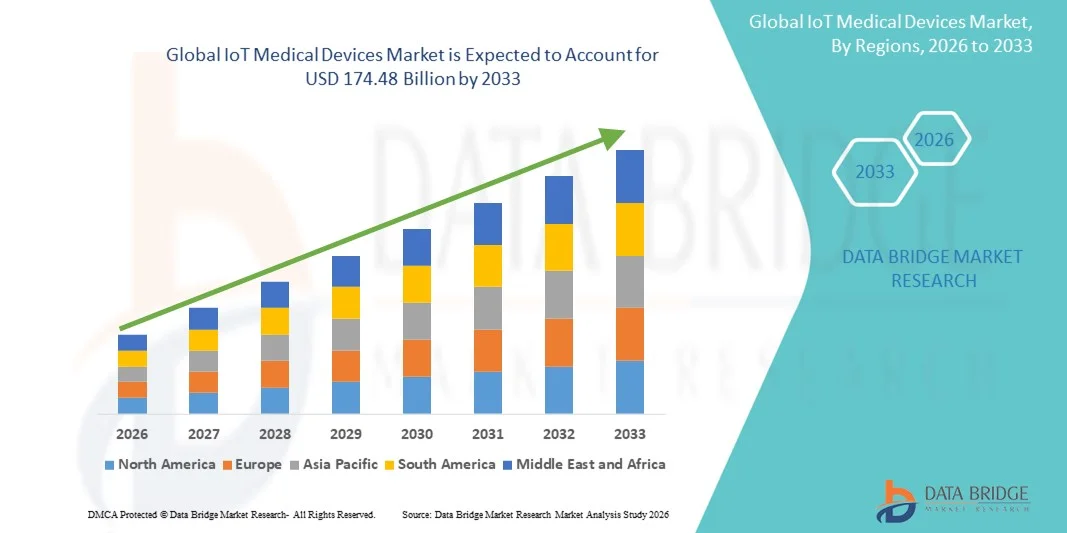
- The global IoT medical devices market size was valued at USD 65.08 billion in 2025 and is expected to reach USD 174.48 billion by 2033, at a CAGR of 13.12% during the forecast period
- The market growth is largely driven by the increasing adoption of connected healthcare technologies and rapid advancements in IoT-enabled medical devices, leading to greater digitalization and real-time data exchange across hospitals, clinics, and home-care settings
- Furthermore, rising demand for continuous patient monitoring, remote diagnostics, and secure, user-friendly, and interoperable healthcare solutions is positioning IoT medical devices as a core component of modern healthcare delivery. These converging factors are accelerating the uptake of IoT Medical Devices solutions, thereby significantly boosting the overall growth of the industry
IoT Medical Devices Market Analysis
- IoT Medical Devices, which enable real-time patient monitoring, data collection, and remote healthcare delivery through connected sensors and platforms, are becoming integral to modern healthcare systems across hospitals, clinics, and home-care settings due to their ability to improve clinical outcomes, operational efficiency, and patient engagement
- The escalating demand for IoT medical devices is primarily driven by the rising prevalence of chronic diseases, growing adoption of remote patient monitoring and telehealth services, increasing healthcare digitalization, and a strong focus on reducing hospital readmissions while improving quality of care
- North America dominated the IoT Medical Devices market with the largest revenue share of approximately 42.3% in 2025, supported by advanced healthcare infrastructure, high healthcare IT spending, early adoption of connected medical technologies, favorable reimbursement policies, and strong presence of leading medical device manufacturers and technology providers, with the U.S. accounting for a significant portion of regional growth
- Asia-Pacific is expected to be the fastest-growing region in the IoT Medical Devices market during the forecast period, registering a CAGR of around 11.6%, driven by rapidly expanding healthcare infrastructure, rising chronic disease burden, increasing government initiatives for digital health, growing adoption of wearable and remote monitoring devices, and improving internet and mobile connectivity across emerging economies
- The Wi-Fi segment held the largest market revenue share of 42.5% in 2025, due to its ubiquitous availability, cost-effectiveness, and ability to provide high-bandwidth connectivity for multiple devices simultaneously
Report Scope and IoT Medical Devices Market Segmentation
|
Attributes |
IoT Medical Devices Key Market Insights |
|
Segments Covered |
|
|
Countries Covered |
North America
Europe
Asia-Pacific
Middle East and Africa
South America
|
|
Key Market Players |
• Philips Healthcare (Netherlands) |
|
Market Opportunities |
|
|
Value Added Data Infosets |
In addition to the insights on market scenarios such as market value, growth rate, segmentation, geographical coverage, and major players, the market reports curated by the Data Bridge Market Research also include in-depth expert analysis, patient epidemiology, pipeline analysis, pricing analysis, and regulatory framework. |
IoT Medical Devices Market Trends
Expansion of Connected Healthcare Solutions and Remote Monitoring
- A significant and accelerating trend in the global IoT medical devices market is the increasing adoption of connected healthcare systems that allow remote monitoring, data collection, and real-time patient management. Hospitals, clinics, and home care providers are increasingly deploying IoT-enabled devices to track patient vitals, manage chronic conditions, and facilitate telehealth services
- For instance, in 2024, several hospitals in Europe and North America integrated connected infusion pumps and wearable monitoring devices into their clinical workflows, enabling continuous patient monitoring and proactive interventions
- Remote monitoring solutions are also being increasingly used in home care settings, allowing healthcare providers to monitor patients with cardiovascular, respiratory, or metabolic conditions without frequent hospital visits
- The trend reflects a broader shift toward digital healthcare ecosystems, where interoperability between devices, electronic health records, and analytics platforms improves patient outcomes and operational efficiency
- Globally, governments and private healthcare institutions are investing in IoT-enabled medical infrastructure to enhance healthcare delivery, reduce hospital readmissions, and optimize resource utilization
IoT Medical Devices Market Dynamics
Driver
Rising Prevalence of Chronic Diseases and Need for Efficient Healthcare Management
- The growth of the IoT Medical Devices market is primarily driven by the increasing prevalence of chronic diseases, aging populations, and the need for timely and efficient healthcare interventions. Remote monitoring, predictive analytics, and connected devices allow clinicians to detect complications early, improve patient adherence, and reduce hospital stays
- For instance, in 2025, hospitals in Asia-Pacific expanded the use of wearable IoT devices for patients with diabetes and hypertension, facilitating continuous glucose and blood pressure monitoring and enabling personalized treatment plans
- Investment in smart hospitals, telemedicine services, and home-based care solutions is further encouraging the adoption of IoT medical devices
- In addition, rising awareness among patients and healthcare providers about the benefits of connected devices, including real-time health tracking, early detection of anomalies, and remote consultation capabilities, is accelerating market growth across both developed and emerging markets
Restraint/Challenge
High Implementation Costs and Data Security Concerns
- Despite strong demand, the IoT Medical Devices market faces challenges related to high initial investment costs and data privacy concerns. Hospitals and healthcare providers often encounter significant expenses for device procurement, integration with existing IT systems, and staff training
- For instance, some mid-sized clinics in Latin America and Africa have delayed adoption due to the high cost of deploying comprehensive IoT-enabled patient monitoring solutions
- Moreover, the collection, transmission, and storage of sensitive patient health data raise significant privacy and cybersecurity concerns. Inadequate data security protocols can lead to breaches, unauthorized access, and regulatory non-compliance, which may deter potential users from implementing IoT solutions
- Addressing these challenges through cost-effective devices, simplified integration processes, robust cybersecurity measures, and compliance with global data protection standards will be critical to sustaining growth in the IoT Medical Devices market worldwide
IoT Medical Devices Market Scope
The market is segmented on the basis of application, connectivity technology, and end users.
- By Application
On the basis of application, the IoT Medical Devices market is segmented into telemedicine, clinical operations and workflow management, connected imaging, inpatient monitoring, and medication management. The telemedicine segment dominated the largest market revenue share of 38.7% in 2025, driven by the rapid adoption of remote patient care solutions, growing prevalence of chronic diseases, and increased patient demand for accessible healthcare. Telemedicine platforms integrate IoT-enabled devices such as wearable sensors and remote monitoring tools, enabling real-time data collection and improved patient outcomes. Government support and reimbursement policies in developed countries are further fueling adoption. Telemedicine also reduces hospital readmissions and enhances continuity of care. Increasing smartphone penetration and broadband internet availability accelerate deployment. Hospitals and clinics leverage telemedicine to manage large patient populations efficiently. Rising awareness about remote monitoring benefits supports market dominance. The segment benefits from AI-assisted diagnostics and predictive analytics features. Integration with electronic health records (EHRs) strengthens workflow efficiency. The COVID-19 pandemic accelerated telemedicine adoption, solidifying its leading position.
The connected imaging segment is expected to witness the fastest CAGR of 19.2% from 2026 to 2033, driven by increasing demand for IoT-enabled imaging devices in radiology, cardiology, and oncology. Hospitals are investing in connected imaging solutions to enable real-time sharing of imaging data, improving collaboration among specialists. The integration of AI and cloud analytics enhances diagnostic accuracy and speeds up clinical decision-making. Rising focus on preventive care and early diagnosis encourages adoption. Imaging equipment vendors are upgrading legacy systems with IoT sensors and connectivity modules. Remote access and secure data transfer capabilities support expansion. The segment is further boosted by demand for portable imaging devices in outpatient and home care settings. Rising investments in healthcare infrastructure in APAC and MEA regions support CAGR growth. Connected imaging solutions reduce workflow bottlenecks and improve patient throughput. Interoperability with hospital information systems (HIS) and PACS facilitates seamless integration. Adoption of IoT in imaging supports tele-radiology services. Increasing research in IoT imaging analytics also drives market momentum.
- By Connectivity Technology
On the basis of connectivity technology, the IoT Medical Devices market is segmented into Bluetooth Low Energy (BLE), Wi-Fi, cellular, near field communication (NFC), and satellite. The Wi-Fi segment held the largest market revenue share of 42.5% in 2025, due to its ubiquitous availability, cost-effectiveness, and ability to provide high-bandwidth connectivity for multiple devices simultaneously. Wi-Fi supports real-time streaming of patient data, remote monitoring, and cloud-based analytics, making it the preferred choice in hospitals and clinics. Integration with hospital IT infrastructure and EHR systems enables seamless workflow management. Wi-Fi-enabled devices are highly compatible with telemedicine and connected imaging applications. High data transfer reliability and low latency enhance clinical accuracy. Hospitals in developed regions extensively deploy Wi-Fi IoT devices. Growing demand for smart hospital solutions accelerates adoption. Vendor-led training and support improve system integration. Wi-Fi technology supports remote firmware updates, ensuring device longevity. Patient monitoring, medication management, and asset tracking benefit from Wi-Fi connectivity. Network security and encryption protocols further reinforce its reliability.
The Bluetooth Low Energy (BLE) segment is expected to witness the fastest CAGR of 18.6% from 2026 to 2033, driven by low power consumption, cost efficiency, and compatibility with wearable devices. BLE is widely adopted in patient monitoring, telemedicine, and medication adherence devices. Portable and wearable devices leverage BLE for seamless data transfer to smartphones or hubs. Rising trend of home-based healthcare and remote patient monitoring fuels demand. Integration with mobile health apps and cloud platforms supports real-time data analysis. BLE-based sensors offer longer battery life, enhancing usability in continuous monitoring. The healthcare workforce increasingly prefers lightweight, portable IoT devices. Startups and emerging vendors contribute to BLE technology adoption. Improved interoperability with hospital devices accelerates deployment. BLE supports scalable network architectures for IoT ecosystems. Patient comfort and non-invasive monitoring drive preference. Rapid innovation in BLE-enabled medical devices underpins CAGR growth.
- By End Users
On the basis of end users, the IoT Medical Devices market is segmented into hospitals, surgical centers and clinics, clinical research organizations (CROs), and research and diagnostics laboratories. The hospitals segment accounted for the largest market revenue share of 47.3% in 2025, driven by the need for integrated patient monitoring, connected medical equipment, and workflow optimization. Hospitals adopt IoT devices for inpatient monitoring, medication management, telemedicine, and connected imaging. The presence of advanced IT infrastructure, high patient volumes, and robust funding enables adoption. Hospitals also benefit from predictive analytics and AI-driven decision support tools. Regulatory standards and quality compliance encourage IoT adoption. Large hospital networks invest in end-to-end IoT solutions for operational efficiency. Integration with electronic medical records (EMRs) streamlines care coordination. Data security and patient privacy compliance reinforce adoption. Government incentives in developed nations further support growth. IoT devices in hospitals enhance staff productivity and patient satisfaction. Continuous R&D investments improve device performance and reliability.
The clinical research organizations (CROs) segment is projected to witness the fastest CAGR of 16.8% from 2026 to 2033, driven by outsourcing trends in clinical trials and demand for real-time patient monitoring and data collection. CROs increasingly use IoT-enabled devices for remote trials, ensuring accurate, continuous data capture and reducing site visits. Integration with cloud-based platforms enables centralized trial management. IoT adoption improves protocol adherence, patient safety, and reporting efficiency. Rising clinical trial activity in emerging markets boosts demand. Wearable sensors, smart infusion pumps, and connected diagnostic tools are widely deployed. Advanced analytics and AI improve trial outcomes. Regulatory support for digital health solutions accelerates adoption. CROs leverage IoT to enhance participant engagement and compliance. Cost-effectiveness and scalability support rapid growth. Expansion of decentralized clinical trials further fuels adoption. Continuous innovation in device connectivity drives CAGR expansion.
IoT Medical Devices Market Regional Analysis
- North America dominated the IoT medical devices market with the largest revenue share of approximately 42.3% in 2025
- Supported by advanced healthcare infrastructure, high healthcare IT spending, early adoption of connected medical technologies, favorable reimbursement policies, and the strong presence of leading medical device manufacturers and technology providers
- The U.S. accounted for a significant portion of regional growth, driven by the integration of connected devices across hospitals, ambulatory surgical centers, and home healthcare programs
U.S. IoT Medical Devices Market Insight
The U.S. IoT medical devices market captured the largest revenue share within North America in 2025, fueled by widespread adoption of remote patient monitoring systems, wearable medical devices, and telehealth technologies. Hospitals and healthcare providers are increasingly investing in IoT-enabled devices for real-time patient monitoring, chronic disease management, and post-operative care. The growing use of cloud-based platforms and mobile health applications further accelerates market expansion.
Europe IoT Medical Devices Market Insight
The Europe IoT medical devices market is projected to expand at a substantial CAGR during the forecast period, driven by increasing demand for digital health solutions, adoption of remote patient monitoring systems, and government initiatives supporting healthcare digitization. Healthcare providers across Germany, France, and the U.K. are focusing on improving patient outcomes, reducing hospital readmissions, and enhancing operational efficiency through connected medical devices.
U.K. IoT Medical Devices Market Insight
The U.K. IoT medical devices market is anticipated to grow at a noteworthy CAGR during the forecast period, propelled by investments in telehealth infrastructure, increasing awareness of digital health solutions, and the expansion of chronic disease management programs. The integration of wearable devices and remote monitoring solutions in both hospitals and home care settings is supporting market adoption.
Germany IoT Medical Devices Market Insight
The Germany IoT medical devices market is expected to expand at a considerable CAGR during the forecast period, driven by technological advancements, supportive healthcare policies, and the growing focus on patient-centric care. Hospitals and outpatient care centers are increasingly leveraging connected medical devices to improve clinical outcomes, optimize workflows, and monitor patients remotely.
Asia-Pacific IoT Medical Devices Market Insight
The Asia-Pacific IoT medical devices market is expected to grow at the fastest CAGR of around 11.6% during the forecast period, driven by rapidly expanding healthcare infrastructure, rising prevalence of chronic diseases, increasing government initiatives for digital health, and growing adoption of wearable and remote monitoring devices. Improving internet penetration and mobile connectivity in emerging economies such as China, India, and Japan are further supporting market growth.
Japan IoT Medical Devices Market Insight
The Japan IoT medical devices market is gaining momentum due to the country’s advanced healthcare system, high adoption of connected devices, and an aging population requiring continuous monitoring. Hospitals and home care providers are integrating wearable and telemonitoring solutions to manage chronic conditions and enhance patient care efficiency.
China IoT Medical Devices Market Insight
The China IoT medical devices market accounted for the largest revenue share in Asia-Pacific in 2025, attributed to government initiatives promoting digital healthcare, the growing number of hospitals adopting connected medical technologies, and increasing demand for home-based monitoring systems. Rising investments from domestic medical device manufacturers and technology providers are further propelling market growth.
IoT Medical Devices Market Share
The IoT Medical Devices industry is primarily led by well-established companies, including:
• Philips Healthcare (Netherlands)
• GE Healthcare (U.S.)
• Medtronic (Ireland)
• Samsung Medison (South Korea)
• Honeywell Life Sciences (U.S.)
• Siemens Healthineers (Germany)
• Cerner Corporation (U.S.)
• ResMed (U.S.)
• Abbott Laboratories (U.S.)
• Baxter International (U.S.)
• Hill-Rom Holdings (U.S.)
• Carestream Health (U.S.)
• Omron Healthcare (Japan)
• Withings (France)
• AliveCor (U.S.)
• Fitbit Health Solutions (U.S.)
• TytoCare (Israel)
• Proteus Digital Health (U.S.)
• CarePredict (U.S.)
Latest Developments in Global IoT Medical Devices Market
- In April 2023, ASSA ABLOY Group, a global leader in access solutions, launched a strategic initiative in South Africa aimed at strengthening the security of residential and commercial properties through its advanced IoT Medical Devices technologies. This initiative underscores the company's dedication to delivering innovative, reliable access control solutions tailored to the unique security needs of the local market. By leveraging its global expertise and cutting-edge product offerings, ASSA ABLOY is not only addressing regional challenges but also reinforcing its position in the rapidly growing global IoT Medical Devices market
- In March 2023, HavenLock Inc., a veteran-led company based in Tennessee, introduced the Power G version of its smart locking system, specifically engineered for schools and commercial environments. The innovative Haven Lockdown System is designed to enhance security protocols, offering a reliable and effective solution for emergency situations. This advancement highlights HavenLock's commitment to developing cutting-edge safety technologies that safeguard vulnerable spaces, ensuring greater protection and peace of mind for institutions and their communities
- In March 2023, Honeywell International Inc. successfully deployed the Bengaluru Safe City Project, aimed at enhancing urban safety through its advanced IoT Medical Devices and security technologies. This initiative harnesses state-of-the-art solutions to create a more secure and resilient city environment, underscoring Honeywell's dedication to utilizing its expertise in innovative security systems. The project highlights the increasing significance of smart technology in urban safety, contributing to the development of safer, smarter communities
- In February 2023, Sentrilock, LLC, a leading provider of electronic lockbox solutions for the real estate industry, announced a strategic partnership with the Chesapeake Bay and Rivers Association of REALTORS (CBRAR) to create a smart electronic lockbox marketplace for REALTOR members. This collaboration is designed to enhance security and streamline accessibility for real estate professionals, facilitating more efficient and secure property transactions. The initiative underscores Sentrilock's commitment to driving innovation and improving operational effectiveness within the real estate sector
- In January 2023, Schlage, a leading provider of access and home security solutions under Allegion Plc, unveiled the Schlage Encode Smart Wi-Fi Lever at the NAHB International Builders’ Show (IBS) 2023. This innovative residential smart lock, equipped with Wi-Fi connectivity, enables users to manage access remotely through a dedicated app. The Schlage Encode lever highlights the company’s commitment to integrating advanced technology into home security systems, offering homeowners enhanced convenience and control while ensuring robust security
SKU-
Get online access to the report on the World's First Market Intelligence Cloud

- Interactive Data Analysis Dashboard
- Company Analysis Dashboard for high growth potential opportunities
- Research Analyst Access for customization & queries
- Competitor Analysis with Interactive dashboard
- Latest News, Updates & Trend analysis
- Harness the Power of Benchmark Analysis for Comprehensive Competitor Tracking
Research Methodology
Data collection and base year analysis are done using data collection modules with large sample sizes. The stage includes obtaining market information or related data through various sources and strategies. It includes examining and planning all the data acquired from the past in advance. It likewise envelops the examination of information inconsistencies seen across different information sources. The market data is analysed and estimated using market statistical and coherent models. Also, market share analysis and key trend analysis are the major success factors in the market report. To know more, please request an analyst call or drop down your inquiry.
The key research methodology used by DBMR research team is data triangulation which involves data mining, analysis of the impact of data variables on the market and primary (industry expert) validation. Data models include Vendor Positioning Grid, Market Time Line Analysis, Market Overview and Guide, Company Positioning Grid, Patent Analysis, Pricing Analysis, Company Market Share Analysis, Standards of Measurement, Global versus Regional and Vendor Share Analysis. To know more about the research methodology, drop in an inquiry to speak to our industry experts.
Customization Available
Data Bridge Market Research is a leader in advanced formative research. We take pride in servicing our existing and new customers with data and analysis that match and suits their goal. The report can be customized to include price trend analysis of target brands understanding the market for additional countries (ask for the list of countries), clinical trial results data, literature review, refurbished market and product base analysis. Market analysis of target competitors can be analyzed from technology-based analysis to market portfolio strategies. We can add as many competitors that you require data about in the format and data style you are looking for. Our team of analysts can also provide you data in crude raw excel files pivot tables (Fact book) or can assist you in creating presentations from the data sets available in the report.












