


Global Juicer Market
Market Size in USD Billion
CAGR :
% 
 USD
3.08 Billion
USD
5.76 Billion
2025
2033
USD
3.08 Billion
USD
5.76 Billion
2025
2033
 Forecast Period Forecast Period |
2026 - 2033 |
 Market Size (Base Year) Market Size (Base Year) |
USD 3.08 Billion |
 Market Size (Forecast Year) Market Size (Forecast Year) |
USD 5.76 Billion |
 CAGR CAGR |
% |
| Major Markets Players |
|
Juicer Market Overview
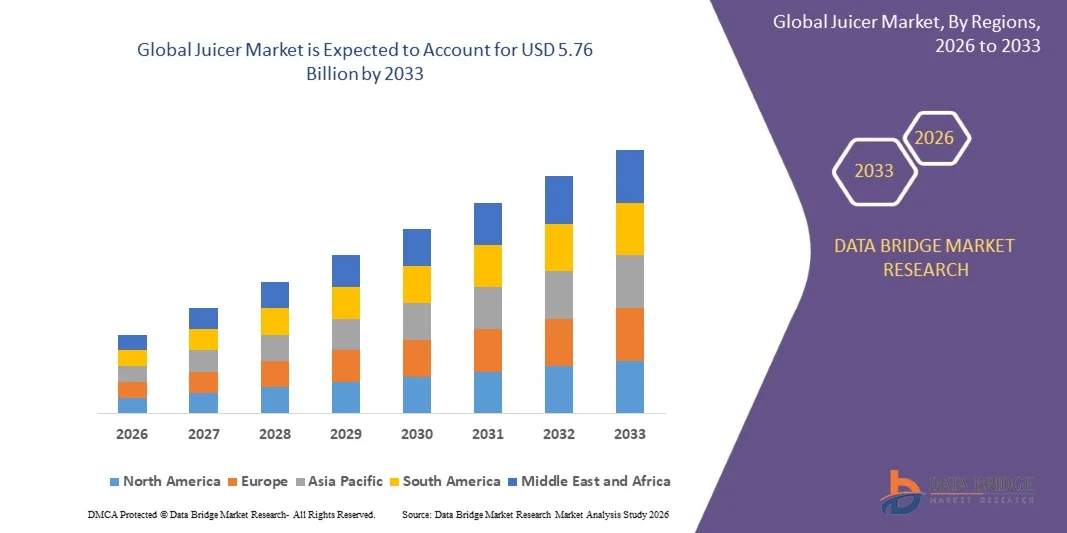
The Juicer Market was valued at USD 3.08 billion in 2025 and is projected to reach USD 5.76 billion by 2033, growing at a CAGR of 8.15% from 2026 to 2033. The market is witnessing steady expansion driven by rising consumer preference for healthy lifestyles, increasing demand for fresh fruit and vegetable juices, and growing adoption of kitchen appliances that support at-home nutrition and wellness routines.
The increasing awareness of preventive healthcare and dietary habits, combined with rising incidences of obesity, diabetes, and lifestyle-related disorders, is encouraging consumers to shift toward natural beverage consumption. In addition, rapid urbanization, expanding middle-class populations, and growing penetration of modern retail and e-commerce platforms are further accelerating the adoption of juicers across residential households and small commercial food service outlets.
Key Market Trends & Insights
- North America dominated the juicer market with the largest revenue share of approximately 36.7% in 2025, supported by strong consumer awareness of health and wellness, rising adoption of home-based nutrition solutions, and high penetration of kitchen appliances.
- Asia-Pacific juicer market is expected to witness the fastest growth rate of around 8.3% from 2026 to 2033, supported by rapid urbanization, rising disposable incomes, and increasing health awareness across countries such as China, India, Japan, and South Korea.
- The Electric Juicers segment held the largest market revenue share of approximately 71.4% in 2025 driven by rising consumer preference for convenience, faster juice extraction, and consistent output quality. Electric juicers are widely adopted in urban households and commercial setups due to their time efficiency and ability to process a wide range of fruits and vegetables with minimal effort.
- The Manual Juicers segment is projected to register a steady growth with a CAGR of around 5.2% from 2026 to 2033, driven by increasing demand in rural areas, cost-sensitive markets, and outdoor usage scenarios where electricity access is limited. Manual juicers are also gaining traction among health-conscious consumers seeking simple, low-maintenance juicing solutions.
- The Residential segment held the largest market revenue share of approximately 68.9% in 2025 driven by increasing household adoption of healthy beverage preparation and rising awareness of fresh juice consumption for daily nutrition and immunity support. Growing urbanization and expansion of nuclear families are further supporting residential demand for compact and easy-to-use juicer appliances.
- The Commercial segment is projected to grow at a CAGR of around 6.7% from 2026 to 2033, driven by rapid expansion of juice bars, cafés, hotels, and fitness centers. Rising demand for freshly prepared beverages in food service outlets, particularly in Asia-Pacific and the Middle East, is accelerating adoption of high-capacity juicing machines.
- The Household segment held the largest market revenue share of approximately 55.6% in 2025 driven by increasing home consumption of fresh juices as part of daily dietary habits and rising preference for home-prepared healthy beverages over packaged alternatives.
- The Food Services segment is projected to register the fastest growth at a CAGR of around 7.4% from 2026 to 2033, driven by the expansion of quick-service restaurants, smoothie chains, and juice-focused retail outlets. For instance, growing café culture in countries such as India and China is significantly increasing demand for commercial-grade juicing equipment.
- The Traditional Juice Extractor segment held the largest market revenue share of approximately 58.2% in 2025 driven by its affordability, widespread availability, and ease of use in both residential and small commercial applications.
- The Slow Juicer segment is projected to register the fastest growth at a CAGR of around 9.6% from 2026 to 2033, driven by increasing consumer awareness of nutrient retention, enzyme preservation, and lower oxidation levels. Slow juicers are increasingly preferred in premium households and health-focused urban populations across North America and Asia-Pacific.
- The Store Based segment held the largest market revenue share of approximately 63.7% in 2025 driven by strong consumer preference for physical product inspection, in-store demonstrations, and immediate purchase availability across supermarkets, specialty appliance stores, and retail outlets.
- The Non-Store Based segment is projected to grow at a CAGR of around 8.1% from 2026 to 2033, driven by rapid expansion of e-commerce platforms and increasing online consumer electronics sales. For instance, growing penetration of online retail in India and Southeast Asia, supported by discount offers and product variety, is significantly boosting digital sales of juicer appliances.
Market Size & Forecast
- Global Market Value (2025): USD 3.08 Billion
- Expected Market Value (2033): USD 5.76 Billion
- Forecast CAGR (2026–2033): 8.15%
- Leading Region in 2025: North America
- Fastest Growing Region: Asia-Pacific
Report Scope and Juicer Market Segmentation
|
Attributes |
Juicer Key Market Insights |
|
Segments Covered |
|
|
Countries Covered |
North America
Europe
Asia-Pacific
Middle East and Africa
South America
|
|
Key Market Players |
• Procter & Gamble (U.S.) |
|
Market Opportunities |
|
|
Value Added Data Infosets |
In addition to the insights on market scenarios such as market value, growth rate, segmentation, geographical coverage, and major players, the market reports curated by the Data Bridge Market Research also include in-depth expert analysis, pricing analysis, brand share analysis, consumer survey, demography analysis, supply chain analysis, value chain analysis, raw material/consumables overview, vendor selection criteria, PESTLE Analysis, Porter Analysis, and regulatory framework. |
Juicer Market Trends
Trend: Growth In Cold-Press Juicing And Health-Oriented Beverage Consumption
Rising consumer focus on preventive healthcare, nutrition-rich diets, and clean-label beverages is significantly driving demand for advanced juicing solutions across household and commercial segments. Conventional centrifugal juicers are gradually being replaced by slow masticating and cold-press juicers due to their ability to retain higher nutrient content, enzymes, and antioxidants with minimal oxidation..
In modern urban households, consumers are increasingly adopting cold-press juicers from brands such as Hurom and Breville for daily consumption of fresh fruit and vegetable juices as part of wellness routines, particularly in North America, Europe, and Asia-Pacific metro cities. For instance, cold-pressed juice consumption in the U.S. wellness beverage segment has grown steadily alongside the broader functional beverage market, which has been expanding at over 6% annual growth in recent years, driven by demand for immunity-boosting drinks and plant-based nutrition.
The expansion of cafés, juice bars, and fitness-focused retail outlets is further accelerating commercial adoption of high-capacity juicing machines. In India, urban juice chains and street vendors in cities such as Delhi, Mumbai, and Bengaluru are increasingly shifting toward high-efficiency juicers to meet rising demand for fresh sugarcane and mixed fruit juices, supported by growing disposable income and health awareness.
In addition, integration of smart kitchen appliances and compact juicer designs is gaining traction, with IoT-enabled features such as preset blending programs and self-cleaning systems enhancing user convenience. The increasing popularity of plant-based diets, supported by global vegan population growth estimated at over 79 million people in 2024, is also reinforcing long-term demand for fresh juice extraction systems.
Juicer Market Dynamics
Key Market Driver: Rising Health Awareness And Demand For Nutrient-Rich Fresh Beverages
Increasing prevalence of lifestyle-related disorders such as obesity and diabetes is driving consumers toward healthier beverage alternatives, including freshly extracted fruit and vegetable juices. According to global health estimates, over 1 billion people worldwide are classified as obese, significantly boosting demand for natural, low-sugar, and additive-free drink options.
Households are increasingly replacing packaged sugary beverages with homemade juices, supported by rising awareness of vitamin-rich diets and detox consumption patterns. For instance, orange juice and green vegetable juice consumption has increased in urban wellness segments across the U.S. and Western Europe, where consumers prioritize immunity and gut health.
The food service industry is also contributing strongly to demand, with cafés, gyms, and quick-service restaurants expanding juice-based menus. In Asia-Pacific, countries such as China and India are witnessing rapid growth in fresh juice kiosks and smoothie chains, driven by urbanization and rising middle-class income levels.
Key Restraint/Challenge: High Maintenance Requirements And Competition From Packaged Alternatives
Despite growing adoption, juicer usage is limited by cleaning complexity, time consumption, and product maintenance challenges, particularly for masticating and cold-press systems that require disassembly after each use. This reduces consumer convenience and discourages frequent usage in price-sensitive households.
In addition, the availability of ready-to-drink packaged juices from beverage manufacturers such as PepsiCo and The Coca-Cola Company creates strong competition, especially in urban retail environments where convenience often outweighs nutritional preference.
Cost sensitivity in emerging economies further restricts adoption of premium juicer models, as advanced cold-press machines remain significantly more expensive than basic centrifugal variants. In addition, limited awareness in rural markets continues to constrain penetration beyond metropolitan regions.
Key Market Opportunity: Expansion Of Smart Kitchens And Commercial Juice Applications
The rapid evolution of smart home ecosystems and connected kitchen appliances is creating new growth opportunities for automated and app-controlled juicing systems. Manufacturers are introducing compact, energy-efficient juicers with multi-function capabilities, catering to space-constrained urban apartments and modern kitchens.
Commercial opportunities are expanding in hospitality, wellness centers, and fitness clubs, where demand for freshly prepared juices is increasing as part of premium service offerings. For instance, hotel chains across Southeast Asia and the Middle East are incorporating live juice counters to enhance guest wellness experiences.
E-commerce platforms are also significantly boosting product accessibility, with online juicer sales increasing steadily across Asia-Pacific markets, particularly in India and China, driven by discounting, product variety, and consumer reviews.
Furthermore, advancements in motor efficiency, noise reduction technology, and multi-ingredient processing capabilities are enhancing product performance. Growing integration of juicers with multifunctional kitchen ecosystems is expected to support long-term market expansion across developed and emerging economies.
Juicer Market Scope
The market is segmented on the basis of product type, end-user, application, type, and distribution channel.
• By Product Type
On the basis of product type, the Juicer Market is segmented into Manual Juicers and Electric Juicers. The Electric Juicers segment held the largest market revenue share of approximately 71.4% in 2025 driven by rising consumer preference for convenience, faster juice extraction, and consistent output quality. Electric juicers are widely adopted in urban households and commercial setups due to their time efficiency and ability to process a wide range of fruits and vegetables with minimal effort.
The Manual Juicers segment is projected to register a steady growth with a CAGR of around 5.2% from 2026 to 2033, driven by increasing demand in rural areas, cost-sensitive markets, and outdoor usage scenarios where electricity access is limited. Manual juicers are also gaining traction among health-conscious consumers seeking simple, low-maintenance juicing solutions.
• By End-User
On the basis of end-user, the market is segmented into Commercial and Residential. The Residential segment held the largest market revenue share of approximately 68.9% in 2025 driven by increasing household adoption of healthy beverage preparation and rising awareness of fresh juice consumption for daily nutrition and immunity support. Growing urbanization and expansion of nuclear families are further supporting residential demand for compact and easy-to-use juicer appliances.
The Commercial segment is projected to grow at a CAGR of around 6.7% from 2026 to 2033, driven by rapid expansion of juice bars, cafés, hotels, and fitness centers. Rising demand for freshly prepared beverages in food service outlets, particularly in Asia-Pacific and the Middle East, is accelerating adoption of high-capacity juicing machines.
• By Application
On the basis of application, the market is segmented into Household, Food Services, Public Services, Shop, and Others. The Household segment held the largest market revenue share of approximately 55.6% in 2025 driven by increasing home consumption of fresh juices as part of daily dietary habits and rising preference for home-prepared healthy beverages over packaged alternatives.
The Food Services segment is projected to register the fastest growth at a CAGR of around 7.4% from 2026 to 2033, driven by the expansion of quick-service restaurants, smoothie chains, and juice-focused retail outlets. For instance, growing café culture in countries such as India and China is significantly increasing demand for commercial-grade juicing equipment.
• By Type
On the basis of type, the market is segmented into Traditional Juice Extractor and Slow Juicer. The Traditional Juice Extractor segment held the largest market revenue share of approximately 58.2% in 2025 driven by its affordability, widespread availability, and ease of use in both residential and small commercial applications.
The Slow Juicer segment is projected to register the fastest growth at a CAGR of around 9.6% from 2026 to 2033, driven by increasing consumer awareness of nutrient retention, enzyme preservation, and lower oxidation levels. Slow juicers are increasingly preferred in premium households and health-focused urban populations across North America and Asia-Pacific.
• By Distribution Channel
On the basis of distribution channel, the market is segmented into Store Based and Non-Store Based. The Store Based segment held the largest market revenue share of approximately 63.7% in 2025 driven by strong consumer preference for physical product inspection, in-store demonstrations, and immediate purchase availability across supermarkets, specialty appliance stores, and retail outlets.
The Non-Store Based segment is projected to grow at a CAGR of around 8.1% from 2026 to 2033, driven by rapid expansion of e-commerce platforms and increasing online consumer electronics sales. For instance, growing penetration of online retail in India and Southeast Asia, supported by discount offers and product variety, is significantly boosting digital sales of juicer appliances.
Juicer Market Regional Analysis
North America Juicer Market Insight
North America dominated the juicer market with the largest revenue share of approximately 36.7% in 2025, supported by strong consumer awareness of health and wellness, rising adoption of home-based nutrition solutions, and high penetration of kitchen appliances. Consumers in the region increasingly prefer fresh juice over packaged beverages due to growing concerns regarding sugar intake and artificial additives. The widespread availability of advanced electric and cold-press juicers, along with strong retail and e-commerce infrastructure, is further driving market expansion. High disposable income levels and a well-established fitness and wellness culture are also contributing significantly to sustained demand for juicer appliances across residential households and commercial food service outlets.
U.S. Juicer Market Insight
The U.S. juicer market captured the largest revenue share of approximately 82.5% within North America in 2025, driven by rapid adoption of health-focused lifestyles and strong demand for premium kitchen appliances. Consumers are increasingly investing in advanced slow juicers and cold-press machines for daily consumption of nutrient-rich beverages at home. The growing popularity of fitness-oriented diets, including detox and plant-based nutrition trends, is further supporting product adoption. In addition, the expansion of retail wellness chains and strong penetration of e-commerce platforms such as Amazon is accelerating juicer sales across urban and suburban households.
Europe Juicer Market Insight
The Europe juicer market is expected to witness the fastest growth rate of around 6.9% from 2026 to 2033, primarily driven by rising demand for organic and natural beverages, strict food quality standards, and increasing health consciousness among consumers. The region’s strong preference for home-prepared fresh juices, particularly in countries such as Germany, France, and Italy, is supporting sustained demand for both electric and slow juicers. Growing café culture and expansion of health-focused retail outlets are further boosting commercial adoption. In addition, European consumers are increasingly shifting toward sustainable and energy-efficient kitchen appliances, strengthening demand for advanced juicing systems.
U.K. Juicer Market Insight
The U.K. juicer market is expected to grow steadily from 2026 to 2033, driven by increasing consumer awareness of preventive healthcare and rising demand for convenient home appliances. Growing concerns related to obesity and lifestyle-related diseases are encouraging households to adopt fresh juice consumption habits. The expansion of online retail channels and strong penetration of smart kitchen appliances are further supporting market growth. In addition, increasing popularity of fitness centers and juice bars across urban cities such as London and Manchester is contributing to rising commercial demand for high-performance juicers.
Germany Juicer Market Insight
The Germany juicer market is expected to register strong growth from 2026 to 2033, supported by high consumer preference for sustainable and energy-efficient appliances. German consumers highly value product durability, precision engineering, and eco-friendly design, which is encouraging adoption of premium slow juicers. The increasing focus on organic food consumption and plant-based diets is further driving household demand. In addition, the integration of juicers into modern smart kitchens and rising adoption across hospitality and wellness sectors are contributing to steady market expansion.
Asia-Pacific Juicer Market Insight
The Asia-Pacific juicer market is expected to witness the fastest growth rate of around 8.3% from 2026 to 2033, supported by rapid urbanization, rising disposable incomes, and increasing health awareness across countries such as China, India, Japan, and South Korea. The growing middle-class population is significantly driving demand for affordable and efficient juicer appliances. Expansion of quick-service restaurants, juice bars, and fitness-focused beverage outlets is further accelerating commercial adoption. In addition, strong domestic manufacturing capabilities and competitive pricing are making juicer products more accessible across both urban and semi-urban regions.
Japan Juicer Market Insight
The Japan juicer market is expected to grow steadily from 2026 to 2033, driven by high health consciousness, advanced consumer electronics adoption, and preference for compact kitchen appliances. Japanese consumers increasingly prioritize nutrient retention and product efficiency, supporting strong demand for slow juicers. The country’s aging population is also contributing to increased consumption of easily digestible fresh juices, encouraging adoption of user-friendly juicing systems. Integration of juicers into smart home ecosystems and compact urban kitchen designs is further supporting market growth.
China Juicer Market Insight
The China juicer market accounted for the largest revenue share of approximately 41.2% in Asia-Pacific in 2025, driven by rapid urbanization, expanding middle-class income, and strong adoption of smart home appliances. Consumers are increasingly shifting toward healthy beverage alternatives as awareness of lifestyle diseases continues to rise. The strong presence of domestic manufacturers offering cost-effective and technologically advanced juicers is significantly boosting market penetration. In addition, the rapid expansion of e-commerce platforms and growing popularity of juice bars in Tier 1 and Tier 2 cities are further accelerating market growth.
Juicer Market Share
The Juicer industry is primarily led by well-established companies, including:
• Procter & Gamble (U.S.)
• Breville USA, Inc. (U.S.)
• Sunbeam Products, Inc. (U.S.)
• Hurom India (India)
• Cuisinart (U.S.)
• KUVINGS (South Korea)
• Koninklijke Philips N.V (Netherlands)
• Panasonic Corporation (Japan)
• AB Electrolux (Sweden)
• Midea Retail (PTY) Ltd. (China)
• SKG ELECTRIC. (China)
• Neo Multi Services. (India)
• J.D. Products (India)
• Bharat Sales Corporation. (India)
• Shree Ram Kitchen Appliances Private Limited. (India)
• HANS APPLIANCES (India)
• Hetal Plastic (India)
• M. M. INDUSTRIES (India)
• Nilkathvarni Engineering Co. (India)
SKU-
Get online access to the report on the World's First Market Intelligence Cloud

- Interactive Data Analysis Dashboard
- Company Analysis Dashboard for high growth potential opportunities
- Research Analyst Access for customization & queries
- Competitor Analysis with Interactive dashboard
- Latest News, Updates & Trend analysis
- Harness the Power of Benchmark Analysis for Comprehensive Competitor Tracking
Research Methodology
Data collection and base year analysis are done using data collection modules with large sample sizes. The stage includes obtaining market information or related data through various sources and strategies. It includes examining and planning all the data acquired from the past in advance. It likewise envelops the examination of information inconsistencies seen across different information sources. The market data is analysed and estimated using market statistical and coherent models. Also, market share analysis and key trend analysis are the major success factors in the market report. To know more, please request an analyst call or drop down your inquiry.
The key research methodology used by DBMR research team is data triangulation which involves data mining, analysis of the impact of data variables on the market and primary (industry expert) validation. Data models include Vendor Positioning Grid, Market Time Line Analysis, Market Overview and Guide, Company Positioning Grid, Patent Analysis, Pricing Analysis, Company Market Share Analysis, Standards of Measurement, Global versus Regional and Vendor Share Analysis. To know more about the research methodology, drop in an inquiry to speak to our industry experts.
Customization Available
Data Bridge Market Research is a leader in advanced formative research. We take pride in servicing our existing and new customers with data and analysis that match and suits their goal. The report can be customized to include price trend analysis of target brands understanding the market for additional countries (ask for the list of countries), clinical trial results data, literature review, refurbished market and product base analysis. Market analysis of target competitors can be analyzed from technology-based analysis to market portfolio strategies. We can add as many competitors that you require data about in the format and data style you are looking for. Our team of analysts can also provide you data in crude raw excel files pivot tables (Fact book) or can assist you in creating presentations from the data sets available in the report.












