


Global Laboratory Furniture Market
Market Size in USD Billion
CAGR :
% 
 USD
2.61 Billion
USD
3.76 Billion
2025
2033
USD
2.61 Billion
USD
3.76 Billion
2025
2033
 Forecast Period Forecast Period |
2026 –2033 |
 Market Size (Base Year) Market Size (Base Year) |
USD 2.61 Billion |
 Market Size (Forecast Year) Market Size (Forecast Year) |
USD 3.76 Billion |
 CAGR CAGR |
% |
| Major Markets Players |
|
Laboratory Furniture Market Size
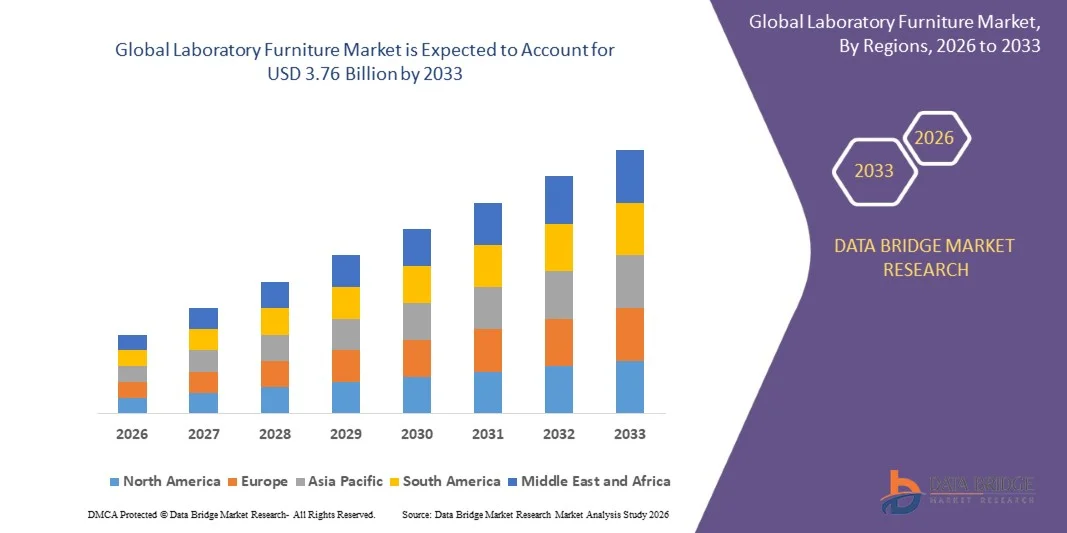
- The global laboratory furniture market size was valued at USD 2.61 billion in 2025 and is expected to reach USD 3.76 billion by 2033, at a CAGR of 4.67% during the forecast period
- The market growth is largely fueled by the rising expansion of pharmaceutical research, biotechnology laboratories, healthcare infrastructure, and academic research facilities, leading to increasing demand for advanced and modular laboratory workspace solutions
- Furthermore, growing focus on laboratory safety, ergonomic workspace optimization, and integration of flexible laboratory furniture systems is establishing modern laboratory furniture as an essential component of research and testing environments. These converging factors are accelerating the adoption of technologically advanced laboratory furniture solutions, thereby significantly boosting the industry’s growth
Laboratory Furniture Market Analysis
- Laboratory furniture, including laboratory benches, workstations, storage cabinets, fume hood systems, and modular casework solutions, plays a critical role in supporting safe, efficient, and organized laboratory operations across pharmaceutical, biotechnology, healthcare, industrial, and academic facilities due to its functionality, durability, and adaptability to modern laboratory requirements
- The escalating demand for laboratory furniture is primarily fueled by increasing investments in laboratory modernization, expanding life sciences and pharmaceutical industries, and rising emphasis on laboratory safety standards and workflow efficiency across research and diagnostic environments
- Asia-Pacific dominated laboratory furniture market with a share of 46.5% in 2025, due to expanding pharmaceutical manufacturing, biotechnology research activities, and increasing laboratory infrastructure development across healthcare and academic sectors
- North America is expected to be the fastest growing region in the laboratory furniture market during the forecast period due to rising investments in biotechnology research, pharmaceutical development, and advanced healthcare infrastructure
- Laboratory tables segment dominated the market with a market share of 35.3% in 2025, due to their essential role in nearly all laboratory environments including educational, industrial, pharmaceutical, and research facilities. Laboratories require durable and chemical-resistant work surfaces capable of supporting heavy instruments, testing procedures, and continuous operational use
Report Scope and Laboratory Furniture Market Segmentation
|
Attributes |
Laboratory Furniture Key Market Insights |
|
Segments Covered |
|
|
Countries Covered |
North America · U.S. · Canada · Mexico Europe · Germany · France · U.K. · Netherlands · Switzerland · Belgium · Russia · Italy · Spain · Turkey · Rest of Europe Asia-Pacific · China · Japan · India · South Korea · Singapore · Malaysia · Australia · Thailand · Indonesia · Philippines · Rest of Asia-Pacific Middle East and Africa · Saudi Arabia · U.A.E. · South Africa · Egypt · Israel · Rest of Middle East and Africa South America · Brazil · Argentina · Rest of South America |
|
Key Market Players |
· Kewaunee Scientific Corporation (U.S.) · Mott Manufacturing Ltd. (Canada) · Thermo Fisher Scientific Inc. (U.S.) · Labconco (U.S.) · Köttermann GmbH (Germany) · Diversified Woodcrafts, Inc. (U.S.) · Esco Micro Pte Ltd. (Singapore) · NuAire (U.S.) · Shimadzu RIKA Corporation (Japan) · The Baker Company (U.S.) · Yamato Scientific Co., Ltd. (Japan) · Terra Universal Inc. (U.S.) · Labtec LLC (U.S.) · A.T. Villa, Inc. (U.S.) · PSA Laboratory Furniture (U.S.) · LOC Scientific (U.S.) · Teclab (Brazil) · HEMCO Corporation (U.S.) · MERCI, s.r.o. (Czech Republic) |
|
Market Opportunities |
· Growing Demand for Smart and Integrated Laboratory Workspaces · Expansion of Healthcare and Diagnostic Laboratory Infrastructure in Emerging Economies |
|
Value Added Data Infosets |
In addition to the insights on market scenarios such as market value, growth rate, segmentation, geographical coverage, and major players, the market reports curated by the Data Bridge Market Research also include in-depth expert analysis, pricing analysis, brand share analysis, consumer survey, demography analysis, supply chain analysis, value chain analysis, raw material/consumables overview, vendor selection criteria, PESTLE Analysis, Porter Analysis, and regulatory framework. |
Laboratory Furniture Market Trends
“Rising Adoption of Modular and Ergonomic Laboratory Furniture Systems”
- A significant trend in the laboratory furniture market is the increasing adoption of modular and ergonomic laboratory furniture systems designed to improve workspace flexibility, operational efficiency, and researcher safety across pharmaceutical, biotechnology, healthcare, and academic laboratories. This trend is strengthening the role of advanced laboratory furniture as a critical component of modern laboratory infrastructure and workflow optimization
- For instance, Kewaunee Scientific Corporation offers modular laboratory furniture systems and adaptable laboratory casework solutions that are widely used across pharmaceutical research facilities and educational laboratories. These systems improve laboratory space utilization and support efficient workflow management in environments that require high operational precision and safety compliance
- Research institutions and healthcare laboratories are increasingly adopting ergonomic laboratory workstations and adjustable laboratory benches to reduce workplace strain and improve productivity for laboratory professionals working in long-duration research environments. This is positioning ergonomic laboratory furniture as an essential requirement for modern laboratory planning and facility design
- The biotechnology and pharmaceutical industries are rapidly integrating flexible laboratory furniture configurations that support changing research requirements and evolving laboratory technologies. This trend is accelerating demand for modular furniture systems that can be easily reconfigured to accommodate expanding research and testing activities
- Laboratories are placing stronger emphasis on durable and chemically resistant furniture materials capable of withstanding harsh laboratory environments and continuous exposure to chemicals and high-usage conditions. This is increasing adoption of stainless-steel furniture systems and high-performance laboratory storage solutions across industrial and healthcare laboratories
- The market is witnessing rising investments in technologically integrated laboratory furniture systems equipped with cable management, utility integration, and smart storage features that enhance laboratory organization and efficiency. This growing focus on flexible, ergonomic, and technologically advanced laboratory environments is reinforcing the transition toward next-generation laboratory infrastructure solutions across global research industries
Laboratory Furniture Market Dynamics
Driver
“Increasing Expansion of Pharmaceutical and Biotechnology Research Facilities”
- The rapid expansion of pharmaceutical manufacturing, biotechnology research activities, and healthcare laboratory infrastructure is driving strong demand for advanced laboratory furniture solutions capable of supporting safe and efficient research operations. Laboratory furniture systems play a vital role in improving laboratory organization, workflow optimization, and compliance with strict safety standards across research and testing environments
- For instance, Thermo Fisher Scientific Inc. continues to expand laboratory infrastructure solutions and laboratory equipment offerings to support growing pharmaceutical and biotechnology research activities worldwide. The company’s laboratory workspace systems help research facilities improve operational efficiency and maintain organized laboratory environments for scientific testing and product development
- The increasing number of biotechnology startups, pharmaceutical production facilities, and research laboratories is fueling demand for modular laboratory furniture systems that can adapt to evolving research requirements. These solutions support flexible laboratory layouts and improve space management across highly specialized research facilities
- Governments and private organizations are investing heavily in healthcare and life sciences infrastructure development, which is increasing installation of laboratory workstations, storage systems, and laboratory benches across hospitals, universities, and research institutes. This growing investment landscape is strengthening demand for modern laboratory infrastructure solutions globally
- The continuous growth of pharmaceutical research, biotechnology innovation, and diagnostic testing activities is reinforcing long-term demand for durable and flexible laboratory furniture solutions. The increasing need for advanced laboratory environments capable of supporting high research output and regulatory compliance is significantly driving market expansion across global laboratory industries
Restraint/Challenge
“High Installation and Laboratory Infrastructure Modernization Costs”
- The laboratory furniture market faces challenges due to the high costs associated with laboratory infrastructure modernization, customized laboratory furniture installation, and integration of advanced laboratory systems within research facilities. These requirements increase overall project expenditures and create financial barriers for small and medium-sized laboratories with limited budgets
- For instance, Köttermann GmbH develops highly specialized laboratory furniture systems with integrated utilities, safety features, and customized laboratory layouts that require substantial installation investments and infrastructure planning. These advanced systems improve laboratory efficiency and safety standards but also increase implementation complexity and overall capital costs for research facilities
- Modern laboratory furniture installations often involve utility integration, ventilation adjustments, chemical-resistant materials, and customized workspace configurations that significantly raise infrastructure development expenses. These additional requirements extend project timelines and increase operational disruptions during laboratory renovation activities
- Laboratories operating in academic and public research sectors frequently encounter budget limitations that restrict large-scale modernization and delay replacement of conventional laboratory furniture systems. This financial pressure slows adoption of technologically advanced laboratory infrastructure solutions across cost-sensitive institutions
- The growing complexity of laboratory environments and increasing expectations for integrated laboratory functionality continue to place pressure on organizations investing in laboratory modernization projects. These challenges collectively influence purchasing decisions and create barriers to rapid adoption of advanced laboratory furniture systems across developing and price-sensitive markets
Laboratory Furniture Market Scope
The market is segmented on the basis of product, end-users, distribution channel, and application.
- By Product
On the basis of product, the laboratory furniture market is segmented into laboratory tables, laboratory stools and chairs, laboratory storage cabinets, pedestal laboratory furniture, laboratory IPS units, lab bench, fume hood, accessories, and others. The laboratory tables segment dominated the market with the largest market revenue share of 35.3% in 2025, driven by their essential role in nearly all laboratory environments including educational, industrial, pharmaceutical, and research facilities. Laboratories require durable and chemical-resistant work surfaces capable of supporting heavy instruments, testing procedures, and continuous operational use. The growing establishment of research laboratories and diagnostic centers has further increased demand for modular and ergonomic laboratory tables designed for flexibility and space optimization. In addition, manufacturers are introducing adjustable and customizable laboratory tables to improve workflow efficiency and user comfort across modern laboratory settings.
The fume hood segment is anticipated to witness the fastest growth rate from 2026 to 2033, fueled by rising emphasis on laboratory safety standards and hazardous chemical handling regulations. Fume hoods are increasingly adopted in pharmaceutical, biotechnology, and chemical laboratories to ensure proper ventilation and protection against toxic fumes and airborne contaminants. Growing investments in advanced research facilities and stricter workplace safety compliance requirements are accelerating the installation of technologically advanced fume hood systems. The increasing preference for energy-efficient and ductless fume hoods with smart monitoring capabilities is also contributing to rapid segment growth across developed and emerging economies.
- By End-Users
On the basis of end-users, the laboratory furniture market is segmented into school and college laboratory and medical laboratory. The medical laboratory segment dominated the market with the largest market revenue share in 2025, driven by the rapid expansion of diagnostic laboratories, hospitals, and healthcare research facilities worldwide. Medical laboratories require highly durable, sterile, and chemically resistant furniture solutions capable of supporting intensive testing and clinical operations. The increasing prevalence of chronic diseases and rising diagnostic testing volumes have encouraged healthcare institutions to invest in advanced laboratory infrastructure and ergonomic furniture systems. In addition, stringent healthcare safety regulations and the need for efficient laboratory workflow management continue to strengthen demand for specialized medical laboratory furniture.
The school and college laboratory segment is anticipated to witness the fastest growth rate from 2026 to 2033, fueled by rising investments in educational infrastructure and increasing focus on practical science and technology learning. Governments and private educational institutions are expanding laboratory facilities to support STEM education and advanced scientific research programs. Educational laboratories are increasingly adopting modular and space-efficient laboratory furniture to improve student safety, flexibility, and collaborative learning environments. Growing awareness regarding modern laboratory standards and the integration of advanced laboratory equipment in academic institutions are further supporting segment expansion globally.
- By Distribution Channel
On the basis of distribution channel, the laboratory furniture market is segmented into online and offline. The offline segment dominated the market with the largest market revenue share in 2025, driven by customer preference for physical product inspection, customized consultation, and installation support before purchasing laboratory furniture. Large research facilities, educational institutions, and healthcare organizations often rely on direct supplier interactions and showroom evaluations to ensure product quality, durability, and compliance with laboratory safety standards. Offline distributors also provide after-sales services, maintenance assistance, and project-based customization, which are highly important for institutional buyers. In addition, long-term supplier relationships and bulk procurement contracts continue to strengthen the dominance of offline sales channels in the market.
The online segment is anticipated to witness the fastest growth rate from 2026 to 2033, fueled by increasing digitalization and the growing adoption of e-commerce platforms for industrial and laboratory equipment procurement. Online platforms offer wider product availability, transparent pricing, and convenient comparison of laboratory furniture specifications, attracting small laboratories and educational institutions. Manufacturers are also expanding their digital presence and providing virtual product demonstrations and customized ordering solutions to improve customer accessibility. The increasing penetration of online procurement systems and rising acceptance of digital purchasing among institutional buyers are further accelerating segment growth.
- By Application
On the basis of application, the laboratory furniture market is segmented into education, government, industry, research, and pharmaceutical. The research segment dominated the market with the largest market revenue share in 2025, driven by increasing global investments in scientific research, biotechnology development, and innovation-focused laboratory infrastructure. Research laboratories require highly specialized and flexible furniture systems capable of accommodating advanced analytical instruments, chemical testing, and experimental activities. The expansion of public and private research institutions along with rising funding for life sciences and material science research has significantly contributed to segment growth. In addition, the growing focus on laboratory modernization and ergonomic workspace optimization continues to support strong demand for advanced laboratory furniture solutions.
The pharmaceutical segment is anticipated to witness the fastest growth rate from 2026 to 2033, fueled by expanding pharmaceutical manufacturing activities and increasing drug discovery and vaccine development programs globally. Pharmaceutical laboratories require contamination-resistant, modular, and highly durable furniture systems to maintain operational efficiency and regulatory compliance. The growing emphasis on research and development activities by pharmaceutical companies and the rising establishment of biologics and biotechnology facilities are accelerating demand for advanced laboratory furniture. Increasing investments in cleanroom laboratories and automated pharmaceutical testing environments are also contributing to rapid segment expansion.
Laboratory Furniture Market Regional Analysis
- Asia-Pacific dominated the laboratory furniture market with the largest revenue share of 46.5% in 2025, driven by expanding pharmaceutical manufacturing, biotechnology research activities, and increasing laboratory infrastructure development across healthcare and academic sectors
- The region benefits from growing investments in research laboratories, cost-efficient manufacturing capabilities, and rising establishment of testing and diagnostic facilities across emerging economies
- Rapid industrialization, increasing R&D expenditure, and growing focus on modern laboratory safety and workflow optimization are accelerating regional market expansion
China Laboratory Furniture Market Insight
China held the largest share in the Asia-Pacific laboratory furniture market in 2025, supported by its strong pharmaceutical production base and expanding biotechnology research ecosystem. The country has a large network of research institutes, healthcare laboratories, and industrial testing facilities that generate significant demand for advanced laboratory furniture solutions. Rising investments in healthcare infrastructure and scientific innovation are further strengthening market growth. In addition, increasing adoption of modular and ergonomically designed laboratory systems is reinforcing China’s leadership in laboratory infrastructure development and exports.
India Laboratory Furniture Market Insight
India is witnessing the fastest growth in the Asia-Pacific region, driven by expanding pharmaceutical manufacturing, increasing biotechnology research, and rising healthcare laboratory establishments. Government initiatives supporting healthcare modernization and domestic research capabilities are significantly boosting demand for laboratory furniture solutions. Academic institutions and diagnostic laboratories are also contributing to rising product adoption across the country. In addition, increasing investments in research parks, life sciences infrastructure, and laboratory automation are accelerating long-term market expansion.
Europe Laboratory Furniture Market Insight
The Europe laboratory furniture market is expanding steadily, supported by strong demand from pharmaceutical research, academic laboratories, and healthcare testing facilities. The region places strong emphasis on laboratory safety standards, ergonomic workspace design, and sustainable furniture solutions across research environments. Strict regulatory requirements and modernization of laboratory infrastructure are encouraging adoption of advanced laboratory furniture systems. In addition, continuous investments in scientific research and healthcare innovation are enhancing market growth across the region.
Germany Laboratory Furniture Market Insight
Germany accounted for the largest share in the Europe laboratory furniture market in 2025, driven by its strong pharmaceutical, chemical, and industrial research sectors. The country has extensive laboratory infrastructure across academic institutions, healthcare facilities, and industrial R&D centers that support consistent demand for laboratory furniture products. Advanced engineering capabilities and emphasis on precision laboratory environments are further driving market development. In addition, strong collaboration between research organizations and manufacturing companies is reinforcing Germany’s leadership in laboratory infrastructure solutions.
U.K. Laboratory Furniture Market Insight
The U.K. market is supported by strong demand from biotechnology research centers, universities, and healthcare laboratories. Increasing focus on modern laboratory design and efficient workspace management is driving adoption of advanced laboratory furniture systems. The country’s research-driven ecosystem supports continuous investments in laboratory modernization projects. In addition, growing expansion of pharmaceutical and life sciences facilities is further supporting market growth.
North America Laboratory Furniture Market Insight
North America is projected to grow at the fastest CAGR from 2026 to 2033, driven by rising investments in biotechnology research, pharmaceutical development, and advanced healthcare infrastructure. Strong adoption of modular and technologically integrated laboratory furniture is supporting efficient laboratory operations across research and diagnostic facilities. Continuous innovation in laboratory design and safety standards is further expanding product demand. In addition, increasing establishment of research laboratories and expansion of life sciences industries are accelerating regional market growth.
U.S. Laboratory Furniture Market Insight
The U.S. accounted for the largest share in the North America laboratory furniture market in 2025, supported by strong demand from pharmaceutical companies, biotechnology firms, and academic research institutions. The country benefits from a highly advanced healthcare and scientific research ecosystem with extensive laboratory infrastructure development. Laboratory furniture systems are widely adopted across healthcare testing, industrial research, and life sciences applications. In addition, continuous investments in laboratory modernization and increasing focus on workplace safety are reinforcing the U.S. leadership position in the regional market.
Laboratory Furniture Market Share
The laboratory furniture industry is primarily led by well-established companies, including:
- Kewaunee Scientific Corporation (U.S.)
- Mott Manufacturing Ltd. (Canada)
- Thermo Fisher Scientific Inc. (U.S.)
- Labconco (U.S.)
- Köttermann GmbH (Germany)
- Diversified Woodcrafts, Inc. (U.S.)
- Esco Micro Pte Ltd. (Singapore)
- NuAire (U.S.)
- Shimadzu RIKA Corporation (Japan)
- The Baker Company (U.S.)
- Yamato Scientific Co., Ltd. (Japan)
- Terra Universal Inc. (U.S.)
- Labtec LLC (U.S.)
- A.T. Villa, Inc. (U.S.)
- PSA Laboratory Furniture (U.S.)
- LOC Scientific (U.S.)
- Teclab (Brazil)
- HEMCO Corporation (U.S.)
- MERCI, s.r.o. (Czech Republic)
Latest Developments in Global Laboratory Furniture Market
- In January 2025, CiF Lab Solutions LP launched advanced laboratory furniture solutions focused on ergonomic laboratory layouts, sustainable material usage, and modular workstation configurations for healthcare, pharmaceutical, and educational laboratories. The development is supporting the growing transition toward flexible and environmentally efficient laboratory infrastructure while helping research facilities improve operational productivity, worker comfort, and long-term space utilization. Rising adoption of modern laboratory setups is further strengthening demand for technologically integrated furniture systems across scientific and industrial laboratories
- In January 2025, Mott Manufacturing Ltd. introduced customizable stainless-steel laboratory furniture systems and specialized laboratory tables designed to improve hygiene, durability, and adaptability across high-performance laboratory environments. The launch is accelerating demand for corrosion-resistant and modular laboratory furniture solutions in biotechnology, healthcare, and research institutions where safety and workspace efficiency remain critical priorities. Increasing preference for reconfigurable laboratory environments is also encouraging wider adoption of advanced furniture systems across modern research facilities
- In October 2024, WNA Labs acquired the laboratory furniture operations of Waldner Group in the Americas to strengthen its regional presence, customer support network, and laboratory infrastructure capabilities across North and Latin America. The acquisition is improving access to advanced laboratory furniture solutions and increasing the availability of localized technical services for research institutions, pharmaceutical companies, and healthcare laboratories. The strategic expansion is also enhancing market competitiveness and supporting faster delivery of customized laboratory furniture systems across the region
- In March 2024, Better Basics Laborbedarf partnered with Waldner Group to launch the SmartEdge WA 001 modular integration solution for WALDNER SCALA fume hoods during Forum LABO Paris. The partnership and product launch are improving laboratory workflow organization, modular integration efficiency, and smart storage compatibility within modern laboratory environments. Growing demand for technologically advanced and space-efficient laboratory furniture systems is further supporting adoption of integrated laboratory infrastructure solutions across research and testing facilities
- In March 2023, WALDNER Holding SE & Co. KG acquired Laboratory Systems Group Pty Ltd. in Australia to expand its regional customer base and strengthen laboratory furniture distribution and service capabilities across Australia and New Zealand. The acquisition enhanced customer access to high-quality laboratory furniture products supported by localized manufacturing and service operations, improving delivery efficiency and after-sales support. The strategic move is also reinforcing the company’s market position in the Asia-Pacific laboratory infrastructure sector while supporting rising laboratory modernization activities across the region
SKU-
Get online access to the report on the World's First Market Intelligence Cloud

- Interactive Data Analysis Dashboard
- Company Analysis Dashboard for high growth potential opportunities
- Research Analyst Access for customization & queries
- Competitor Analysis with Interactive dashboard
- Latest News, Updates & Trend analysis
- Harness the Power of Benchmark Analysis for Comprehensive Competitor Tracking
Research Methodology
Data collection and base year analysis are done using data collection modules with large sample sizes. The stage includes obtaining market information or related data through various sources and strategies. It includes examining and planning all the data acquired from the past in advance. It likewise envelops the examination of information inconsistencies seen across different information sources. The market data is analysed and estimated using market statistical and coherent models. Also, market share analysis and key trend analysis are the major success factors in the market report. To know more, please request an analyst call or drop down your inquiry.
The key research methodology used by DBMR research team is data triangulation which involves data mining, analysis of the impact of data variables on the market and primary (industry expert) validation. Data models include Vendor Positioning Grid, Market Time Line Analysis, Market Overview and Guide, Company Positioning Grid, Patent Analysis, Pricing Analysis, Company Market Share Analysis, Standards of Measurement, Global versus Regional and Vendor Share Analysis. To know more about the research methodology, drop in an inquiry to speak to our industry experts.
Customization Available
Data Bridge Market Research is a leader in advanced formative research. We take pride in servicing our existing and new customers with data and analysis that match and suits their goal. The report can be customized to include price trend analysis of target brands understanding the market for additional countries (ask for the list of countries), clinical trial results data, literature review, refurbished market and product base analysis. Market analysis of target competitors can be analyzed from technology-based analysis to market portfolio strategies. We can add as many competitors that you require data about in the format and data style you are looking for. Our team of analysts can also provide you data in crude raw excel files pivot tables (Fact book) or can assist you in creating presentations from the data sets available in the report.












