What Is The Lactase Market Size And Growth Rate?
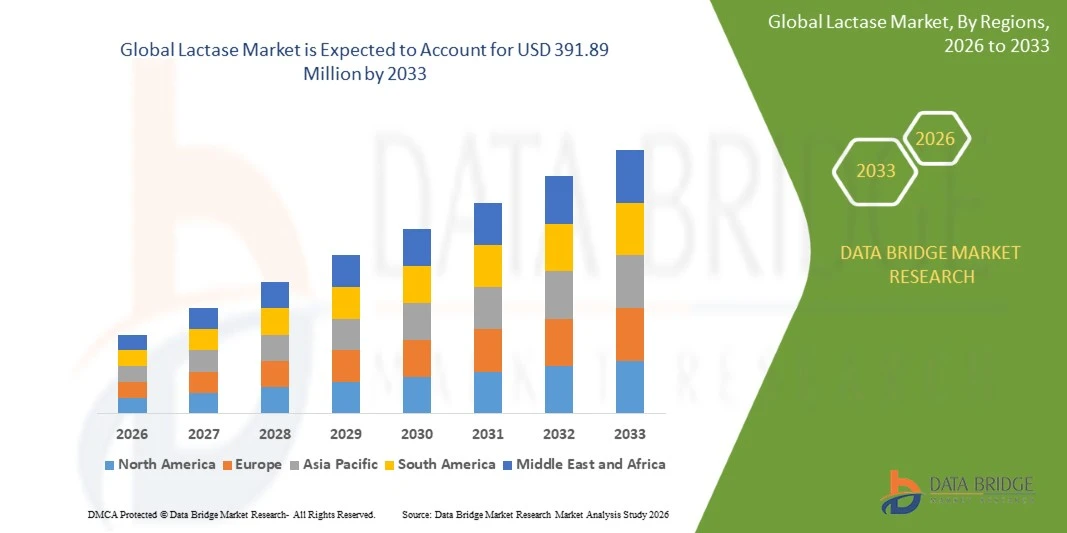
- As per Data Bridge Market Research analysis, the lactase market was valued at USD 255.35 Million in 2025 and is projected to reach USD 391.89 Million by 2033, growing at a CAGR of 5.50% from 2026 to 2033.
- The market is expanding due to rising prevalence of lactose intolerance, growing demand for lactose-free dairy products, increasing consumption of dietary supplements for digestive health, advances in enzyme production and stabilization, and growing awareness of healthy digestion and clean-label food ingredients.
- Lactase is increasingly being adopted in milk, cheese, yogurt, ice cream, infant nutrition, and dietary supplements, supported by its ability to break down lactose into glucose and galactose, improved enzyme efficiency and purity, availability in powder and liquid forms, and growing supply from established enzyme and ingredient companies.
Market Size & Forecast
- Global Market Value (2025): USD 255.35 Million
- Expected Market Value (2033): USD 391.89 Million
- Forecast CAGR (2026–2033): 5.50%
- Leading Region in 2025: Europe
- Fastest Growing Region: Asia-Pacific
What Are The Major Takeaways Of The Lactase Market?
- Europe dominated the global lactase market with a share of 34.00% in 2025, supported by a large dairy industry, high consumption of lactose-free products, strong presence of enzyme producers, and established food processing infrastructure.
- Asia-Pacific is expected to be the fastest-growing regional market at a CAGR of 7.20% from 2026 to 2033, driven by high prevalence of lactose intolerance, rising dairy consumption, growing health awareness, and expanding dairy and supplement industries.
- The yeast segment dominated the market by source with a share of 52.00% in 2025, supported by its low production cost, ease of processing, and suitability for milk and dairy applications.
- The dietary supplements segment is expected to register the fastest growth among applications, at a CAGR of 7.60% from 2026 to 2033, driven by demand for lactase pills, chewable tablets, and digestive health products.
- The food and beverages segment dominated the application category with a share of 78.00% in 2025, supported by widespread use of lactase in milk, cheese, yogurt, ice cream, and other lactose-free dairy products.
- The powder segment dominated the form category with a share of 56.00% in 2025, supported by its stability, longer shelf life, ease of storage, and convenience in dry blends and supplements.
- The dairy manufacturers segment dominated the end user category with a share of 58.00% in 2025, supported by large-scale use of lactase in lactose-free milk and dairy product processing.
Report Scope And Lactase Market Segmentation
|
Attributes |
Lactase Key Market Insights |
|
Segments Covered |
|
|
Countries Covered |
North America
Europe
Asia-Pacific
Middle East and Africa
South America
|
|
Key Market Players |
|
|
Market Opportunities |
|
|
Value Added Data Infosets |
In addition to the insights on market scenarios such as market value, growth rate, segmentation, geographical coverage, and major players, the market reports curated by the Data Bridge Market Research also include in-depth expert analysis, pricing analysis, brand share analysis, consumer survey, demography analysis, supply chain analysis, value chain analysis, raw material/consumables overview, vendor selection criteria, PESTLE Analysis, Porter Analysis, and regulatory framework. |
What Is The Key Trend In The Lactase Market?
- Increasing demand for lactose-free and digestive health products is becoming a major trend in the global lactase market, as consumers look for dairy products and supplements that are easier to digest. Dairy producers are expanding lactose-free milk, yogurt, cheese, and ice cream ranges, while supplement brands are offering lactase in capsules, chewable tablets, and fast-acting formats.
- Integration of enzyme technology, process monitoring, and portfolio expansion is gaining importance as suppliers invest in higher-purity lactase, faster hydrolysis, and tools that help producers control lactose levels. Leading ingredient companies are also strengthening their enzyme portfolios through acquisitions and partnerships, while clean-label and sugar-reduction trends support wider use of lactase.
- For instance, in November 2024, Kerry Group agreed to acquire the LactoSens biosensor technology from DirectSens, a lactose detection solution that complements its lactase enzyme portfolio for food and beverage producers.
- Overall, the lactase market is increasingly shaped by lactose-free dairy demand, digestive health, enzyme innovation, and portfolio integration. Lactase suppliers are therefore moving toward higher-efficiency enzymes, integrated solutions for dairy producers, and diversified applications in supplements and pharmaceuticals.
What Are The Key Drivers Of The Lactase Market?
- Rising prevalence of lactose intolerance is becoming a major growth driver in the global lactase market, as a large share of the world population cannot properly digest lactose and seeks lactose-free dairy and supplements. Growing health and wellness awareness and interest in healthy digestion further support demand for lactase-based products.
- Growth of the lactose-free dairy industry is gaining importance as producers seek enzymes that increase output and efficiency without changing taste. Advances in enzyme production, availability of liquid and powder forms, and rising use in pharmaceutical syrups and dietary supplements are further supporting market demand.
- For instance, in May 2023, dsm-firmenich launched Maxilact Next, a lactase enzyme for lactose-free dairy that is reported to reduce hydrolysis time by about 25% at the same dosage, helping producers increase capacity and efficiency.
- Overall, the lactase market is increasingly shaped by lactose intolerance, lactose-free dairy growth, health awareness, and enzyme innovation. Lactase suppliers are therefore moving toward faster and purer enzyme products, closer partnerships with dairy producers, and expansion into supplements and pharmaceuticals.
What Factors Are Challenging The Growth Of The Lactase Market?
- High enzyme production costs are becoming a major challenge in the global lactase market, as fermentation, purification, and stabilization require significant investment and technical expertise. Price sensitivity among dairy processors and consumers can limit adoption, particularly in cost-sensitive and emerging markets.
- Regulatory requirements, market concentration, and storage and stability limits are also restraining growth, as enzyme products must meet food and supplement standards, concerns over genetically modified production methods can lead to scrutiny, and liquid lactase must be stored under controlled temperatures to maintain activity. Competition from lactose-free alternatives and plant-based products further limits growth.
- For instance, in December 2023, the European Commission cleared the Novozymes and Chr. Hansen merger on the condition that lactase businesses were divested, after raising concerns about lactase manufacturing using genetic modification technology, reflecting the regulatory attention on the lactase market.
- Overall, the global lactase market is increasingly shaped by production costs, regulatory scrutiny, market concentration, and stability requirements. Lactase suppliers are therefore moving toward cost-efficient production, stable and easy-to-use formulations, regulatory compliance, and clear communication of product benefits.
How Is The Lactase Market Segmented?
The global lactase market is segmented on the basis of source, application, form, end user, and distribution channel.
- By Source
On the basis of source, the global lactase market is segmented into yeast, fungi, and bacteria. The yeast segment dominated the market with a share of 52.00% in 2025, supported by its low production cost, ease of processing, and suitability for milk and dairy applications.
The fungi segment is projected to grow at a CAGR of 6.00% from 2026 to 2033, driven by its activity at acidic pH and suitability for whey, supplements, and pharmaceutical applications.
- By Application
On the basis of application, the global lactase market is segmented into food and beverages, dietary supplements, pharmaceuticals, and others. The food and beverages segment dominated the market with a share of 78.00% in 2025, supported by widespread use of lactase in milk, cheese, yogurt, ice cream, and other lactose-free dairy products.
The dietary supplements segment is projected to grow at a CAGR of 7.60% from 2026 to 2033, driven by demand for lactase pills, chewable tablets, and digestive health products.
- By Form
On the basis of form, the global lactase market is segmented into powder and liquid. The powder segment dominated the market with a share of 56.00% in 2025, supported by its stability, longer shelf life, ease of storage, and convenience in dry blends and supplements.
The liquid segment is projected to grow at a CAGR of 6.20% from 2026 to 2033, supported by higher activity, better solubility, and ease of dosing in dairy processing and pharmaceutical syrups.
- By End User
On the basis of end user, the global lactase market is segmented into dairy manufacturers, food and beverage manufacturers, pharmaceutical and nutraceutical companies, and others. The dairy manufacturers segment dominated the market with a share of 58.00% in 2025, supported by large-scale use of lactase in lactose-free milk and dairy product processing.
The pharmaceutical and nutraceutical companies segment is projected to grow at a CAGR of 7.40% from 2026 to 2033, driven by growing launches of digestive health supplements and lactase-based formulations.
- By Distribution Channel
On the basis of distribution channel, the global lactase market is segmented into direct and indirect channels. The direct segment dominated the market with a share of 64.00% in 2025, supported by long-term supply agreements between enzyme producers and large dairy and food manufacturers.
The indirect segment is projected to grow at a CAGR of 6.00% from 2026 to 2033, supported by distributors and traders serving small and mid-sized dairy producers, supplement brands, and emerging markets.
Which Region Holds The Largest Share Of The Lactase Market?
- Europe accounted for the largest share of the global sponge and scouring pads market in 2025, supported by rising household cleaning needs, growing hygiene awareness, and strong demand from commercial and industrial cleaning applications.
- The region's established retail networks, increasing preference for durable and sustainable cleaning products, and availability of diverse cleaning solutions further contribute to market growth.
North America Lactase Market Insight
North America is an important region in the global lactase market. The regional market is supported by strong demand for lactose-free milk, ice cream, and yogurt, a large dietary supplement industry, and consumer interest in digestive health. Growing product launches and clean-label preferences are expected to further support regional growth.
U.S. Lactase Market Insight
The U.S. lactase market is supported by a large dairy sector, strong demand for lactose-free products, and a well-established market for lactase supplements. Domestic and international suppliers such as IFF, BIO-CAT, Creative Enzymes, and Specialty Enzymes & Probiotics serve food, dairy, and supplement manufacturers, while FDA requirements shape labeling and product claims.
Europe Lactase Market Insight
The Europe lactase market is the largest in the world, supported by well-established dairy industries, strong consumption of lactose-free products, and the presence of major enzyme suppliers such as Novonesis, dsm-firmenich, Kerry, and Merck. Strict food and enzyme regulations shape product development, while demand for lactose-free and sugar-reduced dairy supports market growth.
Germany Lactase Market Insight
The Germany lactase market is supported by a strong dairy and food processing industry, high consumer awareness of food intolerances, and the presence of companies such as Merck. Demand is driven by lactose-free dairy products and digestive health supplements, while strict food safety and labeling requirements remain important.
Asia-Pacific Lactase Market Insight
Asia-Pacific is projected to be the fastest-growing region in the global lactase market, at a CAGR of 7.20% from 2026 to 2033. The regional market is supported by high prevalence of lactose intolerance, rising dairy consumption, growing health awareness, and expanding dairy and supplement industries. Local enzyme manufacturers and rising demand for lactose-reduced infant formula are also expected to encourage adoption.
China Lactase Market Insight
The China lactase market is supported by a large population with lactose intolerance, growing dairy consumption, and rising demand for lactose-free milk and infant nutrition. Domestic enzyme production and imports from international suppliers serve dairy processors and supplement brands, while food regulations and quality standards shape product use.
India Lactase Market Insight
The India lactase market is supported by a large dairy sector, growing awareness of lactose intolerance, and a strong base of domestic enzyme manufacturers such as Advanced Enzyme Technologies, Antozyme Biotech, and Biolaxi. Demand is driven by lactose-free dairy, digestive health supplements, and pharmaceutical formulations, while price sensitivity remains a consideration.
Which Are The Top Companies In The Lactase Market?
The lactase industry is primarily led by well-established companies, including:
- Darling Ingredients Inc.Novonesis (Denmark)
- Lauridsen Group, Inc.dsm-firmenich (Switzerland)
- SARIA GroupKerry Group plc (Ireland)
- Kraeber & Co GmbHMerck KGaA (Germany)
- Rocky Mountain BiologicalsInternational Flavors & Fragrances Inc. (U.S.)
- Amano Enzyme Inc. (Japan)
- Advanced Enzyme Technologies Limited (India)
- Antozyme Biotech Pvt. Ltd. (India)
- Creative Enzymes (U.S.)
- Biolaxi Enzymes Pvt. Ltd. (India)
- Mitushi Biopharma (India)
- Aumgene Biosciences (India)
- Infinita Biotech Private Limited (India)
- BIO-CAT, Inc. (U.S.)
- Specialty Enzymes & Probiotics (U.S.)
What Are Latest Developments In Lactase Market?
- In May 2023, dsm-firmenich launched Maxilact Next, a lactase enzyme for lactose-free dairy production that reduces hydrolysis time by about 25% at the same dosage.
- In December 2023, Kerry Group agreed to acquire part of the global lactase enzyme business of Chr. Hansen and Novozymes for about EUR 150 million, as part of divestiture commitments tied to their merger.
- In November 2024, Kerry Group agreed to acquire the LactoSens lactose detection technology from DirectSens to complement its lactase enzyme portfolio.

- Interactive Data Analysis Dashboard
- Company Analysis Dashboard for high growth potential opportunities
- Research Analyst Access for customization & queries
- Competitor Analysis with Interactive dashboard
- Latest News, Updates & Trend analysis
- Harness the Power of Benchmark Analysis for Comprehensive Competitor Tracking
Global Lactase Market, Supply Chain Analysis and Ecosystem Framework
To support market growth and help clients navigate the impact of geopolitical shifts, DBMR has integrated in-depth supply chain analysis into its Global Lactase Market research reports. This addition empowers clients to respond effectively to global changes affecting their industries. The supply chain analysis section includes detailed insights such as Global Lactase Market consumption and production by country, price trend analysis, the impact of tariffs and geopolitical developments, and import and export trends by country and HSN code. It also highlights major suppliers with data on production capacity and company profiles, as well as key importers and exporters. In addition to research, DBMR offers specialized supply chain consulting services backed by over a decade of experience, providing solutions like supplier discovery, supplier risk assessment, price trend analysis, impact evaluation of inflation and trade route changes, and comprehensive market trend analysis.
Data collection and base year analysis are done using data collection modules with large sample sizes. The stage includes obtaining market information or related data through various sources and strategies. It includes examining and planning all the data acquired from the past in advance. It likewise envelops the examination of information inconsistencies seen across different information sources. The market data is analysed and estimated using market statistical and coherent models. Also, market share analysis and key trend analysis are the major success factors in the market report. To know more, please request an analyst call or drop down your inquiry.
The key research methodology used by DBMR research team is data triangulation which involves data mining, analysis of the impact of data variables on the market and primary (industry expert) validation. Data models include Vendor Positioning Grid, Market Time Line Analysis, Market Overview and Guide, Company Positioning Grid, Patent Analysis, Pricing Analysis, Company Market Share Analysis, Standards of Measurement, Global versus Regional and Vendor Share Analysis. To know more about the research methodology, drop in an inquiry to speak to our industry experts.
Data Bridge Market Research is a leader in advanced formative research. We take pride in servicing our existing and new customers with data and analysis that match and suits their goal. The report can be customized to include price trend analysis of target brands understanding the market for additional countries (ask for the list of countries), clinical trial results data, literature review, refurbished market and product base analysis. Market analysis of target competitors can be analyzed from technology-based analysis to market portfolio strategies. We can add as many competitors that you require data about in the format and data style you are looking for. Our team of analysts can also provide you data in crude raw excel files pivot tables (Fact book) or can assist you in creating presentations from the data sets available in the report.