



What is the Laminated Tubes Market Size and Growth Rate?
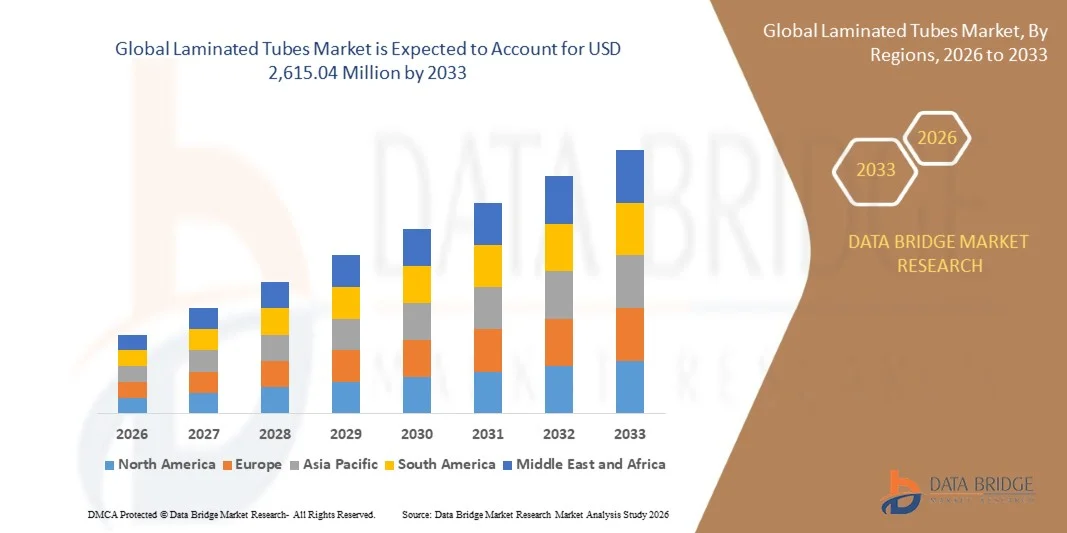
- As per Data Bridge Market Research analysis, the laminated tubes market was valued at USD 942.87 million in 2025 and is projected to reach USD 2,615.04 million by 2033, growing at a CAGR of 13.60% from 2026 to 2033.
- The market is experiencing consistent growth driven by rising demand for convenient and premium packaging formats, increasing consumption of oral care and personal care products, and technological advancements in laminated tube manufacturing. Laminated tubes provide strong protection against oxygen, moisture, light, and contamination while offering flexibility, controlled dispensing, and high-quality printing, making them suitable for products requiring both functional protection and strong shelf appeal.
- The increasing consumption of toothpaste, skincare, cosmetics, pharmaceutical creams, ointments, and gels, combined with growing consumer preference for hygienic, portable, and easy-to-use packaging, is encouraging manufacturers to expand their use of laminated tubes. Plastic Barrier Laminate (PBL) and Aluminum Barrier Laminate (ABL) tubes are widely adopted because they provide enhanced barrier performance and product stability, while newer recyclable and mono-material structures are gaining attention as brands respond to sustainability requirements.
Market Size & Forecast
- Global Market Value (2025): USD 942.87 Million
- Expected Market Value (2033): USD 2,615.04 Million
- Forecast CAGR (2026–2033): 13.60%
- Leading Region in 2025: North America
- Fastest Growing Region: Asia Pacific
What are the Major Takeaways of the Laminated Tubes Market?
- North America dominated the laminated tubes market with the largest revenue share of 33.4% in 2025, supported by strong demand for premium packaging, established personal care and cosmetics industries, and increasing adoption of customized and sustainable laminated tube solutions.
- Asia-Pacific is expected to be the fastest-growing region at a CAGR of 7.48% from 2026 to 2033, fueled by expanding personal care and pharmaceutical industries, rising disposable incomes, increasing urbanization, and growing adoption of sustainable packaging solutions.
- The plastic barrier laminate (PBL) segment led the market with a 52.6% share in 2025, driven by its lightweight construction, flexibility, barrier performance, and cost efficiency.
- Co-extruded laminate tubes are the fastest-growing product type, projected to register a CAGR of 6.7%, reflecting the surge in demand for lightweight, high-performance, and cost-efficient packaging
- The 50 ml to 100 ml segment dominated the capacity category with a 38.4% revenue share in 2025, led by its broad use in toothpaste, skincare, cosmetics, pharmaceutical creams, and gels.
- 5-Layer accounted for 40.45% of the market share in 2025, preferred by its balanced combination of barrier protection, mechanical strength, flexibility, and manufacturing efficiency.
- The stand-up cap segment is the fastest-growing cap type category, with a CAGR of 6.8%, driven by increasing demand for ergonomic and convenient packaging formats.
Report Scope and Laminated Tubes Market Segmentation
|
Attributes |
Laminated Tubes Key Market Insights |
|
Segments Covered |
|
|
Countries Covered |
North America
Europe
Asia-Pacific
Middle East and Africa
South America
|
|
Key Market Players |
|
|
Market Opportunities |
|
|
Value Added Data Infosets |
In addition to the insights on market scenarios such as market value, growth rate, segmentation, geographical coverage, and major players, the market reports curated by the Data Bridge Market Research also include import export analysis, production capacity overview, production consumption analysis, price trend analysis, climate change scenario, supply chain analysis, value chain analysis, raw material/consumables overview, vendor selection criteria, PESTLE Analysis, Porter Analysis, and regulatory framework. |
What is the Key Trend in the Laminated Tubes Market?
- Sustainable and recyclable laminated tube structures are increasingly being adopted as brands seek to reduce packaging waste, improve recyclability, and comply with evolving environmental requirements while maintaining barrier performance, product protection, and premium aesthetics.
- For instance, in May 2025, Neopac's Polyfoil Mono-Material Barrier Tube developed for Colgate's Elmex brand won the WorldStar Award 2025 for its weight-reduced, recyclable, high-barrier design, demonstrating the industry's shift toward mono-material laminated tubes.
- Manufacturers are increasingly developing mono-material PBL tubes, recyclable laminate structures, and lightweight packaging formats to reduce material intensity while preserving the barrier properties required for cosmetics, oral care, pharmaceutical, and food applications.
- Premium personal care and cosmetics brands are leveraging high-resolution printing, customized finishes, and recyclable tube structures to combine sustainability with stronger shelf appeal, product differentiation, and consumer convenience.
- For instance, in July 2024, Albéa Tubes announced that its Greenleaf recycle-ready all-plastic laminate web was being produced in North America, supporting the development of recyclable laminate tubes for cosmetic packaging while maintaining high-barrier performance
- As brand owners increasingly prioritize recyclability, material efficiency, premium aesthetics, and circular packaging, the adoption of sustainable laminated tube technologies is expected to accelerate, reinforcing recyclable and mono-material structures as a core innovation direction across the global market.
What are the Key Drivers of the Laminated Tubes Market?
- The rapid expansion of personal care, cosmetics, pharmaceutical, and oral care products has significantly increased demand for laminated tubes capable of providing strong barrier protection, convenient dispensing, product stability, and attractive packaging across diverse formulations.
- For instance, in May 2025, Neopac showcased its SpringTube Oval and Polyfoil® Sensation tubes at Luxe Pack New York, highlighting growing demand for high-performance and visually attractive packaging in skincare, cosmetics, and personal care. Neopac stated that its Polyfoil Sensation tubes provide high-barrier protection and support cosmetic, skincare, haircare, and pharmaceutical applications.
- Consumer brands, pharmaceutical manufacturers, and oral care companies are integrating laminated tubes into their packaging portfolios to extend product shelf life, minimize contamination, improve dispensing, and strengthen brand differentiation through high-quality graphics and customized formats.
- For instance, in May 2024, Neopac announced a new cosmetics tube production line at its U.S. facility, adding capacity for 70 million additional tubes annually in 25–40 mm diameters and 15–150 ml volumes. The investment demonstrates increasing demand for advanced tube packaging from cosmetics and personal-care brands in North America.
- With manufacturers increasingly requiring packaging that combines product protection, convenience, lightweight construction, premium branding, and sustainability, laminated tubes will remain important for personal care, cosmetics, oral care, pharmaceuticals, and food applications.
Which Factors are Challenging the Growth of the Laminated Tubes Market?
- Complex multilayer structures and recycling limitations create significant challenges because conventional laminated tubes may combine plastic, aluminum, adhesive, and barrier materials that complicate material separation and recycling after consumer use.
- For instance, in October 2024, Albéa Tubes announced three sustainable packaging solutions recognized by the ETMA Tube of the Year Awards, including designs using recycled materials and reduced plastic content. These developments highlight the industry's ongoing efforts to address the recycling and material-complexity challenges associated with conventional laminated tubes.
- These structural complexities can increase material recovery challenges, recycling costs, and requirements for specialized processing infrastructure, particularly as governments and brand owners introduce stricter packaging circularity and recycled-content expectations.
- The recycling challenge associated with conventional multilayer construction continues to encourage manufacturers to redesign tube structures toward mono-material PBL, recyclable laminates, and reduced material intensity.
- Higher manufacturing complexity compared with conventional plastic tubes can constrain adoption because laminated tubes require multiple material layers, specialized barrier films, adhesives, printing processes, and precise conversion technologies.
- For instance, in May 2025, Neopac announced that its Polyfoil Mono-Material Barrier Tube for Colgate's Elmex toothpaste won a WorldStar Award 2025, featuring a weight-reduced, recyclable mono-material structure designed to retain high-barrier performance. The development demonstrates manufacturers' efforts to overcome the recycling limitations of conventional multilayer laminate tubes.
- This transition requires investment in material development, manufacturing processes, barrier technology, and recycling compatibility, potentially increasing development costs and slowing adoption among smaller packaging manufacturers.
How is the Laminated Tubes Market Segmented?
The laminated tubes market is segmented on the basis of product type, capacity, layer, cap type, and end-use.
- By Product Type
On the basis of product type, the laminated tubes market is segmented into plastic barrier laminate (PBL), aluminum barrier laminate (ABL), co-extruded laminate tubes, and other laminated tubes. The plastic barrier laminate (PBL) segment dominated the market with an estimated 52.6% share in 2025, supported by its lightweight construction, flexibility, barrier performance, and cost efficiency. PBL tubes are extensively used across cosmetics, personal care, oral care, and pharmaceutical applications. Their polyethylene-based construction enables manufacturers to combine squeezability with strong protection against moisture and oxygen. PBL structures are also increasingly favored as manufacturers develop recyclable and mono-material packaging solutions. The compatibility of plastic laminates with high-quality printing and premium decoration further supports their widespread adoption.
The co-extruded laminate tubes segment is projected to register the fastest growth, with an estimated CAGR of 6.7% through the forecast period, driven by demand for lightweight, high-performance, and cost-efficient packaging. Co-extruded structures integrate multiple polymer layers to provide improved barrier and mechanical properties. These tubes are suitable for products requiring enhanced protection against oxygen, moisture, light, and external contamination. Advances in polymer and extrusion technologies are enabling manufacturers to reduce material thickness without compromising structural performance. Increasing demand for sustainable polymer-based packaging is also encouraging development of more recyclable co-extruded structures. Growing use across personal care, pharmaceutical, and oral care applications is expected to further accelerate adoption.
- By Capacity
On the basis of capacity, the laminated tubes market is segmented into less than 50 ml, 50 ml to 100 ml, 101 ml to 150 ml, and above 150 ml. The 50 ml to 100 ml segment dominated the market with 38.4% share in 2025, supported by its broad use in toothpaste, skincare, cosmetics, pharmaceutical creams, and gels. The format provides an effective balance between product quantity, portability, consumer convenience, and packaging cost. It is particularly suitable for daily-use products requiring sufficient volume without making the package excessively large. Standard toothpaste and skincare formats represent important demand applications within this capacity range.
The less than 50 ml segment is expected to witness the fastest growth at 6.98% CAGR during forecast period, driven by increasing demand for travel-size, sample-size, premium, and concentrated personal care products. Smaller tubes are particularly attractive for skincare, cosmetics, dermatological products, and specialty pharmaceutical formulations. Their compact dimensions provide portability and convenience for consumers purchasing products through travel and e-commerce channels. Beauty brands increasingly use small tubes for trial packs and promotional products. Smaller formats can also reduce the quantity of material used per individual package when appropriately designed. Rising demand for convenient on-the-go products is therefore expected to strengthen this segment.
- By Layer
On the basis of layer, the laminated tubes market is segmented into 3-layer, 5-layer, 7-layer, and others. The 5-layer segment is estimated to dominated the market, accounting for 40.45% of demand in 2025, owing to its balanced combination of barrier protection, mechanical strength, flexibility, and manufacturing efficiency. Five-layer structures can combine polymer, adhesive, and barrier layers to protect formulations from external environmental conditions. They are widely applicable across oral care, cosmetics, personal care, pharmaceuticals, and food products. The structure allows manufacturers to customize barrier performance according to product sensitivity and shelf-life requirements. It also provides a practical balance between advanced performance and production complexity.
The 7-layer segment is expected to register the fastest growth at 6.5% CAGR, supported by increasing demand for sophisticated barrier structures and enhanced product protection. Seven-layer tubes can incorporate multiple functional layers to improve resistance to oxygen, moisture, light, chemicals, and aroma migration. These characteristics are particularly valuable for pharmaceutical, food, premium cosmetic, and sensitive personal care formulations. Longer shelf-life requirements are encouraging manufacturers to use more advanced multilayer structures. Improvements in extrusion and lamination technology are also making complex layer configurations increasingly practical. Demand for high-performance packaging with greater formulation compatibility is expected to support continued expansion of this segment.
- By Cap Type
On the basis of cap type, the laminated tubes market is segmented into stand-up cap, nozzle cap, fez cap, flip top cap, and other caps. The flip top cap segment is estimated to dominate the market with 35.40% share in 2025, supported by its convenience, controlled dispensing, and extensive use in high-volume consumer products. Flip-top closures are widely utilized for toothpaste, skincare creams, gels, shampoos, and other personal care products. Their attached construction allows consumers to open and close the tube easily without completely removing the cap. They also support one-handed dispensing and help improve overall consumer convenience. Manufacturers can customize the closure shape and dispensing orifice according to product viscosity and application requirements.
The stand-up cap segment is projected to be the fastest-growing cap category at 6.8% CAGR, driven by increasing demand for ergonomic and convenient packaging formats. Stand-up tubes remain upright on shelves and bathroom surfaces, improving storage convenience and product accessibility. This design is increasingly used for premium personal care, cosmetics, oral care, and household products. Stand-up formats can also improve the visibility of branding and decorative elements on retail shelves. Their compatibility with thicker creams, gels, and other viscous formulations further supports adoption. Growing consumer preference for easy-to-use and space-efficient packaging is expected to accelerate demand for stand-up closures.
- By End-Use
On the basis of end-use, the laminated tubes market is segmented into cosmetics, oral care, commercial, pharmaceuticals, home and other personal care, food, and others. The Cosmetics segment dominated the market with 33.7% share in 2025, supported by strong demand for skincare, beauty, haircare, sunscreen, and grooming products. Laminated tubes offer cosmetics brands a combination of high-quality decoration, barrier protection, controlled dispensing, and lightweight construction. The format is particularly attractive for premium products requiring strong shelf appeal and differentiation. Increasing consumption of skincare and beauty products is creating additional demand for flexible tube packaging. Growing interest in recyclable and sustainable cosmetic packaging is also encouraging manufacturers to develop improved laminated structures.
The pharmaceuticals segment is projected to register the fastest growth at 7% CAGR, driven by increasing demand for creams, ointments, gels, and topical medicines. Laminated tubes provide strong protection against moisture, oxygen, light, and contamination, supporting formulation stability and product integrity. Pharmaceutical manufacturers also value their controlled dispensing and hygienic packaging characteristics. Increasing demand for dermatological and topical treatments is generating additional opportunities. High-barrier ABL and PBL structures are particularly relevant for formulations requiring enhanced protection. Rising healthcare consumption and the need for convenient topical drug packaging are expected to maintain strong growth in this segment.
Which Region Holds the Largest Share of the Laminated Tubes Market?
- North America dominated the laminated tubes market with the largest revenue share of 33.4% in 2025, supported by strong demand for premium packaging, established personal care and cosmetics industries, and increasing adoption of customized and sustainable laminated tube solutions.
- The region also benefits from advanced packaging technologies, strong brand presence, high consumer demand for premium personal care products, and increasing focus on recyclable and sustainable tube solutions. Growing investments in high-barrier PBL and ABL structures, customized printing, and convenient dispensing formats are further strengthening North America's market position. The U.S. remains the key contributor due to its large consumer base and established packaging manufacturing infrastructure.
U.S. Laminated Tubes Market Insight
The U.S. laminated tubes market is witnessing strong growth due to rising demand for convenient, lightweight, and premium packaging across cosmetics, personal care, oral care, and pharmaceutical applications. The country’s mature consumer goods and pharmaceutical ecosystem, along with increasing adoption of recyclable PBL and high-barrier laminate solutions, is driving demand across major end-use industries. In addition, growing emphasis on sustainable packaging, product protection, and attractive tube designs is accelerating adoption among brands and packaging manufacturers.
Asia-Pacific Laminated Tubes Market Insight
The Asia-Pacific laminated tubes market is expected to witness rapid growth, driven by increasing urbanization, expanding personal care consumption, and rising investments in modern packaging infrastructure across countries such as China, India, and Japan. Growing consumer awareness regarding premium cosmetics, oral care, and pharmaceutical products, along with increasing adoption of recyclable packaging technologies, is supporting regional market expansion. In addition, the growing presence of domestic beauty brands and expanding manufacturing capabilities is accelerating laminated tube adoption across consumer and healthcare applications.
Japan Laminated Tubes Market Insight
The Japan laminated tubes market is witnessing consistent growth due to rising demand for premium cosmetics, advanced personal care products, oral care solutions, and pharmaceutical packaging. Cosmetic manufacturers and healthcare companies are increasingly adopting high-quality laminated tubes for product protection, convenient dispensing, and premium presentation. Moreover, increasing integration of sustainable materials, high-resolution printing, and advanced barrier technologies, together with Japan’s focus on environmentally responsible packaging, is further contributing to market growth.
China Laminated Tubes Market Insight
The China laminated tubes market is growing rapidly, driven by expanding cosmetics and personal care consumption, increasing pharmaceutical production, and rising demand for convenient and premium packaging formats. Growing adoption of recyclable PBL, high-barrier structures, and advanced printing technologies across cosmetics, oral care, and healthcare applications is significantly boosting market demand. In addition, rising investments in domestic packaging manufacturing, expanding e-commerce sales, and increasing consumer preference for branded personal care products are positioning China as one of the fastest-growing markets for laminated tubes globally.
U.K. Laminated Tubes Market Insight
The U.K. laminated tubes market is experiencing steady growth, supported by rising adoption of sustainable packaging technologies across cosmetics, personal care, oral care, and pharmaceutical applications. Increasing investments in recyclable laminate structures and growing demand for lightweight, convenient, and premium packaging solutions are contributing to market growth. Furthermore, the integration of high-quality printing, innovative dispensing closures, and recycled materials is improving packaging functionality and sustainability, positioning the U.K. as an important market for advanced laminated tube solutions.
Germany Laminated Tubes Market Insight
The Germany laminated tubes market is expanding steadily due to the country’s strong cosmetics, pharmaceutical, oral care, and packaging manufacturing industries and increasing adoption of sustainable packaging technologies. Consumer brands and packaging manufacturers are increasingly utilizing laminated tubes for product protection, premium presentation, and convenient dispensing across diverse applications. Continuous advancements in recyclable mono-material structures, barrier technologies, and lightweight packaging, along with strong environmental sustainability requirements, are further driving market growth in Germany.
Which are the Top Companies in Laminated Tubes Market?
The laminated tubes industry is primarily led by well-established companies, including:
- EPL Limited (India)
- ALLTUB (France)
- Hoffmann Neopac AG (Switzerland)
- Pirlo Holding GmbH (Austria)
- ALBEA SERVICES (France)
- ZÁLESÍ a.s. Luhačovice (Czech Republic)
- Scandolara S.p.A. (Italy)
- PrishaTubes (India)
- Shanghai Boom Corporation (China)
- GUANGZHOU LISSON PLASTIC CO., LTD. (China)
- Guangzhou Lixin Packaging Material Co., Ltd. (China)
- Tube Advantage Inc. (U.S.)
- Antilla Propack (India)
- Shanghai Pactek Industries Co., Ltd. (China)
- Kim Pai Co., Ltd. (Slovenia)
- Permapack AG (Switzerland)
- SkyPack (India)
- Mauni Moon Multi Technologies Pvt Ltd (India)
What are Latest Developments in Laminated Tubes Market?
- In May 2025, Albéa showcased its expanding portfolio of sustainable plastic and laminate tube solutions for the beauty and personal-care sector, highlighting packaging designs focused on weight reduction, recycled content, and improved recyclability. The company continued to develop laminate tubes that combine product protection with sustainability requirements, supporting brands seeking to reduce packaging impacts while maintaining premium appearance and functionality. The development reflects the industry's shift toward recyclable and lower-material tube structures.
- In October 2024, Albéa Tubes received recognition at the ETMA Tube of the Year 2024 awards for its sustainable tube innovations, including a laminate-tube solution developed with L’Occitane. The recognition highlighted the continued development of lighter and more sustainable tube formats, including solutions incorporating recycled materials and improved material efficiency. The development demonstrates how laminated tubes are increasingly being redesigned to meet sustainability and premium-packaging requirements.
- In October 2023, Amcor and Ocean Potion unveiled a laminated tube developed for children's sunscreen, demonstrating the use of laminate-tube technology for sun-care and personal-care applications. The collaboration focused on creating a practical tube format suitable for sunscreen formulations while providing the protection and convenience expected from flexible tube packaging. This development illustrates the continued expansion of laminated tubes beyond traditional oral-care applications into specialized personal-care products
- In January 2022, Albéa introduced its EcoFusion Top two-in-one closure system, designed to combine the tube shoulder and cap into a single component and reduce packaging material. The solution can be combined with Albéa’s Greenleaf laminate tubes and Thin-Wall technology, supporting lightweight and more resource-efficient tube designs. The development reinforced the industry's movement toward reducing plastic consumption while retaining the functionality and aesthetics of laminated tube packaging.
- In November 2021, EPL Limited partnered with Vicco Labs to launch sustainable tube packaging for Vicco Turmeric, using EPL’s Platina laminated-tube technology. Platina was developed as an eco-friendly laminate tube solution focused on recyclability and material efficiency, supporting the transition toward more sustainable packaging for personal-care products. The launch demonstrated growing adoption of recyclable laminated tubes by established consumer brands in the Indian market
SKU-

- Interactive Data Analysis Dashboard
- Company Analysis Dashboard for high growth potential opportunities
- Research Analyst Access for customization & queries
- Competitor Analysis with Interactive dashboard
- Latest News, Updates & Trend analysis
- Harness the Power of Benchmark Analysis for Comprehensive Competitor Tracking
Global Laminated Tubes Market, Supply Chain Analysis and Ecosystem Framework
To support market growth and help clients navigate the impact of geopolitical shifts, DBMR has integrated in-depth supply chain analysis into its Global Laminated Tubes Market research reports. This addition empowers clients to respond effectively to global changes affecting their industries. The supply chain analysis section includes detailed insights such as Global Laminated Tubes Market consumption and production by country, price trend analysis, the impact of tariffs and geopolitical developments, and import and export trends by country and HSN code. It also highlights major suppliers with data on production capacity and company profiles, as well as key importers and exporters. In addition to research, DBMR offers specialized supply chain consulting services backed by over a decade of experience, providing solutions like supplier discovery, supplier risk assessment, price trend analysis, impact evaluation of inflation and trade route changes, and comprehensive market trend analysis.
Data collection and base year analysis are done using data collection modules with large sample sizes. The stage includes obtaining market information or related data through various sources and strategies. It includes examining and planning all the data acquired from the past in advance. It likewise envelops the examination of information inconsistencies seen across different information sources. The market data is analysed and estimated using market statistical and coherent models. Also, market share analysis and key trend analysis are the major success factors in the market report. To know more, please request an analyst call or drop down your inquiry.
The key research methodology used by DBMR research team is data triangulation which involves data mining, analysis of the impact of data variables on the market and primary (industry expert) validation. Data models include Vendor Positioning Grid, Market Time Line Analysis, Market Overview and Guide, Company Positioning Grid, Patent Analysis, Pricing Analysis, Company Market Share Analysis, Standards of Measurement, Global versus Regional and Vendor Share Analysis. To know more about the research methodology, drop in an inquiry to speak to our industry experts.
Data Bridge Market Research is a leader in advanced formative research. We take pride in servicing our existing and new customers with data and analysis that match and suits their goal. The report can be customized to include price trend analysis of target brands understanding the market for additional countries (ask for the list of countries), clinical trial results data, literature review, refurbished market and product base analysis. Market analysis of target competitors can be analyzed from technology-based analysis to market portfolio strategies. We can add as many competitors that you require data about in the format and data style you are looking for. Our team of analysts can also provide you data in crude raw excel files pivot tables (Fact book) or can assist you in creating presentations from the data sets available in the report.












