


Global Laparoscopic Devices Market
Market Size in USD Billion
CAGR :
% 
 USD
11.17 Billion
USD
19.20 Billion
2025
2033
USD
11.17 Billion
USD
19.20 Billion
2025
2033
 Forecast Period Forecast Period |
2026 –2033 |
 Market Size (Base Year) Market Size (Base Year) |
USD 11.17 Billion |
 Market Size (Forecast Year) Market Size (Forecast Year) |
USD 19.20 Billion |
 CAGR CAGR |
% |
| Major Markets Players |
|
Laparoscopic Devices Market Size
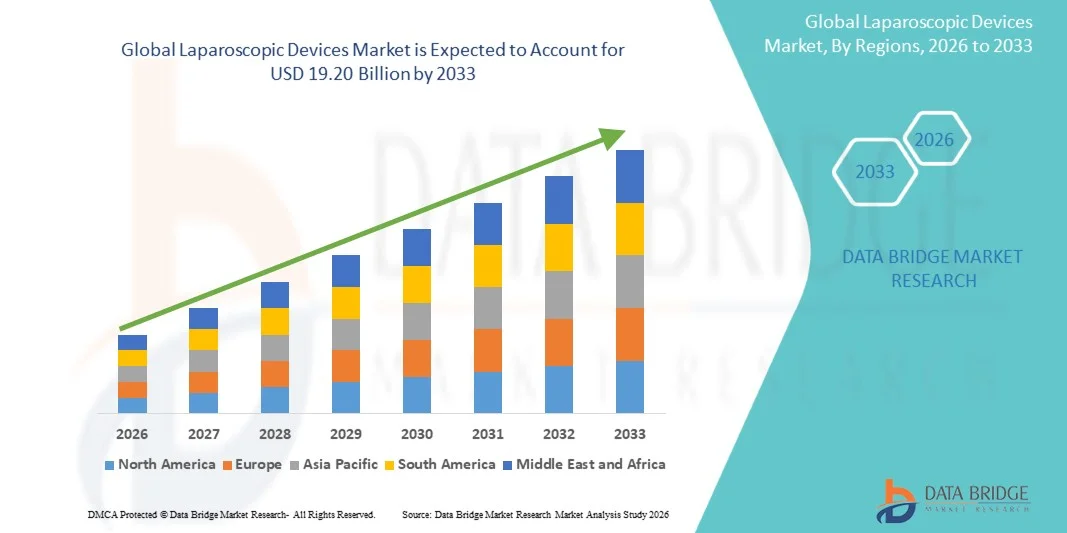
- The global laparoscopic devices market size was valued at USD 11.17 billion in 2025and is expected to reach USD 19.20 billion by 2033, at a CAGR of 7.01% during the forecast period
- The market growth is largely fueled by the rising preference for minimally invasive surgical procedures and continuous technological progress in surgical imaging, energy systems, and precision instruments, leading to increased adoption of laparoscopic devices across hospitals and ambulatory surgical centers in both developed and emerging healthcare markets
- Furthermore, growing patient demand for safer procedures with smaller incisions, reduced postoperative pain, shorter hospital stays, and faster recovery times is establishing laparoscopic devices as a modern standard in surgical care. These converging factors are accelerating the uptake of Laparoscopic Devices solutions, thereby significantly boosting the industry's growth
Laparoscopic Devices Market Analysis
- Laparoscopic Devices, including trocars, insufflators, laparoscopes, hand instruments, energy systems, and visualization platforms, are increasingly vital components of modern surgical care in hospitals and ambulatory surgical centers due to their essential role in enabling minimally invasive procedures with improved precision, reduced trauma, and faster patient recovery
- The escalating demand for Laparoscopic Devices is primarily fueled by the growing global volume of gastrointestinal, gynecological, urological, and bariatric surgeries, increasing preference for minimally invasive techniques, advancements in HD/3D imaging systems, and rising healthcare focus on shorter hospital stays and lower postoperative complications
- North America dominated the laparoscopic devices market with the largest revenue share of 39.10% in 2025, supported by advanced healthcare infrastructure, high surgical procedure volumes, early adoption of robotic and minimally invasive technologies, and strong presence of leading medical device manufacturers, with the U.S. witnessing substantial utilization across general surgery, gynecology, and bariatric centers
- Asia-Pacific is expected to be the fastest growing region in the laparoscopic devices market during the forecast period due to expanding hospital infrastructure, rising healthcare expenditure, increasing awareness of minimally invasive surgery benefits, and growing surgical demand across countries such as China, India, Japan, and South Korea
- The General Surgery segment held the largest market revenue share of 31.6% in 2025, driven by high procedural volume of laparoscopic appendectomy, cholecystectomy, hernia repair, and abdominal surgeries worldwide
Report Scope and Laparoscopic Devices Market Segmentation
|
Attributes |
Laparoscopic Devices Key Market Insights |
|
Segments Covered |
|
|
Countries Covered |
North America · U.S. · Canada · Mexico Europe · Germany · France · U.K. · Netherlands · Switzerland · Belgium · Russia · Italy · Spain · Turkey · Rest of Europe Asia-Pacific · China · Japan · India · South Korea · Singapore · Malaysia · Australia · Thailand · Indonesia · Philippines · Rest of Asia-Pacific Middle East and Africa · Saudi Arabia · U.A.E. · South Africa · Egypt · Israel · Rest of Middle East and Africa South America · Brazil · Argentina · Rest of South America |
|
Key Market Players |
· Medtronic plc (Ireland) · Johnson & Johnson (U.S.) · Stryker Corporation (U.S.) · Olympus Corporation (Japan) · Karl Storz SE & Co. KG (Germany) · B. Braun Melsungen AG (Germany) · Intuitive Surgical, Inc. (U.S.) · CONMED Corporation (U.S.) · Smith+Nephew plc (U.K.) · Richard Wolf GmbH (Germany) · Cook Medical (U.S.) · Applied Medical Resources Corporation (U.S.) · Fujifilm Holdings Corporation (Japan) · Boston Scientific Corporation (U.S.) · Teleflex Incorporated (U.S.) · Zimmer Biomet Holdings, Inc. (U.S.) · Abbott Laboratories (U.S.) · Microline Surgical, Inc. (U.S.) · Peters Surgical (France) · Shenzhen Mindray Bio-Medical Electronics Co., Ltd. (China) |
|
Market Opportunities |
· Expansion of robotic-assisted and AI-integrated minimally invasive surgery · Rising Demand in Emerging Markets |
|
Value Added Data Infosets |
In addition to the insights on market scenarios such as market value, growth rate, segmentation, geographical coverage, and major players, the market reports curated by the Data Bridge Market Research also include in-depth expert analysis, patient epidemiology, pipeline analysis, pricing analysis, and regulatory framework. |
Laparoscopic Devices Market Trends
“Advancements in Minimally Invasive Surgery and Smart Visualization Technologies”
- A significant and accelerating trend in the global Laparoscopic Devices market is the increasing adoption of advanced minimally invasive surgical systems, high-definition imaging platforms, and precision energy devices that enhance procedural accuracy and patient recovery outcomes. These innovations are transforming modern surgical workflows across general surgery, gynecology, urology, and bariatric procedures
- For instance, hospitals and surgical centers are increasingly adopting laparoscopic towers, insufflation systems, and energy-based instruments from companies such as Medtronic and Johnson & Johnson MedTech to improve visualization, reduce blood loss, and shorten recovery time in minimally invasive procedures
- The integration of 3D and 4K imaging systems is significantly improving depth perception and anatomical clarity, enabling surgeons to perform complex procedures with greater precision
- Growing demand for advanced vessel sealing devices, staplers, and ergonomic hand instruments is enhancing procedural efficiency while reducing surgeon fatigue during longer operations
- The increasing adoption of robotic-assisted laparoscopy is further expanding surgical capabilities, particularly in delicate or technically demanding procedures
- This trend toward precision-guided, minimally invasive, and technology-enhanced surgery is reshaping expectations for operating room efficiency and patient care outcomes worldwide
Laparoscopic Devices Market Dynamics
Driver
“Rising Preference for Minimally Invasive Procedures and Increasing Surgical Volumes”
- The growing preference for minimally invasive surgeries, combined with rising global surgical procedure volumes, is a major driver supporting the growth of the Laparoscopic Devices market. Patients and providers increasingly favor laparoscopic approaches due to faster recovery and reduced hospital stays
- For instance, laparoscopic cholecystectomy, appendectomy, hysterectomy, and bariatric surgeries are being widely adopted in hospitals worldwide, driving strong demand for trocars, graspers, cameras, and insufflation systems
- Compared with open surgery, laparoscopic procedures generally offer smaller incisions, lower postoperative pain, reduced infection risk, and quicker return to daily activities
- Expanding healthcare infrastructure and greater availability of trained surgeons in emerging markets are further increasing adoption of laparoscopic techniques
- In addition, the rising burden of obesity, gastrointestinal disorders, and gynecological conditions is contributing to sustained demand for minimally invasive surgical interventions
Restraint/Challenge
“High Equipment Costs, Training Requirements, and Procedural Complexity”
- The high cost of laparoscopic towers, imaging systems, specialized instruments, and maintenance remains a major challenge, particularly for smaller hospitals and budget-constrained healthcare systems
- For instance, many community hospitals and rural surgical centers delay adoption of advanced laparoscopic platforms due to the significant capital investment required for cameras, monitors, energy devices, and sterilization infrastructure
- Successful laparoscopic surgery also requires specialized surgeon training, hand-eye coordination, and experience, creating a learning curve that can slow adoption in some regions
- Equipment malfunction risks, reusable instrument reprocessing requirements, and longer setup times for certain procedures can add operational complexity
- Addressing these challenges through cost-effective product innovation, expanded surgical training programs, and simplified device designs will be essential for sustained market growth
Laparoscopic Devices Market Scope
The market is segmented on the basis of product, application, and end user.
- By Product
On the basis of product, the Laparoscopic Devices market is segmented into Trocars, Energy Systems, Closure Devices, Suction/Irrigation Devices, Camera Monitoring Systems, Insufflation Devices, Laparoscopes, Hand Access Instruments, Robot Assisted System, Accessories, and Others. The Energy Systems segment dominated the largest market revenue share of 24.8% in 2025, driven by extensive use in tissue dissection, vessel sealing, coagulation, and cutting during minimally invasive surgeries. Surgeons increasingly prefer advanced bipolar and ultrasonic energy systems for precision and reduced blood loss. Rising volume of laparoscopic procedures globally is significantly boosting demand. Technological advancements improving safety and operative efficiency are further supporting adoption. Hospitals are investing in multifunctional energy platforms to reduce procedure time. Increasing prevalence of obesity, gastrointestinal disorders, and gynecological diseases requiring surgery also contributes to growth. Expansion of ambulatory surgical centers strengthens market penetration. High replacement demand for upgraded systems further supports revenue generation. Overall, Energy Systems remain the dominant product segment in 2025.
The Robot Assisted System segment is expected to witness the fastest growth rate of 13.4% CAGR from 2026 to 2033, driven by increasing adoption of robotic minimally invasive surgery for enhanced precision and dexterity. Surgeons are increasingly using robotic platforms for complex laparoscopic procedures in urology, gynecology, and colorectal surgery. Rising demand for shorter recovery time and lower complication rates is supporting growth. Hospitals are investing heavily in robotic surgery infrastructure to improve surgical outcomes. Technological innovation in AI-assisted navigation and imaging is accelerating adoption. Growing patient preference for advanced minimally invasive procedures is another key driver. Expansion of training programs for robotic surgeons is supporting usage. Increasing reimbursement support in developed markets strengthens demand. These factors collectively make Robot Assisted Systems the fastest-growing product segment.
- By Application
On the basis of application, the Laparoscopic Devices market is segmented into Bariatric Surgery, Colorectal Surgery, General Surgery, Gynecological Surgery, Urological Surgery, and Others. The General Surgery segment held the largest market revenue share of 31.6% in 2025, driven by high procedural volume of laparoscopic appendectomy, cholecystectomy, hernia repair, and abdominal surgeries worldwide. General surgery remains the most common area of laparoscopic adoption due to proven benefits such as reduced pain, faster recovery, and shorter hospital stay. Increasing prevalence of gallbladder disease and hernias is significantly boosting demand. Hospitals increasingly prefer laparoscopic techniques over open surgery for routine procedures. Advancements in surgical instruments are further supporting growth. Rising healthcare awareness and patient preference for minimally invasive procedures also contribute to segment leadership. Expansion of surgical facilities in emerging economies is strengthening adoption. Favorable reimbursement for common laparoscopic procedures further boosts demand. Overall, General Surgery remains the leading application segment.
The Bariatric Surgery segment is expected to witness the fastest growth rate of 12.1% CAGR from 2026 to 2033, driven by the rising global obesity epidemic and increasing demand for weight-loss surgical interventions. Laparoscopic bariatric procedures such as gastric bypass and sleeve gastrectomy are widely preferred due to lower complication risk and faster recovery. Growing awareness of obesity-related complications like diabetes and cardiovascular disease is boosting demand. Increasing insurance support for bariatric treatment in developed markets further supports growth. Hospitals and specialty centers are expanding bariatric programs globally. Technological improvements in stapling and visualization systems are enhancing outcomes. Rising acceptance of metabolic surgery as long-term treatment is another key factor. Growing middle-class healthcare spending in emerging economies contributes significantly. These factors position Bariatric Surgery as the fastest-growing application segment.
- By End User
On the basis of end user, the Laparoscopic Devices market is segmented into Hospitals, Clinics, Specialty Centers, and Others. The Hospitals segment accounted for the largest market revenue share of 58.7% in 2025, driven by high surgical volumes, availability of advanced operating rooms, and presence of trained laparoscopic surgeons. Hospitals are the primary centers for complex and emergency minimally invasive procedures. Increasing patient admissions for gastrointestinal, gynecological, and urological surgeries are significantly boosting demand. Availability of robotic platforms and high-end imaging systems further strengthens hospital dominance. Rising investments in healthcare infrastructure and modernization programs support growth. Hospitals also benefit from favorable reimbursement and multidisciplinary surgical teams. Expansion of tertiary care centers in developing economies is another key contributor. Strong procurement capacity enables regular equipment upgrades. Overall, hospitals remain the dominant end-user segment.
The Specialty Centers segment is expected to witness the fastest growth rate of 11.5% CAGR from 2026 to 2033, driven by increasing shift toward focused surgical care and outpatient minimally invasive procedures. Specialty centers offer cost-effective treatment, shorter waiting times, and high procedural efficiency. Rising preference for dedicated bariatric, fertility, and urology centers is supporting demand. Technological advancements in compact laparoscopic systems are improving accessibility. Increasing patient preference for same-day discharge procedures is also boosting growth. Expansion of private healthcare investments globally is strengthening specialty center networks. Skilled surgeons increasingly practice in specialized facilities with targeted expertise. Lower operational costs compared to hospitals support expansion. Rising medical tourism in developing countries further accelerates adoption. These factors collectively make Specialty Centers the fastest-growing end-user segment.
Laparoscopic Devices Market Regional Analysis
- North America dominated the laparoscopic devices market with the largest revenue share of 39.10% in 2025, supported by advanced healthcare infrastructure, high surgical procedure volumes, early adoption of robotic and minimally invasive technologies, and strong presence of leading medical device manufacturers. The region benefits from widespread availability of specialized surgical centers, highly trained surgeons, and strong preference for minimally invasive treatment approaches that reduce recovery time and hospital stays
- Healthcare providers in the region highly value precision, safety, and efficiency offered by laparoscopic devices such as trocars, insufflators, energy systems, hand instruments, and visualization platforms. Rising demand for minimally invasive procedures in general surgery, gynecology, urology, and bariatric care is further strengthening market growth
- This widespread adoption is further supported by favorable reimbursement frameworks, continuous innovation in surgical technologies, and increasing patient preference for faster recovery and lower postoperative complications, establishing North America as a leading market for laparoscopic devices
U.S. Laparoscopic Devices Market Insight
The U.S. laparoscopic devices market captured the largest revenue share within North America in 2025, driven by substantial utilization across general surgery, gynecology, and bariatric centers. Hospitals and ambulatory surgical centers are increasingly adopting advanced laparoscopic systems to improve procedural precision and patient outcomes. Growing demand for robotic-assisted laparoscopy, high-definition imaging systems, and advanced energy devices is significantly supporting market expansion. In addition, increasing prevalence of obesity, gastrointestinal disorders, and gynecological conditions requiring surgical intervention is further propelling growth in the U.S.
Europe Laparoscopic Devices Market Insight
The Europe laparoscopic devices market is projected to expand at a substantial CAGR throughout the forecast period, primarily driven by strong healthcare systems, increasing surgical procedure volumes, and growing adoption of minimally invasive techniques. The region is witnessing rising demand for laparoscopic devices across hospitals and specialty surgical centers. Increasing focus on reducing hospitalization time, improving patient recovery outcomes, and optimizing surgical efficiency is contributing significantly to market growth across Europe.
U.K. Laparoscopic Devices Market Insight
The U.K. Laparoscopic Devices market is anticipated to grow at a noteworthy CAGR during the forecast period, supported by increasing use of minimally invasive surgery through National Health Service (NHS) hospitals and private healthcare providers. Demand for advanced laparoscopic instruments is rising in colorectal surgery, gynecology, and gallbladder procedures. Continued emphasis on shorter waiting times, lower complication rates, and enhanced patient recovery is expected to stimulate market growth in the U.K.
Germany Laparoscopic Devices Market Insight
The Germany laparoscopic devices market is expected to expand at a considerable CAGR during the forecast period, fueled by advanced healthcare infrastructure, strong surgical expertise, and high adoption of precision medical technologies. Germany’s hospitals increasingly utilize laparoscopic systems integrated with advanced imaging and energy platforms. The country’s emphasis on innovation and clinical efficiency is supporting wider adoption across general surgery, urology, and gynecological procedures.
Asia-Pacific Laparoscopic Devices Market Insight
The Asia-Pacific laparoscopic devices market is poised to grow at the fastest CAGR during the forecast period, driven by expanding hospital infrastructure, rising healthcare expenditure, increasing awareness of minimally invasive surgery benefits, and growing surgical demand across countries such as China, India, Japan, and South Korea. The region is witnessing rapid growth in tertiary hospitals, specialty surgery centers, and medical tourism hubs. Government healthcare investments and increasing surgeon training in minimally invasive procedures are further accelerating market expansion.
Japan Laparoscopic Devices Market Insight
The Japan laparoscopic devices market is gaining momentum due to the country’s advanced healthcare system, aging population, and strong demand for minimally invasive surgical care. Japanese hospitals are increasingly adopting high-precision laparoscopic and robotic-assisted systems for gastrointestinal, gynecological, and urological procedures. Focus on faster recovery and reduced surgical trauma is supporting steady market growth.
China Laparoscopic Devices Market Insight
The China laparoscopic devices market accounted for the largest market revenue share in Asia Pacific in 2025, attributed to rapid healthcare infrastructure expansion, increasing surgical volumes, and rising adoption of advanced minimally invasive technologies. China is witnessing strong growth in hospital modernization, surgical training programs, and demand for laparoscopic procedures across urban healthcare centers. The presence of domestic manufacturers and expanding access to affordable devices are key factors propelling the market in the country.
Laparoscopic Devices Market Share
The Laparoscopic Devices industry is primarily led by well-established companies, including:
- Medtronic plc (Ireland)
- Johnson & Johnson (U.S.)
- Stryker Corporation (U.S.)
- Olympus Corporation (Japan)
- Karl Storz SE & Co. KG (Germany)
- Braun Melsungen AG (Germany)
- Intuitive Surgical, Inc. (U.S.)
- CONMED Corporation (U.S.)
- Smith+Nephew plc (U.K.)
- Richard Wolf GmbH (Germany)
- Cook Medical (U.S.)
- Applied Medical Resources Corporation (U.S.)
- Fujifilm Holdings Corporation (Japan)
- Boston Scientific Corporation (U.S.)
- Teleflex Incorporated (U.S.)
- Zimmer Biomet Holdings, Inc. (U.S.)
- Abbott Laboratories (U.S.)
- Microline Surgical, Inc. (U.S.)
- Peters Surgical (France)
- Shenzhen Mindray Bio-Medical Electronics Co., Ltd. (China)
Latest Developments in Global Laparoscopic Devices Market
- In June 2021, Ethicon, part of Johnson & Johnson MedTech, announced the launch of its ENSEAL X1 Curved Jaw Tissue Sealer, an advanced laparoscopic energy device designed to provide stronger vessel sealing, improved tissue access, and greater procedural efficiency during minimally invasive surgeries. The launch strengthened Ethicon’s portfolio in advanced laparoscopic instrumentation
- In September 2021, Olympus Corporation announced the commercial launch of its POWERSEAL advanced bipolar surgical energy devices, developed for both laparoscopic and open procedures. The system was designed to deliver reliable vessel sealing, dissection capability, and reduced thermal spread, expanding Olympus’ presence in advanced laparoscopic surgery technologies
- In March 2023, Peters Surgical announced the acquisition of VECTEC, a France-based manufacturer of trocars, scissors, and endoscopic forceps. The acquisition expanded Peters Surgical’s laparoscopic device portfolio and enhanced its ability to serve gynecology, urology, and general surgery markets.
- In June 2023, Canadian surgical technology company Xpan received U.S. FDA 510(k) clearance for its Universal Trocars System, designed to minimize tissue trauma and improve access during laparoscopic surgery. The approval marked an important advancement in trocar innovation for minimally invasive procedures
- In April 2024, Medtronic introduced new AI capabilities for its Touch Surgery Live Stream platform, featuring 14 artificial intelligence algorithms that provide post-operative analytics and surgical insights across laparoscopic and robotic-assisted surgeries. This launch highlighted growing integration of AI into laparoscopic workflow optimization
- In June 2024, Intuitive Surgical announced that the U.S. FDA cleared a labeling update for its da Vinci X and Xi surgical systems related to radical prostatectomy procedures. Although robotic in nature, the update reflected continued convergence between robotic and laparoscopic minimally invasive surgery platforms
- In August 2024, Olympus Corporation launched the new 5mm POWERSEAL Sealer/Divider devices, expanding its advanced bipolar energy range for laparoscopic and open surgeries. The devices were designed to improve sealing performance, dissection capability, and ease of use while requiring less force to close the jaws
- In December 2025, Medtronic received U.S. FDA clearance for its Hugo robotic-assisted surgery system for urologic procedures. The modular platform provides hospitals with a new minimally invasive surgery option and supports broader competition in advanced laparoscopic and robotic surgery markets
SKU-
Get online access to the report on the World's First Market Intelligence Cloud

- Interactive Data Analysis Dashboard
- Company Analysis Dashboard for high growth potential opportunities
- Research Analyst Access for customization & queries
- Competitor Analysis with Interactive dashboard
- Latest News, Updates & Trend analysis
- Harness the Power of Benchmark Analysis for Comprehensive Competitor Tracking
Research Methodology
Data collection and base year analysis are done using data collection modules with large sample sizes. The stage includes obtaining market information or related data through various sources and strategies. It includes examining and planning all the data acquired from the past in advance. It likewise envelops the examination of information inconsistencies seen across different information sources. The market data is analysed and estimated using market statistical and coherent models. Also, market share analysis and key trend analysis are the major success factors in the market report. To know more, please request an analyst call or drop down your inquiry.
The key research methodology used by DBMR research team is data triangulation which involves data mining, analysis of the impact of data variables on the market and primary (industry expert) validation. Data models include Vendor Positioning Grid, Market Time Line Analysis, Market Overview and Guide, Company Positioning Grid, Patent Analysis, Pricing Analysis, Company Market Share Analysis, Standards of Measurement, Global versus Regional and Vendor Share Analysis. To know more about the research methodology, drop in an inquiry to speak to our industry experts.
Customization Available
Data Bridge Market Research is a leader in advanced formative research. We take pride in servicing our existing and new customers with data and analysis that match and suits their goal. The report can be customized to include price trend analysis of target brands understanding the market for additional countries (ask for the list of countries), clinical trial results data, literature review, refurbished market and product base analysis. Market analysis of target competitors can be analyzed from technology-based analysis to market portfolio strategies. We can add as many competitors that you require data about in the format and data style you are looking for. Our team of analysts can also provide you data in crude raw excel files pivot tables (Fact book) or can assist you in creating presentations from the data sets available in the report.












