




Global Laser Hair Loss Devices Market
Market Size in USD Million
CAGR :
% 
 USD
989.32 Million
USD
1,518.29 Million
2025
2033
USD
989.32 Million
USD
1,518.29 Million
2025
2033
 Forecast Period Forecast Period |
2026 - 2033 |
 Market Size (Base Year) Market Size (Base Year) |
USD 989.32 Million |
 Market Size (Forecast Year) Market Size (Forecast Year) |
USD 1,518.29 Million |
 CAGR CAGR |
% |
| Major Markets Players |
|
Laser Hair Loss Devices Market Overview
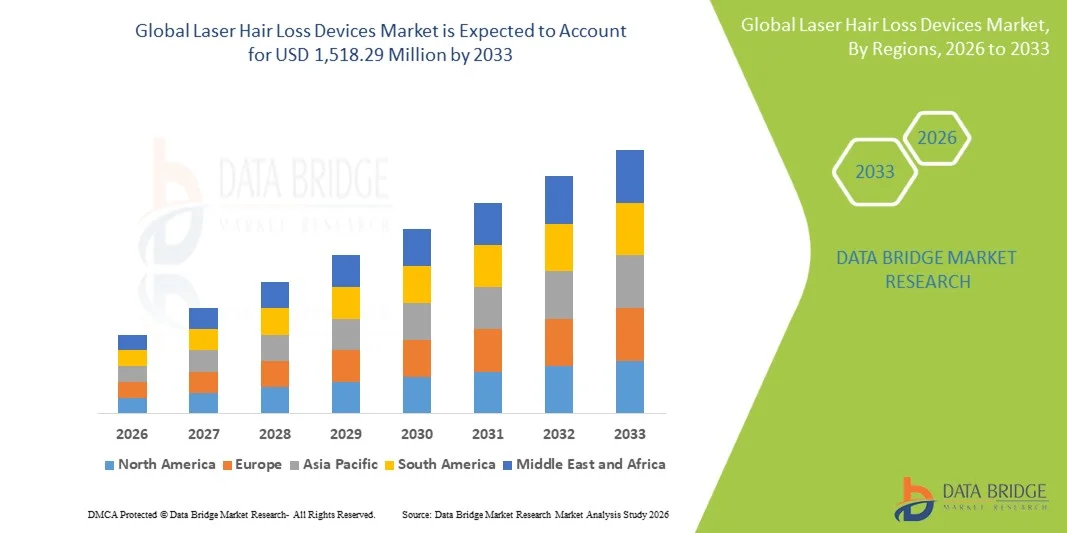
The Laser Hair Loss Devices Market was valued at USD 989.32 million in 2025 and is projected to reach USD 1,518.29 million by 2033, growing at a CAGR of 5.50% from 2026 to 2033. The market is witnessing steady growth driven by increasing prevalence of hair loss disorders, rising consumer awareness regarding non-invasive hair restoration treatments, and continuous advancements in low-level laser therapy (LLLT) technologies.
The growing incidence of androgenetic alopecia, stress-related hair thinning, and age-associated hair loss, coupled with increasing demand for at-home treatment solutions, is encouraging consumers and healthcare providers to adopt laser-based hair growth devices. Wearable laser caps, helmets, combs, and headbands are gaining popularity as convenient and clinically supported alternatives to pharmaceutical and surgical treatments. Furthermore, technological improvements in device design, portability, and treatment efficacy are expanding applications across dermatology clinics, specialty hair restoration centers, and homecare settings, supporting sustained market growth worldwide.
Key Market Trends & Insights
- North America dominated the Laser Hair Loss Devices Market with the largest revenue share of 36.42% in 2025, supported by high consumer awareness, strong adoption of aesthetic technologies, and the presence of leading hair restoration device manufacturers.
- The Diode Lasers segment led the market with a 48.62% share in 2025, driven by their proven effectiveness in stimulating hair follicles and promoting hair regrowth across a broad range of hair loss conditions.
- Asia-Pacific is expected to be the fastest-growing region at a CAGR of 8.1% from 2026 to 2033, fueled by rising disposable incomes, increasing prevalence of hair loss disorders, and expanding demand for non-invasive aesthetic treatments across China, India, South Korea, and Japan.
- Nd:YAG Lasers are the fastest-growing product type, projected to register a CAGR of 8.1%, reflecting the surge in technological advancements and growing adoption in professional dermatology and hair restoration clinics.
- The Males segment dominated the vehicle type category with a 61.37% revenue share in 2025, led by the high prevalence of androgenetic alopecia among men worldwide and growing awareness regarding early intervention for hair loss management.
- Home Use accounted for 52.48% of the market, preferred by the growing consumer demand for convenient, cost-effective, and self-administered hair restoration solutions
- The Females segment is the fastest-growing application category, with a CAGR of 8.4%, driven by the rising awareness of female pattern hair loss and increasing willingness among women to seek treatment for hair thinning conditions.
Market Size & Forecast
- Global Market Value (2025): USD 989.32 Million
- Expected Market Value (2033): USD 1,518.29 Million
- Forecast CAGR (2026–2033): 5.50%
- Leading Region in 2025: North America
- Fastest Growing Region: Asia Pacific
Report Scope and Laser Hair Loss Devices Market Segmentation
|
Attributes |
Laser Hair Loss Devices Key Market Insights |
|
Segments Covered |
|
|
Countries Covered |
North America · U.S. · Canada · Mexico Europe · Germany · France · U.K. · Netherlands · Switzerland · Belgium · Russia · Italy · Spain · Turkey · Rest of Europe Asia-Pacific · China · Japan · India · South Korea · Singapore · Malaysia · Australia · Thailand · Indonesia · Philippines · Rest of Asia-Pacific Middle East and Africa · Saudi Arabia · U.A.E. · South Africa · Egypt · Israel · Rest of Middle East and Africa South America · Brazil · Argentina · Rest of South America |
|
Key Market Players |
· Capillus, LLC (U.S.) · Freedom Laser Therapy, Inc. (U.S.) · The Hairmax Company Ltd (U.K.) · Theradome Inc. (U.S.) · iRESTORE Hair Growth System (U.S.) · Curallux, LLC (U.S.) · Apira Science, Inc. (U.S.) · CurrentBody Skin Limited (U.K.) · illumiflow LLC (U.S.) · Kiierr International, LLC (U.S.) · Sunetics International Ltd. (Canada) · LaserCap Company (U.S.) · Hairguard Ltd (U.K.) · Revian Inc. (U.S.) · NutraStim Hair Growth Systems, Inc. (U.S.) · Omega Laser Systems Ltd (U.K.) · LED Technologies, LLC (U.S.) · Lucinda Ellery Consultancy Ltd (U.K.) · Lexington International, LLC (U.S.) · Celluma Light Therapy LLC (U.S.) |
|
Market Opportunities |
· Expanding demand for clinically validated at-home laser hair growth devices · Growing prevalence of hair loss among women · Integration of mobile applications, treatment tracking, and AI-driven personalization into laser hair loss devices |
|
Value Added Data Infosets |
In addition to the insights on market scenarios such as market value, growth rate, segmentation, geographical coverage, and major players, the market reports curated by the Data Bridge Market Research also include in-depth expert analysis, patient epidemiology, pipeline analysis, pricing analysis, and regulatory framework. |
Laser Hair Loss Devices Market Trends
Trend: Rising Preference for At-Home Hair Restoration Solutions
Consumers are increasingly adopting laser hair loss devices for convenient, non-invasive hair regrowth treatments that can be used without frequent clinic visits. The availability of wearable laser caps, helmets, and combs has improved accessibility while reducing treatment costs compared to surgical procedures. Manufacturers are also incorporating lightweight designs, rechargeable batteries, and mobile app connectivity to enhance user experience and treatment adherence, while clinically supported low-level laser therapy technologies continue to strengthen consumer confidence in home-based hair restoration solutions.
For instance, in January 2025, HairMax expanded its range of wearable laser therapy devices with enhanced treatment tracking features, reflecting growing demand for convenient at-home hair restoration technologies.
Laser Hair Loss Devices Market Dynamics
Key Market Driver: Increasing Prevalence of Hair Loss and Demand for Non-Invasive Treatments
The growing prevalence of androgenetic alopecia, stress-related hair thinning, and age-associated hair loss has created substantial demand for laser-based hair restoration devices that offer safe, drug-free treatment options. Consumers are increasingly seeking alternatives to pharmaceutical therapies and surgical hair transplantation, encouraging dermatologists, hair restoration specialists, and device manufacturers to promote low-level laser therapy solutions. The expanding availability of clinically validated devices is further supporting adoption across both professional healthcare settings and home-use environments worldwide.
For instance, in March 2024, Capillus continued expanding its FDA-cleared laser cap portfolio, highlighting increasing consumer demand for non-invasive hair regrowth technologies.
Key Restraint/Challenge: Limited Clinical Outcomes and Long Treatment Duration Requirements
A significant restraint in the Laser Hair Loss Devices Market is the variability of treatment outcomes and the extended duration required to achieve visible hair regrowth results. Many users must follow consistent treatment schedules for several months before observing measurable improvements, which can affect compliance and satisfaction. In addition, treatment effectiveness may vary depending on the severity of hair loss, age, and individual biological factors, creating challenges for manufacturers seeking broader consumer acceptance and long-term retention.
For instance, clinical studies and manufacturer guidance for several low-level laser therapy devices commonly recommend regular usage over multiple months before visible improvements are achieved, illustrating the challenge of maintaining long-term treatment adherence.
Key Market Opportunity: Expansion of Smart and Personalized Hair Restoration Technologies
The integration of digital health technologies into laser hair loss devices presents a significant market opportunity. Smart platforms can monitor treatment consistency, provide personalized usage recommendations, and track progress through mobile applications and connected ecosystems. The development of AI-enabled treatment optimization tools and data-driven hair health assessments is further enhancing user engagement and supporting customized therapy experiences. These advancements are creating growth opportunities across both premium consumer segments and professional hair restoration markets globally.
For instance, in 2024, CurrentBody expanded its connected beauty technology portfolio, reflecting broader industry movement toward personalized and digitally integrated hair restoration solutions.
Laser Hair Loss Devices Market Scope
The laser hair loss devices market is segmented on the basis of product type, application, and end use.
- By Product Type
On the basis of product type, the Laser Hair Loss Devices Market is segmented into Alexandrite, Nd:YAG, and Diode Lasers. The Diode Lasers segment dominated the market with a 48.62% share in 2025 owing to their proven effectiveness in stimulating hair follicles and promoting hair regrowth across a broad range of hair loss conditions. These devices are widely used in both clinical and home-use settings due to their favorable balance of safety, treatment efficacy, and ease of operation. Manufacturers continue to introduce compact and wearable diode laser systems, enhancing patient convenience and treatment compliance. The technology is supported by extensive clinical research demonstrating positive outcomes in androgenetic alopecia management. Growing consumer preference for non-invasive and drug-free hair restoration solutions is further strengthening demand. Their widespread commercial availability and regulatory approvals continue to support segment leadership globally.
The Nd:YAG Lasers segment is projected to register the fastest growth at a CAGR of 8.1% from 2026 to 2033, driven by increasing technological advancements and growing adoption in professional dermatology and hair restoration clinics. These systems offer deeper tissue penetration, enabling effective stimulation of hair follicles while maintaining patient comfort. Healthcare providers are increasingly utilizing Nd:YAG-based platforms for personalized treatment protocols targeting different hair loss patterns. Continuous innovation in pulse delivery systems and treatment customization is enhancing therapeutic outcomes. Rising investments in advanced aesthetic and dermatological technologies are further accelerating market penetration. Increasing awareness of clinically supervised hair restoration procedures is expected to support strong future growth for this segment.
- By Application
On the basis of application, the Laser Hair Loss Devices Market is segmented into males and females. The Males segment led the market with a 61.37% share in 2025 due to the high prevalence of androgenetic alopecia among men worldwide and growing awareness regarding early intervention for hair loss management. Male consumers represent the largest user base for laser hair restoration devices, particularly in developed markets with high adoption of aesthetic healthcare technologies. Increasing demand for non-surgical and minimally invasive treatment options continues to drive product utilization. The availability of wearable laser caps and helmets specifically designed for male pattern baldness has further supported segment growth. Strong marketing efforts by manufacturers and hair restoration clinics are contributing to increased consumer engagement. The combination of large patient populations and established treatment demand maintains the segment’s dominant position.
The Females segment is expected to witness the fastest growth at a CAGR of 8.4% from 2026 to 2033, driven by rising awareness of female pattern hair loss and increasing willingness among women to seek treatment for hair thinning conditions. Growing social acceptance of aesthetic treatments and expanding educational initiatives are encouraging earlier diagnosis and intervention. Manufacturers are introducing products specifically designed to address female hair restoration requirements, improving treatment personalization and effectiveness. Increasing disposable incomes and spending on personal care and beauty technologies are supporting market expansion. The rise of direct-to-consumer sales channels is improving product accessibility for female users. Enhanced clinical evidence supporting laser therapy for women is also contributing to accelerated adoption rates.
- By End Use
On the basis of end use, the Laser Hair Loss Devices Market is segmented into beauty clinics, home use, and dermatology clinics. The Home Use segment dominated the market with a 52.84% share in 2025 owing to growing consumer demand for convenient, cost-effective, and self-administered hair restoration solutions. Home-use laser devices eliminate the need for frequent clinic visits while providing flexibility in treatment schedules. Advancements in wearable technology have significantly improved device comfort, portability, and ease of use. The increasing availability of FDA-cleared and clinically validated products has strengthened consumer confidence in at-home treatment options. E-commerce expansion and direct-to-consumer marketing strategies have further accelerated product adoption. The segment continues to benefit from the broader trend toward personalized and home-based healthcare solutions.
The Dermatology Clinics segment is anticipated to register the fastest growth at a CAGR of 8.6% from 2026 to 2033, driven by rising demand for professionally supervised hair restoration therapies and comprehensive treatment programs. Patients increasingly prefer clinical settings that offer personalized assessments and combination treatment approaches for improved outcomes. Dermatology clinics are investing in advanced laser technologies to expand service offerings and enhance treatment effectiveness. Growing awareness regarding the importance of accurate diagnosis and professional monitoring is supporting patient visits. The increasing prevalence of complex hair loss conditions requiring specialized care is further fueling demand. Continued advancements in clinical laser platforms and expanding aesthetic dermatology services are expected to drive strong growth throughout the forecast period.
Laser Hair Loss Devices Market Regional Analysis
North America dominated the Laser Hair Loss Devices Market with the largest revenue share of 36.42% in 2025, supported by high consumer awareness, strong adoption of aesthetic technologies, and the presence of leading hair restoration device manufacturers. he region also benefits from increasing prevalence of hair loss disorders, favorable regulatory approvals for laser-based therapies, and growing availability of clinically validated home-use devices. Rising consumer spending on personal care and appearance enhancement, coupled with expanding distribution through online and specialty channels, continues to drive market growth. Increasing demand for non-invasive hair restoration solutions and continuous technological innovation further strengthen North America’s leadership position in the global market.
U.S. Laser Hair Loss Devices Market Insight
The U.S. laser hair loss devices market is witnessing strong growth due to rising awareness of hair restoration treatments, increasing prevalence of androgenetic alopecia, and growing demand for non-invasive aesthetic solutions. The country’s well-established dermatology and aesthetic care ecosystem, along with increasing adoption of FDA-cleared laser hair growth devices, is driving demand across both clinical and home-use settings. In addition, growing consumer spending on personal care and appearance enhancement is accelerating adoption of laser-based hair restoration technologies among diverse patient populations.
Europe Laser Hair Loss Devices Market Insight
The Europe laser hair loss devices market remains a major contributor to global revenue, driven by high awareness of aesthetic treatments, strong healthcare infrastructure, and growing demand for advanced hair restoration solutions. The widespread availability of clinically validated laser therapy devices across dermatology clinics, beauty centers, and retail channels is supporting market expansion throughout the region. Increasing investments in non-invasive cosmetic technologies, coupled with rising consumer focus on appearance and wellness, continue to enhance the adoption of laser hair loss devices across Europe.
U.K. Laser Hair Loss Devices Market Insight
The U.K. laser hair loss devices market is experiencing steady growth, supported by increasing demand for non-surgical hair restoration treatments, rising awareness of hair loss management, and expanding availability of home-use laser devices. Growing investments in aesthetic healthcare services and consumer preference for convenient treatment solutions are contributing to market growth. Furthermore, advancements in wearable laser technologies and increasing acceptance of clinically supported hair regrowth therapies are improving treatment accessibility and effectiveness, positioning the U.K. as a significant market within the industry.
Germany Laser Hair Loss Devices Market Insight
The Germany laser hair loss devices market is expanding steadily due to the country’s advanced healthcare infrastructure, strong adoption of medical technologies, and increasing consumer interest in aesthetic wellness solutions. Dermatology clinics, hair restoration centers, and healthcare professionals are increasingly utilizing laser-based devices for hair regrowth treatments and long-term hair loss management. Continuous advancements in low-level laser therapy technologies, along with growing awareness regarding early intervention and preventive care, are further driving market growth in Germany.
Asia-Pacific Laser Hair Loss Devices Market Insight
The Asia-Pacific laser hair loss devices market is expected to witness rapid growth, driven by increasing disposable incomes, rising prevalence of hair loss conditions, and growing awareness of non-invasive treatment options across countries such as China, India, Japan, and South Korea. Expanding access to aesthetic healthcare services, rising beauty and personal care expenditure, and increasing availability of advanced laser technologies are supporting regional market expansion. In addition, the growing popularity of at-home treatment devices and digital sales channels is accelerating product adoption across the region.
Japan Laser Hair Loss Devices Market Insight
The Japan laser hair loss devices market is witnessing consistent growth due to rising demand for advanced hair restoration technologies, increasing aging population, and growing awareness regarding hair health management. Consumers are increasingly adopting clinically validated laser therapy devices for convenient and non-invasive hair regrowth treatments. Moreover, continuous innovation in wearable medical devices and the country’s strong focus on personal grooming and wellness are further contributing to market growth.
China Laser Hair Loss Devices Market Insight
The China laser hair loss devices market is growing rapidly, driven by increasing urbanization, rising disposable incomes, and growing consumer awareness regarding hair restoration solutions. Growing adoption of home-use laser devices and expanding access to dermatological and aesthetic care services are significantly boosting market demand. In addition, rising prevalence of stress-related hair loss, increasing influence of beauty and wellness trends, and continuous technological advancements are positioning China as one of the fastest-growing markets for laser hair loss devices globally.
Laser Hair Loss Devices Market Share
The laser hair loss devices industry is primarily led by well-established companies, including:
- Capillus, LLC (U.S.)
- Freedom Laser Therapy, Inc. (U.S.)
- The Hairmax Company Ltd (U.K.)
- Theradome Inc. (U.S.)
- iRESTORE Hair Growth System (U.S.)
- Curallux, LLC (U.S.)
- Apira Science, Inc. (U.S.)
- CurrentBody Skin Limited (U.K.)
- illumiflow LLC (U.S.)
- Kiierr International, LLC (U.S.)
- Sunetics International Ltd. (Canada)
- LaserCap Company (U.S.)
- Hairguard Ltd (U.K.)
- Revian Inc. (U.S.)
- NutraStim Hair Growth Systems, Inc. (U.S.)
- Omega Laser Systems Ltd (U.K.)
- LED Technologies, LLC (U.S.)
- Lucinda Ellery Consultancy Ltd (U.K.)
- Lexington International, LLC (U.S.)
- Celluma Light Therapy LLC (U.S.)
Latest Developments in Laser Hair Loss Devices Market
- In April 2025, LYMA announced the U.S. launch of its LYMA Laser PRO following FDA clearance. The device features a larger treatment lens and is positioned as an advanced at-home laser technology platform for hair and skin applications. The launch expanded LYMA's presence in the U.S. market and strengthened the trend toward clinically backed, home-based laser treatment solutions for consumers seeking non-invasive hair restoration options
- In November 2024, Bosley partnered with Lumenis to introduce the FoLix hair loss treatment platform across Bosley clinics in the United States. Bosley became the first national hair restoration medical practice to offer FoLix, the FDA-cleared fractional laser solution for hair loss treatment. The collaboration expanded patient access to non-surgical laser-based hair restoration procedures and marked a significant commercialization milestone for the technology
- In June 2024, Lumenis announced the launch of FoLix™, the first FDA-cleared proprietary fractional laser specifically developed for hair loss treatment. The system utilizes fractional laser technology to stimulate hair follicles and support natural hair regrowth without surgery, needles, or pharmaceuticals. The launch represented a major technological advancement in professional hair restoration and expanded treatment options for both male and female patients experiencing hair loss
- In March 2024, BosleyMD continued expanding its portfolio of clinically supported hair restoration technologies through broader promotion and integration of low-level laser therapy (LLLT) solutions alongside topical and procedural treatment offerings. The initiative reflected increasing industry focus on combining laser-based technologies with comprehensive hair restoration programs to improve treatment outcomes and patient engagement
- In March 2021, Shapiro MD expanded commercialization of its FDA-cleared Laser Hair Restoration Device following regulatory clearance. The wearable laser-based platform was designed to provide clinically supported hair regrowth treatment in a convenient home-use format. The development contributed to growing consumer adoption of at-home laser hair restoration devices and accelerated competition within the low-level laser therapy segment.
SKU-
Get online access to the report on the World's First Market Intelligence Cloud

- Interactive Data Analysis Dashboard
- Company Analysis Dashboard for high growth potential opportunities
- Research Analyst Access for customization & queries
- Competitor Analysis with Interactive dashboard
- Latest News, Updates & Trend analysis
- Harness the Power of Benchmark Analysis for Comprehensive Competitor Tracking
Research Methodology
Data collection and base year analysis are done using data collection modules with large sample sizes. The stage includes obtaining market information or related data through various sources and strategies. It includes examining and planning all the data acquired from the past in advance. It likewise envelops the examination of information inconsistencies seen across different information sources. The market data is analysed and estimated using market statistical and coherent models. Also, market share analysis and key trend analysis are the major success factors in the market report. To know more, please request an analyst call or drop down your inquiry.
The key research methodology used by DBMR research team is data triangulation which involves data mining, analysis of the impact of data variables on the market and primary (industry expert) validation. Data models include Vendor Positioning Grid, Market Time Line Analysis, Market Overview and Guide, Company Positioning Grid, Patent Analysis, Pricing Analysis, Company Market Share Analysis, Standards of Measurement, Global versus Regional and Vendor Share Analysis. To know more about the research methodology, drop in an inquiry to speak to our industry experts.
Customization Available
Data Bridge Market Research is a leader in advanced formative research. We take pride in servicing our existing and new customers with data and analysis that match and suits their goal. The report can be customized to include price trend analysis of target brands understanding the market for additional countries (ask for the list of countries), clinical trial results data, literature review, refurbished market and product base analysis. Market analysis of target competitors can be analyzed from technology-based analysis to market portfolio strategies. We can add as many competitors that you require data about in the format and data style you are looking for. Our team of analysts can also provide you data in crude raw excel files pivot tables (Fact book) or can assist you in creating presentations from the data sets available in the report.












