


Global Laser Resurfacing Market
Market Size in USD Billion
CAGR :
% 
 USD
1.30 Billion
USD
2.17 Billion
2025
2033
USD
1.30 Billion
USD
2.17 Billion
2025
2033
 Forecast Period Forecast Period |
2026 –2033 |
 Market Size (Base Year) Market Size (Base Year) |
USD 1.30 Billion |
 Market Size (Forecast Year) Market Size (Forecast Year) |
USD 2.17 Billion |
 CAGR CAGR |
% |
| Major Markets Players |
|
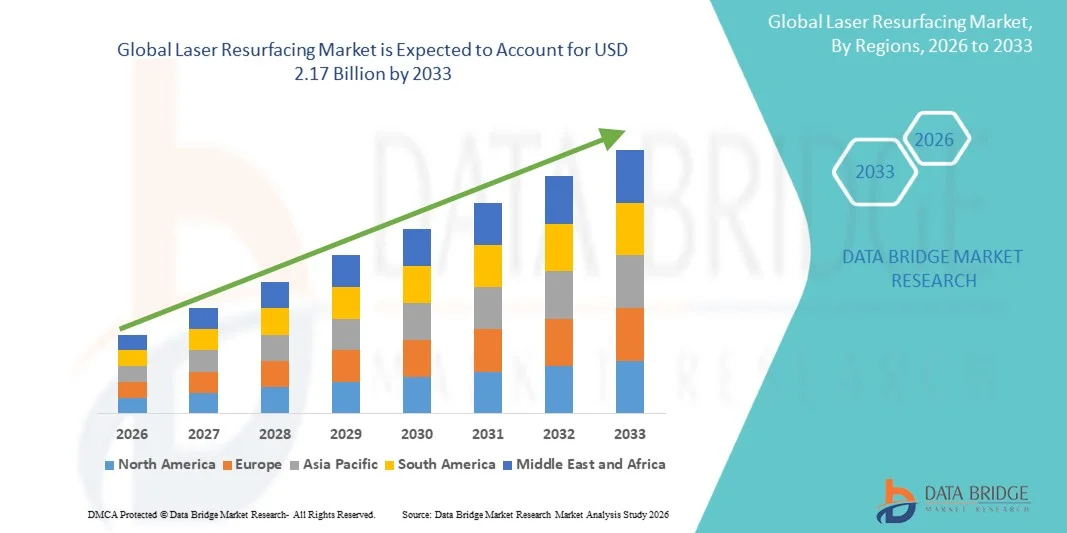
Laser Resurfacing Market Size
- The global laser resurfacing market size was valued at USD 1.30 billion in 2025 and is expected to reach USD 2.17 billion by 2033, at a CAGR of 6.65% during the forecast period
- The market growth is largely fueled by the increasing adoption of advanced aesthetic and dermatological procedures, along with continuous technological progress in laser systems, leading to wider acceptance of laser resurfacing treatments across hospitals, dermatology clinics, and medical spas in both medical and cosmetic settings
- Furthermore, rising consumer demand for minimally invasive, safe, and effective skin rejuvenation solutions for concerns such as wrinkles, scars, pigmentation, and uneven skin tone is establishing laser resurfacing as a preferred aesthetic treatment option. These converging factors are accelerating the uptake of Laser Resurfacing solutions, thereby significantly boosting the overall growth of the Laser Resurfacing market
Laser Resurfacing Market Analysis
- Laser resurfacing, which uses advanced laser technologies to improve skin texture, tone, and appearance, is becoming an increasingly important procedure in modern aesthetic and dermatology practices across hospitals, dermatology clinics, and medical spas due to its precision, minimal invasiveness, and proven clinical outcomes
- The escalating demand for laser resurfacing procedures is primarily driven by rising awareness of aesthetic treatments, increasing prevalence of skin conditions such as acne scars, wrinkles, and pigmentation disorders, and a growing preference for non-surgical and minimally invasive cosmetic solutions
- North America dominated the laser resurfacing market with the largest revenue share of 41.5% in 2025, supported by a well-established aesthetic healthcare infrastructure, high consumer spending on cosmetic procedures, early adoption of advanced laser technologies, and a strong presence of leading dermatology device manufacturers and service providers. The U.S. accounted for a significant share, driven by high procedure volumes and continuous technological innovation
- Asia-Pacific is expected to be the fastest-growing region in the laser resurfacing market during the forecast period, driven by rapidly expanding medical aesthetics clinics, rising disposable incomes, increasing beauty consciousness, growing medical tourism, and improving access to advanced dermatological treatments across countries such as China, India, South Korea, and Japan
- The Non-Ablative segment dominated the largest market revenue share of approximately 58.6% in 2025, driven by its minimally invasive nature and reduced recovery time compared to ablative procedures
Report Scope and Laser Resurfacing Market Segmentation
|
Attributes |
Laser Resurfacing Key Market Insights |
|
Segments Covered |
|
|
Countries Covered |
North America
Europe
Asia-Pacific
Middle East and Africa
South America
|
|
Key Market Players |
|
|
Market Opportunities |
|
|
Value Added Data Infosets |
In addition to the insights on market scenarios such as market value, growth rate, segmentation, geographical coverage, and major players, the market reports curated by the Data Bridge Market Research also include in-depth expert analysis, patient epidemiology, pipeline analysis, pricing analysis, and regulatory framework. |
Laser Resurfacing Market Trends
“Technological Advancements and Growing Preference for Minimally Invasive Aesthetic Procedures”
- A significant and accelerating trend in the global laser resurfacing market is the increasing adoption of advanced laser technologies that enable precise, minimally invasive skin rejuvenation and corrective procedures. Clinics and dermatology centers are increasingly utilizing laser resurfacing to treat wrinkles, acne scars, pigmentation disorders, and sun damage with improved safety and efficacy
- For instance, the development of fractional laser systems and non-ablative laser technologies has significantly reduced patient downtime while delivering effective skin resurfacing results. These innovations are expanding the appeal of laser resurfacing among a broader patient population
- Improvements in laser precision, adjustable energy settings, and enhanced cooling mechanisms are enabling practitioners to tailor treatments based on individual skin types and clinical needs, improving patient satisfaction and treatment outcomes
- In addition, the growing integration of laser resurfacing procedures within aesthetic clinics and medical spas is increasing accessibility and supporting wider adoption of these treatments across urban and semi-urban regions
- The rising demand for cosmetic dermatology procedures, driven by increasing awareness of aesthetic appearance and technological advancements, is further strengthening the growth of the laser resurfacing market
- This trend toward safer, more efficient, and customizable laser-based treatments is reshaping aesthetic medicine practices globally
- Consequently, manufacturers are investing in research and development to introduce next-generation laser systems that offer enhanced performance, reduced side effects, and broader treatment applications
Laser Resurfacing Market Dynamics
Driver
“Growing Demand for Aesthetic Procedures and Rising Skin Disorder Prevalence”
- The increasing demand for aesthetic and cosmetic procedures, along with the rising prevalence of skin conditions such as acne scars, hyperpigmentation, and photoaging, is a major driver fueling the Laser Resurfacing market
- Consumers are increasingly seeking non-surgical solutions that offer visible results with minimal recovery time
- For instance, in 2025, several dermatology clinics and aesthetic centers expanded their laser treatment offerings to meet the growing demand for skin rejuvenation and corrective procedures, contributing to market growth during the forecast period
- Increasing disposable income, urbanization, and growing acceptance of cosmetic treatments across different age groups are further accelerating adoption
- In addition, the influence of social media, improved patient education, and the availability of advanced laser systems in outpatient settings are supporting increased utilization of laser resurfacing procedures
- The expansion of medical tourism and the growing number of trained dermatology professionals are also contributing to sustained demand in both developed and emerging markets
Restraint/Challenge
“High Treatment Costs and Risk of Side Effects”
- High costs associated with laser resurfacing equipment and procedures pose a significant challenge to market growth, particularly for price-sensitive consumers
- Advanced laser systems require substantial investment, which can translate into higher treatment costs for patients
- For instance, multiple-session laser resurfacing treatments may be financially prohibitive for some individuals, limiting broader market adoption
- In addition, potential side effects such as redness, swelling, pigmentation changes, and prolonged recovery time in certain cases can deter patients from opting for laser resurfacing procedures
- Limited availability of skilled practitioners and the need for specialized training to operate advanced laser systems can also restrict market expansion in certain regions
- Addressing these challenges through technological improvements, practitioner training, patient education, and cost-optimized treatment options will be essential for ensuring sustained growth in the global Laser Resurfacing market
Laser Resurfacing Market Scope
The market is segmented on the basis of type, device, end user, and indication.
• By Type
On the basis of type, the Laser Resurfacing market is segmented into Ablative and Non-Ablative. The Non-Ablative segment dominated the largest market revenue share of approximately 58.6% in 2025, driven by its minimally invasive nature and reduced recovery time compared to ablative procedures. Non-ablative laser resurfacing treatments stimulate collagen production without removing the outer skin layer, making them highly preferred among patients seeking cosmetic improvements with minimal downtime. These procedures are widely used for mild to moderate wrinkles, pigmentation issues, and skin rejuvenation. Increasing patient awareness regarding safer aesthetic treatments and rising preference for outpatient procedures further support segment dominance. Dermatologists also favor non-ablative lasers due to lower complication risks and broader patient eligibility. Technological advancements improving treatment precision and efficacy continue to strengthen adoption. Growing demand from working professionals and aging populations has reinforced market leadership.
The Ablative segment is expected to witness the fastest CAGR of 7.9% from 2026 to 2033, driven by its superior efficacy in treating deep wrinkles, severe acne scars, and extensive skin damage. Ablative laser resurfacing delivers more dramatic and long-lasting results, making it increasingly popular among patients seeking intensive cosmetic correction. Rising acceptance of longer recovery periods for improved outcomes supports growth. Advancements in CO₂ and Er:YAG laser technologies have improved safety profiles and reduced healing time. Increasing availability of skilled practitioners and rising medical tourism further fuel demand. Higher procedure costs also contribute to strong revenue growth within this segment.
• By Device
On the basis of device, the Laser Resurfacing market is segmented into Laser Skin Resurfacing Machines, CO₂ Skin Laser Scanner Machines, and Others. The Laser Skin Resurfacing Machine segment accounted for the largest market revenue share of around 46.3% in 2025, due to its widespread use across dermatology clinics and cosmetic centers. These devices offer versatility in treating various skin conditions, including wrinkles, scars, pigmentation, and sun damage. Their compatibility with both ablative and non-ablative procedures enhances adoption. Continuous product innovations, compact designs, and improved energy control systems have increased procedural safety and efficiency. Growing demand for aesthetic treatments globally has accelerated installation of these machines in clinical settings. Favorable reimbursement trends in select regions further support market dominance.
The CO₂ Skin Laser Scanner Machine segment is projected to register the fastest CAGR of 8.4% from 2026 to 2033, owing to its high precision and effectiveness in deep skin resurfacing procedures. These machines are increasingly adopted for advanced aesthetic corrections and scar treatments. Technological advancements such as fractional CO₂ lasers have significantly reduced downtime and complication risks. Rising patient demand for permanent and visible results drives preference for CO₂ systems. Increasing use in medical dermatology and reconstructive procedures further accelerates growth. Expansion of high-end aesthetic clinics globally also contributes to segment momentum.
• By End User
On the basis of end user, the Laser Resurfacing market is segmented into Hospitals, Cosmetic Surgery Centers/Clinics, and Multi-Specialty Centers. The Cosmetic Surgery Centers/Clinics segment dominated the market with a revenue share of approximately 52.1% in 2025, driven by the high volume of aesthetic procedures performed in specialized facilities. These centers offer advanced laser technologies, skilled professionals, and customized treatment plans, attracting a large patient base. Increasing consumer preference for standalone cosmetic clinics due to shorter wait times and specialized expertise supports dominance. Competitive pricing and growing availability of non-invasive cosmetic procedures further enhance demand. Expansion of private aesthetic clinics in urban areas also strengthens this segment.
The Hospitals segment is anticipated to witness the fastest CAGR of 7.3% from 2026 to 2033, fueled by the integration of advanced dermatology departments and rising demand for medically supervised aesthetic treatments. Hospitals are increasingly investing in advanced laser technologies to provide comprehensive cosmetic and therapeutic skin treatments. Higher patient trust and availability of post-procedure care contribute to growth. Increasing incidence of skin disorders requiring laser intervention further supports expansion. Growing collaborations between hospitals and aesthetic technology providers accelerate adoption.
• By Indication
On the basis of indication, the Laser Resurfacing market is segmented into Facial Wrinkles and Acne Scars. The Facial Wrinkles segment accounted for the largest market revenue share of nearly 55.4% in 2025, driven by the growing aging population and increasing focus on anti-aging treatments. Laser resurfacing is widely used to reduce fine lines, deep wrinkles, and skin laxity, particularly among middle-aged and elderly individuals. Rising disposable incomes and growing acceptance of cosmetic procedures further boost demand. Social media influence and increasing awareness about aesthetic appearance significantly contribute to segment dominance. Continuous advancements in laser technology improve treatment outcomes and patient satisfaction.
The Acne Scars segment is expected to grow at the fastest CAGR of 8.1% from 2026 to 2033, driven by the high prevalence of acne among adolescents and young adults. Laser resurfacing offers effective and long-term solutions for acne scar reduction, increasing its popularity. Rising psychological awareness regarding acne scarring and appearance concerns fuels demand. Improvements in fractional laser techniques have enhanced safety and effectiveness. Increasing adoption across dermatology clinics globally supports strong growth. Expanding access to affordable cosmetic treatments in emerging markets further accelerates this segment.
Laser Resurfacing Market Regional Analysis
- North America dominated the laser resurfacing market with the largest revenue share of 41.5% in 2025, supported by a well-established aesthetic healthcare infrastructure, high consumer spending on cosmetic procedures, early adoption of advanced laser technologies, and a strong presence of leading dermatology device manufacturers and service providers
- Consumers in the region highly value minimally invasive cosmetic treatments that offer skin rejuvenation, wrinkle reduction, scar treatment, and pigmentation correction with minimal downtime
- This widespread adoption is further supported by high disposable incomes, strong awareness of aesthetic procedures, and the growing preference for technologically advanced, clinically proven laser resurfacing treatments across both medical and cosmetic dermatology settings
U.S. Laser Resurfacing Market Insight
The U.S. laser resurfacing market captured the largest revenue share within North America in 2025, driven by high procedure volumes, strong demand for anti-aging and skin rejuvenation treatments, and continuous technological innovation in laser-based dermatology devices. The presence of board-certified dermatologists, medical spas, and specialized aesthetic clinics is significantly boosting market growth. Moreover, increasing acceptance of cosmetic procedures among both men and women, along with ongoing advancements in fractional and ablative laser technologies, continues to propel market expansion.
Europe Laser Resurfacing Market Insight
The Europe laser resurfacing market is projected to expand at a substantial CAGR throughout the forecast period, primarily driven by rising demand for non-invasive aesthetic procedures, increasing aging population, and growing awareness of advanced skin treatment options. The region is witnessing increased adoption of laser resurfacing across dermatology clinics, cosmetic surgery centers, and medical spas. Additionally, favorable regulatory frameworks and growing medical tourism in select European countries are supporting market growth.
U.K. Laser Resurfacing Market Insight
The U.K. laser resurfacing market is anticipated to grow at a noteworthy CAGR during the forecast period, driven by rising interest in cosmetic dermatology, increasing demand for anti-aging treatments, and growing awareness of laser-based skin therapies. The expansion of private aesthetic clinics, coupled with strong consumer acceptance of advanced cosmetic procedures, is expected to sustain market growth.
Germany Laser Resurfacing Market Insight
The Germany laser resurfacing market is expected to expand at a considerable CAGR during the forecast period, supported by strong demand for technologically advanced dermatology treatments and a well-developed healthcare infrastructure. Germany’s emphasis on innovation, safety, and clinical efficacy is encouraging the adoption of advanced laser resurfacing systems in dermatology and aesthetic medicine practices.
Asia-Pacific Laser Resurfacing Market Insight
The Asia-Pacific laser resurfacing market is expected to grow at the fastest CAGR during the forecast period, driven by rapidly expanding medical aesthetics clinics, rising disposable incomes, increasing beauty consciousness, growing medical tourism, and improving access to advanced dermatological treatments. Countries such as China, India, South Korea, and Japan are witnessing strong demand for laser resurfacing procedures for skin rejuvenation, acne scars, and pigmentation disorders.
Japan Laser Resurfacing Market Insight
The Japan laser resurfacing market is gaining momentum due to high aesthetic awareness, advanced healthcare technology adoption, and increasing demand for non-invasive cosmetic treatments. The preference for precision-based, minimally invasive procedures and the growing aging population are key factors driving the adoption of laser resurfacing technologies across dermatology and cosmetic clinics.
China Laser Resurfacing Market Insight
The China laser resurfacing market accounted for a significant revenue share in Asia Pacific in 2025, attributed to rapid urbanization, a growing middle-class population, and increasing acceptance of aesthetic medical procedures. The expansion of private aesthetic clinics, availability of advanced yet affordable laser systems, and rising influence of beauty trends and social media are key factors propelling market growth in China.
Laser Resurfacing Market Share
The Laser Resurfacing industry is primarily led by well-established companies, including:
- Lumenis (Israel)
- Cynosure (U.S.)
- Alma Lasers (Israel)
- Cutera (U.S.)
- Fotona (Slovenia)
- Candela Medical (U.S.)
- Sciton (U.S.)
- Lutronic (South Korea)
- Solta Medical (U.S.)
- Quanta System (Italy)
- Asclepion Laser Technologies (Germany)
- Venus Concept (Canada)
- SharpLight Technologies (Israel)
- Aerolas Medical (U.S.)
- Jeisys Medical (South Korea)
- BISON Medical (South Korea)
- Beijing Sincoheren (China)
Latest Developments in Global Laser Resurfacing Market
- In February 2023, BIOLASE, Inc. entered the skin resurfacing market in the U.S. with the launch of its Waterlase Fractional Handpiece, an FDA 510(k)-cleared device capable of delivering both ablative and non-ablative fractional laser treatments and designed to offer faster healing and quicker recovery for skin resurfacing patients. The Waterlase system builds on an established all-tissue laser platform, offering clinicians precise control over depth of penetration and customizable treatment approaches across multiple skin types. This launch signaled Biolase’s expansion beyond dental lasers into aesthetic skin resurfacing, widening competition in the U.S. dermatology device space
- In September 2023, Cutera, Inc. announced the launch of Secret DUO, a dual non-ablative fractional laser and radiofrequency microneedling platform optimized for skin resurfacing and revitalization, featuring dual technologies to treat varied skin layers and indications including wrinkles, scars, and pigmentation issues. This product aimed to enhance treatment precision and versatility across aesthetic clinics and dermatology practices worldwide
- In April 2025, Bausch Health Companies Inc. (Solta Medical) unveiled the Fraxel FTX skin resurfacing laser at the American Society for Laser Medicine & Surgery (ASLMS) 2025, integrating dual wavelength fractional laser technology (1,550 nm erbium-glass and 1,927 nm thulium) to address surface and deeper skin concerns with improved ergonomic design and intelligent tracking for consistent treatment delivery. Fraxel FTX was positioned to expand global availability through rollout to dermatologists and aesthetic professionals, representing a next-generation upgrade in the established Fraxel family
- In April 2025, Spectra Medical India Pvt. Ltd., in collaboration with Italy’s Eufoton S.r.l., launched the EndoliftX treatment in India, introducing Italian-made non-surgical, laser-based technology for skin tightening, contouring, and resurfacing with minimal downtime, marking the first entry of this technology in the Indian market. This launch reflects global diffusion of advanced laser resurfacing devices into emerging markets
- In June 2025, Lumenis Ltd. received FDA 510(k) clearance for ResurFX, a fractional non-ablative laser module for the M22 Aesthetic Platform designed to treat acne scars, periorbital wrinkles, stretch marks, and other common skin concerns with a fiber laser and CoolScan scanner that offers uniform treatment patterns and customizable configurations. This regulatory clearance expanded the clinical utility of an existing multi-modality platform to include advanced resurfacing capabilities in the U.S. market
SKU-
Get online access to the report on the World's First Market Intelligence Cloud

- Interactive Data Analysis Dashboard
- Company Analysis Dashboard for high growth potential opportunities
- Research Analyst Access for customization & queries
- Competitor Analysis with Interactive dashboard
- Latest News, Updates & Trend analysis
- Harness the Power of Benchmark Analysis for Comprehensive Competitor Tracking
Research Methodology
Data collection and base year analysis are done using data collection modules with large sample sizes. The stage includes obtaining market information or related data through various sources and strategies. It includes examining and planning all the data acquired from the past in advance. It likewise envelops the examination of information inconsistencies seen across different information sources. The market data is analysed and estimated using market statistical and coherent models. Also, market share analysis and key trend analysis are the major success factors in the market report. To know more, please request an analyst call or drop down your inquiry.
The key research methodology used by DBMR research team is data triangulation which involves data mining, analysis of the impact of data variables on the market and primary (industry expert) validation. Data models include Vendor Positioning Grid, Market Time Line Analysis, Market Overview and Guide, Company Positioning Grid, Patent Analysis, Pricing Analysis, Company Market Share Analysis, Standards of Measurement, Global versus Regional and Vendor Share Analysis. To know more about the research methodology, drop in an inquiry to speak to our industry experts.
Customization Available
Data Bridge Market Research is a leader in advanced formative research. We take pride in servicing our existing and new customers with data and analysis that match and suits their goal. The report can be customized to include price trend analysis of target brands understanding the market for additional countries (ask for the list of countries), clinical trial results data, literature review, refurbished market and product base analysis. Market analysis of target competitors can be analyzed from technology-based analysis to market portfolio strategies. We can add as many competitors that you require data about in the format and data style you are looking for. Our team of analysts can also provide you data in crude raw excel files pivot tables (Fact book) or can assist you in creating presentations from the data sets available in the report.












