




Global Lighting As A Service Market
Market Size in USD Billion
CAGR :
% 
 USD
8.22 Billion
USD
186.86 Billion
2025
2033
USD
8.22 Billion
USD
186.86 Billion
2025
2033
 Forecast Period Forecast Period |
2026 –2033 |
 Market Size (Base Year) Market Size (Base Year) |
USD 8.22 Billion |
 Market Size (Forecast Year) Market Size (Forecast Year) |
USD 186.86 Billion |
 CAGR CAGR |
% |
| Major Markets Players |
|
Lighting-as-a Service Market Size
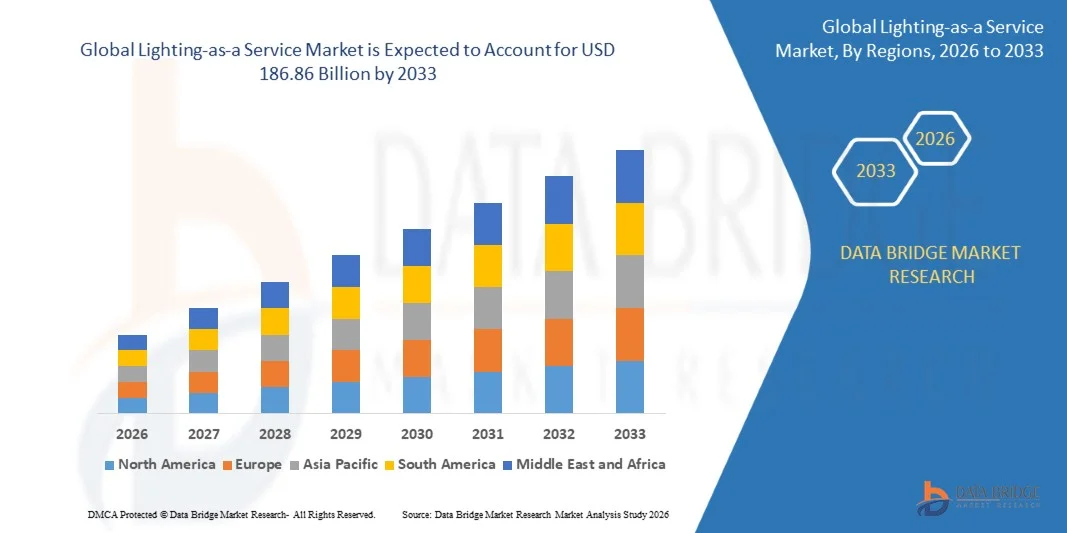
- The global lighting-as-a service market size was valued at USD 8.22 billion in 2025 and is expected to reach USD 186.86 billion by 2033, at a CAGR of 47.75% during the forecast period
- • The market growth is largely fuelled by the rising adoption of energy-efficient lighting systems and the increasing shift toward subscription-based business models across commercial and industrial sectors
- Increasing focus on sustainability, carbon emission reduction targets, and government regulations promoting energy efficiency is accelerating the adoption of lighting-as-a-service solutions globally
Lighting-as-a Service Market Analysis
- The lighting-as-a-service market is witnessing rapid growth driven by the increasing preference for operational expenditure models, which eliminate high upfront capital investment and provide flexibility, scalability, and maintenance support
- The integration of advanced technologies such as IoT, connected lighting systems, and data analytics is transforming lighting into a value-added service, enabling improved energy management, enhanced user experience, and long-term cost savings for organizations
- North America dominated the lighting-as-a service market with the largest revenue share in 2025, driven by strong adoption of energy-efficient lighting solutions and increasing focus on reducing operational and energy costs across commercial and industrial facilities
- Asia-Pacific region is expected to witness the highest growth rate in the global lighting-as-a service market, driven by expanding commercial infrastructure, increasing investments in smart buildings, and rising focus on energy conservation. In addition, rapid industrialization, government efficiency initiatives, and growing awareness of operational cost savings are supporting strong regional market growth
- The luminaires segment held the largest market revenue share in 2025 driven by the widespread transition from conventional lighting to energy-efficient LED luminaires across commercial and industrial facilities. These luminaires offer improved illumination, longer lifespan, and reduced energy consumption, making them a core element of service-based lighting solutions. In addition, integrated luminaires with sensors and connectivity features support automation and real-time monitoring, enhancing their adoption
Report Scope and Lighting-as-a Service Market Segmentation
|
Attributes |
Lighting-as-a Service Key Market Insights |
|
Segments Covered |
|
|
Countries Covered |
North America
Europe
Asia-Pacific
Middle East and Africa
South America
|
|
Key Market Players |
|
|
Market Opportunities |
|
|
Value Added Data Infosets |
In addition to the market insights such as market value, growth rate, market segments, geographical coverage, market players, and market scenario, the market report curated by the Data Bridge Market Research team includes in-depth expert analysis, import/export analysis, pricing analysis, production consumption analysis, and pestle analysis. |
Lighting-as-a Service Market Trends
“Rising Adoption of Smart and Energy-Efficient Lighting Solutions”
• The growing focus on reducing energy consumption and operational costs is significantly shaping the lighting-as-a service market, as organizations increasingly prefer service-based lighting models that eliminate upfront capital investment. Lighting-as-a service allows users to access advanced LED systems, maintenance, and optimization under subscription models, improving efficiency and financial flexibility. This trend strengthens adoption across commercial buildings, industrial facilities, and public infrastructure, encouraging providers to expand intelligent lighting offerings
• Increasing awareness around sustainability goals and carbon emission reduction has accelerated the demand for lighting-as-a service across offices, warehouses, and municipalities. Organizations are actively replacing traditional lighting systems with connected LED solutions to enhance efficiency and meet regulatory requirements. This transition also enables automated control, predictive maintenance, and real-time monitoring, improving operational performance and long-term cost savings
• Smart lighting integration with IoT, sensors, and automation platforms is influencing purchasing decisions, with organizations prioritizing intelligent and connected infrastructure. These systems support occupancy sensing, daylight harvesting, and remote management, improving user comfort and reducing energy waste. Service providers are emphasizing performance guarantees and flexible payment models to attract customers and strengthen long-term service relationships
• For instance, in 2024, Signify in the Netherlands and Siemens in Germany expanded their lighting-as-a service solutions for commercial buildings and smart city projects. These deployments focused on connected LED lighting and intelligent control systems to improve efficiency and sustainability. The projects also helped clients lower operational costs and energy consumption, strengthening provider presence and market competitiveness
• While demand for lighting-as-a service is growing, sustained market expansion depends on continuous technological innovation, cost-effective deployment, and reliable service delivery. Providers are focusing on improving scalability, enhancing analytics capabilities, and offering customized solutions that balance cost, efficiency, and performance for broader adoption
Lighting-as-a Service Market Dynamics
Driver
“Growing Demand for Energy Efficiency and Cost Optimization”
• Rising demand for energy-efficient lighting solutions is a major driver for the lighting-as-a service market. Organizations are increasingly adopting service-based lighting models to reduce electricity costs, improve efficiency, and avoid high initial investment. This trend is also encouraging the transition toward advanced LED lighting supported by service agreements, improving accessibility and affordability
• Expanding applications across commercial, industrial, and public sectors are influencing market growth. Lighting-as-a service helps enhance lighting quality, reduce maintenance requirements, and extend system lifespan while maintaining cost efficiency. The increasing adoption of smart buildings and energy management systems globally further reinforces this trend
• Facility managers and organizations are actively promoting lighting-as-a service through infrastructure modernization and sustainability initiatives. These efforts are supported by growing demand for environmentally responsible solutions and encourage partnerships between lighting providers and enterprises to improve performance and reduce environmental impact
• For instance, in 2023, lighting providers in the U.S. and U.K. increased deployment of lighting-as-a service across commercial offices and industrial facilities. This expansion followed rising demand for energy-efficient and connected lighting solutions, improving energy savings and operational efficiency. Providers also emphasized sustainability and long-term cost benefits to strengthen customer adoption and retention
• Although rising sustainability trends support growth, wider adoption depends on cost optimization, infrastructure readiness, and service awareness. Investment in digital platforms, efficient deployment models, and advanced lighting technologies will be critical for meeting global demand and maintaining competitive advantage
Restraint/Challenge
“High Initial Implementation Complexity and Limited Awareness”
• The complexity involved in implementing lighting-as-a service solutions compared to traditional lighting systems remains a key challenge, limiting adoption among certain organizations. Integration with existing infrastructure, sensors, and control platforms requires technical expertise and planning. In addition, varying infrastructure standards can further affect deployment efficiency and adoption
• Consumer and enterprise awareness remains uneven, particularly in developing markets where service-based lighting models are still emerging. Limited understanding of operational and financial benefits restricts adoption across certain sectors. This also leads to slower adoption in regions where modernization initiatives and awareness programs are limited
• Infrastructure and contractual challenges also impact market growth, as lighting-as-a service requires long-term agreements and collaboration between multiple stakeholders. Operational complexities and service management requirements increase implementation efforts. Companies must invest in technical expertise, efficient project management, and reliable service delivery to maintain performance
• For instance, in 2024, commercial building operators in Southeast Asia reported slower adoption due to integration challenges and limited awareness of long-term efficiency benefits. Infrastructure limitations and financial concerns were additional barriers. These factors also prompted some organizations to delay service-based lighting upgrades, affecting market expansion
• Overcoming these challenges will require simplified deployment models, expanded awareness initiatives, and flexible financing options for enterprises. Collaboration with technology providers, facility managers, and financial institutions can help unlock the long-term growth potential of the global lighting-as-a service market. Furthermore, improving cost efficiency and strengthening value communication will be essential for widespread adoption
Lighting-as-a Service Market Scope
The market is segmented on the basis of component and end-user.
• By Component
On the basis of component, the lighting-as-a service market is segmented into software & communication systems, maintenance services, and luminaires. The luminaires segment held the largest market revenue share in 2025 driven by the widespread transition from conventional lighting to energy-efficient LED luminaires across commercial and industrial facilities. These luminaires offer improved illumination, longer lifespan, and reduced energy consumption, making them a core element of service-based lighting solutions. In addition, integrated luminaires with sensors and connectivity features support automation and real-time monitoring, enhancing their adoption.
The software & communication systems segment is expected to witness the fastest growth rate from 2026 to 2033, driven by the increasing integration of IoT platforms, analytics tools, and centralized lighting management systems. These solutions enable remote monitoring, predictive maintenance, and energy optimization, helping organizations improve operational efficiency and reduce costs. The growing demand for smart buildings and connected infrastructure is further accelerating the adoption of software-driven lighting services.
• By End-User
On the basis of end-user, the lighting-as-a service market is segmented into commercial, industrial, municipal, and others. The commercial segment held the largest market revenue share in 2025 driven by the growing adoption of energy-efficient lighting across offices, retail spaces, and healthcare facilities. Organizations in this segment are increasingly adopting lighting-as-a service to reduce operational costs, improve lighting quality, and meet sustainability targets without high upfront investment.
The municipal segment is expected to witness the fastest growth rate from 2026 to 2033, driven by the increasing implementation of smart city projects and energy-efficient public lighting systems. Municipal authorities are adopting service-based lighting models for street lighting, public infrastructure, and urban spaces to reduce energy consumption and maintenance costs. These solutions also support remote monitoring and improved public safety, making them a preferred choice for modern urban development initiatives.
Lighting-as-a Service Market Regional Analysis
• North America dominated the lighting-as-a service market with the largest revenue share in 2025, driven by strong adoption of energy-efficient lighting solutions and increasing focus on reducing operational and energy costs across commercial and industrial facilities
• Organizations in the region highly value the benefits of lighting-as-a-service such as reduced upfront investment, predictable operating expenses, and access to advanced lighting technologies including smart controls and connected systems
• This widespread adoption is further supported by strict energy efficiency regulations, sustainability initiatives, and the presence of major service providers, establishing lighting-as-a-service as a preferred solution for modernization and energy optimization
U.S. Lighting-as-a Service Market Insight
The U.S. lighting-as-a service market captured the largest revenue share in 2025 within North America, fueled by increasing investments in smart buildings and energy efficiency upgrades. Businesses are actively replacing traditional lighting with service-based LED solutions to lower energy consumption and maintenance costs. The growing integration of IoT-enabled lighting systems and smart controls further enhances operational efficiency and automation. In addition, government incentives and corporate sustainability goals are significantly contributing to market expansion.
Europe Lighting-as-a Service Market Insight
The Europe lighting-as-a service market is expected to witness the fastest growth rate from 2026 to 2033, primarily driven by strict environmental regulations and strong focus on carbon reduction. Increasing adoption of circular economy models and energy-efficient infrastructure is encouraging organizations to shift toward service-based lighting solutions. European businesses are also attracted to flexible financing and performance-based service models. The region is experiencing significant adoption across commercial buildings, municipalities, and industrial sectors.
U.K. Lighting-as-a Service Market Insight
The U.K. lighting-as-a service market is expected to witness the fastest growth rate from 2026 to 2033, driven by growing demand for sustainable lighting and smart infrastructure. Businesses and public sector organizations are focusing on reducing energy costs and achieving environmental targets. The increasing deployment of smart lighting in offices, public buildings, and urban infrastructure is supporting market growth. In addition, favorable government policies and energy efficiency programs continue to accelerate adoption.
Germany Lighting-as-a Service Market Insight
The Germany lighting-as-a service market is expected to witness the fastest growth rate from 2026 to 2033, fueled by strong industrial base and emphasis on energy efficiency. Companies are increasingly adopting lighting-as-a-service to modernize facilities and improve operational efficiency. Germany’s focus on sustainability and advanced manufacturing supports integration of intelligent lighting systems. The growing implementation of smart factory and Industry 4.0 initiatives is also contributing to market growth.
Asia-Pacific Lighting-as-a Service Market Insight
The Asia-Pacific lighting-as-a service market is expected to witness the fastest growth rate from 2026 to 2033, driven by rapid urbanization, infrastructure development, and increasing energy demand. Governments and businesses are investing in energy-efficient lighting to reduce electricity consumption and operational costs. The region’s expanding commercial sector and smart city projects are further accelerating adoption. In addition, increasing awareness about sustainability and cost efficiency is supporting market expansion.
Japan Lighting-as-a Service Market Insight
The Japan lighting-as-a service market is expected to witness the fastest growth rate from 2026 to 2033 due to strong focus on energy conservation and advanced technology adoption. Organizations are replacing traditional lighting systems with efficient service-based LED solutions to reduce operational expenses. The integration of smart lighting with building automation systems is also gaining popularity. Moreover, government initiatives promoting energy efficiency are supporting market development.
China Lighting-as-a Service Market Insight
The China lighting-as-a service market accounted for the largest market revenue share in Asia Pacific in 2025, attributed to rapid urbanization and large-scale infrastructure development. Businesses and municipalities are increasingly adopting service-based lighting to improve energy efficiency and reduce costs. China’s strong manufacturing sector and smart city initiatives are driving demand for advanced lighting systems. The availability of cost-effective solutions and supportive government policies are key factors propelling the market.
Lighting-as-a Service Market Share
The Lighting-as-a Service industry is primarily led by well-established companies, including:
- Signify Holding (Netherlands)
- Acuity Brands Lighting, Inc. (U.S.)
- Hafele (Germany)
- Honeywell International Inc. (U.S.)
- Cree, Inc. (U.S.)
- Digital Lumens, Inc. (U.S.)
- OSRAM GmbH (Germany)
- Lutron Electronics Co., Inc. (U.S.)
- Legrand SA (France)
- Seiko Epson Corporation (Japan)
- Encelium Technologies (U.S.)
- Virtual Extension (Israel)
- Zumtobel Group AG (Austria)
- Wipro Consumer Care & Lighting (India)
- Schneider Electric SE (France)
- Eaton (Ireland)
- Leviton Manufacturing Co., Inc. (U.S.)
- Syska LED (India)
- Beam Labs B.V. (Netherlands)
Latest Developments in Global Lighting-as-a Service Market
- In July 2025, LumenStream, funding, secured USD 1.4 million investment to expand its lighting-as-a-service model for high-energy-consuming businesses. The company will use the funds to accelerate the deployment of energy-efficient lighting solutions through its Pay-as-you-Save approach. This enables customers to upgrade without upfront capital while achieving immediate cost savings and reduced CO₂ emissions. The development strengthens adoption of service-based lighting solutions and supports the transition toward sustainable infrastructure. It also reinforces the growth of green economy initiatives and encourages wider market acceptance of zero-capex lighting models
- In June 2025, Solas Capital AG and Signify Holding, partnership agreement, signed a framework deal to deploy LED and connected lighting across Europe under the Light as a Service model. This initiative will allow private and public organizations to adopt advanced lighting systems without upfront investment barriers. The agreement aims to significantly lower energy consumption, operational costs, and carbon emissions. It will accelerate LED penetration across European infrastructure and commercial facilities. The collaboration is expected to drive innovation and increase demand for service-based and connected lighting solutions in the regional market
- In January 2025, Acclaim Lighting, product launch, introduced the Unity S1, an advanced outdoor floodlight featuring Spectrum Five RGBAL technology. The new solution delivers high-quality white lighting, full-spectrum color mixing, and dynamic lighting performance in a single fixture. It enhances flexibility, efficiency, and lighting precision for architectural and outdoor applications. The innovation strengthens Acclaim Lighting’s product portfolio and supports the shift toward multifunctional LED fixtures. It also contributes to increased adoption of advanced LED lighting systems across commercial and infrastructure projects
- In September 2024, FOHSE, product launch, introduced its PRO Series LED lighting designed to improve cannabis cultivation efficiency and performance. The new technology provides enhanced functionality, optimized light output, and improved crop yield capabilities. This advancement supports growers in achieving better productivity and energy efficiency. The launch reinforces the role of specialized LED lighting in controlled environment agriculture. It also expands growth opportunities for LED lighting providers in emerging horticulture and cannabis cultivation markets
- In March 2024, Signify Holding and Nexans, partnership, collaborated to upgrade lighting systems across 12 European sites using energy-efficient LED technology. The project will help reduce carbon emissions, improve operational efficiency, and enhance workplace lighting conditions. Signify’s Light as a Service model enables cost optimization while eliminating upfront investment requirements. This initiative supports Nexans’ decarbonization and sustainability goals. It also highlights the increasing importance of LED retrofits and service-based lighting in achieving corporate environmental targets and driving market growth
SKU-
Get online access to the report on the World's First Market Intelligence Cloud

- Interactive Data Analysis Dashboard
- Company Analysis Dashboard for high growth potential opportunities
- Research Analyst Access for customization & queries
- Competitor Analysis with Interactive dashboard
- Latest News, Updates & Trend analysis
- Harness the Power of Benchmark Analysis for Comprehensive Competitor Tracking
Research Methodology
Data collection and base year analysis are done using data collection modules with large sample sizes. The stage includes obtaining market information or related data through various sources and strategies. It includes examining and planning all the data acquired from the past in advance. It likewise envelops the examination of information inconsistencies seen across different information sources. The market data is analysed and estimated using market statistical and coherent models. Also, market share analysis and key trend analysis are the major success factors in the market report. To know more, please request an analyst call or drop down your inquiry.
The key research methodology used by DBMR research team is data triangulation which involves data mining, analysis of the impact of data variables on the market and primary (industry expert) validation. Data models include Vendor Positioning Grid, Market Time Line Analysis, Market Overview and Guide, Company Positioning Grid, Patent Analysis, Pricing Analysis, Company Market Share Analysis, Standards of Measurement, Global versus Regional and Vendor Share Analysis. To know more about the research methodology, drop in an inquiry to speak to our industry experts.
Customization Available
Data Bridge Market Research is a leader in advanced formative research. We take pride in servicing our existing and new customers with data and analysis that match and suits their goal. The report can be customized to include price trend analysis of target brands understanding the market for additional countries (ask for the list of countries), clinical trial results data, literature review, refurbished market and product base analysis. Market analysis of target competitors can be analyzed from technology-based analysis to market portfolio strategies. We can add as many competitors that you require data about in the format and data style you are looking for. Our team of analysts can also provide you data in crude raw excel files pivot tables (Fact book) or can assist you in creating presentations from the data sets available in the report.












