

Global Lubricant Additives Market
Market Size in USD Billion
CAGR :
% 
 USD
20.04 Billion
USD
32.06 Billion
2025
2033
USD
20.04 Billion
USD
32.06 Billion
2025
2033
 Forecast Period Forecast Period |
2026 –2033 |
 Market Size (Base Year) Market Size (Base Year) |
USD 20.04 Billion |
 Market Size (Forecast Year) Market Size (Forecast Year) |
USD 32.06 Billion |
 CAGR CAGR |
% |
| Major Markets Players |
|
Lubricant Additives Market Size
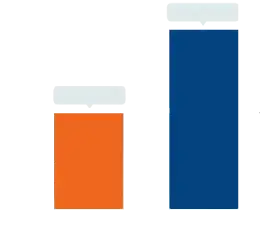
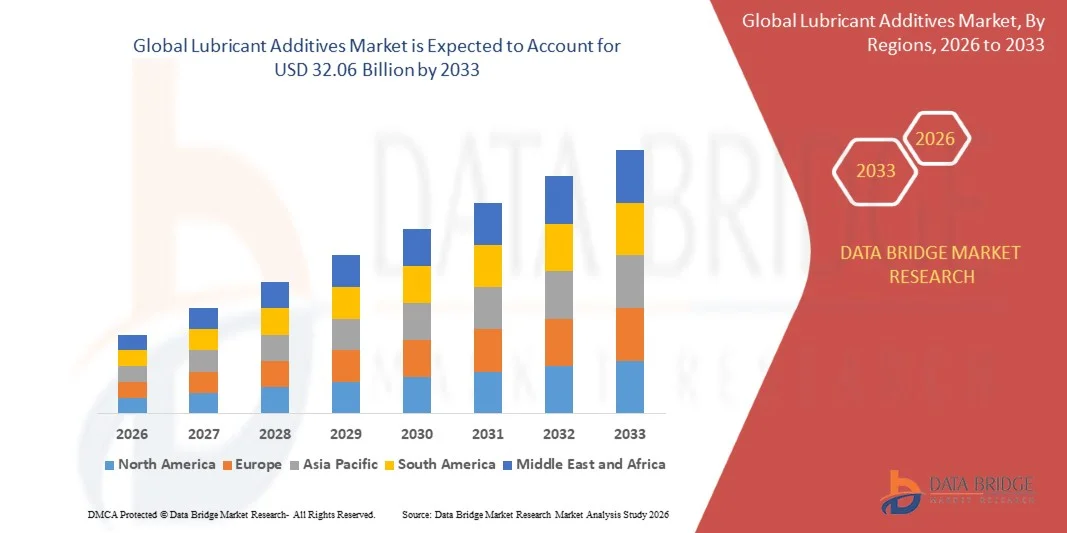
- The global lubricant additives market size was valued at USD 20.04 billion in 2025 and is expected to reach USD 32.06 billion by 2033, at a CAGR of 6.05% during the forecast period
- The market growth is largely fueled by the rising demand for high-performance lubricants across automotive and industrial sectors, driven by increasing vehicle production, expanding industrial activities, and the need for enhanced equipment efficiency and durability
- Furthermore, stringent environmental regulations and emission norms are pushing manufacturers to develop advanced additive formulations that improve fuel efficiency, reduce emissions, and extend lubricant life. These converging factors are accelerating the adoption of lubricant additives, thereby significantly boosting the market growth
Lubricant Additives Market Analysis
- Lubricant additives are chemical compounds blended with base oils to enhance properties such as viscosity, wear protection, oxidation stability, and corrosion resistance. These additives play a critical role in improving lubricant performance across automotive, industrial machinery, marine, and aviation applications
- The escalating demand for lubricant additives is primarily driven by increasing focus on equipment longevity, rising need for energy-efficient lubrication solutions, and continuous advancements in engine and machinery technologies requiring specialized additive formulations
- Asia-Pacific dominated the lubricant additives market with a share of 36.53% in 2025, due to rapid industrialization, expanding automotive production, and strong demand for high-performance lubricants across emerging economies
- North America is expected to be the fastest growing region in the lubricant additives market during the forecast period due to strong demand from automotive, aerospace, and industrial sectors
- Engine oil segment dominated the market with a market share of 39% in 2025, due to the extensive use of passenger and commercial vehicles globally and the critical role of additives in enhancing engine efficiency and durability. Additives in engine oils help reduce wear, improve fuel efficiency, and maintain engine cleanliness, which makes them indispensable across automotive applications. Increasing vehicle parc, rising demand for high-performance lubricants, and stringent emission regulations further support segment growth
Report Scope and Lubricant Additives Market Segmentation
|
Attributes |
Lubricant Additives Key Market Insights |
|
Segments Covered |
|
|
Countries Covered |
North America
Europe
Asia-Pacific
Middle East and Africa
South America
|
|
Key Market Players |
|
|
Market Opportunities |
|
|
Value Added Data Infosets |
In addition to the insights on market scenarios such as market value, growth rate, segmentation, geographical coverage, and major players, the market reports curated by the Data Bridge Market Research also include import export analysis, production capacity overview, production consumption analysis, price trend analysis, climate change scenario, supply chain analysis, value chain analysis, raw material/consumables overview, vendor selection criteria, PESTLE Analysis, Porter Analysis, and regulatory framework. |
Lubricant Additives Market Trends
“Growing Shift Toward Sustainable and Bio-Based Lubricant Additives”
- A notable trend in the lubricant additives market is the increasing shift toward sustainable, bio-based, and environmentally friendly formulations, driven by rising environmental regulations, carbon reduction mandates, and the demand for energy-efficient lubrication solutions. These trends are encouraging manufacturers to innovate and incorporate renewable or low-emission additive technologies in both automotive and industrial applications
- For instance, Evonik has actively developed bio-based dispersants and viscosity modifiers to support lower environmental impact lubricants, promoting compliance with global sustainability standards. These products enhance fuel efficiency and reduce harmful emissions while maintaining lubricant performance
- The rising adoption of hybrid and electric vehicles is further pushing demand for additives that support alternative powertrain technologies, such as thermal management and electrical compatibility. This trend is accelerating innovation in lubricant chemistries that can operate efficiently under new mobility conditions
- Industrial machinery and heavy equipment sectors are increasingly seeking high-performance, environmentally responsible lubricant solutions that reduce waste, extend oil life, and improve equipment longevity. This is driving preference for advanced additive technologies capable of meeting these requirements
- The market is also seeing strong growth in high-performance lubricants for commercial transportation and marine applications, where additives improve operational efficiency, reduce maintenance costs, and support compliance with emission regulations. Such applications are reinforcing the adoption of sustainable additive technologies
- The expansion of stringent emission norms in regions such as Europe and North America is encouraging lubricant formulators to integrate advanced oxidation inhibitors, friction modifiers, and corrosion inhibitors in eco-friendly formulations, thereby shaping a shift toward greener lubricant additive solutions
Lubricant Additives Market Dynamics
Driver
“Rising Demand for High-Performance Lubricants”
- The growing demand for high-performance lubricants across automotive, industrial machinery, and marine sectors is driving the adoption of advanced lubricant additives that enhance viscosity, reduce wear, improve fuel efficiency, and extend service life. These additives are essential for meeting the operational demands of modern engines and equipment
- For instance, Lubrizol’s Lubrizol CV9660 low-SAPS heavy-duty additive technology provides high-performance protection for commercial vehicle engines while supporting multiple viscosity grades, helping manufacturers meet emission and fuel efficiency standards. This innovation highlights the critical role of additives in improving engine durability and efficiency
- Rising consumer and industrial awareness of the benefits of optimized lubrication in reducing downtime and operational costs is boosting investment in additive-enhanced formulations. Companies are increasingly relying on specialized additives to maintain performance under extreme operating conditions
- The integration of additives that improve thermal stability, reduce friction, and support extended drain intervals is becoming crucial as manufacturers adopt advanced machinery and high-performance engines. This is reinforcing the importance of additive technologies in sustaining lubricant quality
- Global expansion of automotive production, fleet growth, and industrialization in emerging economies is further supporting the adoption of high-performance lubricants and associated additive solutions. These factors collectively accelerate market growth
Restraint/Challenge
“Volatility in Raw Material Prices and Supply Chain Constraints”
- The lubricant additives market faces challenges from fluctuations in the prices of key raw materials such as base chemicals, metals, and specialty compounds, which directly impact production costs and profit margins for additive manufacturers. Supply chain disruptions can also delay product delivery and affect market availability
- For instance, price variations in oleochemicals and organophosphates have impacted companies such as Afton Chemical, requiring adjustments in formulation costs and procurement strategies. These fluctuations create uncertainty for both manufacturers and lubricant formulators
- Limited availability of certain specialty chemicals in regions with high demand can restrict production scalability and delay the introduction of new additive technologies. Such constraints affect the ability of manufacturers to respond quickly to changing market needs
- Global supply chain disruptions, including logistics delays, trade restrictions, and raw material shortages, increase operational complexity for manufacturers and create cost pressures that may slow market expansion
- The dependence on imported raw materials for specific high-performance additives exposes manufacturers to geopolitical and economic risks, making supply security a critical concern. These challenges collectively limit the speed at which new additive formulations can be commercialized and scaled across markets
Lubricant Additives Market Scope
The market is segmented on the basis of lubricant type, function, and end-user.
• By Lubricant Type
On the basis of lubricant type, the lubricant additives market is segmented into engine oil, hydraulic oil, transmission fluids, general industrial oils, gear oil, metal working fluids, grease, and others. The engine oil segment dominated the largest market revenue share of 39% in 2025, driven by the extensive use of passenger and commercial vehicles globally and the critical role of additives in enhancing engine efficiency and durability. Additives in engine oils help reduce wear, improve fuel efficiency, and maintain engine cleanliness, which makes them indispensable across automotive applications. Increasing vehicle parc, rising demand for high-performance lubricants, and stringent emission regulations further support segment growth. In addition, advancements in synthetic engine oils have increased the demand for specialized additive packages. The strong aftermarket demand for engine oil replacement also contributes significantly to sustained dominance.
The metal working fluids segment is anticipated to witness the fastest growth rate from 2026 to 2033, fueled by rapid industrialization and expansion of manufacturing activities across emerging economies. Additives used in metal working fluids enhance cooling, lubrication, and corrosion protection during machining processes, improving operational efficiency and tool life. Growing demand from automotive, aerospace, and heavy machinery manufacturing sectors is accelerating the adoption of advanced fluid formulations. Increasing focus on precision engineering and surface finishing further supports segment expansion. In addition, the shift toward environmentally friendly and bio-based metal working fluids is creating new growth opportunities.
• By Function
On the basis of function, the lubricant additives market is segmented into dispersants and emulsifier, viscosity index improvers, detergents, corrosion inhibitors, oxidation inhibitors, extreme-pressure additives, friction modifiers, and others. The dispersants and emulsifier segment dominated the largest market revenue share in 2025, driven by its essential role in maintaining engine cleanliness by preventing sludge and deposit formation. These additives help keep contaminants suspended in the lubricant, ensuring smooth engine operation and extended oil life. Their widespread use in automotive lubricants, particularly in engine oils, supports strong demand across global markets. Increasing engine efficiency standards and emission norms further amplify their importance. In addition, their compatibility with modern lubricant formulations strengthens their market position.
The friction modifiers segment is expected to witness the fastest CAGR from 2026 to 2033, driven by the rising demand for fuel-efficient and energy-saving lubrication solutions. These additives reduce friction between moving parts, enhancing performance and lowering energy consumption in both automotive and industrial applications. Growing regulatory pressure to improve fuel economy and reduce carbon emissions is accelerating adoption. Increasing use of advanced engine technologies and electric vehicles also contributes to demand for specialized friction-reducing additives. Furthermore, continuous innovation in additive chemistry is enabling improved performance under extreme operating conditions.
• By End-User
On the basis of end-user, the lubricant additives market is segmented into automotive and other transportation, power generation, heavy equipment, metallurgy and metal working, food processing, and others. The automotive and other transportation segment dominated the largest market revenue share in 2025, driven by high lubricant consumption across passenger cars, commercial vehicles, aviation, and marine sectors. Lubricant additives are essential in ensuring engine performance, reducing emissions, and extending maintenance intervals, making them critical in transportation applications. Rising vehicle production, increasing mobility demand, and stringent emission regulations continue to drive segment growth. In addition, the growing aftermarket for vehicle maintenance further strengthens demand for additive-enhanced lubricants. Continuous advancements in engine technologies also require more sophisticated additive formulations.
The power generation segment is anticipated to witness the fastest growth rate from 2026 to 2033, fueled by increasing global energy demand and expansion of renewable and conventional power plants. Lubricant additives play a vital role in maintaining turbine efficiency, reducing wear, and ensuring reliable operation under high-temperature and high-load conditions. Growing investments in power infrastructure and the need for uninterrupted energy supply are driving demand for high-performance lubricants. The shift toward cleaner energy sources also requires advanced additive technologies for optimized equipment performance. In addition, increasing maintenance and operational efficiency requirements in power plants support sustained growth of this segment.
Lubricant Additives Market Regional Analysis
- Asia-Pacific dominated the lubricant additives market with the largest revenue share of 36.53% in 2025, driven by rapid industrialization, expanding automotive production, and strong demand for high-performance lubricants across emerging economies
- The region’s cost-effective manufacturing base, increasing investments in refining and petrochemical industries, and rising demand for industrial machinery are accelerating market expansion
- Growing vehicle ownership, infrastructure development, and supportive government initiatives promoting manufacturing activities are contributing to increased consumption of lubricant additives across automotive and industrial sectors
China Lubricant Additives Market Insight
China held the largest share in the Asia-Pacific lubricant additives market in 2025, owing to its position as a global manufacturing hub and leading automotive producer. The country’s strong industrial base, extensive lubricant consumption, and presence of major additive manufacturers support market growth. Rising demand from construction, mining, and heavy industries further strengthens the consumption of lubricant additives. In addition, ongoing investments in advanced lubricant formulations and domestic production capabilities are driving sustained expansion.
India Lubricant Additives Market Insight
India is witnessing the fastest growth in the Asia-Pacific region, fueled by increasing vehicle production, expanding industrial activities, and rising demand for high-performance lubricants. Government initiatives promoting manufacturing and infrastructure development are boosting lubricant consumption across sectors. Growth in automotive aftermarket services and rising awareness regarding equipment maintenance are also supporting additive demand. In addition, increasing investments in refining capacity and industrial machinery are contributing to strong market growth.
Europe Lubricant Additives Market Insight
The Europe lubricant additives market is expanding steadily, supported by stringent environmental regulations, demand for fuel-efficient lubricants, and strong presence of automotive and industrial sectors. The region emphasizes advanced additive technologies that enhance performance while meeting emission standards. Increasing focus on sustainability and bio-based lubricants is further influencing market dynamics. Growth in industrial automation and machinery efficiency requirements also supports steady expansion.
Germany Lubricant Additives Market Insight
Germany’s lubricant additives market is driven by its leadership in automotive engineering, strong industrial base, and advanced manufacturing capabilities. The country’s demand for high-performance lubricants in precision machinery and vehicles fuels additive consumption. Continuous innovation in lubricant formulations and strong R&D infrastructure support market development. Export-oriented automotive and machinery industries further strengthen demand.
U.K. Lubricant Additives Market Insight
The U.K. market is supported by a well-established automotive sector, increasing demand for efficient industrial lubricants, and growing focus on sustainability. Rising adoption of advanced lubricant technologies in manufacturing and transportation sectors contributes to market growth. The country’s emphasis on reducing emissions and improving energy efficiency drives demand for high-quality additives. In addition, ongoing developments in specialty lubricants support steady expansion.
North America Lubricant Additives Market Insight
North America is projected to grow at the fastest CAGR from 2026 to 2033, driven by strong demand from automotive, aerospace, and industrial sectors. Increasing focus on fuel efficiency, equipment reliability, and emission reduction is boosting adoption of advanced lubricant additives. The presence of major industry players and continuous technological advancements support market expansion. In addition, rising investments in high-performance lubricants and industrial automation are accelerating growth.
U.S. Lubricant Additives Market Insight
The U.S. accounted for the largest share in the North America market in 2025, underpinned by its large automotive fleet, advanced industrial sector, and strong demand for high-performance lubricants. The country’s focus on innovation, regulatory compliance, and energy efficiency drives the adoption of advanced additive formulations. Presence of leading manufacturers and extensive distribution networks further support market growth. Increasing demand from aviation, construction, and heavy equipment sectors also strengthens consumption.
Lubricant Additives Market Share
The lubricant additives industry is primarily led by well-established companies, including:
- BASF SE (Germany)
- Lanxess AG (Germany)
- Afton Chemical (U.S.)
- Chevron Corporation (U.S.)
- BRB International (Netherlands)
- Evonik Industries AG (Germany)
- The Lubrizol Corporation (U.S.)
- Tianhe Chemicals Group (China)
- Dover Chemical Corporation (U.S.)
- DOG Chemie (Germany)
- JINZHOU KANGTAI LUBRICANT ADDITIVES CO. LTD. (China)
- Wuxi South Petroleum Additives Co. Ltd. (China)
- Chemtura Corporation (U.S.)
- Infineum International Limited (U.K.)
- Dorf Ketal (India)
- Vanderbilt Chemicals, LLC (U.S.)
Latest Developments in Global Lubricant Additives Market
- In May 2025, Lubrizol appointed IMCD Group as its channel partner for lubricant and additive distribution in Vietnam, strengthening its regional supply chain and significantly improving product accessibility and delivery speed across Southeast Asia. This development enables the company to respond more efficiently to local customer requirements while enhancing technical support and service capabilities. It also supports deeper market penetration in emerging economies where automotive production and industrialization are rapidly increasing, thereby accelerating overall market growth
- In September 2024, Lubrizol completed a dispersant capacity expansion at its Deer Park, Texas facility to address increasing demand for ILSAC GF-7-compliant additive components. This expansion allows the company to meet the rising need for advanced engine oil formulations designed to comply with stringent emission and fuel efficiency standards. It further strengthens supply reliability and production scalability, positioning Lubrizol to effectively support global lubricant manufacturers transitioning toward next-generation engine technologies
- In May 2024, Lubrizol launched Lubrizol CV9660, a low-SAPS heavy-duty lubricant technology designed to meet higher performance standards and support multiple viscosity grades. The product enhances engine durability, improves fuel efficiency, and reduces emissions, making it highly suitable for modern heavy-duty applications. Its formulation flexibility enables lubricant manufacturers to streamline product portfolios while meeting diverse regulatory requirements across regions, thereby increasing adoption in commercial vehicle and industrial sectors
- In March 2024, Evonik entered into an agreement with Tongyi Petrochemical to advance green development in the lubricant industry, focusing on the development of low-carbon lubricant solutions aligned with sustainability goals. This collaboration strengthens research and development capabilities, enabling the creation of innovative additive technologies that reduce environmental impact. It also supports the industry’s transition toward eco-friendly products while helping manufacturers comply with tightening environmental regulations and carbon reduction targets
- In January 2024, Chevron Oronite introduced a new range of advanced additive packages for electric and hybrid vehicle lubricants, addressing the evolving requirements of electrified mobility. These additives are designed to provide thermal stability, electrical compatibility, and enhanced protection for components operating under new conditions. This development expands the application scope of lubricant additives beyond conventional internal combustion engines and positions the company to capture growth opportunities in the rapidly evolving electric vehicle market
SKU-
Get online access to the report on the World's First Market Intelligence Cloud

- Interactive Data Analysis Dashboard
- Company Analysis Dashboard for high growth potential opportunities
- Research Analyst Access for customization & queries
- Competitor Analysis with Interactive dashboard
- Latest News, Updates & Trend analysis
- Harness the Power of Benchmark Analysis for Comprehensive Competitor Tracking
Global Lubricant Additives Market, Supply Chain Analysis and Ecosystem Framework
To support market growth and help clients navigate the impact of geopolitical shifts, DBMR has integrated in-depth supply chain analysis into its Global Lubricant Additives Market research reports. This addition empowers clients to respond effectively to global changes affecting their industries. The supply chain analysis section includes detailed insights such as Global Lubricant Additives Market consumption and production by country, price trend analysis, the impact of tariffs and geopolitical developments, and import and export trends by country and HSN code. It also highlights major suppliers with data on production capacity and company profiles, as well as key importers and exporters. In addition to research, DBMR offers specialized supply chain consulting services backed by over a decade of experience, providing solutions like supplier discovery, supplier risk assessment, price trend analysis, impact evaluation of inflation and trade route changes, and comprehensive market trend analysis.
Research Methodology
Data collection and base year analysis are done using data collection modules with large sample sizes. The stage includes obtaining market information or related data through various sources and strategies. It includes examining and planning all the data acquired from the past in advance. It likewise envelops the examination of information inconsistencies seen across different information sources. The market data is analysed and estimated using market statistical and coherent models. Also, market share analysis and key trend analysis are the major success factors in the market report. To know more, please request an analyst call or drop down your inquiry.
The key research methodology used by DBMR research team is data triangulation which involves data mining, analysis of the impact of data variables on the market and primary (industry expert) validation. Data models include Vendor Positioning Grid, Market Time Line Analysis, Market Overview and Guide, Company Positioning Grid, Patent Analysis, Pricing Analysis, Company Market Share Analysis, Standards of Measurement, Global versus Regional and Vendor Share Analysis. To know more about the research methodology, drop in an inquiry to speak to our industry experts.
Customization Available
Data Bridge Market Research is a leader in advanced formative research. We take pride in servicing our existing and new customers with data and analysis that match and suits their goal. The report can be customized to include price trend analysis of target brands understanding the market for additional countries (ask for the list of countries), clinical trial results data, literature review, refurbished market and product base analysis. Market analysis of target competitors can be analyzed from technology-based analysis to market portfolio strategies. We can add as many competitors that you require data about in the format and data style you are looking for. Our team of analysts can also provide you data in crude raw excel files pivot tables (Fact book) or can assist you in creating presentations from the data sets available in the report.