

Global Lubricant Anti Wear Agents Market
Market Size in USD Million
CAGR :
% 
 USD
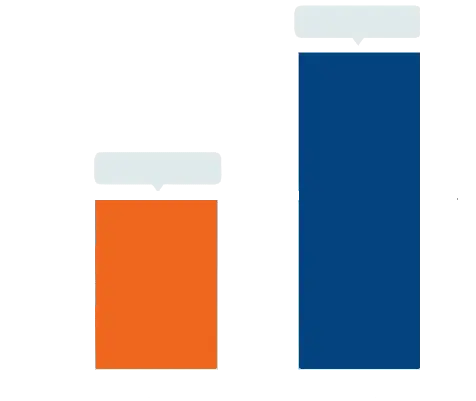
784.50 Million
USD
944.70 Million
2025
2033
USD
784.50 Million
USD
944.70 Million
2025
2033
 Forecast Period Forecast Period |
2026 –2033 |
 Market Size (Base Year) Market Size (Base Year) |
USD 784.50 Million |
 Market Size (Forecast Year) Market Size (Forecast Year) |
USD 944.70 Million |
 CAGR CAGR |
% |
| Major Markets Players |
|
Lubricant Anti-wear Agents Market Size
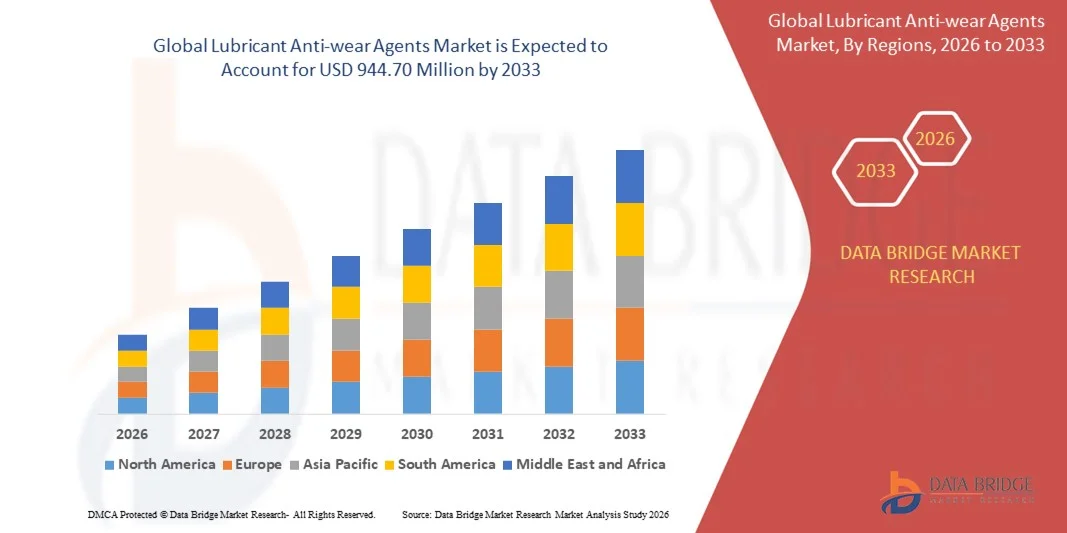
- The global lubricant anti-wear agents market size was valued at USD 784.5 million in 2025 and is expected to reach USD 944.70 million by 2033, at a CAGR of 2.35% during the forecast period
- The market growth is largely fueled by increasing industrialization, rising automotive production, and the growing adoption of high-performance lubricants across machinery, engines, and industrial applications, leading to higher demand for anti-wear additives
- Furthermore, stringent emission regulations, a focus on equipment longevity, and the need for fuel-efficient operations are driving manufacturers and end-users to prefer advanced anti-wear formulations. These factors are accelerating the adoption of lubricant anti-wear agents, thereby significantly boosting the market's growth
Lubricant Anti-wear Agents Market Analysis
- Anti-wear agents, incorporated in engine oils, hydraulic fluids, gear oils, and industrial lubricants, are increasingly critical for reducing friction, preventing wear, and enhancing the operational life of mechanical systems in automotive, energy, and industrial sectors
- The escalating demand for lubricant anti-wear agents is primarily fueled by the rapid expansion of automotive and industrial machinery production, rising maintenance and efficiency requirements, and growing awareness of performance-enhancing lubricants in both developed and emerging markets
- Asia-Pacific dominated the lubricant anti-wear agents market with a share of 58.5% in 2025, due to rapid industrialization, growing automotive production, and increasing demand for high-performance lubricants across machinery and manufacturing sectors
- North America is expected to be the fastest growing region in the lubricant anti-wear agents market during the forecast period due to rising demand for high-performance lubricants in automotive, aerospace, and industrial sectors
- Engine oils segment dominated the market with a market share of 41.7% in 2025, due to their widespread application in automotive and industrial engines requiring constant protection against wear and friction. The integration of advanced anti-wear additives into engine oils enhances fuel efficiency, reduces maintenance frequency, and ensures longer engine life, driving strong adoption among OEMs and aftermarket users. The segment also benefits from stringent engine performance standards and growing demand for high-performance, low-viscosity lubricants across emerging and developed markets
Report Scope and Lubricant Anti-wear Agents Market Segmentation
|
Attributes |
Lubricant Anti-wear Agents Key Market Insights |
|
Segments Covered |
|
|
Countries Covered |
North America
Europe
Asia-Pacific
Middle East and Africa
South America
|
|
Key Market Players |
|
|
Market Opportunities |
|
|
Value Added Data Infosets |
In addition to the insights on market scenarios such as market value, growth rate, segmentation, geographical coverage, and major players, the market reports curated by the Data Bridge Market Research also include import export analysis, production capacity overview, production consumption analysis, price trend analysis, climate change scenario, supply chain analysis, value chain analysis, raw material/consumables overview, vendor selection criteria, PESTLE Analysis, Porter Analysis, and regulatory framework. |
Lubricant Anti-wear Agents Market Trends
Growing Adoption of High-Performance and Eco-Friendly Lubricants
- A significant trend in the lubricant anti-wear agents market is the increasing adoption of high-performance and eco-friendly lubricants across automotive, industrial, and energy sectors, driven by the rising need to enhance machinery longevity, improve fuel efficiency, and comply with stringent emission regulations. This trend is elevating the role of anti-wear agents as essential components for high-performance lubrication in engines, hydraulic systems, and gear applications
- For instance, BASF SE has developed advanced molybdenum disulfide-based solid lubricants under its NeoSteel Eco line, which are being widely adopted in automotive and industrial applications to reduce friction and wear while supporting sustainability goals. These solutions are reinforcing the demand for environmentally responsible and efficient lubricant technologies
- The rising awareness of environmental compliance and sustainability across the automotive and industrial sectors is increasing preference for biodegradable and low-toxicity lubricants containing anti-wear additives. This is prompting manufacturers to reformulate products with advanced additives that reduce wear while meeting environmental standards
- Industrial machinery manufacturers are increasingly specifying lubricants with anti-wear agents to ensure operational reliability under high-load conditions. The use of such additives in hydraulic fluids, gear oils, and engine oils is becoming standard practice to prevent downtime and reduce maintenance costs
- The market is witnessing heightened demand for eco-friendly and high-performance lubricants in emerging economies, driven by rapid industrialization and growing automotive production. The incorporation of anti-wear agents in locally produced lubricants is enabling companies to compete with global brands while meeting performance expectations
- Energy and renewable sectors are also contributing to the trend as turbines, wind energy systems, and heavy-duty machinery require advanced lubrication solutions to maintain efficiency and minimize wear. This is accelerating investment in R&D for next-generation anti-wear additives that offer both performance and sustainability benefits
Lubricant Anti-wear Agents Market Dynamics
Driver
Rising Industrialization and Automotive Production
- The growing industrial and automotive sectors are driving demand for lubricant anti-wear agents, as the performance and durability of engines, gear systems, and hydraulic equipment heavily depend on high-quality lubrication. This increasing reliance on advanced lubricants is boosting adoption across automotive OEMs, heavy machinery, and industrial equipment
- For instance, Shell Lubricants has partnered with Schaeffler Technologies to develop advanced anti-wear formulations for wind energy applications, targeting improved operational efficiency and reduced maintenance costs. Such collaborations illustrate how industrial expansion is directly increasing demand for high-performance lubricant solutions
- The rapid growth of automotive production in countries such as China and India is fueling the need for engine oils and transmission fluids with anti-wear additives to enhance vehicle longevity, reduce friction, and ensure compliance with fuel economy standards
- Heavy industries, including construction, mining, and metallurgy, are increasingly investing in machinery with higher operational loads, creating a strong demand for anti-wear agents to reduce wear, extend equipment life, and improve overall system reliability
- The rising focus on equipment efficiency and reduced operational costs is compelling end-users to adopt advanced anti-wear lubricants, supporting sustained market growth across both mature and emerging economies
Restraint/Challenge
High Cost and Technical Complexity of Advanced Anti-Wear Formulations
- The lubricant anti-wear agents market faces challenges due to the high cost and technical complexity involved in developing advanced formulations. Producing additives that perform reliably under extreme loads and temperatures requires sophisticated chemistry, specialized equipment, and rigorous quality control, increasing production expenses
- For instance, FUCHS Petrolub SE invests heavily in R&D to create customized anti-wear additives for engine oils and gear oils, which demands advanced laboratory capabilities and precise formulation techniques. These requirements increase production costs and limit widespread adoption, particularly in cost-sensitive markets
- Stringent regulatory requirements for emissions and environmental compliance add complexity to formulation development, as additives must reduce wear and also meet biodegradability and low-toxicity standards
- Manufacturers also face challenges in scaling up high-performance formulations while maintaining consistent quality, which can restrict market expansion and limit the availability of advanced anti-wear agents in emerging regions
- Balancing performance, sustainability, and cost efficiency continues to be a critical challenge for the industry, requiring continuous innovation and strategic investment to sustain market growth
Lubricant Anti-wear Agents Market Scope
The market is segmented on the basis of function, type, and end-use industry.
- By Function
On the basis of function, the lubricant anti-wear agents market is segmented into dispersants, antioxidants, rust & corrosion inhibitors, viscosity index improvers, anti-wear agents, extreme pressure additives, detergents, anti-foaming agents, friction modifiers, demulsifiers, emulsifiers, tackifiers, pour point depressants, and others. The anti-wear agents segment dominated the market with the largest revenue share in 2025, driven by their critical role in reducing metal-to-metal contact and minimizing friction in high-stress mechanical systems. Industries increasingly rely on anti-wear additives to enhance machinery lifespan, reduce maintenance costs, and improve operational efficiency in engines, hydraulic systems, and gear applications. The segment also benefits from growing awareness of equipment reliability and fuel efficiency, supporting consistent demand across automotive, energy, and industrial applications.
The extreme pressure additives segment is anticipated to witness the fastest growth rate from 2026 to 2033, fueled by rising demand in heavy-duty industrial and automotive applications where high loads and extreme conditions are common. For instance, companies such as Lubrizol have introduced advanced extreme pressure formulations that protect components under high pressure and shock loads, enhancing equipment performance and durability. Increasing adoption of high-performance lubricants in construction machinery, mining equipment, and metalworking operations further drives the expansion of this segment.
- By Type
On the basis of type, the lubricant anti-wear agents market is segmented into engine oils, hydraulic fluids, transmission fluids, steering fluids, absorber fluids, gear oils, turbine oils, metalworking fluids, grease, and others. Engine oils dominated the market with the largest revenue share of 41.7% in 2025, supported by their widespread application in automotive and industrial engines requiring constant protection against wear and friction. The integration of advanced anti-wear additives into engine oils enhances fuel efficiency, reduces maintenance frequency, and ensures longer engine life, driving strong adoption among OEMs and aftermarket users. The segment also benefits from stringent engine performance standards and growing demand for high-performance, low-viscosity lubricants across emerging and developed markets.
The gear oils segment is expected to register the fastest CAGR from 2026 to 2033, driven by the increasing use of automated and electric transmission systems in commercial and passenger vehicles. For instance, Shell has developed gear oils with specialized anti-wear additives to provide superior load-carrying capacity and thermal stability, catering to high-performance automotive and industrial gear systems. Rising industrialization and mechanization, along with expanding wind energy and heavy machinery applications, support growing demand for advanced gear oil formulations.
- By End-Use Industry
On the basis of end-use industry, the lubricant anti-wear agents market is segmented into automotive, aerospace & defense, energy, construction, marine, metallurgy & metalworking, food processing, and others. The automotive industry dominated the market with the largest revenue share in 2025, driven by the increasing production of passenger and commercial vehicles and the need for high-performance engine and transmission protection. Anti-wear agents are widely adopted in engine oils, hydraulic fluids, and gear oils to improve efficiency, reduce wear, and ensure compliance with emission and fuel economy regulations. The segment also benefits from aftermarket demand and growing replacement cycles in mature and emerging markets, sustaining consistent adoption of advanced lubricant formulations.
The energy sector is anticipated to witness the fastest growth from 2026 to 2033, fueled by the expansion of power generation, renewable energy installations, and oil & gas infrastructure requiring high-performance lubricants. For instance, ExxonMobil has launched specialized anti-wear additives for turbine and hydraulic systems to enhance operational reliability and reduce downtime. Increasing investment in offshore and onshore energy projects, coupled with a focus on equipment longevity and efficiency, drives the rapid adoption of lubricant anti-wear agents in this sector.
Lubricant Anti-wear Agents Market Regional Analysis
- Asia-Pacific dominated the lubricant anti-wear agents market with the largest revenue share of 58.5% in 2025, driven by rapid industrialization, growing automotive production, and increasing demand for high-performance lubricants across machinery and manufacturing sectors
- The region’s cost-effective manufacturing landscape, rising investments in specialty lubricant production, and expanding industrial equipment base are accelerating market growth
- The availability of skilled labor, favorable government policies, and rapid adoption of advanced lubrication technologies across developing economies are contributing to increased consumption of anti-wear agents in automotive, energy, and industrial applications
China Lubricant Anti-Wear Agents Market Insight
China held the largest share in the Asia-Pacific lubricant anti-wear agents market in 2025, owing to its status as a global hub for automotive manufacturing and industrial machinery production. The country's strong industrial base, favorable government policies supporting lubricant production, and extensive export capabilities for high-performance lubricants are key growth drivers. Rising adoption of advanced engine oils and hydraulic fluids with anti-wear additives further supports demand across automotive and industrial sectors.
India Lubricant Anti-Wear Agents Market Insight
India is witnessing the fastest growth in the Asia-Pacific region, fueled by expanding automotive production, growing construction and energy sectors, and increasing adoption of high-performance lubricants. Government initiatives promoting Make in India and local manufacturing are enhancing production of lubricant formulations. In addition, rising mechanization in industrial and mining operations is driving robust demand for anti-wear agents in engine oils, gear oils, and hydraulic fluids.
Europe Lubricant Anti-Wear Agents Market Insight
The Europe lubricant anti-wear agents market is expanding steadily, supported by stringent emission regulations, high demand for high-performance lubricants, and growing adoption of sustainable formulations. The region emphasizes quality, environmental compliance, and efficiency in automotive and industrial applications. Increasing use of anti-wear additives in advanced engine oils, gear oils, and industrial machinery lubricants is further boosting market growth.
Germany Lubricant Anti-Wear Agents Market Insight
Germany’s lubricant anti-wear agents market is driven by its leadership in automotive and industrial machinery manufacturing, strong chemical industry heritage, and focus on high-performance lubricants. The country benefits from established R&D networks and collaborations between lubricant manufacturers and OEMs, fostering continuous innovation. Demand is particularly strong in engine oils, transmission fluids, and industrial gear applications.
U.K. Lubricant Anti-Wear Agents Market Insight
The U.K. market is supported by a mature automotive and industrial equipment sector, focus on localizing lubricant supply chains, and growing demand for specialty lubricants. With emphasis on R&D and sustainability, adoption of high-performance anti-wear additives in engine oils and industrial lubricants is increasing. The market is further strengthened by collaborations between lubricant manufacturers, research institutions, and industrial OEMs.
North America Lubricant Anti-Wear Agents Market Insight
North America is projected to grow at the fastest CAGR from 2026 to 2033, driven by rising demand for high-performance lubricants in automotive, aerospace, and industrial sectors. Increasing focus on equipment reliability, fuel efficiency, and emission compliance is boosting consumption of anti-wear additives. Reshoring of industrial manufacturing and technological advancements in lubricant formulations are further supporting market expansion.
U.S. Lubricant Anti-Wear Agents Market Insight
The U.S. accounted for the largest share in the North America market in 2025, underpinned by its strong automotive, aerospace, and industrial equipment industries. Advanced R&D infrastructure, regulatory emphasis on efficiency and emissions, and high adoption of premium engine oils and industrial lubricants are key growth drivers. Presence of major lubricant additive manufacturers and established distribution networks strengthens the country’s leading position in the region.
Lubricant Anti-wear Agents Market Share
The lubricant anti-wear agents industry is primarily led by well-established companies, including:
- BASF SE (Germany)
- LANXESS (Germany)
- Chevron Corporation (U.S.)
- Afton Chemical (U.S.)
- BRB International (U.S.)
- Evonik AG (Germany)
- Croda International PLC (U.K.)
- Infineum International Limited (U.K.)
- The Lubrizol Corporation (U.S.)
- DOVER CHEMICAL CORPORATION (U.S.)
- SHEPHERD CHEMICAL COMPANY (U.S.)
- Wuxi South Petroleum Additives Co. Ltd (China)
Latest Developments in Global Lubricant Anti-wear Agents Market
- In April 2025, TotalEnergies received regulatory approval for its new lubricant production facility in South Korea. The facility is set to manufacture high-performance anti-wear agents, significantly strengthening TotalEnergies’ presence in the Asian lubricants market. This expansion is expected to enhance the company’s production capacity, improve supply chain efficiency, and meet rising regional demand for advanced, high-performance lubricant formulations, thereby contributing to sustained market growth
- In February 2025, ExxonMobil unveiled a next-generation anti-wear additive for gear oils and hydraulic fluids, designed to enhance load-bearing capacity and reduce friction under extreme operating conditions. The launch is expected to reinforce ExxonMobil’s position in high-performance lubricants, improve product reliability in heavy machinery and industrial applications, and drive adoption of advanced anti-wear formulations across automotive and industrial sectors
- In May 2024, FUCHS Petrolub SE completed the acquisition of Lukoil Lubricants, a key player in the Russian lubricants market. This strategic acquisition expanded FUCHS’s geographical footprint across Eastern Europe and the Commonwealth of Independent States, enabling the company to access new customer segments and distribution channels. The move strengthens FUCHS’s competitive position in the anti-wear agents market and enhances its ability to supply advanced lubricant solutions to industrial and automotive sectors
- In March 2024, Shell Lubricants entered into a strategic partnership with Schaeffler Technologies AG & Co. KG, focusing on the development and commercialization of advanced lubricants for the wind energy sector. This collaboration aims to improve operational efficiency, reduce maintenance costs, and extend equipment lifespan. By targeting the growing renewable energy segment, Shell is positioning itself as a provider of specialized anti-wear solutions for high-performance industrial applications
- In January 2024, BASF SE expanded its NeoSteel Eco product line with the launch of a new molybdenum disulfide-based solid lubricant. The introduction addresses the increasing demand for sustainable and high-performance anti-wear agents across automotive, industrial, and manufacturing applications. This development strengthens BASF’s market offering in eco-friendly lubrication technologies and supports the company’s strategy to cater to environmentally conscious industries
SKU-
Get online access to the report on the World's First Market Intelligence Cloud

- Interactive Data Analysis Dashboard
- Company Analysis Dashboard for high growth potential opportunities
- Research Analyst Access for customization & queries
- Competitor Analysis with Interactive dashboard
- Latest News, Updates & Trend analysis
- Harness the Power of Benchmark Analysis for Comprehensive Competitor Tracking
Global Lubricant Anti Wear Agents Market, Supply Chain Analysis and Ecosystem Framework
To support market growth and help clients navigate the impact of geopolitical shifts, DBMR has integrated in-depth supply chain analysis into its Global Lubricant Anti Wear Agents Market research reports. This addition empowers clients to respond effectively to global changes affecting their industries. The supply chain analysis section includes detailed insights such as Global Lubricant Anti Wear Agents Market consumption and production by country, price trend analysis, the impact of tariffs and geopolitical developments, and import and export trends by country and HSN code. It also highlights major suppliers with data on production capacity and company profiles, as well as key importers and exporters. In addition to research, DBMR offers specialized supply chain consulting services backed by over a decade of experience, providing solutions like supplier discovery, supplier risk assessment, price trend analysis, impact evaluation of inflation and trade route changes, and comprehensive market trend analysis.
Research Methodology
Data collection and base year analysis are done using data collection modules with large sample sizes. The stage includes obtaining market information or related data through various sources and strategies. It includes examining and planning all the data acquired from the past in advance. It likewise envelops the examination of information inconsistencies seen across different information sources. The market data is analysed and estimated using market statistical and coherent models. Also, market share analysis and key trend analysis are the major success factors in the market report. To know more, please request an analyst call or drop down your inquiry.
The key research methodology used by DBMR research team is data triangulation which involves data mining, analysis of the impact of data variables on the market and primary (industry expert) validation. Data models include Vendor Positioning Grid, Market Time Line Analysis, Market Overview and Guide, Company Positioning Grid, Patent Analysis, Pricing Analysis, Company Market Share Analysis, Standards of Measurement, Global versus Regional and Vendor Share Analysis. To know more about the research methodology, drop in an inquiry to speak to our industry experts.
Customization Available
Data Bridge Market Research is a leader in advanced formative research. We take pride in servicing our existing and new customers with data and analysis that match and suits their goal. The report can be customized to include price trend analysis of target brands understanding the market for additional countries (ask for the list of countries), clinical trial results data, literature review, refurbished market and product base analysis. Market analysis of target competitors can be analyzed from technology-based analysis to market portfolio strategies. We can add as many competitors that you require data about in the format and data style you are looking for. Our team of analysts can also provide you data in crude raw excel files pivot tables (Fact book) or can assist you in creating presentations from the data sets available in the report.