


Global Lunch Bags Market
Market Size in USD Billion
CAGR :
% 
 USD
1.29 Billion
USD
25.78 Billion
2025
2033
USD
1.29 Billion
USD
25.78 Billion
2025
2033
 Forecast Period Forecast Period |
2026 –2033 |
 Market Size (Base Year) Market Size (Base Year) |
USD 1.29 Billion |
 Market Size (Forecast Year) Market Size (Forecast Year) |
USD 25.78 Billion |
 CAGR CAGR |
% |
| Major Markets Players |
|
Lunch Bags Market Overview
The global lunch bags market was valued at USD 1.29 billion in 2025 and is projected to reach USD 25.78 billion by 2033, growing at a CAGR of 11.00% from 2026 to 2033. The market is experiencing strong growth driven by increasing consumer preference for reusable food storage products, rising demand for insulated and portable meal-carrying solutions, and growing awareness regarding sustainable lifestyle practices. Expanding urbanization, busy work schedules, and increasing adoption of meal-prep routines among students and working professionals are further supporting market expansion across residential, educational, and corporate sectors.
The growing focus on reducing single-use plastic waste, combined with rising demand for eco-friendly and durable lunch storage products, is encouraging consumers to adopt reusable lunch bags with advanced insulation and leak-proof features. Manufacturers are increasingly introducing lightweight, fashionable, and multifunctional lunch bags integrated with thermal insulation, antimicrobial linings, and smart storage compartments to improve convenience and food freshness. In addition, rapid expansion of e-commerce platforms, rising health-conscious eating habits, and increasing popularity of customized lifestyle accessories are accelerating global demand for premium lunch bag products across developed and emerging markets
Key Market Trends & Insights
- North America dominated the lunch bags market with the largest revenue share of in 2025, supported by increasing consumer preference for reusable food storage products, rising adoption of meal-prep lifestyles, and growing awareness regarding sustainable packaging solutions.
- Asia-Pacific is expected to be the fastest-growing region, recording a CAGR of from 2026 to 2033. Growth is driven by rapid urbanization, rising disposable incomes, and increasing adoption of reusable food storage products across China, Japan, and India.
- The Reusable Lunch Bags segment held the largest market revenue share of approximately 72.4% in 2025 driven by increasing consumer preference for sustainable food storage products, rising environmental awareness, and growing adoption of insulated reusable meal-carrying solutions among students and working professionals. Reusable lunch bags are highly preferred due to their durability, thermal insulation capability, and cost-effectiveness for long-term daily usage across school, office, and travel applications.
- The Disposable Lunch Bags segment is projected to register the fastest growth at a CAGR of 9.8% from 2026 to 2033, driven by rising demand for convenient single-use food packaging solutions across food delivery services, quick-service restaurants, and outdoor events. Increasing adoption in short-term and on-the-go meal packaging applications is supporting segment expansion globally.
- The Adults segment accounted for the largest market revenue share of nearly 61.3% in 2025 owing to increasing adoption of meal-prep routines, rising office-going population, and growing preference for reusable insulated lunch bags among working professionals and fitness-conscious consumers. Expanding demand for premium, stylish, and multifunctional lunch bags suitable for workplaces and travel is further supporting segment dominance.
- The Kids segment is anticipated to witness the fastest growth at a CAGR of 10.5% from 2026 to 2033 driven by increasing school enrollment rates, rising parental focus on hygienic food storage solutions, and growing demand for lightweight and visually attractive lunch bags featuring cartoon characters and customizable designs.
- The Offline segment held the largest market revenue share of approximately 66.8% in 2025 driven by strong consumer preference for physical product inspection, immediate product availability, and extensive retail presence across supermarkets, hypermarkets, specialty stores, and departmental outlets. Offline channels continue to dominate due to higher consumer trust and wider product accessibility across regional markets.
- The Online segment is projected to witness the fastest growth at a CAGR of 12.2% from 2026 to 2033, fueled by rapid expansion of e-commerce platforms, increasing smartphone penetration, and rising consumer preference for convenient digital shopping experiences. Attractive discounts, wider product variety, and growing availability of premium and customized lunch bags through online retail channels are accelerating segment growth globally.
Market Size & Forecast
- Global Market Value (2025): USD 1.29 Billion
- Expected Market Value (2033): USD 25.78 Billion
- Forecast CAGR (2026–2033): 11.00%
- Leading Region in 2025: North America
- Fastest Growing Region: Asia-Pacific
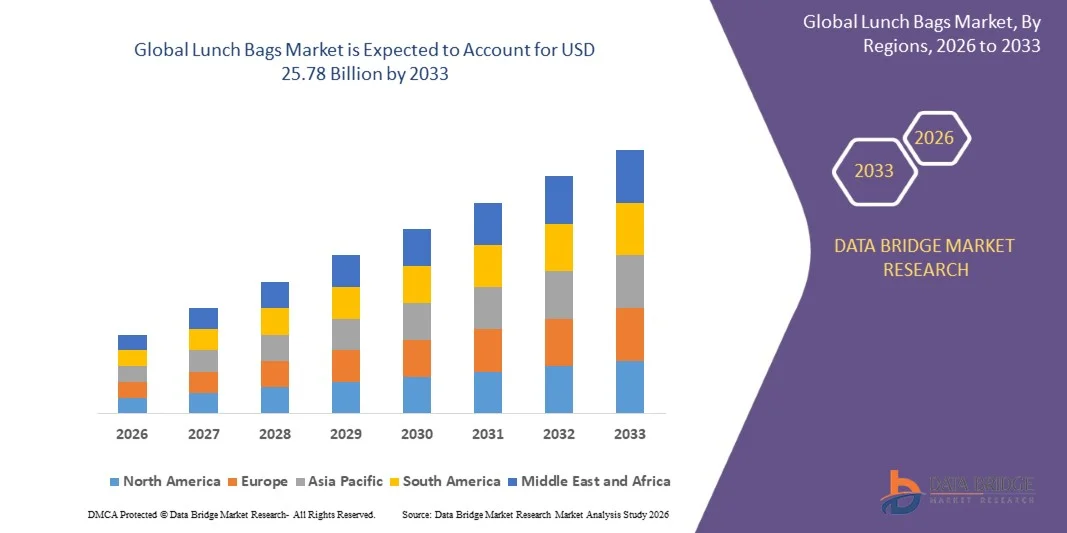
Report Scope and Lunch Bags Market Segmentation
|
Attributes |
Lunch Bags Key Market Insights |
|
Segments Covered |
|
|
Countries Covered |
North America
Europe
Asia-Pacific
Middle East and Africa
South America
|
|
Key Market Players |
• Fit & Fresh (U.S.) |
|
Market Opportunities |
• Rising Demand For Sustainable And Reusable Food Storage Products |
|
Value Added Data Infosets |
In addition to the insights on market scenarios such as market value, growth rate, segmentation, geographical coverage, and major players, the market reports curated by the Data Bridge Market Research also include in-depth expert analysis, pricing analysis, brand share analysis, consumer survey, demography analysis, supply chain analysis, value chain analysis, raw material/consumables overview, vendor selection criteria, PESTLE Analysis, Porter Analysis, and regulatory framework. |
Global Lunch Bags Market Trends
Trend: Rising Demand For Sustainable, Insulated, And Lifestyle-Oriented Lunch Bags
Increasing consumer preference for convenient food storage solutions, reusable packaging products, and portable meal-carrying accessories is significantly driving demand for advanced lunch bags across school, office, travel, and outdoor applications. Conventional disposable food packaging solutions are gradually being replaced by reusable insulated lunch bags due to growing environmental concerns and increasing awareness regarding plastic waste reduction. Consumers are increasingly seeking lightweight, durable, and aesthetically appealing lunch bags with enhanced insulation performance and multiple storage compartments for daily meal transportation.
In modern urban lifestyles, manufacturers are introducing insulated lunch bags, For instance leak-proof and temperature-controlled designs, to maintain food freshness and improve convenience for working professionals and students. In outdoor recreation and travel applications, premium lunch bags with thermal insulation layers and water-resistant materials are being widely adopted for camping, hiking, and long-distance commuting. The growing popularity of meal-prep culture and health-conscious eating habits is also increasing demand for reusable lunch storage products compatible with portion-controlled meal containers and beverage bottles.
The rapid expansion of e-commerce platforms and lifestyle-oriented consumer goods markets is further accelerating global lunch bag demand. In addition, manufacturers are increasingly integrating eco-friendly materials such as recycled polyester, organic cotton, and biodegradable insulation layers into product development strategies to align with sustainability goals. Product launches during 2024–2025 featuring antimicrobial inner linings and advanced thermal retention technology demonstrated nearly 10–14% higher consumer adoption rates across premium urban retail segments in North America and Asia-Pacific.
Global Lunch Bags Market Dynamics
Key Market Driver: Rising Adoption Of Reusable And Eco-Friendly Food Storage Products
Consumers worldwide are becoming increasingly conscious regarding environmental sustainability, food safety, and reusable packaging solutions, creating strong demand for durable lunch bags across residential, educational, and corporate sectors. Rising restrictions on single-use plastics and growing awareness regarding waste reduction are encouraging consumers to shift toward reusable insulated meal-carrying products. Increasing urbanization and busy work lifestyles are also contributing to the expansion of portable food packaging and lunch storage solutions globally.
Manufacturers are continuously introducing advanced lunch bag products, For instance insulated tote bags, collapsible lunch carriers, and leak-resistant thermal containers, to improve portability and food preservation capabilities. Educational institutions and corporate workplaces are increasingly promoting reusable food storage products to support sustainability initiatives and reduce disposable packaging waste. In addition, expanding demand for customized and lifestyle-oriented lunch accessories is strengthening product innovation across online and retail distribution channels.
Commercial retail assessments during 2024–2025 indicated that reusable insulated lunch bag sales increased by approximately 11–13% across urban consumer markets due to growing adoption of sustainable lifestyle products. Similarly, rising demand for reusable meal-prep accessories and portable food containers is significantly supporting market expansion across working professionals and school-going populations.
Key Restraint/Challenge: Fluctuating Raw Material Costs And Intense Market Competition
The lunch bags market is significantly influenced by fluctuations in raw material pricing, including polyester fabrics, aluminum insulation layers, zippers, foam materials, and synthetic textiles used in manufacturing processes. Rising transportation costs, supply chain disruptions, and inflationary pressure on packaging materials continue to create operational challenges for manufacturers operating in cost-sensitive consumer goods markets. Intense competition from low-cost local manufacturers is also affecting pricing strategies and profit margins among established brands.
In addition, low product differentiation across standard lunch bag categories creates challenges for premium manufacturers seeking long-term brand loyalty and pricing advantages. The increasing availability of inexpensive imported products across e-commerce platforms further intensifies competitive pressure in both developed and emerging economies. Concerns regarding durability and thermal retention performance in low-cost products also impact consumer purchasing decisions and replacement cycles.
Industry pricing benchmarks during 2024 indicated that synthetic textile and insulation material costs increased by approximately 8–12% due to global supply chain volatility and higher petroleum-derived material prices. These cost fluctuations significantly affected manufacturing expenses and reduced operating margins for lunch bag producers across global retail markets.
Key Market Opportunity: Expansion Of Smart, Premium, And Customized Lunch Bag Solutions
Modern consumers increasingly prefer multifunctional, stylish, and technologically enhanced food storage products capable of supporting active lifestyles, health-conscious meal planning, and on-the-go convenience. Conventional lunch carriers are evolving into premium lifestyle accessories with advanced insulation, smart storage features, and customizable designs to meet changing consumer expectations. Growing demand for personalized consumer goods and premium travel accessories is creating strong opportunities for innovation within the lunch bags industry.
Manufacturers are increasingly developing smart lunch bags, For instance USB-powered heated lunch bags, temperature-monitoring compartments, and modular storage systems, to improve convenience for office workers, travelers, and students. In premium product categories, rising demand for fashionable and eco-friendly lunch bags made using sustainable fabrics and designer aesthetics is accelerating product differentiation strategies. The increasing popularity of fitness-focused meal preparation and healthy eating routines is also driving demand for compartmentalized and high-capacity insulated lunch bags.
In addition, advancements in lightweight insulation materials, antimicrobial fabric coatings, and recyclable packaging technologies are improving product functionality and long-term durability across premium product segments. Consumer product launches during 2025 introducing smart heated lunch bags and customizable insulated carriers reported nearly 15–18% higher online engagement and sales conversion rates across digitally active urban consumers in North America and Europe.
Global Lunch Bags Market Scope
The market is segmented on the basis of type, application, and distribution channel.
• By Type
On the basis of type, the lunch bags market is segmented into Reusable Lunch Bags and Disposable Lunch Bags. The Reusable Lunch Bags segment held the largest market revenue share of approximately 72.4% in 2025 driven by increasing consumer preference for sustainable food storage products, rising environmental awareness, and growing adoption of insulated reusable meal-carrying solutions among students and working professionals. Reusable lunch bags are highly preferred due to their durability, thermal insulation capability, and cost-effectiveness for long-term daily usage across school, office, and travel applications.
The Disposable Lunch Bags segment is projected to register the fastest growth at a CAGR of 9.8% from 2026 to 2033, driven by rising demand for convenient single-use food packaging solutions across food delivery services, quick-service restaurants, and outdoor events. Increasing adoption in short-term and on-the-go meal packaging applications is supporting segment expansion globally.
• By Application
On the basis of application, the lunch bags market is segmented into Kids and Adults. The Adults segment accounted for the largest market revenue share of nearly 61.3% in 2025 owing to increasing adoption of meal-prep routines, rising office-going population, and growing preference for reusable insulated lunch bags among working professionals and fitness-conscious consumers. Expanding demand for premium, stylish, and multifunctional lunch bags suitable for workplaces and travel is further supporting segment dominance.
The Kids segment is anticipated to witness the fastest growth at a CAGR of 10.5% from 2026 to 2033 driven by increasing school enrollment rates, rising parental focus on hygienic food storage solutions, and growing demand for lightweight and visually attractive lunch bags featuring cartoon characters and customizable designs.
• By Distribution Channel
On the basis of distribution channel, the lunch bags market is segmented into Offline and Online. The Offline segment held the largest market revenue share of approximately 66.8% in 2025 driven by strong consumer preference for physical product inspection, immediate product availability, and extensive retail presence across supermarkets, hypermarkets, specialty stores, and departmental outlets. Offline channels continue to dominate due to higher consumer trust and wider product accessibility across regional markets.
The Online segment is projected to witness the fastest growth at a CAGR of 12.2% from 2026 to 2033, fueled by rapid expansion of e-commerce platforms, increasing smartphone penetration, and rising consumer preference for convenient digital shopping experiences. Attractive discounts, wider product variety, and growing availability of premium and customized lunch bags through online retail channels are accelerating segment growth globally.
Global Lunch Bags Market Regional Analysis
• North America dominated the lunch bags market with the largest revenue share in 2025, driven by increasing consumer preference for reusable food storage products, rising adoption of meal-prep lifestyles, and growing awareness regarding sustainable packaging solutions
• Consumers in the region highly value insulated lunch bags offering convenience, durability, temperature retention, and portability for school, office, travel, and outdoor applications
• This widespread adoption is further supported by high disposable incomes, strong demand for eco-friendly lifestyle products, and increasing preference for reusable and stylish food-carrying accessories, establishing lunch bags as an essential daily-use product across residential and commercial sectors
U.S. Lunch Bags Market Insight
The U.S. lunch bags market captured the largest revenue share in 2025 within North America, fueled by increasing demand for reusable insulated lunch bags among office workers, students, and fitness-conscious consumers. Consumers are increasingly prioritizing convenient meal transportation solutions that maintain food freshness and support healthy eating habits. The growing popularity of meal-prep culture, combined with strong demand for eco-friendly and premium lifestyle products, is further propelling market growth. Moreover, the rapid expansion of e-commerce platforms and customized lunch bag offerings is significantly contributing to industry expansion.
Europe Lunch Bags Market Insight
The Europe lunch bags market is expected to witness the fastest growth rate from 2026 to 2033, primarily driven by rising environmental awareness and increasing restrictions on single-use plastic packaging products. The growing demand for reusable insulated lunch bags across schools, workplaces, and travel applications is fostering product adoption across the region. European consumers are also highly inclined toward sustainable, lightweight, and aesthetically designed lunch storage products. The market is witnessing strong growth across retail and online distribution channels, with increasing preference for eco-friendly and recyclable lunch bag materials.
U.K. Lunch Bags Market Insight
The U.K. lunch bags market is expected to witness strong growth from 2026 to 2033, driven by rising adoption of reusable food storage products and increasing demand for portable meal-carrying solutions among working professionals and school-going consumers. In addition, growing awareness regarding sustainable living practices and waste reduction is encouraging consumers to shift toward reusable insulated lunch bags. The country’s expanding e-commerce sector, alongside increasing preference for premium and customized lifestyle accessories, is expected to continue supporting market growth.
Germany Lunch Bags Market Insight
The Germany lunch bags market is expected to witness strong growth from 2026 to 2033, fueled by increasing consumer preference for eco-friendly products and technologically advanced insulated lunch storage solutions. Germany’s strong sustainability culture, combined with rising demand for reusable and durable food packaging accessories, is promoting market expansion across residential and commercial applications. The integration of lightweight insulation materials and recyclable fabrics into lunch bag manufacturing is also becoming increasingly prevalent. Furthermore, growing demand for premium lifestyle-oriented lunch accessories is accelerating product adoption in Germany.
Asia-Pacific Lunch Bags Market Insight
The Asia-Pacific lunch bags market is expected to witness the fastest growth rate from 2026 to 2033, driven by rapid urbanization, rising disposable incomes, and increasing adoption of reusable food storage products across China, Japan, and India. The region’s growing working population and rising awareness regarding healthy eating habits are accelerating demand for portable lunch-carrying solutions. Furthermore, expanding e-commerce penetration and strong growth in organized retail channels are improving product accessibility across urban and semi-urban markets. The emergence of Asia-Pacific as a major manufacturing hub for textile and lifestyle products is also supporting regional market expansion.
Japan Lunch Bags Market Insight
The Japan lunch bags market is expected to witness strong growth from 2026 to 2033 due to the country’s strong culture of carrying homemade meals and increasing demand for compact and aesthetically designed lunch storage products. Japanese consumers place significant emphasis on convenience, hygiene, and food freshness, encouraging adoption of insulated and compartmentalized lunch bags. The integration of lightweight materials and advanced thermal insulation technologies is further fueling market growth. Moreover, Japan’s growing preference for sustainable and reusable lifestyle accessories is significantly contributing to industry expansion.
China Lunch Bags Market Insight
The China lunch bags market accounted for the largest market revenue share in Asia-Pacific in 2025, attributed to rapid urbanization, rising middle-class population, and increasing demand for affordable reusable food storage solutions. China stands as one of the largest manufacturing centers for textile and insulated consumer products, enabling wide product availability across domestic and international markets. The growing popularity of online retail platforms and increasing adoption of meal-prep lifestyles among younger consumers are significantly driving market growth. Furthermore, the availability of cost-effective and customized lunch bag products, alongside strong domestic manufacturing capabilities, are key factors propelling the market in China.
Global Lunch Bags Market Share
The Lunch Bags industry is primarily led by well-established companies, including:
• Fit & Fresh (U.S.)
• Swinstar Inc. (U.S.)
• Nordic By Nature (Denmark)
• Bentgo (U.S.)
• Newell Brands (U.S.)
• Thermos L.L.C. (U.S.)
• PackIt LLC (U.S.)
• Wildkin (U.S.)
• Freddie and Sebbie (U.S.)
• Kohl’s, Inc. (U.S.)
• LIFETIME BRANDS, INC. (U.S.)
• Raveena Bags (India)
• Magna International Inc. (Canada)
• Pinnium Brands Private Limited (India)
• Craftstages International Private Limited (India)
• Geo Care Products. (India)
• Sharp Trading Co (India)
• Aashirwad Gifts. (India)
• Aurrera Beaumonde Private Limited (India)
SKU-
Get online access to the report on the World's First Market Intelligence Cloud

- Interactive Data Analysis Dashboard
- Company Analysis Dashboard for high growth potential opportunities
- Research Analyst Access for customization & queries
- Competitor Analysis with Interactive dashboard
- Latest News, Updates & Trend analysis
- Harness the Power of Benchmark Analysis for Comprehensive Competitor Tracking
Research Methodology
Data collection and base year analysis are done using data collection modules with large sample sizes. The stage includes obtaining market information or related data through various sources and strategies. It includes examining and planning all the data acquired from the past in advance. It likewise envelops the examination of information inconsistencies seen across different information sources. The market data is analysed and estimated using market statistical and coherent models. Also, market share analysis and key trend analysis are the major success factors in the market report. To know more, please request an analyst call or drop down your inquiry.
The key research methodology used by DBMR research team is data triangulation which involves data mining, analysis of the impact of data variables on the market and primary (industry expert) validation. Data models include Vendor Positioning Grid, Market Time Line Analysis, Market Overview and Guide, Company Positioning Grid, Patent Analysis, Pricing Analysis, Company Market Share Analysis, Standards of Measurement, Global versus Regional and Vendor Share Analysis. To know more about the research methodology, drop in an inquiry to speak to our industry experts.
Customization Available
Data Bridge Market Research is a leader in advanced formative research. We take pride in servicing our existing and new customers with data and analysis that match and suits their goal. The report can be customized to include price trend analysis of target brands understanding the market for additional countries (ask for the list of countries), clinical trial results data, literature review, refurbished market and product base analysis. Market analysis of target competitors can be analyzed from technology-based analysis to market portfolio strategies. We can add as many competitors that you require data about in the format and data style you are looking for. Our team of analysts can also provide you data in crude raw excel files pivot tables (Fact book) or can assist you in creating presentations from the data sets available in the report.












