




Global Magnetic Levitation Market
Market Size in USD Billion
CAGR :
% 
 USD
3.60 Billion
USD
11.64 Billion
2025
2033
USD
3.60 Billion
USD
11.64 Billion
2025
2033
 Forecast Period Forecast Period |
2026 - 2033 |
 Market Size (Base Year) Market Size (Base Year) |
USD 3.60 Billion |
 Market Size (Forecast Year) Market Size (Forecast Year) |
USD 11.64 Billion |
 CAGR CAGR |
% |
| Major Markets Players |
|
Magnetic Levitation Market Overview
The Magnetic Levitation Market was valued at USD 3.60 billion in 2025 and is projected to reach USD 11.64 billion by 2033, growing at a CAGR of 15.8% from 2026 to 2033. The market is witnessing strong growth driven by increasing investments in high-speed rail infrastructure, rising demand for low-friction and energy-efficient transportation systems, and continuous advancements in superconducting magnet technologies and precision control systems.
The growing need for faster, safer, and more sustainable mobility solutions, along with government initiatives to modernize public transportation networks, is accelerating the adoption of maglev-based systems, particularly in Asia-Pacific and parts of Europe. In addition, expanding applications of magnetic levitation in industrial bearings, energy storage systems, and high-precision engineering are further supporting market expansion beyond transportation, making it a key enabling technology across multiple high-performance sectors.
Key Market Trends & Insights
- North America dominated the Magnetic Levitation Market with the largest revenue share of 38.45% in 2025, supported by strong investments in next-generation transportation infrastructure, advanced R&D capabilities, and increasing focus on sustainable high-speed mobility solutions.
- The Electromagnetic Suspension segment led the market with a 52.6% share in 2025, driven by its widespread deployment in operational maglev rail systems and proven stability in commercial transport applications.
- Asia-Pacific is expected to be the fastest-growing region at a CAGR of 16.9% from 2026 to 2033, fueled by large-scale infrastructure expansion, rapid urbanization, and continued maglev adoption in China, Japan, and South Korea.
- Electrodynamic Suspension are the fastest-growing type, projected to register a CAGR of 17.4%, reflecting the surge in demand for the ultra-high-speed transportation systems.
- The guideways segment dominated the component category with a 38.9% revenue share in 2025, led by it represents the most infrastructure-intensive and capital-heavy component of maglev systems.
- 3D cell culture accounted for 61.3% of the market, preferred by pharmaceutical companies, biotechnology firms, and academic research institutes for its ability to closely mimic in-vivo biological conditions in drug discovery and disease modeling applications.
- The 3D bio printing segment is the fastest-growing application category, with a CAGR of 19.2%, driven by breakthroughs in tissue engineering and regenerative medicine.
Market Size & Forecast
- Global Market Value (2025): USD 3.60 Billion
- Expected Market Value (2033): USD 11.64 Billion
- Forecast CAGR (2026–2033): 15.8%
- Leading Region in 2025: North America
- Fastest Growing Region: Asia Pacific
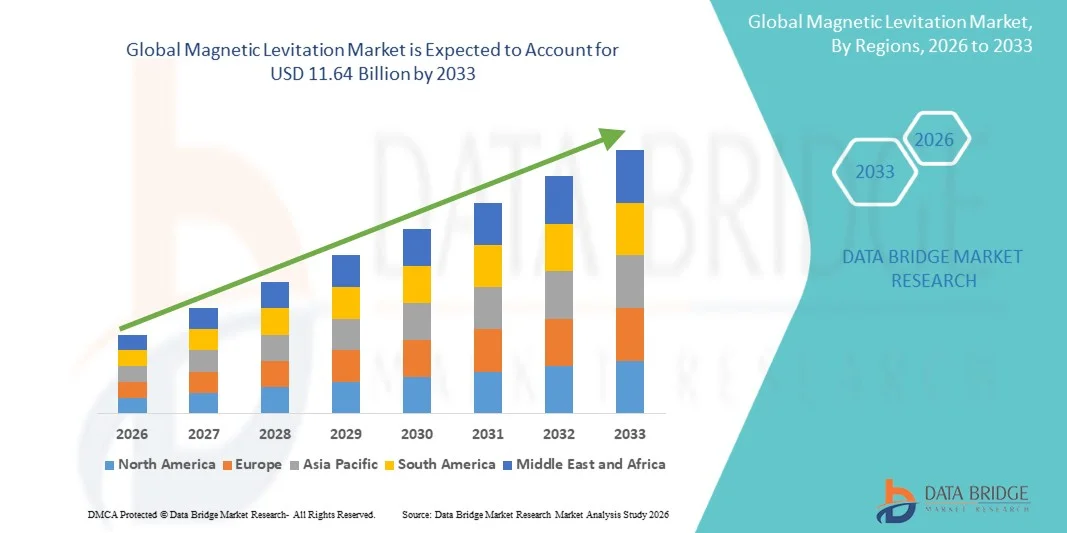
Report Scope and Magnetic Levitation Market Segmentation
|
Attributes |
Magnetic Levitation Key Market Insights |
|
Segments Covered |
|
|
Countries Covered |
North America · U.S. · Canada · Mexico Europe · Germany · France · U.K. · Netherlands · Switzerland · Belgium · Russia · Italy · Spain · Turkey · Rest of Europe Asia-Pacific · China · Japan · India · South Korea · Singapore · Malaysia · Australia · Thailand · Indonesia · Philippines · Rest of Asia-Pacific Middle East and Africa · Saudi Arabia · U.A.E. · South Africa · Egypt · Israel · Rest of Middle East and Africa South America · Brazil · Argentina · Rest of South America |
|
Key Market Players |
· CRRC Corporation Limited (China) · Siemens AG (Germany) · Hitachi Ltd. (Japan) · Thales Group (France) · Alstom S.A. (France) · Mitsubishi Heavy Industries Ltd. (Japan) · Hyundai Rotem Company (South Korea) · Boeing Company (U.S.) · General Atomics (U.S.) · Lockheed Martin Corporation (U.S.) · American Maglev Technology, Inc. (U.S.) · Transrapid International (Germany) · Max Bögl Group (Germany) · AnsaldoBreda (Italy) · Kawasaki Heavy Industries Ltd. (Japan) · IHI Corporation (Japan) · ABB Ltd. (Switzerland) · SKF Group (Sweden) · Parker Hannifin Corporation (U.S.) · Honeywell International Inc. (U.S.) |
|
Market Opportunities |
· Expansion of ultra-high-speed intercity corridors linking major economic hubs · Rising adoption of superconducting magnetic bearings in industrial turbines and energy storage systems · Increasing government-backed smart city and sustainable mobility programs |
|
Value Added Data Infosets |
In addition to the insights on market scenarios such as market value, growth rate, segmentation, geographical coverage, and major players, the market reports curated by the Data Bridge Market Research also include in-depth expert analysis, patient epidemiology, pipeline analysis, pricing analysis, and regulatory framework. |
Magnetic Levitation Market Trends
Trend: Expansion of High-Speed Maglev Transportation Networks
Countries across the globe are increasingly prioritizing magnetic levitation-based high-speed rail systems as a next-generation mobility solution to address rising congestion, urbanization pressures, and demand for faster intercity travel. These systems offer significantly higher speeds compared to conventional rail, along with reduced mechanical wear due to non-contact levitation technology. Continuous advancements in superconducting magnets, linear motor propulsion, and automated control systems are improving operational stability, energy efficiency, and passenger safety. Governments are also integrating maglev corridors into long-term national infrastructure strategies to create ultra-fast regional connectivity networks that can compete with short-haul aviation.
For instance, China’s Shanghai Maglev Train demonstrates commercial-scale deployment of high-speed levitation transport, while Japan’s Chuo Shinkansen project represents one of the most advanced next-generation maglev corridors under development, designed to connect major economic hubs with ultra-high-speed capability.
Magnetic Levitation Market Dynamics
Key Market Driver: Rising Demand for Energy Efficient & Low Friction Transport Systems
The global push toward decarbonization and sustainable infrastructure is significantly accelerating the adoption of magnetic levitation technology in transportation systems. Unlike traditional railways, maglev systems eliminate direct physical contact between train and track, which reduces frictional losses, mechanical wear, and long-term maintenance requirements. This results in higher energy efficiency and lower lifecycle operating costs, making maglev an attractive option for governments seeking greener mobility solutions. In addition, rising urban population density is increasing demand for high-capacity transit systems that can operate at higher speeds with improved reliability and reduced congestion.
For instance, South Korea’s Incheon Airport Maglev demonstrates the use of low-speed urban maglev systems for efficient airport connectivity, while Germany’s Transrapid program highlights early technological advancements aimed at long-distance frictionless transport solutions.
Key Restraint/Challenge: High Infrastructure Development Cost and Technical Complexity
One of the most significant barriers to widespread adoption of magnetic levitation systems is the extremely high initial capital investment required for infrastructure development. Unlike conventional rail, maglev requires completely new dedicated guideways, specialized propulsion systems, and precision-engineered control networks, all of which substantially increase project costs. In addition, the need for superconducting magnets often involves cryogenic cooling systems, which further adds to operational complexity and maintenance requirements. These factors make financing and scalability difficult, particularly for developing economies and private operators.
For instance, several proposed intercity maglev projects in the United States have faced delays or cancellations due to funding constraints and high construction costs, reflecting the economic challenges associated with large-scale deployment of this technology.
Key Market Opportunity: Integration with Smart Cities and Next Generation Mobility Networks
The integration of magnetic levitation systems into smart city frameworks and multimodal transportation networks presents a strong long-term growth opportunity for the market. Maglev systems can be strategically incorporated into urban planning as high-speed connectors between airports, business districts, and surrounding metropolitan regions, enabling seamless and time-efficient mobility. The adoption of digital technologies such as IoT-based monitoring, AI-powered predictive maintenance, and automated traffic control is further enhancing system reliability and operational efficiency. As cities evolve toward intelligent transport ecosystems, maglev technology is expected to play a critical role in next-generation mobility infrastructure.
For instance, China’s planned intercity maglev corridors and feasibility studies in Gulf countries such as Saudi Arabia and the UAE demonstrate growing interest in integrating ultra-fast rail systems into smart city and megacity development projects.
Magnetic Levitation Market Scope
The magnetic levitation market is segmented on the basis of type, component, application, and end use.
- By Type
On the basis of type, the Magnetic Levitation Market is segmented into Electromagnetic Suspension (EMS), Electrodynamic Suspension (EDS), and Inductrack systems. The Electromagnetic Suspension (EMS) segment dominated the market with a 52.6% share in 2025, owing to its widespread deployment in operational maglev rail systems and proven stability in commercial transport applications. EMS is extensively used in urban and intercity rail networks due to its mature engineering design and reliable low-to-medium speed performance. It ensures continuous active control of levitation, offering high passenger comfort and operational safety. Governments prefer EMS systems due to lower technological risk and established infrastructure compatibility. Ongoing improvements in power electronics and control algorithms are further reinforcing its dominant position.
The Electrodynamic Suspension (EDS) segment is expected to be the fastest-growing, registering a 17.4% CAGR from 2026–2033, driven by rising demand for ultra-high-speed transportation systems. EDS technology offers superior stability at very high speeds using superconducting magnets and induced magnetic fields. It is increasingly being explored for long-distance intercity corridors requiring speeds beyond conventional rail limits. Advancements in cryogenic systems and superconducting materials are improving feasibility and reducing energy losses. Countries investing in next-generation transport infrastructure are actively testing EDS-based prototypes. Growing emphasis on high-capacity, low-friction mobility is accelerating adoption globally.
- By Component
On the basis of component, the market is segmented into magnets & superconducting coils, power supply systems, guideways, control & stabilization systems, and propulsion systems. The guideways segment dominated the market with a 38.9% share in 2025, as it represents the most infrastructure-intensive and capital-heavy component of maglev systems. Guideways form the structural backbone of the entire network and require high-precision engineering and significant civil construction investment. They account for the largest portion of project cost due to land acquisition, material use, and installation complexity. Governments prioritize guideway development as the first step in maglev deployment. Continuous improvements in structural design and materials are enhancing durability and reducing lifecycle maintenance costs.
The magnets & superconducting coils segment is expected to be the fastest-growing, with a CAGR of 18.1% from 2026–2033, driven by rapid innovation in superconducting technologies. These components are critical for achieving stable levitation and efficient propulsion in next-generation maglev systems. Increasing development of high-temperature superconductors is reducing cooling requirements and improving energy efficiency. Rising investment in ultra-high-speed rail research is accelerating technological advancements. Demand for lightweight, high-performance magnetic systems is increasing across transport and industrial applications. Strong R&D funding from both governments and private players is further boosting growth.
- By Application
On the basis of application, the market is segmented into 3D bio printing and 3D cell culture applications. The 3D cell culture segment dominated the market with a 61.3% share in 2025, as magnetic levitation is widely used for scaffold-free tissue formation in biomedical research. This technique enables realistic cell aggregation that closely mimics in-vivo biological conditions. It is heavily used in pharmaceutical testing, cancer research, and drug discovery workflows. High reproducibility and accuracy make it ideal for advanced laboratory applications. Increasing demand for regenerative medicine research is further strengthening adoption. Growing biotechnology funding globally is supporting expansion of this segment.
The 3D bio printing segment is expected to be the fastest-growing, registering a CAGR of 19.2% from 2026–2033, driven by breakthroughs in tissue engineering and regenerative medicine. Magnetic levitation enables precise assembly of complex 3D tissue structures without physical scaffolding. This allows better replication of human organs for research and transplantation studies. Rising demand for personalized medicine and organ regeneration is accelerating innovation. Continuous improvements in biofabrication technologies are improving scalability and precision. Expanding clinical and academic research applications are further boosting growth.
- By End Use
On the basis of end use, the market is segmented into hospitals, clinics, public health labs, private/commercial labs, physician labs, research institutes, and others. The research institutes segment dominated the market with a 44.7% share in 2025, driven by extensive use of magnetic levitation in advanced scientific research and experimental studies. These institutes play a key role in developing biomedical, material science, and engineering applications of maglev systems. Strong government funding and academic collaborations support continuous innovation. Research environments require highly controlled and precise experimental setups, making maglev-based systems highly suitable. Increasing interdisciplinary research is further strengthening adoption. Well-established laboratory infrastructure supports widespread usage globally.
The private or commercial labs segment is expected to be the fastest-growing, with a CAGR of 16.8% from 2026–2033, driven by rising outsourcing of pharmaceutical and biotech research. These labs are increasingly adopting advanced levitation-based systems to enhance efficiency and reduce experimental variability. Growing demand for faster drug development and diagnostic testing is accelerating adoption. Expansion of CROs and biotech startups is further supporting growth. Continuous technological advancements are improving affordability and accessibility of maglev systems. Increasing commercialization of life science research is a key growth driver.
Magnetic Levitation Market Regional Analysis
North America dominated the Magnetic Levitation Market with the largest revenue share of 38.45% in 2025, supported by strong investments in next-generation transportation infrastructure, advanced R&D capabilities, and increasing focus on sustainable high-speed mobility solutions. The region also benefits from increasing government initiatives toward sustainable transit systems, rising adoption of magnetic bearings in industrial applications, and expanding research into ultra-high-speed rail concepts. Continuous technological advancements and collaborations between public agencies and private players are further strengthening North America’s leadership position in the global market.
U.S. Magnetic Levitation Market Insight
The U.S. magnetic levitation market is witnessing steady growth due to rising investments in next-generation transportation infrastructure, increasing focus on sustainable mobility solutions, and growing research into high-speed rail alternatives. The country’s strong technological ecosystem, along with advancements in superconducting materials, magnetic bearing systems, and linear motor propulsion, is supporting market development across transportation and industrial applications. In addition, increasing government interest in reducing carbon emissions and improving intercity connectivity is accelerating exploration of maglev-based mobility systems.
Europe Magnetic Levitation Market Insight
The Europe magnetic levitation market remains a key contributor to global development, driven by strong regulatory focus on green transportation, advanced rail infrastructure, and continuous innovation in high-speed mobility technologies. The region benefits from extensive research programs, government-backed sustainability initiatives, and collaborations between public agencies and engineering firms. Increasing emphasis on reducing aviation dependency for short-haul routes and improving rail efficiency is further supporting adoption. Europe’s strong engineering base and long-term transport modernization plans continue to strengthen market growth.
U.K. Magnetic Levitation Market Insight
The U.K. magnetic levitation market is gradually evolving, supported by growing interest in futuristic rail systems, infrastructure modernization programs, and increasing research into low-carbon transport solutions. Investments in advanced mobility technologies and feasibility studies for high-speed rail alternatives are contributing to market development. The integration of digital control systems, AI-based monitoring, and smart transport planning is further enhancing innovation potential. However, high infrastructure costs remain a key challenge for large-scale deployment.
Germany Magnetic Levitation Market Insight
The Germany magnetic levitation market is expanding steadily due to the country’s strong engineering capabilities, advanced transportation research, and focus on sustainable mobility systems. Automotive and rail technology firms are actively exploring maglev applications for both passenger transport and industrial systems. Strong government emphasis on innovation, energy efficiency, and emission reduction is supporting long-term market development. Continuous advancements in superconducting technologies and precision engineering are further strengthening Germany’s position in the global market landscape.
Asia-Pacific Magnetic Levitation Market Insight
The Asia-Pacific magnetic levitation market is expected to witness rapid growth, driven by large-scale infrastructure investments, rapid urbanization, and strong government support for high-speed rail projects. Countries such as China, Japan, and South Korea are leading adoption with operational and under-development maglev corridors. Increasing demand for faster intercity connectivity and sustainable transportation systems is further accelerating market expansion. In addition, growing technological capabilities and expanding urban transit networks are strengthening regional dominance.
Japan Magnetic Levitation Market Insight
The Japan magnetic levitation market is witnessing strong progress due to continuous advancements in superconducting maglev technology, long-term high-speed rail development projects, and strong emphasis on precision engineering. The country’s focus on ultra-high-speed transportation is driving investments in next-generation rail systems such as advanced intercity corridors. Increasing integration of energy-efficient propulsion systems and automated control technologies is further supporting market growth. Japan’s leadership in rail innovation continues to position it as a key global technology hub.
China Magnetic Levitation Market Insight
The China magnetic levitation market is growing rapidly, driven by massive infrastructure investments, strong government support for high-speed rail expansion, and increasing focus on advanced transportation technologies. The country is actively deploying and expanding commercial maglev lines while also investing heavily in next-generation ultra-high-speed rail research. Rising urbanization, demand for efficient intercity mobility, and technological advancements in superconducting systems are further accelerating growth. China continues to dominate global maglev deployment and development initiatives.
Magnetic Levitation Market Share
The magnetic levitation industry is primarily led by well-established companies, including:
- CRRC Corporation Limited (China)
- Siemens AG (Germany)
- Hitachi Ltd. (Japan)
- Thales Group (France)
- Alstom S.A. (France)
- Mitsubishi Heavy Industries Ltd. (Japan)
- Hyundai Rotem Company (South Korea)
- Boeing Company (U.S.)
- General Atomics (U.S.)
- Lockheed Martin Corporation (U.S.)
- American Maglev Technology, Inc. (U.S.)
- Transrapid International (Germany)
- Max Bögl Group (Germany)
- AnsaldoBreda (Italy)
- Kawasaki Heavy Industries Ltd. (Japan)
- IHI Corporation (Japan)
- ABB Ltd. (Switzerland)
- SKF Group (Sweden)
- Parker Hannifin Corporation (U.S.)
- Honeywell International Inc. (U.S.)
Latest Developments in Magnetic Levitation Market
- In March 2025, Japan reaffirmed continued investment in the SCMaglev Chuo Shinkansen project, with government and JR Central coordination focusing on accelerating construction segments and improving tunneling efficiency. The project remains a flagship initiative for ultra-high-speed rail connectivity between Tokyo and Osaka, showcasing Japan’s long-term commitment to superconducting maglev technology. Despite delays, it continues to be one of the most ambitious transport infrastructure projects globally
- In December 2024, China advanced its high-speed maglev development program in Qingdao, with CRRC expanding testing and production capabilities for next-generation 600 km/h maglev systems. The development is part of China’s broader strategy to commercialize ultra-high-speed rail corridors and strengthen domestic manufacturing of superconducting transport technologies. The initiative supports integration of maglev systems into future intercity transport networks
- In June 2023, Japan Central Railway (JR Central) continued progress on its SCMaglev Chuo Shinkansen project, with test runs in the Yamanashi test track reaching sustained high-speed performance milestones. However, Reuters reported ongoing delays in full commercial launch due to construction challenges in mountainous regions and rising infrastructure costs. The project remains one of the most advanced superconducting maglev developments globally
- In May 2022, South Korea suspended operations of the Incheon Airport Maglev line, one of the world’s first urban maglev transit systems, due to low ridership and high operational costs. The decision reflected challenges in scaling low-speed maglev systems in urban environments despite their technological success. The suspension raised broader questions about economic viability and long-term sustainability of urban maglev transport projects
- In July 2021, CRRC (China Railway Rolling Stock Corporation) unveiled a new high-speed maglev train prototype capable of reaching speeds up to 600 km/h in Qingdao, China, marking a major breakthrough in ultra-high-speed ground transportation technology. The development highlighted China’s leadership in next-generation maglev systems and its focus on reducing travel time between major cities through advanced superconducting propulsion technologies. The train was designed for intercity corridors and represents a significant step toward commercial deployment of ultra-fast rail networks
SKU-
Get online access to the report on the World's First Market Intelligence Cloud

- Interactive Data Analysis Dashboard
- Company Analysis Dashboard for high growth potential opportunities
- Research Analyst Access for customization & queries
- Competitor Analysis with Interactive dashboard
- Latest News, Updates & Trend analysis
- Harness the Power of Benchmark Analysis for Comprehensive Competitor Tracking
Research Methodology
Data collection and base year analysis are done using data collection modules with large sample sizes. The stage includes obtaining market information or related data through various sources and strategies. It includes examining and planning all the data acquired from the past in advance. It likewise envelops the examination of information inconsistencies seen across different information sources. The market data is analysed and estimated using market statistical and coherent models. Also, market share analysis and key trend analysis are the major success factors in the market report. To know more, please request an analyst call or drop down your inquiry.
The key research methodology used by DBMR research team is data triangulation which involves data mining, analysis of the impact of data variables on the market and primary (industry expert) validation. Data models include Vendor Positioning Grid, Market Time Line Analysis, Market Overview and Guide, Company Positioning Grid, Patent Analysis, Pricing Analysis, Company Market Share Analysis, Standards of Measurement, Global versus Regional and Vendor Share Analysis. To know more about the research methodology, drop in an inquiry to speak to our industry experts.
Customization Available
Data Bridge Market Research is a leader in advanced formative research. We take pride in servicing our existing and new customers with data and analysis that match and suits their goal. The report can be customized to include price trend analysis of target brands understanding the market for additional countries (ask for the list of countries), clinical trial results data, literature review, refurbished market and product base analysis. Market analysis of target competitors can be analyzed from technology-based analysis to market portfolio strategies. We can add as many competitors that you require data about in the format and data style you are looking for. Our team of analysts can also provide you data in crude raw excel files pivot tables (Fact book) or can assist you in creating presentations from the data sets available in the report.












