

Global Malt Ingredients Market
Market Size in USD Billion
CAGR :
% 
 USD
28.94 Billion
USD
44.52 Billion
2025
2033
USD
28.94 Billion
USD
44.52 Billion
2025
2033
 Forecast Period Forecast Period |
2026 –2033 |
 Market Size (Base Year) Market Size (Base Year) |
USD 28.94 Billion |
 Market Size (Forecast Year) Market Size (Forecast Year) |
USD 44.52 Billion |
 CAGR CAGR |
% |
| Major Markets Players |
|
Malt Ingredients Market Size
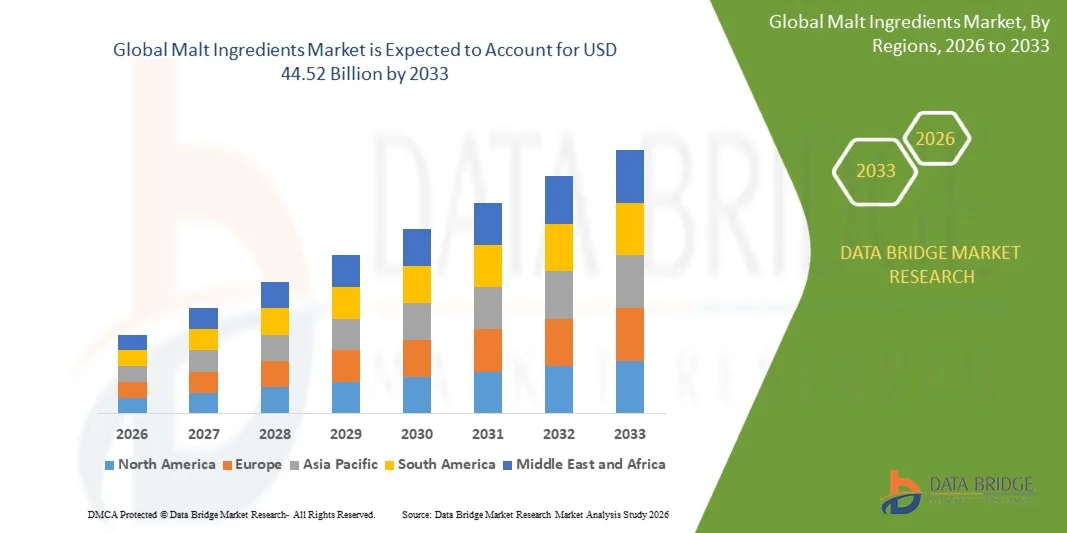
- The global malt ingredients market size was valued at USD 28.94 billion in 2025 and is expected to reach USD 44.52 billion by 2033, at a CAGR of 5.53% during the forecast period
- The market growth is largely fueled by the increasing demand for malt-based beverages and processed food products, supported by rising consumption of beer, bakery, and confectionery items across global markets
- Furthermore, growing consumer preference for natural, clean-label, and functional ingredients is positioning malt ingredients as a valuable component in food and beverage formulations. These converging factors are accelerating the adoption of malt ingredients, thereby significantly boosting the industry's growth
Malt Ingredients Market Analysis
- Malt ingredients are derived from cereal grains such as barley, wheat, and rye through controlled germination and drying processes, and are widely used to enhance flavor, color, texture, and nutritional value in food and beverages
- The escalating demand for malt ingredients is primarily driven by the expansion of the brewing industry, increasing demand for convenience and functional foods, and rising interest in premium and craft product offerings
- Europe dominated the malt ingredients market with a share of 35.82% in 2025, due to its strong brewing tradition and well-established food and beverage industry across countries such as Germany, the U.K., and France
- Asia-Pacific is expected to be the fastest growing region in the malt ingredients market during the forecast period due to rising urbanization and increasing disposable incomes in countries such as China, India, and Japan
- Barley segment dominated the market with a market share of 66.63% in 2025, due to its widespread availability and superior enzymatic properties suitable for malting. Barley remains the preferred raw material in brewing and distilling industries due to its consistent performance and flavor contribution. Its well-established supply chain and processing infrastructure further strengthen its dominance
Report Scope and Malt Ingredients Market Segmentation
|
Attributes |
Malt Ingredients Key Market Insights |
|
Segments Covered |
|
|
Countries Covered |
North America
Europe
Asia-Pacific
Middle East and Africa
South America
|
|
Key Market Players |
|
|
Market Opportunities |
|
|
Value Added Data Infosets |
In addition to the insights on market scenarios such as market value, growth rate, segmentation, geographical coverage, and major players, the market reports curated by the Data Bridge Market Research also include in-depth expert analysis, pricing analysis, brand share analysis, consumer survey, demography analysis, supply chain analysis, value chain analysis, raw material/consumables overview, vendor selection criteria, PESTLE Analysis, Porter Analysis, and regulatory framework. |
Malt Ingredients Market Trends
“Rising Demand for Clean-Label and Natural Malt Ingredients”
- A significant trend in the malt ingredients market is the increasing demand for clean-label and natural ingredients, driven by growing consumer awareness regarding food transparency and health-conscious consumption patterns. This trend is strengthening the role of malt ingredients as naturally derived additives that enhance flavor, color, and texture across food and beverage applications
- For instance, companies such as Muntons plc and Briess Malt & Ingredients are actively expanding their portfolios of organic and non-GMO malt products to meet evolving clean-label requirements. These offerings are supporting manufacturers in developing products aligned with consumer demand for minimally processed and traceable ingredients
- The demand for natural malt ingredients is rising across bakery and confectionery sectors where they are used to replace artificial sweeteners and colorants. This is encouraging food manufacturers to reformulate products with malt-based solutions that improve both taste and nutritional perception
- The brewing industry is witnessing a shift toward premium and craft beers where high-quality malt plays a central role in defining product differentiation. This is increasing the adoption of specialty malt varieties that deliver distinct flavor profiles and enhance product appeal
- Food producers are integrating malt ingredients into functional and fortified food products to improve nutritional value while maintaining clean-label standards. This is expanding the scope of malt usage beyond traditional applications and supporting market diversification
- The growing emphasis on sustainable sourcing and transparency in ingredient supply chains is further reinforcing this trend. The increasing reliance on natural malt ingredients is positioning them as essential components in modern food and beverage innovation, thereby driving long-term market growth
Malt Ingredients Market Dynamics
Driver
“Increasing Consumption of Beer and Malt-Based Beverages Globally”
- The increasing global consumption of beer and malt-based beverages is a major driver for the malt ingredients market, as malt serves as a fundamental raw material in brewing processes. Rising demand for premium, craft, and flavored beers is significantly boosting the need for diverse malt varieties
- For instance, Malteurop Groupe and Boortmalt have expanded their production capacities to cater to the growing demand from breweries worldwide. These expansions are enabling consistent supply and supporting the scalability of brewing operations across key markets
- The rapid growth of craft breweries is driving the demand for specialty malts that enhance flavor complexity and product differentiation. This is encouraging malt producers to innovate and diversify their product offerings to meet evolving brewer requirements
- Emerging markets are witnessing increasing beer consumption due to changing lifestyles and rising disposable incomes. This is creating new growth opportunities for malt ingredient suppliers to expand their geographical presence
- The sustained rise in global beverage consumption continues to reinforce this driver. The expanding brewing industry and evolving consumer preferences are significantly contributing to the overall growth of the malt ingredients market
Restraint/Challenge
“Fluctuations in Barley Supply and Price Volatility”
- The malt ingredients market faces challenges due to fluctuations in barley supply and price volatility, as barley is the primary raw material used in malt production. Climatic variations and agricultural uncertainties directly impact crop yield and quality, affecting overall supply stability
- For instance, GrainCorp Limited has reported variability in barley production due to changing weather patterns in Australia, influencing pricing and supply chain dynamics. Such fluctuations create uncertainty for malt producers and increase procurement costs
- The dependence on agricultural outputs makes the market vulnerable to external factors such as droughts, floods, and changing climate conditions. These factors disrupt raw material availability and create inconsistencies in production planning
- Rising input costs and logistical challenges further contribute to price instability across the malt supply chain. This impacts profit margins for manufacturers and creates pricing pressures for end-users
- These ongoing uncertainties in raw material supply and pricing continue to restrain market growth. The volatility in barley availability remains a critical challenge influencing the stability and expansion of the malt ingredients market
Malt Ingredients Market Scope
The market is segmented on the basis of form, source, grade, and application.
•By Form
On the basis of form, the malt ingredients market is segmented into dry extract and liquid extract. The dry extract segment dominated the largest market revenue share in 2025, driven by its longer shelf life, ease of storage, and lower transportation costs compared to liquid variants. Manufacturers prefer dry malt extracts for their stability and convenience in large-scale food and beverage processing. Their versatility across bakery, confectionery, and brewing applications further strengthens demand. In addition, dry extracts offer consistent quality and concentration, supporting standardized production processes.
The liquid extract segment is anticipated to witness the fastest growth rate from 2026 to 2033, fueled by increasing demand in craft brewing and premium beverage applications. Liquid malt extracts provide richer flavor profiles and faster fermentation processes, making them attractive for breweries. Their ease of blending and reduced processing time enhances operational efficiency for manufacturers. Growing preference for high-quality and artisanal products is further supporting segment expansion.
•By Source
On the basis of source, the malt ingredients market is segmented into barley, wheat, rye, and others. The barley segment dominated the largest market revenue share of 66.63% in 2025, driven by its widespread availability and superior enzymatic properties suitable for malting. Barley remains the preferred raw material in brewing and distilling industries due to its consistent performance and flavor contribution. Its well-established supply chain and processing infrastructure further strengthen its dominance. In addition, barley-based malt supports a wide range of applications across food and beverage sectors.
The wheat segment is anticipated to witness the fastest growth rate from 2026 to 2033, fueled by rising demand for specialty beers and bakery products. Wheat malt contributes unique taste, texture, and foam stability, making it desirable in premium beverage formulations. Increasing consumer inclination toward diversified flavors and healthier grain options is supporting its adoption. Expanding use in functional and fortified food products is further driving segment growth.
•By Grade
On the basis of grade, the malt ingredients market is segmented into standard malt and specialty malt. The standard malt segment dominated the largest market revenue share in 2025, driven by its extensive use in mass-scale brewing and food processing industries. It provides consistent quality, cost efficiency, and reliable performance in large production volumes. Manufacturers rely on standard malt for its predictable characteristics and ease of integration into existing processes. Its affordability and availability make it a preferred choice across conventional applications.
The specialty malt segment is anticipated to witness the fastest growth rate from 2026 to 2033, fueled by increasing demand for premium and craft products. Specialty malts enhance flavor, aroma, and color, enabling product differentiation in competitive markets. Growing interest in artisanal beverages and gourmet food products is supporting this trend. Producers are focusing on innovation and customization, which is further accelerating demand for specialty malt varieties.
•By Application
On the basis of application, the malt ingredients market is segmented into food, beverages, and others. The beverages segment dominated the largest market revenue share in 2025, driven by strong demand from the global brewing and distilling industries. Malt ingredients play a critical role in beer production, influencing taste, texture, and fermentation efficiency. The expansion of craft breweries and premium alcoholic beverages is further strengthening segment dominance. In addition, rising consumption of malt-based drinks is contributing to sustained demand.
The food segment is anticipated to witness the fastest growth rate from 2026 to 2033, fueled by increasing use in bakery, confectionery, and breakfast products. Malt ingredients enhance flavor, color, and nutritional profile, making them suitable for diverse food applications. Growing demand for clean-label and natural ingredients is encouraging their adoption in processed foods. Continuous innovation in food formulations is further supporting segment expansion.
Malt Ingredients Market Regional Analysis
- Europe dominated the malt ingredients market with the largest revenue share of 35.82% in 2025, driven by its strong brewing tradition and well-established food and beverage industry across countries such as Germany, the U.K., and France
- The region benefits from a high consumption of beer and malt-based beverages, along with increasing demand for premium and craft products enhancing the use of specialty malt ingredients
- This widespread demand is further supported by advanced processing infrastructure, presence of leading malt producers, and continuous innovation in product formulations, establishing Europe as a key hub for malt ingredient production and consumption
U.K. Malt Ingredients Market Insight
The U.K. malt ingredients market is anticipated to grow at a noteworthy CAGR during the forecast period, driven by rising demand for craft beer and premium alcoholic beverages. Consumers are increasingly favoring unique flavors and high-quality ingredients, which is boosting the use of specialty malt. The strong presence of microbreweries and expanding retail distribution channels are further supporting market growth. In addition, increasing interest in malt-based food products is contributing to steady expansion.
Germany Malt Ingredients Market Insight
The Germany malt ingredients market captured the largest share in 2025, fueled by its position as a major beer producer and exporter. The country’s well-established brewing industry and adherence to traditional brewing standards drive consistent demand for high-quality malt. Increasing focus on specialty and organic malt variants is further supporting market development. Moreover, technological advancements in malting processes are enhancing production efficiency.
North America Malt Ingredients Market Insight
The North America malt ingredients market is expected to expand at a steady CAGR during the forecast period, driven by the growing craft brewing industry and rising demand for clean-label ingredients. Increasing consumer preference for natural and minimally processed food products is supporting the use of malt ingredients. The region also benefits from advanced food processing technologies and strong distribution networks. Moreover, innovation in malt-based applications is contributing to sustained market growth.
U.S. Malt Ingredients Market Insight
The U.S. malt ingredients market captured the largest revenue share within North America in 2025, fueled by the strong presence of craft breweries and increasing consumption of malt-based beverages. Consumers are showing growing interest in premium and flavored beer varieties, boosting demand for specialty malt. The expanding food and beverage sector and rising focus on product differentiation are further propelling the market. In addition, technological advancements in malting processes are supporting production efficiency.
Asia-Pacific Malt Ingredients Market Insight
The Asia-Pacific malt ingredients market is poised to grow at the fastest CAGR during the forecast period of 2026 to 2033, driven by rising urbanization and increasing disposable incomes in countries such as China, India, and Japan. The growing popularity of beer consumption and expansion of the food processing sector are supporting demand for malt ingredients. Government initiatives promoting industrial growth and food processing are further accelerating market expansion. In addition, the region is emerging as a key production base due to cost advantages.
Japan Malt Ingredients Market Insight
The Japan malt ingredients market is gaining momentum due to increasing demand for premium and flavored alcoholic beverages. The country’s strong preference for quality and innovation is encouraging the use of specialty malt in brewing and food applications. Growing adoption of western dietary patterns is also contributing to demand growth. Furthermore, continuous product innovation is supporting the expansion of malt-based offerings.
China Malt Ingredients Market Insight
The China malt ingredients market accounted for the largest market revenue share in Asia Pacific in 2025, attributed to rapid urbanization and growing consumer base for beer and processed food products. The expanding middle class and increasing demand for premium beverages are supporting market growth. Strong domestic production capabilities and investments in food processing infrastructure are further strengthening the market. In addition, rising consumption of malt-based beverages is driving consistent demand.
Malt Ingredients Market Share
The malt ingredients industry is primarily led by well-established companies, including:
- BOORTMALT (Belgium)
- Cargill, Incorporated (U.S.)
- GrainCorp Limited (Australia)
- Malteurop Groupe (France)
- The Soufflet Group (France)
- Barmalt Malting (Canada)
- Briess Malt & Ingredients Co. (U.S.)
- Country Malt Group (U.S.)
- Crisp Malt (U.K.)
- EDME Ltd (U.K.)
- IREKS GmbH (Germany)
- COFCO International (China)
- BSG CraftBrewing (U.S.)
- Döhler Group (Germany)
- Malt Products Corporation (U.S.)
- Muntons plc (U.K.)
- Pure Malt Products Ltd (U.K.)
- Rahr Corporation (U.S.)
- Axéréal (France)
- Bairds Malt Limited (U.K.)
- Simpsons Malt Ltd (U.K.)
- VIVESCIA Industries (France)
Latest Developments in Global Malt Ingredients Market
- In March 2025, Soufflet Malt and HEINEKEN Beverages entered into a commercial partnership in South Africa, where Soufflet Malt committed an investment of EUR 100 million to establish a new malting facility near HEINEKEN’s Sedibeng Brewery, which is expected to be operational by mid-2027. This development is strengthening regional supply chains by enabling local sourcing of malt and supporting barley farmers, while reducing dependency on imports and enhancing cost efficiency across the brewing ecosystem
- In December 2024, Boortmalt announced investments to expand its Scottish maltings capacity, including an additional 40,000 tonnes at Buckie and 15,000 tonnes at Glenesk, with operations expected to commence in early 2026 using the 2025 barley harvest. This expansion is enhancing production capabilities to meet rising demand from distilleries, while supporting local agriculture and reinforcing Scotland’s position as a key hub for malt production
- In September 2024, Cargill Incorporated announced the expansion of its malt ingredient portfolio with a focus on sustainable and traceable barley sourcing across Europe and North America. This initiative is improving supply chain transparency and addressing the increasing demand for clean-label and sustainably produced ingredients, thereby strengthening the company’s competitive positioning in the global malt ingredients market
- In June 2023, Simpsons Malt Ltd established a long-term collaboration with Yara U.K. and Varda to reduce the carbon footprint associated with malting barley and distilling wheat production through the adoption of fossil-free fertilizers and precision farming. This initiative is advancing sustainable agricultural practices, improving nutrient efficiency, and aligning with growing industry demand for low-carbon and environmentally responsible production processes
- In March 2023, Malteries Soufflet proposed the acquisition of United Malt Group at a significant premium, aiming to create the world’s largest malt producer with an annual capacity of 3.7 million tons. This strategic move is enhancing global market consolidation, expanding production scale, and strengthening presence in key regions such as the U.S., Canada, and Australia, thereby intensifying competitive dynamics in the malt ingredients industry
SKU-
Get online access to the report on the World's First Market Intelligence Cloud

- Interactive Data Analysis Dashboard
- Company Analysis Dashboard for high growth potential opportunities
- Research Analyst Access for customization & queries
- Competitor Analysis with Interactive dashboard
- Latest News, Updates & Trend analysis
- Harness the Power of Benchmark Analysis for Comprehensive Competitor Tracking
Global Malt Ingredients Market, Supply Chain Analysis and Ecosystem Framework
To support market growth and help clients navigate the impact of geopolitical shifts, DBMR has integrated in-depth supply chain analysis into its Global Malt Ingredients Market research reports. This addition empowers clients to respond effectively to global changes affecting their industries. The supply chain analysis section includes detailed insights such as Global Malt Ingredients Market consumption and production by country, price trend analysis, the impact of tariffs and geopolitical developments, and import and export trends by country and HSN code. It also highlights major suppliers with data on production capacity and company profiles, as well as key importers and exporters. In addition to research, DBMR offers specialized supply chain consulting services backed by over a decade of experience, providing solutions like supplier discovery, supplier risk assessment, price trend analysis, impact evaluation of inflation and trade route changes, and comprehensive market trend analysis.
Research Methodology
Data collection and base year analysis are done using data collection modules with large sample sizes. The stage includes obtaining market information or related data through various sources and strategies. It includes examining and planning all the data acquired from the past in advance. It likewise envelops the examination of information inconsistencies seen across different information sources. The market data is analysed and estimated using market statistical and coherent models. Also, market share analysis and key trend analysis are the major success factors in the market report. To know more, please request an analyst call or drop down your inquiry.
The key research methodology used by DBMR research team is data triangulation which involves data mining, analysis of the impact of data variables on the market and primary (industry expert) validation. Data models include Vendor Positioning Grid, Market Time Line Analysis, Market Overview and Guide, Company Positioning Grid, Patent Analysis, Pricing Analysis, Company Market Share Analysis, Standards of Measurement, Global versus Regional and Vendor Share Analysis. To know more about the research methodology, drop in an inquiry to speak to our industry experts.
Customization Available
Data Bridge Market Research is a leader in advanced formative research. We take pride in servicing our existing and new customers with data and analysis that match and suits their goal. The report can be customized to include price trend analysis of target brands understanding the market for additional countries (ask for the list of countries), clinical trial results data, literature review, refurbished market and product base analysis. Market analysis of target competitors can be analyzed from technology-based analysis to market portfolio strategies. We can add as many competitors that you require data about in the format and data style you are looking for. Our team of analysts can also provide you data in crude raw excel files pivot tables (Fact book) or can assist you in creating presentations from the data sets available in the report.