


Global Manufacturing Execution System Mes Market
Market Size in USD Billion
CAGR :
% 
 USD
25.16 Billion
USD
62.53 Billion
2025
2033
USD
25.16 Billion
USD
62.53 Billion
2025
2033
 Forecast Period Forecast Period |
2026 –2033 |
 Market Size (Base Year) Market Size (Base Year) |
USD 25.16 Billion |
 Market Size (Forecast Year) Market Size (Forecast Year) |
USD 62.53 Billion |
 CAGR CAGR |
% |
| Major Markets Players |
|
What is the Global Manufacturing Execution System (MES) Market Size and Growth Rate?
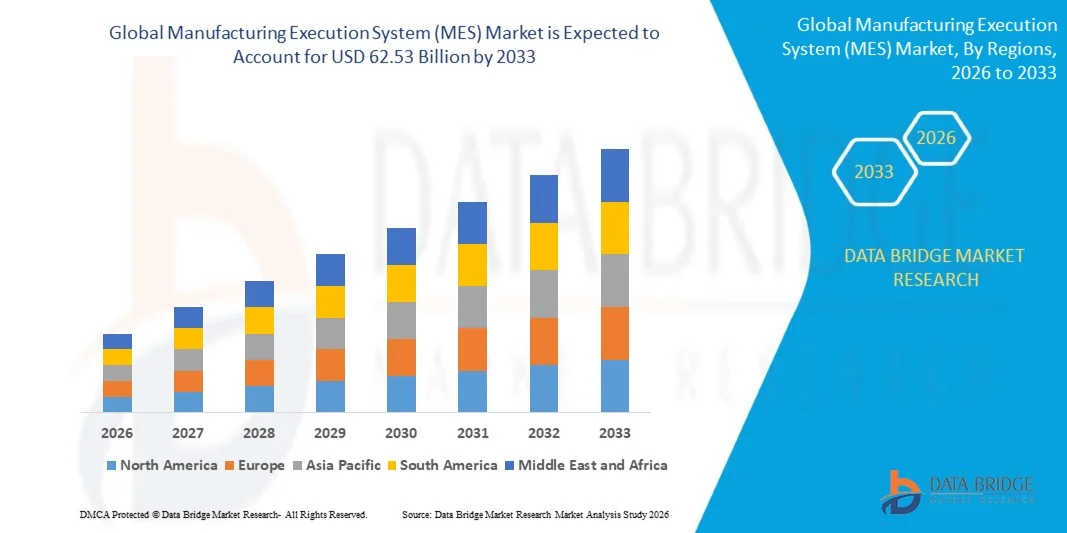
- The global manufacturing execution system (MES) market size was valued at USD 25.16 billion in 2025 and is expected to reach USD 62.53 billion by 2033, at a CAGR of 12.05% during the forecast period
- Rising demand from the pulp and paper industry and growth in the focus towards development in manufacturing design and necessity to accomplish production efficacy will emerge as the major market growth driving factors
- Growing demand for automation in oil and gas industries, surging need for real time visibility, increasing initiatives by the government to promote awareness and introduce favourable policies, and widespread industrialization will further aggravate the market value
What are the Major Takeaways of Manufacturing Execution System (MES) Market?
- Growing expenditure to undertake research and development proficiencies, easy availability of resources and low cost required for production purposes in the emerging economies and growing demand for optimum resource utilization will further carve the way for the growth of the market
- However, high costs associated with the research and development proficiencies and rising distortion due to high cost of establishment will act as a growth restraint for the market. Also, stringent regulatory framework and lack of understanding of the benefits will further dampen the growth rate of the market
- Asia-Pacific dominated the manufacturing execution system (MES) market with a 46.0% revenue share in 2025, driven by rapid industrialization, strong smart factory investments, and large-scale manufacturing expansion across China, Japan, India, South Korea, and Southeast Asia
- North America is projected to register the fastest CAGR of 11.4% from 2026 to 2033, driven by rapid adoption of smart manufacturing systems, rising cloud MES deployments, and growing digital transformation initiatives across the U.S. and Canada
- The Large Enterprise segment dominated the market with a 61.4% share in 2025, as large-scale manufacturers continue to prioritize production visibility, compliance tracking, and multi-site process optimization
Report Scope and Manufacturing Execution System (MES) Market Segmentation
|
Attributes |
Manufacturing Execution System (MES) Key Market Insights |
|
Segments Covered |
|
|
Countries Covered |
North America
Europe
Asia-Pacific
Middle East and Africa
South America
|
|
Key Market Players |
|
|
Market Opportunities |
|
|
Value Added Data Infosets |
In addition to the insights on market scenarios such as market value, growth rate, segmentation, geographical coverage, and major players, the market reports curated by the Data Bridge Market Research also include in-depth expert analysis, pricing analysis, brand share analysis, consumer survey, demography analysis, supply chain analysis, value chain analysis, raw material/consumables overview, vendor selection criteria, PESTLE Analysis, Porter Analysis, and regulatory framework. |
What is the Key Trend in the Manufacturing Execution System (MES) Market?
“Increasing Shift Toward Cloud-Based, AI-Integrated, and Smart Factory MES Platforms”
- The manufacturing execution system (MES) market is witnessing strong adoption of cloud-based, modular, and AI-enabled platforms designed to support real-time production monitoring, quality control, and shop-floor visibility across industries
- Manufacturers are increasingly introducing IoT-integrated, low-code, and analytics-driven MES solutions that offer predictive maintenance, digital work instructions, and seamless ERP/SCADA integration
- Growing demand for cost-efficient, scalable, and remotely accessible production management systems is driving usage across automotive, electronics, pharmaceuticals, and food processing facilities
- For instance, companies such as Siemens, ABB, Schneider Electric, SAP, and Rockwell Automation are upgrading their MES portfolios with cloud deployment, AI-driven dashboards, and real-time traceability features
- Increasing need for paperless workflows, production traceability, and rapid decision-making is accelerating the shift toward smart, cloud-connected MES platforms
- As factories become more automated and data-driven, MES solutions will remain vital for real-time execution, quality assurance, and smart manufacturing optimization
What are the Key Drivers of Manufacturing Execution System (MES) Market?
- Rising demand for real-time production visibility, improved OEE, and reduced downtime is a major driver supporting MES adoption across industrial facilities
- For instance, in 2025–2026, leading companies such as Siemens, Honeywell, and AVEVA enhanced their MES offerings with AI-based predictive maintenance, advanced scheduling, and cloud integration capabilities
- Growing adoption of Industry 4.0, smart factories, IoT devices, robotics, and automated production lines is boosting demand across the U.S., Europe, and Asia-Pacific
- Advancements in edge computing, machine learning, digital twins, and hybrid cloud architectures have strengthened scalability, efficiency, and system responsiveness
- Rising need for compliance management, product traceability, and supply chain visibility is creating strong demand for advanced MES solutions
- Supported by steady investments in industrial automation, digital transformation, and smart manufacturing infrastructure, the MES market is expected to witness strong long-term growth
Which Factor is Challenging the Growth of the Manufacturing Execution System (MES) Market?
- High costs associated with software implementation, integration, and workforce training restrict adoption among SMEs and cost-sensitive manufacturers
- For instance, during 2024–2026, integration complexities with legacy ERP, SCADA, and plant-floor systems increased deployment timelines and project costs for several enterprises
- Complexity in handling multi-site production data, cybersecurity risks, and custom workflow configurations increases the need for skilled IT and operations teams
- Limited awareness and budget constraints in emerging markets continue to slow enterprise-scale adoption
- Competition from ERP suites and SCADA platforms with built-in manufacturing modules creates pricing pressure and reduces product differentiation
- To address these issues, companies are focusing on modular cloud-based MES, low-code deployment models, and flexible subscription pricing to increase global adoption
How is the Manufacturing Execution System (MES) Market Segmented?
The market is segmented on the basis of organization size, component type, process industry, offering, and end-user industry.
• By Organization Size
On the basis of organization size, the Manufacturing Execution System (MES) market is segmented into Small and Medium Size Enterprise and Large Enterprise. The Large Enterprise segment dominated the market with a 61.4% share in 2025, as large-scale manufacturers continue to prioritize production visibility, compliance tracking, and multi-site process optimization. These enterprises extensively deploy MES platforms to integrate plant-floor operations with ERP, SCADA, and supply chain systems, enabling real-time monitoring, predictive maintenance, and quality assurance. Strong investments in smart factories, automation, and digital transformation initiatives further support segment leadership across automotive, electronics, and pharmaceuticals.
The Small and Medium Size Enterprise segment is expected to grow at the fastest CAGR from 2026 to 2033, driven by increasing adoption of cloud-based and subscription-driven MES solutions. Lower deployment costs, modular architecture, and growing awareness of operational efficiency benefits are accelerating penetration among SMEs globally.
• By Component Type
On the basis of component type, the market is segmented into On-Premises, On-Demand, and Hybrid. The On-Premises segment dominated the market with a 43.7% share in 2025, supported by strong demand from large industrial facilities requiring full control over production data, cybersecurity, and system customization. Industries such as aerospace, defence, pharmaceuticals, and automotive prefer on-premises deployment due to strict compliance requirements and the need for seamless integration with legacy manufacturing infrastructure.
The Hybrid segment is projected to grow at the fastest CAGR from 2026 to 2033, driven by increasing demand for scalable deployment models that combine on-site operational control with cloud-based analytics and remote access. Rising focus on data flexibility, disaster recovery, and multi-site production visibility is significantly boosting hybrid MES adoption.
• By Process Industry
On the basis of process industry, the market is segmented into Food and Beverages, Oil and Gas, Water and Wastewater Treatment, Energy and Power Market, Pharmaceutical, and Pulp and Paper. The Food and Beverages segment dominated the market with a 28.9% share in 2025, driven by growing need for batch traceability, quality compliance, inventory synchronization, and production scheduling. MES solutions are widely adopted in this segment for real-time monitoring of production lines, contamination prevention, and regulatory reporting. Rising demand for packaged foods and automated processing plants continues to support strong growth.
The Pharmaceutical segment is expected to grow at the fastest CAGR from 2026 to 2033, propelled by increasing compliance requirements, electronic batch records, and stringent quality standards in drug manufacturing and medical production.
• By Offering
On the basis of offering, the market is segmented into Software and Services. The Software segment dominated the market with a 67.2% share in 2025, as MES software platforms remain the core of digital production execution, enabling workflow automation, quality monitoring, asset tracking, and analytics-driven decision-making. Increasing integration with AI, IoT, and digital twin technologies continues to strengthen demand across industries.
The Services segment is expected to grow at the fastest CAGR from 2026 to 2033, driven by rising need for system integration, consulting, customization, cybersecurity support, and managed services. Growing complexity of deployment environments is accelerating demand for professional and support services.
• By End-User Industry
On the basis of end-user industry, the MES market is segmented into Automotive and Transportation, Aerospace and Defence, IT and Telecommunications, Education and Government, Electronics and Semiconductor, Industrial, and Healthcare. The Industrial segment dominated the market with a 31.8% share in 2025, supported by widespread deployment in factory automation, machine monitoring, and process optimization across manufacturing plants. Strong demand for predictive maintenance, downtime reduction, and real-time analytics continues to drive segment leadership.
The Electronics and Semiconductor segment is projected to grow at the fastest CAGR from 2026 to 2033, driven by increasing semiconductor fabrication, precision electronics assembly, and need for production traceability in high-value component manufacturing.
Which Region Holds the Largest Share of the Manufacturing Execution System (MES) Market?
- Asia-Pacific dominated the manufacturing execution system (MES) market with a 46.0% revenue share in 2025, driven by rapid industrialization, strong smart factory investments, and large-scale manufacturing expansion across China, Japan, India, South Korea, and Southeast Asia. The region continues to witness strong adoption of MES platforms across automotive, electronics, pharmaceuticals, food processing, and semiconductor manufacturing facilities. Growing focus on real-time production monitoring, quality traceability, and workflow automation continues to strengthen demand across large-scale industrial plants
- Leading companies across Asia-Pacific are increasingly deploying cloud-based, hybrid, and AI-integrated MES platforms with predictive analytics, IoT connectivity, and digital twin integration, strengthening the region’s technological advantage
- Strong government initiatives such as Made in China 2025, Make in India, and smart manufacturing programs in Japan and South Korea continue to reinforce regional market leadership
China Manufacturing Execution System (MES) Market Insight
China is the largest contributor in Asia-Pacific, supported by massive industrial automation investments, strong electronics and automotive production, and government-backed smart manufacturing initiatives. Increasing deployment of Industry 4.0 technologies, robotics, and AI-driven quality management systems continues to drive strong MES adoption across production facilities
Japan Manufacturing Execution System (MES) Market Insight
Japan contributes significantly to regional growth, driven by advanced industrial automation, precision manufacturing, and rising demand for real-time plant monitoring systems across automotive, semiconductor, and electronics industries. Strong focus on lean manufacturing and operational excellence supports long-term MES expansion
India Manufacturing Execution System (MES) Market Insight
India is emerging as a major growth hub, driven by expanding smart factory initiatives, government-backed industrial digitalization programs, and increasing investments in automotive, pharmaceutical, and food processing sectors. Rising adoption of cloud MES among SMEs further accelerates market penetration
South Korea Manufacturing Execution System (MES) Market Insight
South Korea contributes strongly due to its robust semiconductor, electronics, and automotive manufacturing base. Increasing deployment of AI-enabled production monitoring, traceability solutions, and predictive maintenance platforms continues to support strong MES demand
North America Manufacturing Execution System (MES) Market
North America is projected to register the fastest CAGR of 11.4% from 2026 to 2033, driven by rapid adoption of smart manufacturing systems, rising cloud MES deployments, and growing digital transformation initiatives across the U.S. and Canada. Increasing investments in aerospace, pharmaceuticals, automotive, and industrial automation continue to accelerate regional market expansion
U.S. Manufacturing Execution System (MES) Market Insight
The U.S. is the largest contributor in North America, supported by strong Industry 4.0 adoption, extensive smart factory modernization, and high investments in AI, IoT, and predictive maintenance solutions. Growing demand from automotive, healthcare, aerospace, and semiconductor sectors continues to strengthen market growth
Canada Manufacturing Execution System (MES) Market Insight
Canada contributes significantly to regional growth, driven by rising investments in industrial automation, food processing, healthcare manufacturing, and clean energy sectors. Increasing focus on compliance management, production visibility, and process optimization further supports MES adoption across the country
Which are the Top Companies in Manufacturing Execution System (MES) Market?
The Manufacturing Execution System (MES) industry is primarily led by well-established companies, including:
- ABB (Switzerland)
- Schneider Electric (France)
- Emerson Electric Co. (U.S.)
- General Electric (U.S.)
- Honeywell International Inc. (U.S.)
- Rockwell Automation, Inc. (U.S.)
- Körber AG (Germany)
- Yokogawa India Ltd. (India)
- AVEVA Group plc (U.K.)
- thyssenkrupp System Engineering GmbH (Germany)
- Siemens (Germany)
- Plex (U.S.)
- Oracle (U.S.)
- Lighthouse Systems (U.K.)
- Dassault Systèmes (France)
- Cogiscan (Canada)
- Yokogawa Electric Corporation (Japan)
- Accenture (Ireland)
- SAP SE (Germany)
What are the Recent Developments in Global Manufacturing Execution System (MES) Market?
- In July 2024, Critical Manufacturing, a leading provider of manufacturing execution systems, entered into a strategic partnership with Loftware, a prominent cloud-based labeling and artwork management company. The collaboration is aimed at combining expertise to establish a new benchmark for MES and labeling integration, while delivering improved productivity, enhanced quality control, and reduced operational errors across manufacturing facilities. In conclusion, this partnership highlights the growing industry focus on integrated digital workflows and process accuracy within MES platforms
- In June 2024, Critical Manufacturing, a business unit of ASMPT, announced the expansion of its strategic alliance with RoviSys to strengthen its presence across Southeast Asia, Taiwan, and Japan. The company identified RoviSys as a highly capable system integrator with proven expertise in successfully deploying MES solutions for customers across complex industrial environments. In conclusion, this expansion reflects the rising regional demand for advanced MES deployments and system integration services in Asia-Pacific
- In October 2023, AVEVA, a major leader in the industrial MES market, announced a strategic collaboration with Microsoft to strengthen its data integration platforms through artificial intelligence capabilities. The partnership focuses on organizing and integrating data from multiple operational domains to expand AI-driven applications and support green software initiatives. In conclusion, this collaboration underlines the increasing role of AI and data intelligence in the evolution of next-generation MES solutions
- In September 2023, Rockwell Automation Inc. announced the successful deployment of its Plex MES platform at BIC’s Bizerte manufacturing facility. BIC, a leading producer of shavers, lighters, and stationery products, implemented the system to enhance operational efficiency and innovation by enabling a 360-degree view of plant activities. The company also plans to extend this partnership to digitize its additional factories using Plex MES. In conclusion, this implementation demonstrates the growing adoption of MES solutions for enterprise-wide smart factory transformation
- In January 2023, Schneider Electric completed the acquisition of AVEVA, a leading software solutions provider, to strengthen its digital transformation capabilities and enhance customer value delivery. Through this acquisition, Schneider Electric aims to accelerate its vision of becoming a Software-as-a-Service (SaaS) leader and a subscription-only enterprise model provider in the market. In conclusion, this acquisition reflects the ongoing consolidation and cloud-driven transformation trend within the MES industry
SKU-
Get online access to the report on the World's First Market Intelligence Cloud

- Interactive Data Analysis Dashboard
- Company Analysis Dashboard for high growth potential opportunities
- Research Analyst Access for customization & queries
- Competitor Analysis with Interactive dashboard
- Latest News, Updates & Trend analysis
- Harness the Power of Benchmark Analysis for Comprehensive Competitor Tracking
Global Manufacturing Execution System Mes Market, Supply Chain Analysis and Ecosystem Framework
To support market growth and help clients navigate the impact of geopolitical shifts, DBMR has integrated in-depth supply chain analysis into its Global Manufacturing Execution System Mes Market research reports. This addition empowers clients to respond effectively to global changes affecting their industries. The supply chain analysis section includes detailed insights such as Global Manufacturing Execution System Mes Market consumption and production by country, price trend analysis, the impact of tariffs and geopolitical developments, and import and export trends by country and HSN code. It also highlights major suppliers with data on production capacity and company profiles, as well as key importers and exporters. In addition to research, DBMR offers specialized supply chain consulting services backed by over a decade of experience, providing solutions like supplier discovery, supplier risk assessment, price trend analysis, impact evaluation of inflation and trade route changes, and comprehensive market trend analysis.
Research Methodology
Data collection and base year analysis are done using data collection modules with large sample sizes. The stage includes obtaining market information or related data through various sources and strategies. It includes examining and planning all the data acquired from the past in advance. It likewise envelops the examination of information inconsistencies seen across different information sources. The market data is analysed and estimated using market statistical and coherent models. Also, market share analysis and key trend analysis are the major success factors in the market report. To know more, please request an analyst call or drop down your inquiry.
The key research methodology used by DBMR research team is data triangulation which involves data mining, analysis of the impact of data variables on the market and primary (industry expert) validation. Data models include Vendor Positioning Grid, Market Time Line Analysis, Market Overview and Guide, Company Positioning Grid, Patent Analysis, Pricing Analysis, Company Market Share Analysis, Standards of Measurement, Global versus Regional and Vendor Share Analysis. To know more about the research methodology, drop in an inquiry to speak to our industry experts.
Customization Available
Data Bridge Market Research is a leader in advanced formative research. We take pride in servicing our existing and new customers with data and analysis that match and suits their goal. The report can be customized to include price trend analysis of target brands understanding the market for additional countries (ask for the list of countries), clinical trial results data, literature review, refurbished market and product base analysis. Market analysis of target competitors can be analyzed from technology-based analysis to market portfolio strategies. We can add as many competitors that you require data about in the format and data style you are looking for. Our team of analysts can also provide you data in crude raw excel files pivot tables (Fact book) or can assist you in creating presentations from the data sets available in the report.












