




Global Maritime Satellite Communication Market
Market Size in USD Billion
CAGR :
% 
 USD
4.21 Billion
USD
7.18 Billion
2025
2033
USD
4.21 Billion
USD
7.18 Billion
2025
2033
 Forecast Period Forecast Period |
2026 –2033 |
 Market Size (Base Year) Market Size (Base Year) |
USD 4.21 Billion |
 Market Size (Forecast Year) Market Size (Forecast Year) |
USD 7.18 Billion |
 CAGR CAGR |
% |
| Major Markets Players |
|
What is the Maritime Satellite Communication Market Size and Growth Rate?
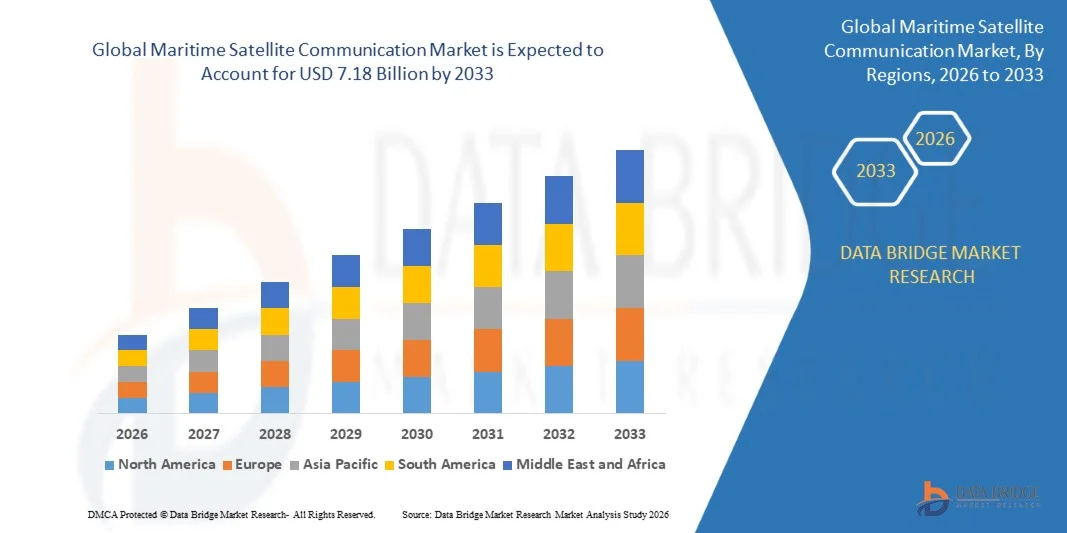
- The Maritime Satellite Communication Market size was valued at USD 4.21 billion in 2025 and is expected to reach USD 7.18 billion by 2033, at a CAGR of 6.90% during the forecast period
- Rise in the new satellite systems and data-intensive applications is a crucial factor accelerating the market growth, also and rise in the rate of adoption and deployment of low cost cloud solutions, are the major factors among others boosting the maritime satellite communication market
What are the Major Takeaways of Maritime Satellite Communication Market?
- Increase in the demand for broadband connections and VSAT connectivity and rise in the unification of satellites and cellular communication technology will further create new opportunities for maritime satellite communication market in the forecast period mentioned above
- However, lack of awareness about advanced maritime satellite services and reliance on high-cost satellite equipment are the major factors among others restraining the market growth, while rise in the cybersecurity attacks, lack of reliability and flexibility of satellite communication and coping up with rapidly changing technologies will further challenge the maritime satellite communication market in the forecast period mentioned above
- Asia-Pacific dominated the maritime satellite communication market with a 32.05% revenue share in 2025, driven by rapid expansion in electronics manufacturing, strong government-backed digital infrastructure, and increasing adoption of satellite communication systems across shipping, offshore, and government applications
- North America is projected to register the fastest CAGR of 9.19% from 2026 to 2033, driven by rising adoption of VSAT, Ka-Band, and MSS solutions across merchant shipping, offshore energy, and defense sectors in the U.S. and Canada
- The VSAT segment dominated the market with a 41.2% share in 2025, driven by its ability to provide high-speed broadband connectivity, low latency, and global coverage for large vessels and offshore platforms
Report Scope and Maritime Satellite Communication Market Segmentation
|
Attributes |
Maritime Satellite Communication Key Market Insights |
|
Segments Covered |
|
|
Countries Covered |
North America
Europe
Asia-Pacific
Middle East and Africa
South America
|
|
Key Market Players |
|
|
Market Opportunities |
|
|
Value Added Data Infosets |
In addition to the insights on market scenarios such as market value, growth rate, segmentation, geographical coverage, and major players, the market reports curated by the Data Bridge Market Research also include in-depth expert analysis, pricing analysis, brand share analysis, consumer survey, demography analysis, supply chain analysis, value chain analysis, raw material/consumables overview, vendor selection criteria, PESTLE Analysis, Porter Analysis, and regulatory framework. |
What is the Key Trend in the Maritime Satellite Communication Market?
“Increasing Shift Toward High-Speed, Compact, and PC-Based Maritime Satellite Communications”
- The maritime satellite communications market is experiencing strong adoption of compact, USB-powered, and high-performance communication terminals designed to support high-speed data transfer, satellite IoT connectivity, and real-time vessel monitoring
- Manufacturers are introducing multi-band, high-throughput, and software-defined terminals that offer advanced signal processing, low-latency communication, and seamless integration with cloud platforms
- Growing demand for lightweight, portable, and field-deployable communication solutions is driving usage across shipping fleets, offshore platforms, and maritime research vessels
- For instance, companies such as Inmarsat, Iridium, Viasat, and Hughes Network Systems have upgraded their satellite terminals with higher data rates, enhanced encryption, and global coverage capabilities
- Increasing need for real-time fleet tracking, high-speed internet access at sea, and secure communication is accelerating the shift toward compact, PC-integrated terminals
- As maritime operations become more connected and digitally dependent, Maritime Satellite Communications remain critical for navigation, fleet efficiency, and operational safety
What are the Key Drivers of Maritime Satellite Communication Market?
- Rising demand for reliable, high-speed, and cost-effective satellite communication solutions for maritime navigation, fleet management, and offshore operations
- For instance, in 2025, leading providers such as Inmarsat, Iridium, and Viasat launched terminals with higher throughput, better antenna technology, and integration with AI-based fleet analytics
- Expanding adoption of IoT-enabled vessels, autonomous ships, offshore energy platforms, and maritime e-navigation systems is boosting demand across global shipping lanes
- Advancements in satellite network coverage, signal compression, antenna miniaturization, and software-defined networking have enhanced communication performance and portability
- Increasing deployment of high-speed VSAT, L-band, and Ka-band systems is creating demand for multi-band, multi-channel maritime terminals
- Supported by sustained investments in satellite infrastructure, maritime digitalization, and regulatory initiatives for vessel connectivity, the Maritime Satellite Communications market is expected to witness strong long-term growth
Which Factor is Challenging the Growth of the Maritime Satellite Communication Market?
- High costs associated with premium, high-throughput, and multi-band satellite terminals limit adoption among small vessel operators and emerging-market fleets
- For instance, during 2024–2025, fluctuations in satellite bandwidth pricing, component shortages, and longer deployment cycles increased equipment costs for several global vendors
- Complexity in integrating satellite systems with shipboard networks, cybersecurity protocols, and cloud-based analytics increases the need for skilled technical support
- Limited awareness of advanced maritime communication solutions in developing regions slows market adoption
- Competition from terrestrial communication alternatives, hybrid networks, and emerging 5G-based marine connectivity solutions creates pricing pressure and reduces differentiation
- To overcome these challenges, companies are focusing on cost-optimized terminals, flexible subscription models, training programs, and higher software integration to expand global adoption of Maritime Satellite Communications
How is the Maritime Satellite Communication Market Segmented?
The market is segmented on the basis of type, service, and end-user.
• By Type
On the basis of type, the maritime satellite communications market is segmented into Very Small Aperture Terminal (VSAT), Ka-Band, Ku-Band, C-Band, and Mobile Satellite Services (MSS). The VSAT segment dominated the market with a 41.2% share in 2025, driven by its ability to provide high-speed broadband connectivity, low latency, and global coverage for large vessels and offshore platforms. VSAT terminals are extensively used for real-time navigation, fleet management, and operational communications, making them the preferred choice for merchant shipping, passenger vessels, and offshore installations.
The Ka-Band segment is expected to grow at the fastest CAGR from 2026 to 2033, fueled by higher bandwidth capacity, improved data throughput, and growing adoption for autonomous ships, IoT-enabled vessels, and high-volume maritime communications. Increasing investment in high-speed maritime networks is accelerating Ka-Band deployment across commercial and defense fleets.
• By Service
On the basis of service, the market is segmented into Voice, Video, Data, and Tracking & Monitoring. The Data segment dominated the market with a 38.5% share in 2025, supported by rising demand for high-speed internet access at sea, real-time telemetry, remote vessel monitoring, and IoT connectivity for offshore operations. Data services are extensively integrated with navigation systems, fleet analytics, and predictive maintenance platforms.
The Tracking & Monitoring segment is projected to grow at the fastest CAGR from 2026 to 2033, driven by increasing regulatory requirements for vessel tracking, cargo monitoring, and maritime safety, as well as growing adoption of AI-based fleet management platforms. Expansion of satellite constellations and IoT-based vessel monitoring systems continues to accelerate demand for advanced tracking services globally.
• By End-User
On the basis of end-user, the Maritime Satellite Communications market is segmented into Merchant Shipping, Fishing, Passenger Ship, Leisure Vessels, Offshore, Government, and Others. The Merchant Shipping segment dominated the market with a 42.7% share in 2025, owing to its large-scale operations, high connectivity needs, and extensive deployment of VSAT and Ka-Band systems for navigation, communication, and operational efficiency.
The Offshore segment is expected to grow at the fastest CAGR from 2026 to 2033, driven by increasing offshore oil, gas, and renewable energy operations requiring reliable real-time communication, telemetry, and remote monitoring. Rising investments in autonomous platforms, offshore safety, and digitalization are further accelerating adoption of satellite communication systems in offshore applications.
Which Region Holds the Largest Share of the Maritime Satellite Communication Market?
- Asia-Pacific dominated the maritime satellite communication market with a 32.05% revenue share in 2025, driven by rapid expansion in electronics manufacturing, strong government-backed digital infrastructure, and increasing adoption of satellite communication systems across shipping, offshore, and government applications
- High-volume production of consumer electronics, industrial automation, and maritime IoT devices further strengthens regional demand. Leading companies in Asia-Pacific are deploying high-bandwidth VSAT, Ka-Band, and Ku-Band solutions, along with tracking and monitoring services, to meet the growing connectivity needs of merchant shipping, passenger vessels, and offshore operations
- Expansion of smart ports, maritime automation, and AI-enabled fleet monitoring solutions reinforce the region’s technological advantage and sustain long-term growth
China Maritime Satellite Communication Market Insight
China is the largest contributor to Asia-Pacific due to massive investments in maritime communications infrastructure, world-leading shipbuilding and electronics manufacturing capacity, and strong government support for digital maritime innovation. Rising deployment of high-speed Ka- and Ku-Band networks, VSAT solutions, and vessel tracking systems drives adoption across merchant, offshore, and leisure vessels. Competitive local manufacturing and favorable pricing further expand market penetration domestically and internationally.
Japan Maritime Satellite Communication Market Insight
Japan shows steady growth supported by advanced port infrastructure, precision electronics manufacturing, and continuous modernization of commercial and offshore shipping systems. Strong focus on reliability and integration of high-speed satellite services drives adoption of premium Maritime Satellite Communications. Rising need for low-latency communications, AI-based vessel monitoring, and autonomous ship trials reinforces long-term expansion.
India Maritime Satellite Communication Market Insight
India is emerging as a significant growth hub, driven by increasing port modernization, offshore energy development, and government-backed digital infrastructure initiatives. High demand for reliable connectivity in fishing, offshore, and commercial shipping applications fuels adoption of Ka-Band, VSAT, and MSS solutions. Rising R&D investments and expanding manufacturing of maritime electronics further accelerate market penetration.
South Korea Maritime Satellite Communication Market Insight
South Korea contributes substantially due to growing demand for advanced processors, AI-enabled fleet management, and high-speed maritime communications. Rapid development of autonomous ships, offshore platforms, and maritime IoT devices drives adoption of satellite communication services with high bandwidth and multi-protocol support. Strong local innovation and export-oriented manufacturing reinforce sustained market growth
North America Maritime Satellite Communication Market
North America is projected to register the fastest CAGR of 9.19% from 2026 to 2033, driven by rising adoption of VSAT, Ka-Band, and MSS solutions across merchant shipping, offshore energy, and defense sectors in the U.S. and Canada. High investment in smart ports, autonomous vessel trials, and maritime IoT platforms accelerates growth. Leading companies are integrating cloud-enabled services, tracking, and real-time monitoring solutions, strengthening regional technological competitiveness and long-term expansion.
Which are the Top Companies in Maritime Satellite Communication Market?
The maritime satellite communication industry is primarily led by well-established companies, including:
- Inmarsat Global Limited (U.K.)
- Iridium Communications Inc (U.S.)
- Hughes Network Systems, LLC (U.S.)
- Leonardo S.p.A (Italy)
- Viasat, Inc (U.S.)
- Thuraya Telecommunications Company (U.A.E.)
- MTN Group Management Services (Pty) Ltd (South Africa)
- ORBCOMM (U.S.)
- KVH Industries, Inc (U.S.)
- ST Engineering (Singapore)
- EchoStar Corporation (U.S.)
- Kongsberg Maritime (Norway)
- Saab AB (Sweden)
- Rohde & Schwarz (Germany)
- RASCOM Company (Mauritius)
- Globecomm Systems Inc (U.S.)
What are the Recent Developments in Maritime Satellite Communication Market?
- In January 2026, Eutelsat OneWeb began live trials of 5G backhaul over its LEO network on feeder vessels operating in North Sea offshore wind farms, validating the effectiveness of LEO-enabled maritime 5G connectivity and paving the way for advanced offshore communications
- In June 2025, Alén Space successfully launched its SATMAR nanosatellite into orbit aboard a SpaceX Falcon 9 rocket from Vandenberg Space Force Base, in collaboration with Egatel and Gradiant, under the Ports 4.0 initiative led by Puertos del Estado and the Spanish Port Authorities, marking a key milestone in testing the VHF Data Exchange System (VDES) standard for bidirectional satellite communication, which will enhance maritime digitalization
- In October 2025, SpaceX deployed its 8,000th Starlink satellite, expanding polar coverage and increasing its maritime subscriber base to over 15,000, strengthening the company’s global maritime connectivity footprint and network reliability
- In September 2025, Viasat integrated Inmarsat Fleet Xpress services into its Ka-Band network, forming a unified GEO-LEO platform serving 12,000 maritime customers, significantly enhancing satellite coverage, speed, and redundancy across global shipping lanes
- In August 2025, Carnival Corporation signed a USD 250 million agreement to retrofit 92 cruise ships with Starlink terminals, targeting a 40% increase in onboard connectivity revenue and improving passenger experience through high-speed satellite internet
- In February 2025, Space Norway commissioned the Thor 8 geostationary satellite, set for launch in 2027, to deliver Ka- and Ku-Band connectivity for maritime and offshore sectors across the Middle East, Europe, and Africa, with a lifespan exceeding 15 years, enhancing VSAT services for commercial shipping and national authorities
SKU-
Get online access to the report on the World's First Market Intelligence Cloud

- Interactive Data Analysis Dashboard
- Company Analysis Dashboard for high growth potential opportunities
- Research Analyst Access for customization & queries
- Competitor Analysis with Interactive dashboard
- Latest News, Updates & Trend analysis
- Harness the Power of Benchmark Analysis for Comprehensive Competitor Tracking
Research Methodology
Data collection and base year analysis are done using data collection modules with large sample sizes. The stage includes obtaining market information or related data through various sources and strategies. It includes examining and planning all the data acquired from the past in advance. It likewise envelops the examination of information inconsistencies seen across different information sources. The market data is analysed and estimated using market statistical and coherent models. Also, market share analysis and key trend analysis are the major success factors in the market report. To know more, please request an analyst call or drop down your inquiry.
The key research methodology used by DBMR research team is data triangulation which involves data mining, analysis of the impact of data variables on the market and primary (industry expert) validation. Data models include Vendor Positioning Grid, Market Time Line Analysis, Market Overview and Guide, Company Positioning Grid, Patent Analysis, Pricing Analysis, Company Market Share Analysis, Standards of Measurement, Global versus Regional and Vendor Share Analysis. To know more about the research methodology, drop in an inquiry to speak to our industry experts.
Customization Available
Data Bridge Market Research is a leader in advanced formative research. We take pride in servicing our existing and new customers with data and analysis that match and suits their goal. The report can be customized to include price trend analysis of target brands understanding the market for additional countries (ask for the list of countries), clinical trial results data, literature review, refurbished market and product base analysis. Market analysis of target competitors can be analyzed from technology-based analysis to market portfolio strategies. We can add as many competitors that you require data about in the format and data style you are looking for. Our team of analysts can also provide you data in crude raw excel files pivot tables (Fact book) or can assist you in creating presentations from the data sets available in the report.












