


Global Massive Mimo Market
Market Size in USD Billion
CAGR :
% 
 USD
19.76 Billion
USD
343.56 Billion
2025
2033
USD
19.76 Billion
USD
343.56 Billion
2025
2033
 Forecast Period Forecast Period |
2026 –2033 |
 Market Size (Base Year) Market Size (Base Year) |
USD 19.76 Billion |
 Market Size (Forecast Year) Market Size (Forecast Year) |
USD 343.56 Billion |
 CAGR CAGR |
% |
| Major Markets Players |
|
Massive Multiple-Input, Multiple-Output (MIMO) Market Size
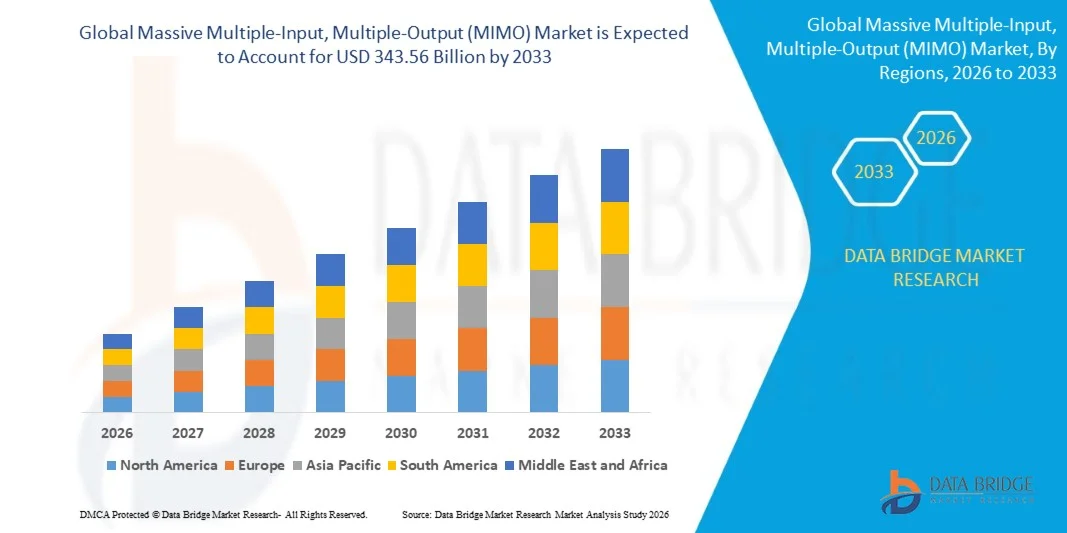
- The global massive multiple-input, multiple-output (MIMO) market size was valued at USD 19.76 billion in 2025 and is expected to reach USD 343.56 billion by 2033, at a CAGR of 42.90% during the forecast period
- The market growth is largely fuelled by the rapid deployment of 5G networks, increasing demand for high-speed data connectivity, and rising adoption of advanced wireless communication technologies across industries
- Growing investments in telecom infrastructure, expansion of smart cities, and increasing data traffic driven by IoT devices and cloud-based services are further accelerating the demand for massive MIMO solutions
Massive Multiple-Input, Multiple-Output (MIMO) Market Analysis
- The massive MIMO market is witnessing strong growth due to its ability to enhance network capacity, improve spectral efficiency, and support high user density, making it a critical component in next-generation wireless communication systems
- Increasing adoption across telecommunications, defense, and enterprise applications, combined with the growing need for reliable and low-latency connectivity, is driving innovation and competitive developments in the global market
- North America dominated the massive multiple-input, multiple-output (MIMO) market with the largest revenue share in 2025, driven by rapid deployment of advanced wireless communication infrastructure and strong investments in 5G technology
- Asia-Pacific region is expected to witness the highest growth rate in the global massive multiple-input, multiple-output (MIMO) market, driven by large-scale 5G rollouts, expanding telecom infrastructure, and increasing demand for high-speed mobile data services across major economies such as China, Japan, and India
- The 64T64R and 128T and 128R segment held the largest market revenue share in 2025 driven by its ability to significantly enhance network capacity, spectral efficiency, and coverage in dense urban environments. These advanced antenna configurations enable telecom operators to serve a larger number of users simultaneously while improving signal quality and overall network performance
Report Scope and Massive Multiple-Input, Multiple-Output (MIMO) Market Segmentation
|
Attributes |
Massive Multiple-Input, Multiple-Output (MIMO) Key Market Insights |
|
Segments Covered |
|
|
Countries Covered |
North America
Europe
Asia-Pacific
Middle East and Africa
South America
|
|
Key Market Players |
• China Mobile Limited (China) |
|
Market Opportunities |
• Increasing Deployment Of 5G And Next-Generation Wireless Networks |
|
Value Added Data Infosets |
In addition to the insights on market scenarios such as market value, growth rate, segmentation, geographical coverage, and major players, the market reports curated by the Data Bridge Market Research also include in-depth expert analysis, geographically represented company-wise production and capacity, network layouts of distributors and partners, detailed and updated price trend analysis and deficit analysis of supply chain and demand. |
Massive Multiple-Input, Multiple-Output (MIMO) Market Trends
“Rising Deployment of 5G and High-Speed Wireless Communication Networks”
• The rapid expansion of next-generation wireless networks is significantly shaping the massive MIMO market, as telecom operators increasingly adopt advanced antenna technologies to improve network capacity and spectral efficiency. Massive MIMO systems enable multiple antennas to transmit and receive signals simultaneously, enhancing data throughput and reliability. This capability is becoming essential for supporting high-speed connectivity across densely populated urban environments and data-intensive applications
• Growing demand for high-bandwidth services such as video streaming, cloud computing, augmented reality, and online gaming is accelerating the adoption of massive MIMO solutions. Communication service providers are investing heavily in upgrading network infrastructure to handle increasing data traffic and ensure seamless connectivity. This trend is encouraging equipment manufacturers to develop advanced base station technologies that support efficient spectrum utilization and improved network performance
• Increasing integration of massive MIMO technology with advanced network architectures is influencing purchasing and deployment strategies among telecom operators. Vendors are focusing on developing energy-efficient, compact, and scalable antenna systems to reduce operational costs and simplify installation. These developments are helping operators expand coverage and improve network quality while supporting the growing ecosystem of connected devices and smart applications
• For instance, in 2024, Ericsson in Sweden and Nokia in Finland expanded their massive MIMO portfolios with advanced 5G radio solutions designed to enhance network capacity and energy efficiency. These systems were deployed by multiple telecom operators to strengthen 5G coverage in urban and suburban areas. The solutions were also promoted as cost-efficient upgrades for existing infrastructure, improving network performance and user experience across high-demand environments
• While adoption of massive MIMO is increasing, sustained market expansion depends on continued investment in network infrastructure, spectrum availability, and technological advancements in antenna design. Companies are focusing on research and development to improve signal processing, reduce power consumption, and enhance compatibility with evolving wireless standards to support long-term industry growth
Massive Multiple-Input, Multiple-Output (MIMO) Market Dynamics
Driver
“Growing Demand for High-Capacity and Efficient Wireless Communication”
• Rising global data consumption and the increasing number of connected devices are major drivers for the massive MIMO market. Telecommunications operators are deploying massive MIMO systems to significantly enhance network capacity and spectral efficiency, allowing multiple users to access high-speed data simultaneously. This capability supports the growing demand for reliable and high-performance wireless communication networks
• Expanding applications across telecommunications, enterprise networks, and smart infrastructure are influencing market growth. Massive MIMO technology enables improved signal strength, reduced latency, and higher data throughput, which are essential for emerging technologies such as smart cities, connected vehicles, and industrial automation. These benefits are encouraging network operators to integrate massive MIMO into their next-generation infrastructure strategies
• Telecom equipment manufacturers are actively promoting massive MIMO solutions through technological innovation, strategic partnerships, and large-scale network deployments. These initiatives are supported by increasing investments in 5G infrastructure and the global transition toward advanced wireless communication systems. Collaboration between network providers and technology vendors is also accelerating product development and improving deployment efficiency
• For instance, in 2023, Huawei in China and Samsung in South Korea expanded the deployment of massive MIMO base stations across multiple 5G networks. These deployments were aimed at improving coverage and enhancing network capacity in high-density urban environments. Both companies highlighted improved spectral efficiency and lower operational costs as key benefits, strengthening their competitive position in the telecom equipment market
• Although demand for high-capacity wireless networks continues to grow, successful implementation of massive MIMO systems requires significant investment in infrastructure, advanced signal processing technologies, and skilled technical expertise. Continuous innovation and collaboration across the telecommunications ecosystem will be essential to support large-scale deployments and sustain market growth
Restraint/Challenge
“High Infrastructure Cost and Complex Deployment Requirements”
• The relatively high cost associated with deploying massive MIMO infrastructure remains a key challenge for market expansion. Installation of large antenna arrays, advanced base stations, and supporting network equipment requires significant capital investment. These costs can be particularly challenging for telecom operators in developing markets where budget constraints limit large-scale infrastructure upgrades
• Technical complexity and integration challenges also restrict adoption in certain regions. Massive MIMO systems require sophisticated signal processing, precise antenna alignment, and advanced network management capabilities. Limited technical expertise and the need for specialized equipment can slow down deployment and increase operational costs for network providers
• Spectrum management and regulatory challenges also impact market growth, as efficient operation of massive MIMO systems depends on access to sufficient radio frequency spectrum. Differences in spectrum allocation policies across countries can create barriers for telecom operators seeking to expand network coverage and capacity. Regulatory approvals and compliance requirements may further delay large-scale deployments
• For instance, in 2024, telecom operators in Indonesia and Vietnam reported challenges in expanding massive MIMO deployments due to high infrastructure costs and spectrum limitations. Network providers working with equipment vendors such as ZTE and NEC highlighted the need for additional spectrum allocation and investment incentives to accelerate adoption. These barriers also affected the pace of 5G network expansion in certain emerging markets
• Overcoming these challenges will require cost-efficient hardware development, improved spectrum management strategies, and enhanced collaboration between telecom operators, technology providers, and regulatory authorities. Investment in advanced network planning tools and innovative deployment models will also play a crucial role in supporting the long-term growth of the global massive MIMO market
Massive Multiple-Input, Multiple-Output (MIMO) Market Scope
The massive multiple-input, multiple-output (MIMO) market is segmented into three notable segments based on antennas, spectrum, and technology.
• By Antennas
On the basis of antennas, the massive multiple-input, multiple-output (MIMO) market is segmented into 8T8R, 16T16R and 32T32R, 64T64R and 128T and 128R, and Above. The 64T64R and 128T and 128R segment held the largest market revenue share in 2025 driven by its ability to significantly enhance network capacity, spectral efficiency, and coverage in dense urban environments. These advanced antenna configurations enable telecom operators to serve a larger number of users simultaneously while improving signal quality and overall network performance.
The Above 128T and 128R segment is expected to witness the fastest growth rate from 2026 to 2033, driven by the increasing deployment of next-generation wireless infrastructure and the growing need for ultra-high-capacity networks. These high-order antenna systems are gaining traction due to their capability to support extremely high data throughput and enhanced beamforming efficiency, making them ideal for advanced 5G deployments and future wireless communication technologies.
• By Spectrum
On the basis of spectrum, the massive multiple-input, multiple-output (MIMO) market is segmented into TDD, FDD, and Others. The TDD segment held the largest market revenue share in 2025 driven by its flexibility in allocating uplink and downlink capacity according to traffic demand. TDD-based massive MIMO systems are widely used in 5G deployments as they enable efficient spectrum utilization and improved network performance in high-data-traffic environments.
The FDD segment is expected to witness the fastest growth rate from 2026 to 2033, driven by its widespread use in existing LTE and advanced wireless networks. FDD spectrum provides stable and reliable communication by utilizing separate frequency bands for uplink and downlink transmissions, making it suitable for operators upgrading legacy infrastructure with massive MIMO technology.
• By Technology
On the basis of technology, the massive multiple-input, multiple-output (MIMO) market is segmented into LTE Advanced, LTE Advanced Pro, and 5G. The 5G segment held the largest market revenue share in 2025 driven by the rapid global rollout of 5G networks and the increasing demand for ultra-fast data connectivity. Massive MIMO is a critical component of 5G infrastructure, enabling higher spectral efficiency, improved latency, and enhanced network capacity.
The LTE Advanced Pro segment is expected to witness the fastest growth rate from 2026 to 2033, driven by the continuous evolution of LTE networks and the transition toward full-scale 5G deployments. LTE Advanced Pro integrates advanced carrier aggregation and massive MIMO capabilities, allowing telecom operators to enhance network performance and bridge the technological gap between LTE and next-generation wireless systems.
Massive Multiple-Input, Multiple-Output (MIMO) Market Regional Analysis
• North America dominated the massive multiple-input, multiple-output (MIMO) market with the largest revenue share in 2025, driven by rapid deployment of advanced wireless communication infrastructure and strong investments in 5G technology
• Telecom operators in the region highly prioritize high-capacity network solutions that can efficiently handle rising mobile data traffic and support large-scale connectivity requirements
• This widespread adoption is further supported by strong presence of leading telecom equipment providers, high technology investments, and increasing demand for reliable high-speed connectivity across enterprises and consumers
U.S. Massive Multiple-Input, Multiple-Output (MIMO) Market Insight
The U.S. massive multiple-input, multiple-output (MIMO) market captured the largest revenue share in 2025 within North America, fueled by rapid expansion of 5G infrastructure and continuous investments in advanced wireless technologies. Telecom operators are increasingly deploying massive MIMO base stations to improve spectral efficiency and expand network capacity. The growing demand for high-speed mobile data, cloud applications, and connected devices further supports market growth. Moreover, strong collaboration between telecom companies and technology providers is accelerating the development and deployment of next-generation communication systems.
Europe Massive Multiple-Input, Multiple-Output (MIMO) Market Insight
The Europe massive multiple-input, multiple-output (MIMO) market is expected to witness the fastest growth rate from 2026 to 2033, primarily driven by the increasing rollout of 5G networks and rising demand for enhanced wireless connectivity. Growing digital transformation initiatives across industries are encouraging telecom operators to invest in advanced network infrastructure. The region is experiencing expanding adoption of massive MIMO solutions across urban and industrial communication networks, supporting improved coverage and network performance.
U.K. Massive Multiple-Input, Multiple-Output (MIMO) Market Insight
The U.K. massive multiple-input, multiple-output (MIMO) market is expected to witness the fastest growth rate from 2026 to 2033, driven by rising investments in 5G infrastructure and growing demand for high-speed wireless communication services. Increasing adoption of smart technologies and connected devices is encouraging telecom operators to upgrade their networks with advanced antenna systems. The country’s strong digital ecosystem and increasing focus on improving mobile connectivity are further supporting market growth.
Germany Massive Multiple-Input, Multiple-Output (MIMO) Market Insight
The Germany massive multiple-input, multiple-output (MIMO) market is expected to witness the fastest growth rate from 2026 to 2033, fueled by strong technological innovation and increasing investments in next-generation communication infrastructure. Germany’s well-developed telecom industry and focus on industrial digitalization are encouraging the deployment of advanced network technologies. Massive MIMO solutions are increasingly being adopted to support high-performance wireless communication across enterprise networks, smart manufacturing environments, and connected infrastructure.
Asia-Pacific Massive Multiple-Input, Multiple-Output (MIMO) Market Insight
The Asia-Pacific massive multiple-input, multiple-output (MIMO) market is expected to witness the fastest growth rate from 2026 to 2033, driven by rapid urbanization, expanding telecom networks, and large-scale deployment of 5G infrastructure across major economies such as China, Japan, and India. The region’s increasing smartphone penetration and rising demand for high-speed data connectivity are accelerating the adoption of advanced wireless technologies. In addition, the presence of major telecom equipment manufacturers in the region is strengthening market expansion.
Japan Massive Multiple-Input, Multiple-Output (MIMO) Market Insight
The Japan massive multiple-input, multiple-output (MIMO) market is expected to witness the fastest growth rate from 2026 to 2033 due to the country’s advanced technological ecosystem and strong focus on digital connectivity. Telecom operators are investing heavily in next-generation network infrastructure to support emerging applications such as smart cities, autonomous mobility, and advanced IoT systems. The integration of massive MIMO technology into 5G networks is enabling improved network capacity and enhanced communication efficiency across the country.
China Massive Multiple-Input, Multiple-Output (MIMO) Market Insight
The China massive multiple-input, multiple-output (MIMO) market accounted for the largest market revenue share in Asia Pacific in 2025, attributed to the country’s aggressive rollout of 5G infrastructure and strong government support for digital transformation initiatives. China remains one of the largest markets for advanced telecom equipment, with telecom operators rapidly deploying massive MIMO base stations to support increasing mobile data traffic. The presence of major domestic telecom technology companies and continuous expansion of smart city projects are key factors propelling the market in China.
Massive Multiple-Input, Multiple-Output (MIMO) Market Share
The Massive Multiple-Input, Multiple-Output (MIMO) industry is primarily led by well-established companies, including:
• China Mobile Limited (China)
• China Unicom (Hong Kong) Limited (China)
• Telefonaktiebolaget LM Ericsson (Sweden)
• Deutsche Telekom AG (Germany)
• Comba Telecom Systems Holdings Ltd. (Hong Kong)
• CommScope, Inc. (U.S.)
• Huawei Technologies Co., Ltd. (China)
• Nokia (Finland)
• SAMSUNG (South Korea)
• T-Mobile USA, Inc. (U.S.)
• Verizon (U.S.)
• Telstra (Australia)
• Vodafone Group (U.K.)
• ZTE Corporation (China)
• Reliance Jio Infocomm Ltd. (India)
• Singtel Optus Pty., Ltd. (Australia)
• SmarTone Mobile Communications Limited (Hong Kong)
• Telefonica SA (Spain)
• Telstra Corporation Ltd. (Australia)
• Airtel India (India)
Latest Developments in Global Massive Multiple-Input, Multiple-Output (MIMO) Market
- In June 2025, Inseego, product launch and technology deployment, introduced the first 5G-Advanced fixed wireless access (FWA) platform for T-Mobile Business featuring network-slicing capabilities specifically designed for small and medium-sized enterprises lacking dedicated IT teams. The platform enables simplified network management, improved connectivity performance, and efficient bandwidth allocation across multiple applications. This development is expected to accelerate enterprise adoption of advanced wireless connectivity solutions. It also strengthens the role of 5G-Advanced infrastructure in supporting scalable, reliable, and high-performance business communication networks
- In May 2025, CommScope, financial performance and infrastructure expansion, reported Q1 2025 net sales of USD 1.11 billion, representing a 23.5% year-on-year increase driven by strong growth in data-center infrastructure and shipments of Ruckus small-cell network solutions. The company’s performance reflects rising global demand for high-capacity wireless infrastructure and advanced connectivity systems. Increasing deployment of small-cell networks is helping telecom operators enhance network coverage and data capacity. This growth highlights expanding investments in next-generation telecom infrastructure and supports the broader development of high-performance wireless communication networks
- In March 2025, Ericsson, strategic collaboration and technology advancement, partnered with NBN Co and Qualcomm to successfully extend the range of 5G millimeter-wave connectivity to approximately 14 kilometers while achieving multi-gigabit data throughput for rural fixed wireless access networks in Australia. This initiative aims to improve high-speed connectivity in remote and underserved regions where fiber deployment is limited. The project demonstrates the potential of advanced wireless technologies to bridge digital connectivity gaps. It is also expected to encourage wider adoption of high-capacity 5G infrastructure for rural and regional broadband services
- In March 2025, Qualcomm, product innovation and network technology development, introduced the X85 5G Modem-RF system equipped with integrated artificial intelligence capabilities and supporting peak download speeds of up to 12.5 Gbps. The advanced chipset enables improved signal processing, enhanced network efficiency, and optimized device connectivity for next-generation wireless applications. In addition, Viettel activated a live Open RAN massive MIMO network site using the chipset, demonstrating the system’s real-world performance capabilities. This advancement is expected to strengthen the development of open, flexible, and high-performance telecom networks globally
SKU-
Get online access to the report on the World's First Market Intelligence Cloud

- Interactive Data Analysis Dashboard
- Company Analysis Dashboard for high growth potential opportunities
- Research Analyst Access for customization & queries
- Competitor Analysis with Interactive dashboard
- Latest News, Updates & Trend analysis
- Harness the Power of Benchmark Analysis for Comprehensive Competitor Tracking
Global Massive Mimo Market, Supply Chain Analysis and Ecosystem Framework
To support market growth and help clients navigate the impact of geopolitical shifts, DBMR has integrated in-depth supply chain analysis into its Global Massive Mimo Market research reports. This addition empowers clients to respond effectively to global changes affecting their industries. The supply chain analysis section includes detailed insights such as Global Massive Mimo Market consumption and production by country, price trend analysis, the impact of tariffs and geopolitical developments, and import and export trends by country and HSN code. It also highlights major suppliers with data on production capacity and company profiles, as well as key importers and exporters. In addition to research, DBMR offers specialized supply chain consulting services backed by over a decade of experience, providing solutions like supplier discovery, supplier risk assessment, price trend analysis, impact evaluation of inflation and trade route changes, and comprehensive market trend analysis.
Research Methodology
Data collection and base year analysis are done using data collection modules with large sample sizes. The stage includes obtaining market information or related data through various sources and strategies. It includes examining and planning all the data acquired from the past in advance. It likewise envelops the examination of information inconsistencies seen across different information sources. The market data is analysed and estimated using market statistical and coherent models. Also, market share analysis and key trend analysis are the major success factors in the market report. To know more, please request an analyst call or drop down your inquiry.
The key research methodology used by DBMR research team is data triangulation which involves data mining, analysis of the impact of data variables on the market and primary (industry expert) validation. Data models include Vendor Positioning Grid, Market Time Line Analysis, Market Overview and Guide, Company Positioning Grid, Patent Analysis, Pricing Analysis, Company Market Share Analysis, Standards of Measurement, Global versus Regional and Vendor Share Analysis. To know more about the research methodology, drop in an inquiry to speak to our industry experts.
Customization Available
Data Bridge Market Research is a leader in advanced formative research. We take pride in servicing our existing and new customers with data and analysis that match and suits their goal. The report can be customized to include price trend analysis of target brands understanding the market for additional countries (ask for the list of countries), clinical trial results data, literature review, refurbished market and product base analysis. Market analysis of target competitors can be analyzed from technology-based analysis to market portfolio strategies. We can add as many competitors that you require data about in the format and data style you are looking for. Our team of analysts can also provide you data in crude raw excel files pivot tables (Fact book) or can assist you in creating presentations from the data sets available in the report.












