

Global Meat Extract Market
Market Size in USD Billion
CAGR :
% 
 USD
18.84 Billion
USD
30.03 Billion
2025
2033
USD
18.84 Billion
USD
30.03 Billion
2025
2033
 Forecast Period Forecast Period |
2026 –2033 |
 Market Size (Base Year) Market Size (Base Year) |
USD 18.84 Billion |
 Market Size (Forecast Year) Market Size (Forecast Year) |
USD 30.03 Billion |
 CAGR CAGR |
% |
| Major Markets Players |
|
Meat Extract Market Size
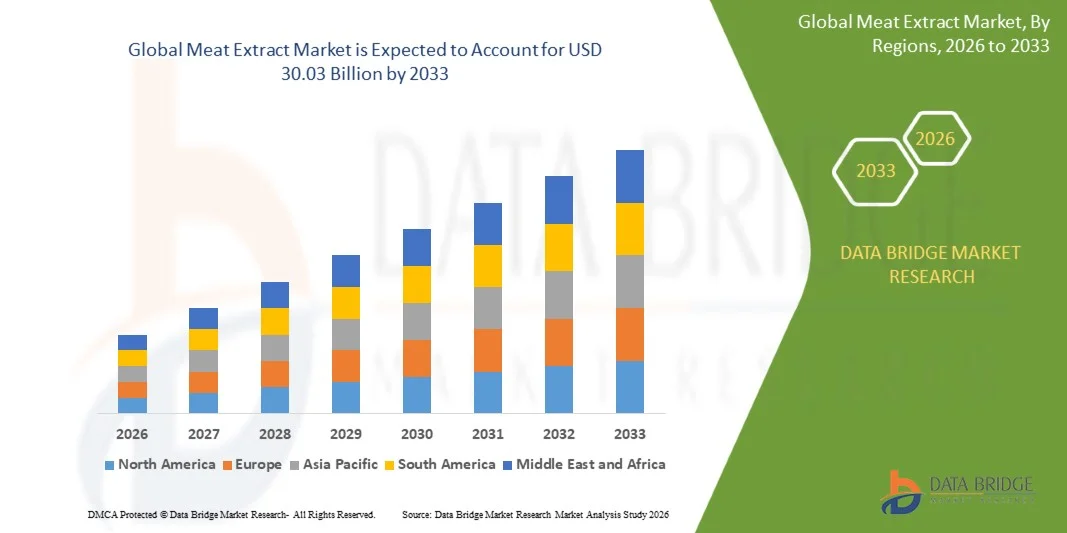
- The global meat extract market size was valued at USD 18.84 billion in 2025and is expected to reach USD 30.03 billion by 2033, at a CAGR of 6.00% during the forecast period
- The market growth is largely fuelled by the rising demand for convenient and ready-to-use food ingredients, increasing consumption of processed and packaged food products, and expanding applications in soups, sauces, and seasonings across the global food industry
- In addition, growing urbanization, changing dietary preferences, and rising preference for umami-rich natural flavor enhancers are further supporting market expansion
Meat Extract Market Analysis
- The meat extract market is witnessing steady growth driven by strong demand from the food and beverage industry, particularly in processed foods and instant meal products
- Increasing consumer preference for natural flavoring agents over artificial additives, along with advancements in food processing technologies, is further strengthening market adoption across both developed and emerging economies
- North America dominated the meat extract market with the largest revenue share in 2025, driven by strong demand for processed and convenience food products, along with well-established food manufacturing and foodservice industries
- Asia-Pacific region is expected to witness the highest growth rate in the global meat extract market, driven by increasing population, rising demand for ready-to-eat foods, and rapid expansion of the food and beverage industry. Growing urban lifestyles, improving retail infrastructure, and strong growth in countries such as China, India, and Japan are further accelerating market expansion in the region
- The beef extract segment held the largest market revenue share in 2025 driven by its strong umami flavor profile, wide availability, and extensive use in soups, sauces, gravies, and instant food products across global cuisines. Beef extract is widely preferred by food manufacturers due to its cost-effectiveness and ability to enhance taste consistency in large-scale processed food production
Report Scope and Meat Extract Market Segmentation
|
Attributes |
Meat Extract Key Market Insights |
|
Segments Covered |
· By Product: Beef Extract, Pork Extract, Chicken Extract, Fish Extract, Lamb Extract, and Other Meat Extracts · By Type: Stock and Extract · By Form: Powder, Paste, and Liquid · By Function: Flavoring Agent, Preparation of Culture Media, and Others · By Category: Conventional, Organic · By Application: Food & Beverage and Pharmaceutical /Laboratory Research |
|
Countries Covered |
North America · U.S. · Canada · Mexico Europe · Germany · France · U.K. · Netherlands · Switzerland · Belgium · Russia · Italy · Spain · Turkey · Rest of Europe Asia-Pacific · China · Japan · India · South Korea · Singapore · Malaysia · Australia · Thailand · Indonesia · Philippines · Rest of Asia-Pacific Middle East and Africa · Saudi Arabia · U.A.E. · South Africa · Egypt · Israel · Rest of Middle East and Africa South America · Brazil · Argentina · Rest of South America |
|
Key Market Players |
• Kerry (Ireland) |
|
Market Opportunities |
• Expansion In Processed Food Industry • Rising Demand For Natural Flavor Enhancers |
|
Value Added Data Infosets |
In addition to the insights on market scenarios such as market value, growth rate, segmentation, geographical coverage, and major players, the market reports curated by the Data Bridge Market Research also include in-depth expert analysis, pricing analysis, brand share analysis, consumer survey, demography analysis, supply chain analysis, value chain analysis, raw material/consumables overview, vendor selection criteria, PESTLE Analysis, Porter Analysis, and regulatory framework. |
Meat Extract Market Trends
“Rising Demand for Convenience And Processed Food Products”
- The growing preference for convenient, ready-to-cook, and ready-to-eat food products is significantly shaping the meat extract market, as consumers increasingly seek rich flavor enhancers that improve taste and reduce cooking time. Meat extracts are widely used in soups, sauces, seasonings, and instant meals due to their strong umami profile and natural flavor enhancement properties, supporting their rising adoption across food manufacturing industries. This demand is further strengthened by the expansion of global fast-food chains and packaged food brands, which rely on standardized flavor profiles for consistency. In addition, meat extracts help manufacturers maintain taste stability across long shelf-life products, making them essential in large-scale food production. Growing preference for premium taste experiences in affordable convenience foods is also boosting their usage
- Increasing urbanization, busy lifestyles, and changing dietary patterns have accelerated the demand for processed and packaged foods globally. This has strengthened the use of meat extracts in commercial food production, where manufacturers aim to deliver consistent taste, improved shelf life, and cost-effective flavor solutions across large-scale operations. Rising dual-income households and time-constrained consumers are further driving reliance on processed meals. In addition, food manufacturers are increasingly adopting meat extracts to reduce dependency on fresh meat while maintaining flavor intensity. The growth of e-commerce grocery platforms is also expanding access to processed foods containing meat extracts
- Clean-label and natural ingredient preferences are also influencing product development, with food companies focusing on minimally processed meat extracts derived from high-quality raw materials. This shift is encouraging innovation in extraction techniques to maintain nutritional value while meeting consumer demand for transparency and quality. Companies are investing in advanced hydrolysis and fermentation-based extraction methods to improve purity and taste. Furthermore, regulatory pressure on artificial additives is pushing manufacturers to replace synthetic flavor enhancers with natural alternatives. This trend is also increasing collaboration between ingredient suppliers and food brands to ensure traceability and sustainability
- For instance, in 2024, Nestlé in Switzerland and Unilever in the U.K. expanded the use of meat extract-based formulations in soups and ready meals across European and Asian markets. These launches targeted increasing demand for flavorful convenience foods, with distribution through retail, foodservice, and online platforms. Both companies also emphasized improved nutritional profiles and reduced artificial additives in their reformulated products. The expansion helped strengthen brand positioning in premium convenience food segments. In addition, these product innovations were aligned with sustainability goals and evolving consumer expectations for natural ingredients
- While demand continues to grow, manufacturers face pressure to balance cost efficiency, product consistency, and sustainable sourcing of raw materials to ensure long-term market expansion. Supply chain volatility in meat sourcing and fluctuating livestock prices add further complexity to production planning. Companies are also required to invest in quality control systems to maintain uniform flavor standards across batches. Increasing competition from plant-based alternatives is pushing manufacturers to innovate continuously. At the same time, regulatory compliance and sustainability requirements are increasing operational costs
Meat Extract Market Dynamics
Driver
“Growing Demand For Flavor Enhancers In Processed Foods”
- Rising consumption of processed, frozen, and packaged food products is a major driver for the meat extract market, as manufacturers seek natural flavor enhancers to improve taste profiles and product appeal. Meat extracts provide strong umami flavor, making them widely used in soups, broths, sauces, and ready meals. Their ability to enhance depth of flavor without requiring large quantities of raw meat makes them cost-efficient for large-scale production. In addition, they support consistent taste formulation across global product lines. Increasing demand for premium and restaurant-style flavors in packaged foods is further boosting adoption
- Expanding foodservice industries, including restaurants, quick-service outlets, and catering services, are increasingly incorporating meat extracts to ensure consistent flavor quality and reduce preparation time. This supports operational efficiency and enhances customer satisfaction. The use of meat extracts also helps standardize recipes across multiple outlets, ensuring uniform taste experiences. In addition, rising demand for instant flavor solutions in institutional catering and airline food services is contributing to market growth. The trend toward automation in commercial kitchens is further increasing reliance on standardized flavor bases
- Increasing consumer preference for rich-tasting, protein-based flavoring ingredients is further boosting demand across both developed and emerging markets. The trend toward high-protein diets is also indirectly supporting the use of meat-based ingredients in packaged foods. Consumers associate meat extracts with natural and authentic taste enhancement, driving repeat purchases. Moreover, growing awareness of protein-enriched diets in fitness-oriented populations is strengthening demand. Food manufacturers are also introducing fortified products that combine taste and nutritional value using meat extracts
- For instance, in 2023, Kraft Heinz Company in the U.S. and Ajinomoto Co. in Japan expanded their meat extract-based seasoning and instant soup product lines to meet rising demand for convenient and flavorful meal solutions. These products were widely distributed across supermarkets and online retail channels. The expansion also included reformulated products with improved nutritional profiles and reduced additives. Both companies focused on enhancing consumer convenience while maintaining strong taste profiles. This strategy helped strengthen their presence in competitive packaged food markets
- Despite strong growth drivers, expansion depends on raw material availability, price stability of meat sources, and continuous innovation in extraction and processing technologies. Supply chain disruptions in livestock industries can significantly impact production costs. In addition, manufacturers must invest in advanced processing techniques to maintain flavor quality and efficiency. Competition from plant-based flavor alternatives is also increasing pressure on traditional meat extract producers. Long-term sustainability will depend on diversification of sourcing and technological advancements
Restraint/Challenge
“Fluctuating Raw Material Prices And Health Concerns”
- The meat extract market faces challenges due to fluctuating prices of raw meat and livestock-derived inputs, which directly impact production costs and final product pricing. This volatility can affect profitability for manufacturers and limit adoption in price-sensitive markets. Seasonal variations in livestock supply further increase cost unpredictability. In addition, disease outbreaks in livestock populations can disrupt supply chains. These factors collectively create instability in long-term procurement planning for manufacturers
- Increasing health awareness and growing preference for plant-based diets are also restraining market growth, as some consumers reduce intake of animal-derived ingredients. This shift is particularly visible in developed economies where vegan and vegetarian trends are expanding. Concerns related to cholesterol and sodium content in processed meat-based products are also influencing consumer choices. As a result, food companies are gradually diversifying into plant-based alternatives. This transition is reshaping product portfolios across the global food industry
- Regulatory scrutiny related to food safety, labeling, and sodium content in meat extracts also poses challenges for manufacturers, requiring continuous reformulation and compliance with international standards. Governments in several regions are enforcing stricter guidelines on processed food ingredients. Companies must also invest in labeling transparency and nutritional disclosure. Compliance with export-import regulations adds further complexity for global players. These requirements increase operational costs and slow down product innovation cycles
- For instance, in 2024, several food manufacturers in Germany and the U.S. reported reformulation of meat extract-based products due to rising demand for low-sodium and plant-based alternatives in retail and foodservice sectors, leading to adjustments in product portfolios. Companies also introduced hybrid formulations combining meat extracts with plant-based ingredients. Retailers responded by expanding shelf space for alternative protein products. This shift impacted traditional meat extract product visibility in some markets. It also encouraged manufacturers to accelerate innovation in healthier formulations
- Addressing these challenges will require investment in cost-efficient sourcing, diversification into hybrid and plant-based extracts, and innovation in healthier, low-sodium formulations to ensure sustainable market growth. Strengthening supply chain resilience will also be essential to manage raw material volatility. Companies must focus on R&D to develop functional alternatives without compromising taste quality. Strategic partnerships with agricultural suppliers can help stabilize sourcing costs. In addition, consumer education campaigns will be important to maintain demand in evolving dietary landscapes
Meat Extract Market Scope
The market is segmented on the basis of product, type, form, function, category, and application.
- By Product
On the basis of product, the meat extract market is segmented into beef extract, pork extract, chicken extract, fish extract, lamb extract, and other meat extracts. The beef extract segment held the largest market revenue share in 2025 driven by its strong umami flavor profile, wide availability, and extensive use in soups, sauces, gravies, and instant food products across global cuisines. Beef extract is widely preferred by food manufacturers due to its cost-effectiveness and ability to enhance taste consistency in large-scale processed food production.
The chicken extract segment is expected to witness the fastest growth rate from 2026 to 2033, driven by rising consumer preference for lighter flavor profiles and increasing demand for chicken-based convenience foods. Chicken extract is widely used in ready meals, instant noodles, and health-oriented food formulations due to its perceived lower fat content and broad acceptance across diverse dietary habits.
- By Type
On the basis of type, the meat extract market is segmented into stock and extract. The extract segment held the largest market revenue share in 2025 driven by its high concentration, strong flavor intensity, and widespread usage across processed food manufacturing industries. Meat extracts are preferred for their ability to provide consistent taste enhancement and longer shelf stability compared to traditional stock preparations.
The stock segment is expected to witness the fastest growth rate from 2026 to 2033, driven by increasing demand for natural and less processed culinary bases in both household and foodservice applications. Stocks are gaining popularity due to their clean-label positioning and rising use in premium and artisanal food preparations.
- By Form
On the basis of form, the meat extract market is segmented into powder, paste, and liquid. The liquid segment held the largest market revenue share in 2025 driven by its easy solubility, high flavor dispersion, and extensive use in industrial food processing and commercial kitchens. Liquid meat extracts are widely used in soups, sauces, and ready-to-eat meals due to their convenience and rapid blending properties.
The powder segment is expected to witness the fastest growth rate from 2026 to 2033, driven by its longer shelf life, ease of transportation, and increasing demand in packaged food formulations. Powdered meat extracts are highly preferred in instant food products and seasoning mixes due to their stability and cost efficiency.
- By Function
On the basis of function, the meat extract market is segmented into flavoring agent, preparation of culture media, and others. The flavoring agent segment held the largest market revenue share in 2025 driven by its extensive application in enhancing taste profiles of processed foods, sauces, snacks, and ready meals. Meat extracts are widely used as natural flavor enhancers due to their rich umami characteristics and compatibility with diverse food formulations.
The preparation of culture media segment is expected to witness the fastest growth rate from 2026 to 2033, driven by increasing demand in pharmaceutical and microbiological research applications. Meat extracts are commonly used as nutrient sources in laboratory culture media, supporting microbial growth in diagnostic and research environments.
- By Category
On the basis of category, the meat extract market is segmented into conventional and organic. The conventional segment held the largest market revenue share in 2025 driven by its wide availability, lower production cost, and established usage across mass-market food manufacturing industries. Conventional meat extracts are extensively used due to their affordability and consistent supply chain networks.
The organic segment is expected to witness the fastest growth rate from 2026 to 2033, driven by rising consumer demand for clean-label, natural, and sustainably sourced food ingredients. Organic meat extracts are gaining traction as manufacturers shift toward healthier and more transparent product formulations in response to evolving dietary preferences.
- By Application
On the basis of application, the meat extract market is segmented into food & beverage and pharmaceutical / laboratory research. The food & beverage segment held the largest market revenue share in 2025 driven by strong demand from processed food manufacturers, quick-service restaurants, and packaged food brands. Meat extracts are widely used in soups, sauces, seasonings, and instant meals to enhance flavor and ensure product consistency.
The pharmaceutical / laboratory research segment is expected to witness the fastest growth rate from 2026 to 2033, driven by increasing use of meat extracts in culture media preparation and biochemical research applications. Growing investment in biotechnology and pharmaceutical R&D is further supporting demand for high-quality nutrient-rich extract ingredients.
Meat Extract Market Regional Analysis
- North America dominated the meat extract market with the largest revenue share in 2025, driven by strong demand for processed and convenience food products, along with well-established food manufacturing and foodservice industries
- Consumers in the region highly value rich flavor profiles, consistent taste quality, and easy-to-use natural flavor enhancers such as meat extracts in soups, sauces, ready meals, and packaged foods
- This widespread adoption is further supported by high consumption of processed foods, advanced food processing technologies, and strong presence of global food brands, establishing meat extracts as a key ingredient in commercial food production
U.S. Meat Extract Market Insight
The U.S. meat extract market captured the largest revenue share in 2025 within North America, fueled by high demand for packaged and convenience foods and the strong presence of major food manufacturers. Consumers are increasingly prioritizing flavorful, protein-rich, and time-saving food options, which is driving the use of meat extracts in instant meals, soups, and seasonings. The growing trend of clean-label and natural ingredients is further encouraging manufacturers to replace artificial flavor enhancers with meat-based extracts. In addition, strong retail distribution networks and expanding foodservice chains are significantly supporting market expansion.
Europe Meat Extract Market Insight
The Europe meat extract market is expected to witness the fastest growth rate from 2026 to 2033, primarily driven by increasing demand for premium processed foods and rising preference for natural flavoring ingredients. Strict food quality regulations and growing consumer awareness regarding clean-label products are encouraging the adoption of meat extracts in processed food formulations. The region is also experiencing strong growth in ready-to-eat meals and gourmet food segments, where meat extracts are widely used to enhance taste and aroma across various applications.
U.K. Meat Extract Market Insight
The U.K. meat extract market is expected to witness strong growth from 2026 to 2033, driven by increasing demand for convenience foods and expanding foodservice consumption. Rising consumer preference for flavorful and easy-to-prepare meals is supporting the use of meat extracts in packaged soups, sauces, and ready meals. In addition, the growth of retail and online grocery platforms is improving product accessibility, while food manufacturers are focusing on clean-label and natural ingredient formulations to meet evolving consumer expectations.
Germany Meat Extract Market Insight
The Germany meat extract market is expected to witness strong growth from 2026 to 2033, fueled by high demand for processed foods and increasing focus on natural and high-quality food ingredients. Germany’s strong food manufacturing base and emphasis on product innovation are supporting the adoption of meat extracts across various applications. Growing consumer preference for traditional and rich-flavored food products is also contributing to market growth, along with rising demand for clean-label and sustainably sourced ingredients.
Asia-Pacific Meat Extract Market Insight
The Asia-Pacific meat extract market is expected to witness the fastest growth rate from 2026 to 2033, driven by rapid urbanization, rising disposable incomes, and increasing consumption of processed and packaged foods in countries such as China, India, and Japan. Expanding foodservice industries and growing demand for instant and convenience foods are further supporting market adoption. In addition, the region’s strong manufacturing capabilities and availability of raw materials are making meat extracts more affordable and widely accessible.
Japan Meat Extract Market Insight
The Japan meat extract market is expected to witness strong growth from 2026 to 2033 due to high demand for convenience foods and strong consumer preference for umami-rich flavors. The country’s advanced food processing industry and growing aging population are increasing demand for easy-to-consume, nutritious food products. Meat extracts are widely used in soups, instant noodles, and ready meals, while integration with modern food technologies is further enhancing product development and innovation.
China Meat Extract Market Insight
The China meat extract market accounted for the largest market revenue share in Asia Pacific in 2025, attributed to rapid urbanization, expanding middle-class population, and strong growth in processed food consumption. China’s large food manufacturing industry and increasing demand for ready-to-eat meals are driving the use of meat extracts across multiple applications. In addition, rising investments in food innovation, strong domestic production capabilities, and growing retail penetration are significantly propelling market growth in the country.
Meat Extract Market Share
The Meat Extract industry is primarily led by well-established companies, including:
- Kerry (Ireland)
- PACIFIC FOODS OF OREGON, LLC (U.S.)
- Bare Bones (U.S.)
- PT. Foodex Indonesia (Indonesia)
- A. Costantino & C. spa (Italy)
- Abbexa (U.K.)
- Maverick Biosciences (Australia)
- MP BIOMEDICALS (U.S.)
- NH Foods Australia (Australia)
- Nikken Foods Co., Ltd. (Japan)
- Essentia Protein Solutions (Denmark)
- Alpha Biosciences (U.S.)
- Bio Basic Inc. (Canada)
- Colin Ingrédients (France)
- Carnad (France)
- HiMedia Laboratories (India)
- Thermo Fisher Scientific Inc. (U.S.)
- BD (U.S.)
- Bonafide Provisions (U.S.)
- Hardy Diagnostics (U.S.)
- JBS GLOBAL (Brazil)
- NEOGEN Corporation (U.S.)
- International Dehydrated Foods, Inc. (U.S.)
- Proliant Biologicals, LLC. (U.S.)
- ARIAKE JAPAN Co., Ltd. (Japan)
- Meioh Bussan Co., Ltd. (Japan)
Latest Developments in Global Meat Extract Market
- In March 2025, JBS SA, a global food company, announced the acquisition of The Vegetarian Butcher, aiming to expand its presence in the plant-based protein segment. This strategic move is expected to diversify its product portfolio beyond traditional meat-based offerings and strengthen its position in alternative protein markets. The acquisition is likely to enhance JBS’s competitiveness in the evolving protein industry and support long-term sustainability trends in the global food sector
- In May 2024, PT Ajinomoto Indonesia, a food and seasoning company, launched KALDOPLUS, a liquid chicken meat extract seasoning designed for the hotel, restaurant, and catering industry. The product is intended to provide a convenient and cost-effective alternative to traditional chicken broth while maintaining authentic taste and aroma. This launch is expected to improve operational efficiency for foodservice providers and expand Ajinomoto’s presence in the ready-to-use seasoning segment
- In November 2023, Givaudan, a global flavor and fragrance company, collaborated with neuroscience firm Thimus to develop “Food Emotions” using the TBox platform. This initiative integrates behavioral and neurological data to better understand consumer food preferences and experiences. The development is expected to enhance product innovation capabilities and strengthen Givaudan’s ability to design more consumer-centric food solutions in the global flavor market
- In October 2022, Essentia Protein Solutions, a meat and protein ingredients manufacturer, announced plans to expand its production facility near Dalton, Georgia. The new plant is focused on producing food-grade stocks, broths, extracts, and fats. This expansion is expected to increase production capacity, improve supply chain efficiency, and strengthen the company’s ability to meet rising demand for meat-based ingredients in food applications
- In June 2021, Kerry Group, a global taste and nutrition company, acquired Niacet, a clean-label, low-sodium preservation specialist, for approximately USD one billion. The acquisition is aimed at integrating advanced preservation technologies into meat-based and other food products, including drying and granulation processes. This development is expected to enhance product shelf life, support clean-label formulations, and strengthen Kerry’s position in the functional ingredients market
- In June 2021, Essentia Protein Solutions launched Essentia C3307 Chicken Flavor under its ProFlavor line to expand its meat-based flavor portfolio. The product is high in protein, low in carbohydrates, and contains no added salt, catering to health-conscious food manufacturers. This launch is expected to support clean-label trends, improve nutritional positioning of processed foods, and expand the company’s footprint in the functional meat flavor segment
SKU-
Get online access to the report on the World's First Market Intelligence Cloud

- Interactive Data Analysis Dashboard
- Company Analysis Dashboard for high growth potential opportunities
- Research Analyst Access for customization & queries
- Competitor Analysis with Interactive dashboard
- Latest News, Updates & Trend analysis
- Harness the Power of Benchmark Analysis for Comprehensive Competitor Tracking
Global Meat Extract Market, Supply Chain Analysis and Ecosystem Framework
To support market growth and help clients navigate the impact of geopolitical shifts, DBMR has integrated in-depth supply chain analysis into its Global Meat Extract Market research reports. This addition empowers clients to respond effectively to global changes affecting their industries. The supply chain analysis section includes detailed insights such as Global Meat Extract Market consumption and production by country, price trend analysis, the impact of tariffs and geopolitical developments, and import and export trends by country and HSN code. It also highlights major suppliers with data on production capacity and company profiles, as well as key importers and exporters. In addition to research, DBMR offers specialized supply chain consulting services backed by over a decade of experience, providing solutions like supplier discovery, supplier risk assessment, price trend analysis, impact evaluation of inflation and trade route changes, and comprehensive market trend analysis.
Research Methodology
Data collection and base year analysis are done using data collection modules with large sample sizes. The stage includes obtaining market information or related data through various sources and strategies. It includes examining and planning all the data acquired from the past in advance. It likewise envelops the examination of information inconsistencies seen across different information sources. The market data is analysed and estimated using market statistical and coherent models. Also, market share analysis and key trend analysis are the major success factors in the market report. To know more, please request an analyst call or drop down your inquiry.
The key research methodology used by DBMR research team is data triangulation which involves data mining, analysis of the impact of data variables on the market and primary (industry expert) validation. Data models include Vendor Positioning Grid, Market Time Line Analysis, Market Overview and Guide, Company Positioning Grid, Patent Analysis, Pricing Analysis, Company Market Share Analysis, Standards of Measurement, Global versus Regional and Vendor Share Analysis. To know more about the research methodology, drop in an inquiry to speak to our industry experts.
Customization Available
Data Bridge Market Research is a leader in advanced formative research. We take pride in servicing our existing and new customers with data and analysis that match and suits their goal. The report can be customized to include price trend analysis of target brands understanding the market for additional countries (ask for the list of countries), clinical trial results data, literature review, refurbished market and product base analysis. Market analysis of target competitors can be analyzed from technology-based analysis to market portfolio strategies. We can add as many competitors that you require data about in the format and data style you are looking for. Our team of analysts can also provide you data in crude raw excel files pivot tables (Fact book) or can assist you in creating presentations from the data sets available in the report.