


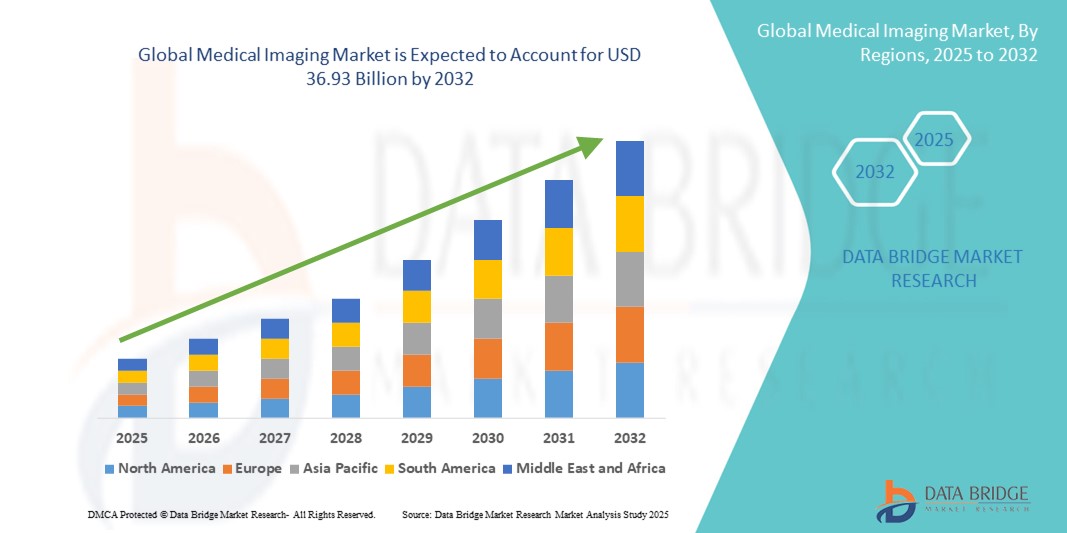
Medical Imaging Market Size
- The global medical imaging market size was valued at USD 23.72 billion in 2024 and is expected to reach USD 36.93 billion by 2032, at a CAGR of 5.69% during the forecast period
- The market growth is largely fueled by the increasing adoption of advanced imaging technologies and continuous technological advancements in diagnostic equipment, which are enhancing the accuracy and efficiency of medical diagnoses across healthcare settings
- Furthermore, rising demand for non-invasive diagnostic procedures and growing prevalence of chronic diseases such as cancer, cardiovascular disorders, and neurological conditions are driving the adoption of sophisticated medical imaging solutions globally. These factors are significantly contributing to the expansion of the Medical Imaging market
Medical Imaging Market Analysis
- The Medical Imaging market is witnessing significant growth driven by rapid technological advancements, increasing demand for early disease diagnosis, and expanding healthcare infrastructure worldwide. Imaging modalities such as MRI, CT, ultrasound, and X-ray systems are becoming essential tools in clinical decision-making across various medical specialties
- The escalating demand for advanced diagnostic tools is primarily fueled by the rising prevalence of chronic diseases, growing geriatric population, and increasing healthcare expenditure globally
- North America dominated the medical imaging market with the largest revenue share of 39.5% in 2024, supported by well-established healthcare infrastructure, high adoption rates of innovative imaging technologies, and the presence of key industry players. The U.S. notably leads the region with substantial growth in installations of cutting-edge imaging systems, driven by ongoing research and technological integration such as AI-enhanced diagnostics
- Asia-Pacific is expected to be the fastest growing region in the medical imaging market during the forecast period, projected to register a CAGR of around 10.8%, owing to increasing urbanization, expanding healthcare access, rising disposable incomes, and government initiatives to improve medical facilities in emerging economies such as China, India, and Japan
- The adult patient segment dominated the market with a substantial share of 85% in 2024, primarily due to the higher incidence of chronic and lifestyle-related diseases such as cardiovascular disorders, cancer, and musculoskeletal conditions within this group. Increased public health awareness and screening programs further boost the use of medical imaging in adult populations
Report Scope and Medical Imaging Market Segmentation
|
Attributes |
Medical Imaging Key Market Insights |
|
Segments Covered |
|
|
Countries Covered |
North America
Europe
Asia-Pacific
Middle East and Africa
South America
|
|
Key Market Players |
|
|
Market Opportunities |
|
|
Value Added Data Infosets |
In addition to the insights on market scenarios such as market value, growth rate, segmentation, geographical coverage, and major players, the market reports curated by the Data Bridge Market Research also include in-depth expert analysis, pricing analysis, brand share analysis, consumer survey, demography analysis, supply chain analysis, value chain analysis, raw material/consumables overview, vendor selection criteria, PESTLE Analysis, Porter Analysis, and regulatory framework. |
Medical Imaging Market Trends
Advancements Driving Enhanced Diagnostic Capabilities
- A significant and ongoing trend in the global Medical Imaging market is the continuous advancement in imaging technologies such as high-resolution MRI, CT, ultrasound, and PET scanners, which are substantially improving diagnostic accuracy and patient outcomes
- Innovations like 3D imaging, contrast enhancement techniques, and hybrid imaging systems are enabling clinicians to detect diseases earlier and with greater precision, facilitating timely interventions
- The integration of digital imaging with hospital information systems and electronic health records (EHR) is streamlining workflows, improving data accessibility, and enabling better clinical decision-making across healthcare facilities
- Increasing investment in research and development by major market players is fostering the launch of portable and point-of-care imaging devices, which expand access to medical imaging services in remote and underserved areas
- The growing adoption of minimally invasive diagnostic procedures supported by advanced imaging modalities is driving the demand for sophisticated equipment in hospitals, diagnostic centers, and outpatient facilities worldwide
- In addition, the trend toward personalized medicine is boosting the demand for imaging technologies that can provide detailed anatomical and functional information, enhancing tailored treatment plans and monitoring disease progression
Medical Imaging Market Dynamics
Driver
Growing Need Due to Rising Healthcare Awareness and Technological Advancements
- The increasing prevalence of chronic diseases, aging populations, and rising healthcare awareness globally are significant drivers fueling the demand for advanced medical imaging technologies
- For instance, in April 2024, Onity, Inc. (Honeywell International, Inc.) announced advancements in IoT-enabled security solutions, showcasing how integration of innovative technologies is transforming healthcare infrastructure. Such strategic initiatives by leading companies are expected to bolster growth in the Medical Imaging industry over the forecast period
- As healthcare providers seek more accurate diagnostic tools, medical imaging devices offer critical capabilities including early disease detection, real-time monitoring, and improved patient management, driving widespread adoption across hospitals and diagnostic centers
- Furthermore, the growing emphasis on personalized medicine and minimally invasive procedures is increasing reliance on sophisticated imaging systems to guide treatments and assess therapeutic outcomes
- The demand for portable, user-friendly, and high-resolution imaging equipment is also rising, supported by advancements in digital technologies and enhanced data integration with hospital information systems. These factors collectively contribute to the expanding Medical Imaging market
Restraint/Challenge
Key Challenges and Barriers to Adoption in the Medical Imaging Market
- Despite robust growth, concerns such as high initial investment costs for advanced imaging systems and the complexity of integrating these technologies into existing healthcare workflows pose challenges to market penetration, particularly in developing regions
- In addition, ensuring data security and patient privacy when managing large volumes of imaging data remains a critical concern, necessitating stringent cybersecurity measures and compliance with regulatory standards
- The need for skilled personnel to operate sophisticated imaging equipment and interpret results accurately is another limiting factor, highlighting the importance of ongoing training and education in healthcare facilities
- While prices of some imaging technologies are gradually decreasing due to innovation and economies of scale, the premium cost associated with cutting-edge devices can still be a barrier for smaller healthcare providers and budget-conscious institutions
- Addressing these challenges through technological innovation, enhanced cybersecurity protocols, and targeted training programs will be essential for sustained growth and wider adoption of medical imaging solutions worldwide
Medical Imaging Market Scope
The market is segmented on the basis of procedure, technology, modality, patient age, application, and end users.
- By Procedure
On the basis of procedure, the market is segmented into X-Ray imaging, computed tomography (CT) scan, magnetic resonance imaging (MRI), ultrasound, nuclear imaging (SPECT/PET), mammography, molecular imaging, and others. The X-Ray imaging segment held the largest market revenue share of approximately 28.5% in 2024, owing to its long-established use in medical diagnostics, cost-effectiveness, and quick imaging capabilities, making it a preferred choice in both emergency and routine clinical settings.
The CT Scan segment is projected to witness a strong CAGR of around 8.7% from 2025 to 2032, driven by its growing adoption for detailed cross-sectional imaging critical in trauma care, oncology, and cardiovascular diagnostics.
- By Technology
On the basis of technology, the market is segmented into direct digital radiology and computed radiology. Direct digital radiology held a commanding position in the market with an estimated revenue share of about 60% in 2024. This dominance is largely due to its advanced capabilities such as superior image resolution, faster image acquisition times, and enhanced workflow efficiency. In addition, its seamless integration with electronic health record (EHR) systems facilitates streamlined diagnostics and improved patient management.
Conversely, Computed Radiology is expected to witness the fastest CAGR from 2025 to 2032, especially in emerging economies where healthcare infrastructure modernization is ongoing. Its relatively lower capital expenditure requirements and ability to retrofit existing analog systems make it an attractive choice for facilities looking to upgrade without extensive overhaul, thereby supporting gradual adoption worldwide.
- By Modality
On the basis of modality, the market is segmented into stationary and portable imaging systems. Stationary imaging systems accounted for the largest share of 75% in 2024, reflecting their widespread deployment in hospitals, large diagnostic centers, and specialized medical facilities. These systems are preferred in settings where high patient throughput and complex imaging capabilities are essential.
In contrast, portable medical imaging devices are expected to exhibit the fastest growth with a CAGR of around 10.3% from 2025 to 2032. This growth is driven by increasing demand for bedside diagnostics, emergency medical services, and mobile health initiatives. Portable systems enable healthcare providers to extend diagnostic services beyond traditional clinical settings, reaching remote or underserved populations and enhancing point-of-care decision making.
- By Patient Age
On the basis of patient age, the market is segmented into adults and paediatric. The adult patient segment dominated the market with a substantial share of 85% in 2024, primarily due to the higher incidence of chronic and lifestyle-related diseases such as cardiovascular disorders, cancer, and musculoskeletal conditions within this group. Increased public health awareness and screening programs further boost the use of medical imaging in adult populations.
Meanwhile, the pediatric segment, although smaller in size, is progressively gaining importance. Growing investments in pediatric-specific imaging technologies, coupled with heightened concerns over radiation exposure and safety protocols for children, are encouraging the development and adoption of tailored imaging solutions that cater to the unique needs of younger patients, fostering steady market growth in this category.
- By Application
On the basis of application, the market is segmented into general imaging, thoracic cardiology, obstetrics, orthopaedics and musculoskeletal, neuro and spine, pelvic and abdominal, oncology, radiography, fluoroscopy, gynaecology, urology, musculoskeletal, dental, and others. General imaging is the dominating subsegment in the market based on application, holding the largest share in 2024. This prominence stems from its broad usage across multiple medical specialties for routine diagnostic purposes, making it a foundational component of healthcare imaging services worldwide.
Orthopaedics and musculoskeletal imaging is projected to be the fastest-growing subsegment, expected to register a robust CAGR of around 9.2% during the forecast period. This growth is driven by the rising prevalence of sports-related injuries, arthritis, and other bone and joint disorders, alongside increasing demand for advanced imaging techniques to support diagnosis and treatment planning in these areas.
- By End Users
On the basis of end users, the market is segmented into hospitals, diagnostic centers, imaging centers, specialty clinics, ambulatory surgical centers, academic and research institutes, and others. Hospitals dominated the market with a commanding revenue share of approximately 55% in 2024, due to their extensive imaging infrastructure, multidisciplinary services, and critical role in acute and specialized care. Diagnostic centers is expected to witness the fastest CAGR from 2025 to 2032, driven by increasing outsourcing trends and the establishment of dedicated imaging facilities offering convenience and specialized services. Specialty clinics and ambulatory surgical centers are expected to grow steadily, supported by the increasing preference for minimally invasive procedures and outpatient care models.
Medical Imaging Market Regional Analysis
- North America dominated the medical imaging market with the largest revenue share of 39.5% in 2024, driven by the increasing prevalence of chronic diseases, growing investments in advanced healthcare infrastructure, and rising demand for early and accurate diagnosis. High healthcare expenditure and the presence of major medical imaging companies in the region further support market growth
- The region’s technologically advanced healthcare systems, coupled with growing patient awareness about early disease detection, are boosting the adoption of sophisticated imaging modalities such as MRI, CT scans, and ultrasound across hospitals and diagnostic centers
- The widespread availability of trained radiologists and increasing government initiatives to promote advanced healthcare services are also contributing factors to North America’s dominance in the market
U.S. Medical Imaging Market Insight
The U.S. medical imaging market dominated North America in 2024, capturing a substantial revenue share of 56%. This robust growth is fueled by significant investments in healthcare infrastructure and a rapid pace of technological innovation. Increasing demand for minimally invasive diagnostic procedures, coupled with the country’s emphasis on precision medicine, is driving adoption of advanced imaging modalities such as Positron Emission Tomography (PET), Magnetic Resonance Imaging (MRI), and Computed Tomography (CT). The expanding geriatric population, prone to chronic and age-related diseases, further elevates the need for accurate and timely imaging diagnostics. Moreover, the integration of artificial intelligence (AI) and machine learning (ML) technologies into imaging workflows is enhancing diagnostic accuracy, reducing interpretation times, and supporting better patient outcomes, thereby propelling market expansion.
Europe Medical Imaging Market Insight
The Europe medical imaging market is set to witness steady growth throughout the forecast period, supported by increasing healthcare expenditure across key countries. Rising prevalence of chronic diseases such as cardiovascular conditions, cancer, and neurological disorders is prompting early diagnostic interventions, which drives demand for sophisticated imaging technologies. The region benefits from well-established healthcare infrastructure and a strong presence of leading medical imaging manufacturers offering innovative, portable, and user-friendly devices. Governments across Europe are enforcing stringent regulations to promote early disease detection and better healthcare delivery, thus accelerating market growth. In addition, favorable reimbursement policies and a rising focus on research and development activities are creating an enabling environment for continuous advancements in imaging technologies.
U.K. Medical Imaging Market Insight
The U.K. medical imaging market is expected to experience notable growth during the forecast period, supported by various government-led healthcare initiatives aimed at enhancing diagnostic services. Increased awareness among healthcare providers and patients about the benefits of non-invasive imaging procedures is stimulating demand. The rising incidence of chronic diseases such as cancer, cardiovascular ailments, and neurological disorders is significantly contributing to the need for advanced imaging systems. Furthermore, the U.K.’s well-established public healthcare system, combined with increasing capital investments in diagnostic equipment, is facilitating wider adoption of cutting-edge imaging technologies. This, in turn, is improving diagnostic precision and enabling timely medical interventions.
Germany Medical Imaging Market Insight
The Germany’s medical imaging market is projected to expand considerably, driven by continuous technological innovation and rising healthcare expenditure. The country’s commitment to precision medicine and preventive healthcare is fostering the adoption of advanced diagnostic imaging modalities. Germany’s robust network of research institutions and high-quality medical facilities provides a strong foundation for the development and deployment of state-of-the-art imaging technologies. In addition, the country is increasingly focusing on environmental sustainability within medical technology development, encouraging manufacturers to innovate eco-friendly and energy-efficient imaging devices. This emphasis on green technology not only meets regulatory demands but also resonates with healthcare providers aiming for sustainable medical practices..
Asia-Pacific Medical Imaging Market Insight
The Asia-Pacific Medical Imaging market is set to experience the fastest growth globally, with a robust projected CAGR of 10.8% between 2025 and 2032. This rapid expansion is driven by several critical factors including accelerating urbanization, significant investments in healthcare infrastructure, and steadily rising disposable incomes across key countries such as China, Japan, and India. The increasing prevalence of chronic diseases and growing awareness among the population about the importance of early and accurate disease diagnosis are fueling demand for sophisticated imaging technologies. Furthermore, governments in the region are actively supporting healthcare modernization initiatives, with a particular focus on integrating digital health solutions and telemedicine services to enhance accessibility and efficiency. These efforts are resulting in wider adoption of advanced imaging modalities like MRI, CT scans, ultrasound, and nuclear imaging in both public and private healthcare facilities. The ongoing expansion of healthcare insurance coverage and the development of new hospitals and diagnostic centers are also key contributors to the region’s accelerating medical imaging market growth.
Japan Medical Imaging Market Insight
The Japan medical imaging market is gaining momentum due to the country’s aging population, advanced healthcare infrastructure, and increasing focus on early diagnosis and treatment of chronic diseases. The demand for compact and portable imaging devices is rising, supported by the need for home healthcare and outpatient services. Japan’s emphasis on integrating AI and robotics in medical imaging is also fueling technological advancements and market expansion.
China Medical Imaging Market Insight
The China medical imaging market accounted for the largest market revenue share in Asia-Pacific in 2024, owing to rapid urbanization, expanding middle-class population, and significant investments in healthcare infrastructure. The country’s increasing prevalence of lifestyle diseases, government support for healthcare reforms, and growing number of private healthcare providers are driving demand for advanced imaging systems. Furthermore, the emergence of domestic manufacturers offering cost-effective solutions is enhancing market accessibility across urban and rural areas
Medical Imaging Market Share
The medical imaging industry is primarily led by well-established companies, including:
- Koninklijke Philips N.V. (Netherlands)
- RamSoft, Inc. (Canada)
- InHealth Group (U.K)
- Siemens Healthineers AG (Germany)
- Sonic Healthcare Limited (Australia)
- GE HealthCare (U.S)
- Akumin Inc. (U.S)
- Hologic Inc. (U.S)
- Shimadzu Corporation (Japan)
- Shenzhen Mindray Bio-Medical Electronics Co., Ltd. (China)
- CANON MEDICAL SYSTEMS CORPORATION (Japan)
- ZEISS (Germany)
- FUJIFILM Corporation (Japan)
- Hitachi, Ltd. (Japan)
- Carestream Health (U.S)
- UNILABS (Switzerland)
- ONRAD, Inc. (U.S)
- Narang Medical Limited (India)
- Johnson & Johnson and its affiliates (U.S.)
- BD (U.S.)
Latest Developments in Global Medical Imaging Market
- In April 2023, GE Healthcare announced the launch of its next-generation Revolution Apex CT Scanner, designed to deliver high-quality imaging with faster scan times and lower radiation doses. This innovation reflects GE Healthcare’s focus on enhancing diagnostic accuracy while improving patient safety and workflow efficiency in medical facilities worldwide. The product has received positive reviews for its AI-powered image reconstruction technology
- In March 2023, Siemens Healthineers unveiled its new MAGNETOM Free.Max 0.55T MRI system, which offers advanced imaging capabilities with a lower magnetic field strength, making it safer and more cost-effective for a wider range of clinical applications. This system targets expanding access to MRI diagnostics in emerging markets and smaller healthcare settings
- In March 2025, GE HealthCare announced a collaboration with NVIDIA to advance autonomous diagnostic imaging. Leveraging NVIDIA's Isaac for Healthcare platform, the partnership aims to develop AI-enabled X-ray and ultrasound systems that can autonomously capture and analyze medical images. This initiative seeks to reduce the burden on healthcare professionals and improve diagnostic efficiency
- In May 2025, Philips unveiled a global initiative to strengthen medical imaging capacity. The company plans to support hospitals and health systems by implementing imaging infrastructures, including AI-driven solutions, to enhance diagnostics, increase efficiency, and address resource constraints. This effort aligns with the World Health Organization's resolution to improve access to medical imaging services worldwide

- Interactive Data Analysis Dashboard
- Company Analysis Dashboard for high growth potential opportunities
- Research Analyst Access for customization & queries
- Competitor Analysis with Interactive dashboard
- Latest News, Updates & Trend analysis
- Harness the Power of Benchmark Analysis for Comprehensive Competitor Tracking
Data collection and base year analysis are done using data collection modules with large sample sizes. The stage includes obtaining market information or related data through various sources and strategies. It includes examining and planning all the data acquired from the past in advance. It likewise envelops the examination of information inconsistencies seen across different information sources. The market data is analysed and estimated using market statistical and coherent models. Also, market share analysis and key trend analysis are the major success factors in the market report. To know more, please request an analyst call or drop down your inquiry.
The key research methodology used by DBMR research team is data triangulation which involves data mining, analysis of the impact of data variables on the market and primary (industry expert) validation. Data models include Vendor Positioning Grid, Market Time Line Analysis, Market Overview and Guide, Company Positioning Grid, Patent Analysis, Pricing Analysis, Company Market Share Analysis, Standards of Measurement, Global versus Regional and Vendor Share Analysis. To know more about the research methodology, drop in an inquiry to speak to our industry experts.
Data Bridge Market Research is a leader in advanced formative research. We take pride in servicing our existing and new customers with data and analysis that match and suits their goal. The report can be customized to include price trend analysis of target brands understanding the market for additional countries (ask for the list of countries), clinical trial results data, literature review, refurbished market and product base analysis. Market analysis of target competitors can be analyzed from technology-based analysis to market portfolio strategies. We can add as many competitors that you require data about in the format and data style you are looking for. Our team of analysts can also provide you data in crude raw excel files pivot tables (Fact book) or can assist you in creating presentations from the data sets available in the report.













