




Global Metal Biocides Market
Market Size in USD Billion
CAGR :
% 
 USD
3.93 Billion
USD
5.72 Billion
2025
2033
USD
3.93 Billion
USD
5.72 Billion
2025
2033
 Forecast Period Forecast Period |
2026 –2033 |
 Market Size (Base Year) Market Size (Base Year) |
USD 3.93 Billion |
 Market Size (Forecast Year) Market Size (Forecast Year) |
USD 5.72 Billion |
 CAGR CAGR |
% |
| Major Markets Players |
|
Metal Biocides Market Size
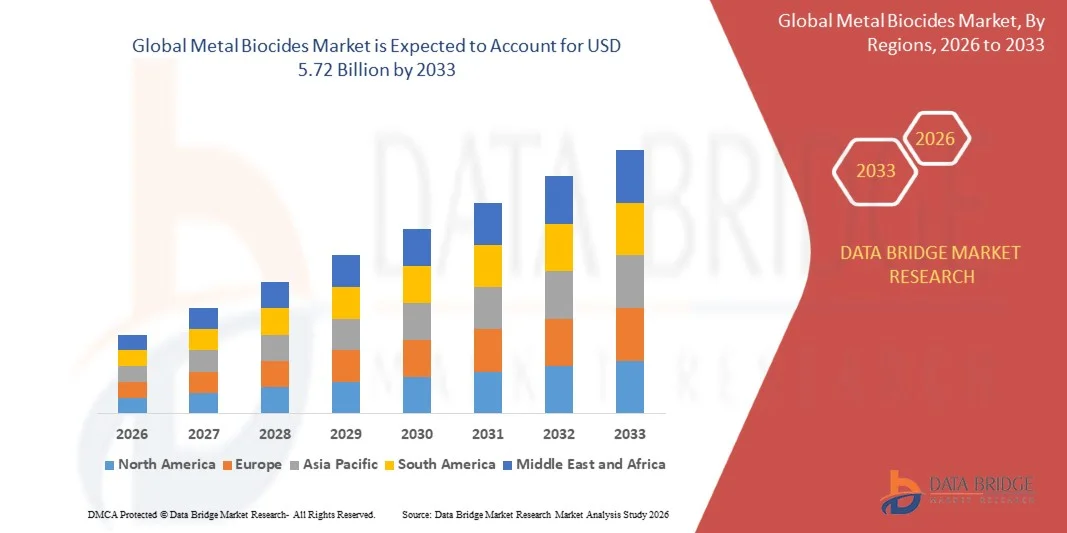
- The global metal biocides market size was valued at USD 3.93 billion in 2025 and is expected to reach USD 5.72 billion by 2033, at a CAGR of 4.80% during the forecast period
- The market growth is largely fuelled by the increasing demand from water treatment applications such as industrial wastewater management and cooling systems
- Rising regulatory focus on preventing microbial contamination in oil & gas operations driving adoption of metal biocides
Metal Biocides Market Analysis
- The market is driven by the unique efficacy of metal biocides in controlling a broad spectrum of microorganisms, ensuring equipment longevity and reducing maintenance costs
- Increasing industrialization and expansion of manufacturing units necessitating effective biocide solutions for process water and cooling towers
- North America dominated the metal biocides market with the largest revenue share in 2025, driven by strong demand from water treatment, oil & gas, and industrial manufacturing sectors, along with stringent regulations on microbial control and water quality
- Asia-Pacific region is expected to witness the highest growth rate in the global metal biocides market, driven by expanding manufacturing activities, urbanization, and growing demand for efficient water management and antimicrobial solutions
- The Silver segment held the largest market revenue share in 2025, driven by its strong antimicrobial efficacy, broad-spectrum activity against bacteria, fungi, and algae, and compatibility with diverse industrial systems such as cooling towers, water treatment, and coatings. Silver-based biocides are widely preferred for their long-lasting performance and regulatory acceptance in sensitive applications. Increasing adoption in high-value sectors, such as medical devices, paints, and coatings, further strengthens market demand. Ongoing research into nanoparticle formulations is enhancing efficiency and reducing required dosages, boosting cost-effectiveness
Report Scope and Metal Biocides Market Segmentation
|
Attributes |
Metal Biocides Key Market Insights |
|
Segments Covered |
|
|
Countries Covered |
North America
Europe
Asia-Pacific
Middle East and Africa
South America
|
|
Key Market Players |
• Akzo Nobel N.V. (Netherlands) |
|
Market Opportunities |
• Growing Demand For Eco-Friendly Metal Biocides |
|
Value Added Data Infosets |
In addition to the insights on market scenarios such as market value, growth rate, segmentation, geographical coverage, and major players, the market reports curated by the Data Bridge Market Research also include import export analysis, production capacity overview, production consumption analysis, price trend analysis, climate change scenario, supply chain analysis, value chain analysis, raw material/consumables overview, vendor selection criteria, PESTLE Analysis, Porter Analysis, and regulatory framework. |
Metal Biocides Market Trends
“Rising Demand For Advanced Microbial Control Solutions”
• The increasing need for effective microbial control across industries is significantly shaping the global metal biocides market, as companies seek solutions that prevent biofouling, corrosion, and microbial induced deterioration without compromising system performance or regulatory compliance. Metal biocides are gaining traction due to their broad‑spectrum antimicrobial properties and compatibility with various industrial processes, encouraging end‑users to adopt them in water treatment, oil & gas, and cooling systems
• Heightened regulatory emphasis on maintaining water quality and preventing health hazards has accelerated demand for metal biocides in industrial effluent management and potable water systems. Industrial sectors are actively seeking biocidal solutions that meet stringent environmental and safety standards, prompting manufacturers to innovate with new formulations that balance efficacy and environmental responsibility
• Sustainability and operational efficiency trends are influencing purchasing decisions, with industrial players emphasizing long‑term system protection, reduced downtime, and compliance with eco‑regulatory mandates. These factors are helping companies differentiate service offerings in a competitive landscape while driving the adoption of metal biocide technologies that deliver consistent performance with minimal environmental impact
• For instance, in 2025, major petrochemical and power generation firms expanded the use of metal biocide solutions in their cooling water and wastewater treatment operations to address rising concerns over microbial contamination and regulatory compliance. These implementations focused on enhancing equipment longevity and ensuring uninterrupted operations, with distribution across industrial facilities and maintenance programs
• While demand for metal biocides continues to grow, sustained market expansion depends on continuous R&D, improved cost efficiency, and developing solutions that align with evolving environmental regulations. Manufacturers are increasingly focusing on formulation enhancements, supply chain reliability, and strategic collaborations with industrial end‑users to deliver optimized metal biocide solutions
Metal Biocides Market Dynamics
Driver
“Increasing Industrial Applications And Regulatory Compliance”
• The expanding industrial base across sectors such as oil & gas, power generation, and water treatment is a major driver for the global metal biocides market. Industries are increasingly relying on metal biocides to mitigate microbial growth, prevent system failures, and ensure regulatory compliance for water quality and safety standards
• Metal biocides enhance operational efficiency by controlling biofouling and corrosion in cooling towers, process water systems, and wastewater treatment plants. Their effectiveness in protecting infrastructure and reducing maintenance costs is reinforcing adoption among industrial players seeking reliable antimicrobial solutions
• Industrial stakeholders are promoting the integration of metal biocides into preventive maintenance and water management programs through awareness campaigns, technical support, and performance validation. These efforts are supported by the growing emphasis on environmental stewardship, operational reliability, and reduction of unplanned downtime across industrial applications
• For instance, in 2024, leading chemical manufacturers and industrial service providers reported heightened incorporation of metal biocide treatments in cooling water and wastewater programs of major manufacturing facilities. This expansion followed increased regulatory scrutiny and the pursuit of operational excellence, driving repeat usage and long‑term contracts for metal biocide products
• Although growing industrial applications and regulatory focus support market growth, wider adoption depends on cost optimization, product customization, and scalable supply chain operations. Investment in formulation technology, performance validation, and sustainable sourcing will be critical for meeting global demand and maintaining competitive advantage
Restraint/Challenge
“Environmental Concerns And Cost Constraints”
• Environmental concerns related to the use of metal‑based biocides, especially regarding their toxicity and potential ecological impact, remain a key challenge, limiting adoption among environmentally sensitive end‑users. Stricter discharge regulations and public scrutiny are prompting companies to seek greener alternatives or invest in advanced treatment measures to mitigate environmental risks
• The relatively higher cost of metal biocides compared to conventional organic biocides can restrict adoption among cost‑sensitive industrial sectors. Higher raw material costs and complex manufacturing processes contribute to elevated pricing, affecting market penetration in certain applications
• Limited awareness of the functional advantages and environmental management practices for metal biocides in emerging markets also hampers market growth. Educational gaps and uneven regulatory frameworks restrict adoption in regions where microbial control solutions are still emerging
• For instance, in 2025, industrial facilities in some Southeast Asian countries reported slower uptake of metal biocide solutions due to concerns over environmental discharge limits and cost competitiveness compared to alternative antimicrobial treatments. Compliance requirements and additional monitoring obligations were cited as barriers to broader deployment
• Overcoming these challenges will require development of cost‑effective, environmentally responsible formulations, expanded educational initiatives for industrial stakeholders, and collaboration with regulators to establish clearer guidelines. Strengthening marketing strategies around performance, compliance, and sustainability benefits will be essential for wider adoption of metal biocides in the global market
Metal Biocides Market Scope
The market is segmented on the basis of type and application.
• By Type
On the basis of type, the global metal biocides market is segmented into Silver, Copper & Alloys, Zinc, and Others. The Silver segment held the largest market revenue share in 2025, driven by its strong antimicrobial efficacy, broad-spectrum activity against bacteria, fungi, and algae, and compatibility with diverse industrial systems such as cooling towers, water treatment, and coatings. Silver-based biocides are widely preferred for their long-lasting performance and regulatory acceptance in sensitive applications. Increasing adoption in high-value sectors, such as medical devices, paints, and coatings, further strengthens market demand. Ongoing research into nanoparticle formulations is enhancing efficiency and reducing required dosages, boosting cost-effectiveness.
The Copper & Alloys segment is expected to witness the fastest growth rate from 2026 to 2033, driven by its cost-effectiveness, proven biocidal properties, and versatility across industrial and commercial applications. Copper-based biocides are particularly favored for water treatment, paints, and coatings, offering reliable microbial control and extended equipment life. Rising awareness of environmental sustainability and regulatory approval for copper use in certain applications is also supporting growth. In addition, technological advancements in alloy composition are enhancing antimicrobial performance, widening their industrial adoption.
• By Application
On the basis of application, the metal biocides market is segmented into Paints and Coatings, Medical, Textiles, Pesticides, Wood Preservation, Food and Beverages, and Others. The Paints and Coatings segment held the largest market revenue share in 2025, owing to the growing need for anti-fouling and anti-corrosion solutions in infrastructure, marine, and industrial surfaces. Metal biocides enhance durability, prevent microbial degradation, and maintain aesthetic quality over time. Increased demand in residential, commercial, and marine construction projects is further supporting growth. Innovations in coating formulations, including eco-friendly and low-VOC products, are accelerating adoption
The Medical segment is expected to witness the fastest growth rate from 2026 to 2033 due to the need for stringent microbial control in hospitals, surgical instruments, and medical devices. Silver-based and copper-based biocides are extensively used for their strong antimicrobial properties and biocompatibility. Rising global awareness of hospital-acquired infections and hygiene compliance regulations is driving market expansion. In addition, development of antimicrobial surfaces and coatings for medical equipment is creating new opportunities
Metal Biocides Market Regional Analysis
• North America dominated the metal biocides market with the largest revenue share in 2025, driven by strong demand from water treatment, oil & gas, and industrial manufacturing sectors, along with stringent regulations on microbial control and water quality
• Industries in the region place high importance on operational efficiency, equipment longevity, and compliance with environmental standards, increasing the adoption of effective antimicrobial solutions such as metal biocides
• This widespread adoption is further supported by advanced industrial infrastructure, high investment in maintenance practices, and the presence of key market players, establishing metal biocides as essential components in industrial water management and protection systems.
U.S. Metal Biocides Market Insight
The U.S. metal biocides market captured the largest revenue share in 2025 within North America, fueled by strong demand across water treatment, oil & gas, and power generation industries. Industrial operators are increasingly prioritizing microbial control to enhance system performance and comply with strict environmental regulations. The growing focus on sustainable industrial practices and efficient water management solutions further propels the market. Moreover, continuous investment in advanced treatment technologies and infrastructure modernization is significantly contributing to market expansion.
Europe Metal Biocides Market Insight
The Europe metal biocides market is expected to witness steady growth from 2026 to 2033, primarily driven by stringent environmental and safety regulations governing biocide usage. The increasing emphasis on sustainable industrial practices and water conservation is fostering the adoption of regulated and efficient biocidal solutions. European industries are also focusing on reducing environmental impact while maintaining system efficiency, encouraging innovation in eco-friendly metal biocide formulations. Growth is supported by applications across manufacturing, marine, and infrastructure sectors.
U.K. Metal Biocides Market Insight
The U.K. metal biocides market is expected to witness notable growth from 2026 to 2033, driven by rising demand for effective microbial control in water treatment and industrial systems. In addition, increasing awareness regarding infrastructure protection and maintenance efficiency is encouraging industries to adopt advanced biocide solutions. The country’s focus on regulatory compliance and sustainability is expected to further support market expansion, along with growing investments in industrial modernization and environmental protection
Germany Metal Biocides Market Insight
The Germany metal biocides market is expected to witness significant growth from 2026 to 2033, fueled by strong industrial base and increasing demand for high-performance antimicrobial solutions. Germany’s emphasis on technological innovation, environmental sustainability, and efficient manufacturing processes promotes the adoption of advanced metal biocides. The integration of these solutions in water treatment, coatings, and industrial applications is becoming increasingly prevalent, supported by strict regulatory frameworks and high-quality standards.
Asia-Pacific Metal Biocides Market Insight
The Asia-Pacific metal biocides market is expected to witness the fastest growth rate from 2026 to 2033, driven by rapid industrialization, urbanization, and increasing investments in water treatment infrastructure in countries such as China, India, and Japan. The region's growing manufacturing sector and rising awareness regarding water quality and hygiene are driving demand for effective biocidal solutions. Furthermore, expanding industrial activities and supportive government initiatives are enhancing the adoption of metal biocides across multiple sectors.
Japan Metal Biocides Market Insight
The Japan metal biocides market is expected to witness steady growth from 2026 to 2033 due to the country’s advanced industrial landscape and strong focus on quality and efficiency. The Japanese market places significant emphasis on maintaining high standards of hygiene and system performance, driving the adoption of metal biocides in water treatment and manufacturing processes. Integration with advanced technologies and automation systems is further supporting market growth, along with continuous innovation in high-performance formulations.
China Metal Biocides Market Insight
The China metal biocides market accounted for the largest market revenue share in Asia Pacific in 2025, attributed to rapid industrial expansion, increasing water treatment requirements, and growing environmental awareness. China stands as a major manufacturing hub, where demand for microbial control solutions is rising across industrial, construction, and marine sectors. Government initiatives focused on pollution control and sustainable development, along with the presence of domestic manufacturers, are key factors propelling the market in China.
Metal Biocides Market Share
The Metal Biocides industry is primarily led by well-established companies, including:
• Akzo Nobel N.V. (Netherlands)
• BASF SE (Germany)
• Clariant (Switzerland)
• Dow (U.S.)
• DuPont (U.S.)
• Evonik Industries AG (Germany)
• Croda International Plc (U.K.)
• Huntsman International LLC. (U.S.)
• Kao Corporation (Japan)
• Galaxy Surfactants Ltd (India)
• Solvay (Belgium)
• Vinamax Organics Pvt. (India)
• CHEMTEX SPECIALITY LTD (India)
• Enaspol a.s. (Czech Republic)
• Unger Fabrikker AS (Norway)
• AARTI INDUSTRIES LIMITED (India)
• Oxiteno (Brazil)
• KLK OLEO. (Malaysia)
• Pilot Chemical Corp. (U.S.)
• Procter & Gamble (U.S.)
• Lankem (U.K.)
Latest Developments in Global Metal Biocides Market
- In July 2022, LANXESS AG, acquisition, acquired the microbial control business unit of IFF Inc. to strengthen its biocide portfolio and expand its specialty chemicals capabilities. This development enables LANXESS to enhance its product range across industrial and water treatment applications while leveraging IFF’s established technologies. The acquisition also improves operational synergies and global distribution capabilities. It supports LANXESS in addressing growing demand for high-performance antimicrobial solutions. Overall, this move strengthens its competitive position and contributes to market consolidation
- In January 2022, Veolia Group, acquisition, acquired Suez to expand its presence in the water treatment sector and integrated environmental services. This strategic move increases the demand for biocide solutions across municipal and industrial water treatment operations. The combined entity benefits from expanded infrastructure, advanced treatment technologies, and a broader global footprint. It also enhances Veolia’s ability to deliver comprehensive water management solutions. This acquisition positively impacts the market by accelerating the adoption of advanced biocides in large-scale treatment facilities
- In March 2021, Arxada AG, partnership/distribution agreement, signed a distribution agreement with LifeClean International for healthcare disinfectants in the European market. This initiative aims to improve accessibility of high-quality disinfectant products and expand Arxada’s regional presence. The collaboration supports the growing need for effective infection control solutions in healthcare and institutional settings. It also strengthens distribution networks and enhances customer reach across Europe. This development contributes to increased awareness and adoption of biocide-based hygiene solutions in the market
SKU-
Get online access to the report on the World's First Market Intelligence Cloud

- Interactive Data Analysis Dashboard
- Company Analysis Dashboard for high growth potential opportunities
- Research Analyst Access for customization & queries
- Competitor Analysis with Interactive dashboard
- Latest News, Updates & Trend analysis
- Harness the Power of Benchmark Analysis for Comprehensive Competitor Tracking
Global Metal Biocides Market, Supply Chain Analysis and Ecosystem Framework
To support market growth and help clients navigate the impact of geopolitical shifts, DBMR has integrated in-depth supply chain analysis into its Global Metal Biocides Market research reports. This addition empowers clients to respond effectively to global changes affecting their industries. The supply chain analysis section includes detailed insights such as Global Metal Biocides Market consumption and production by country, price trend analysis, the impact of tariffs and geopolitical developments, and import and export trends by country and HSN code. It also highlights major suppliers with data on production capacity and company profiles, as well as key importers and exporters. In addition to research, DBMR offers specialized supply chain consulting services backed by over a decade of experience, providing solutions like supplier discovery, supplier risk assessment, price trend analysis, impact evaluation of inflation and trade route changes, and comprehensive market trend analysis.
Research Methodology
Data collection and base year analysis are done using data collection modules with large sample sizes. The stage includes obtaining market information or related data through various sources and strategies. It includes examining and planning all the data acquired from the past in advance. It likewise envelops the examination of information inconsistencies seen across different information sources. The market data is analysed and estimated using market statistical and coherent models. Also, market share analysis and key trend analysis are the major success factors in the market report. To know more, please request an analyst call or drop down your inquiry.
The key research methodology used by DBMR research team is data triangulation which involves data mining, analysis of the impact of data variables on the market and primary (industry expert) validation. Data models include Vendor Positioning Grid, Market Time Line Analysis, Market Overview and Guide, Company Positioning Grid, Patent Analysis, Pricing Analysis, Company Market Share Analysis, Standards of Measurement, Global versus Regional and Vendor Share Analysis. To know more about the research methodology, drop in an inquiry to speak to our industry experts.
Customization Available
Data Bridge Market Research is a leader in advanced formative research. We take pride in servicing our existing and new customers with data and analysis that match and suits their goal. The report can be customized to include price trend analysis of target brands understanding the market for additional countries (ask for the list of countries), clinical trial results data, literature review, refurbished market and product base analysis. Market analysis of target competitors can be analyzed from technology-based analysis to market portfolio strategies. We can add as many competitors that you require data about in the format and data style you are looking for. Our team of analysts can also provide you data in crude raw excel files pivot tables (Fact book) or can assist you in creating presentations from the data sets available in the report.












