


What is the Microencapsulation Market Size and Growth Rate?
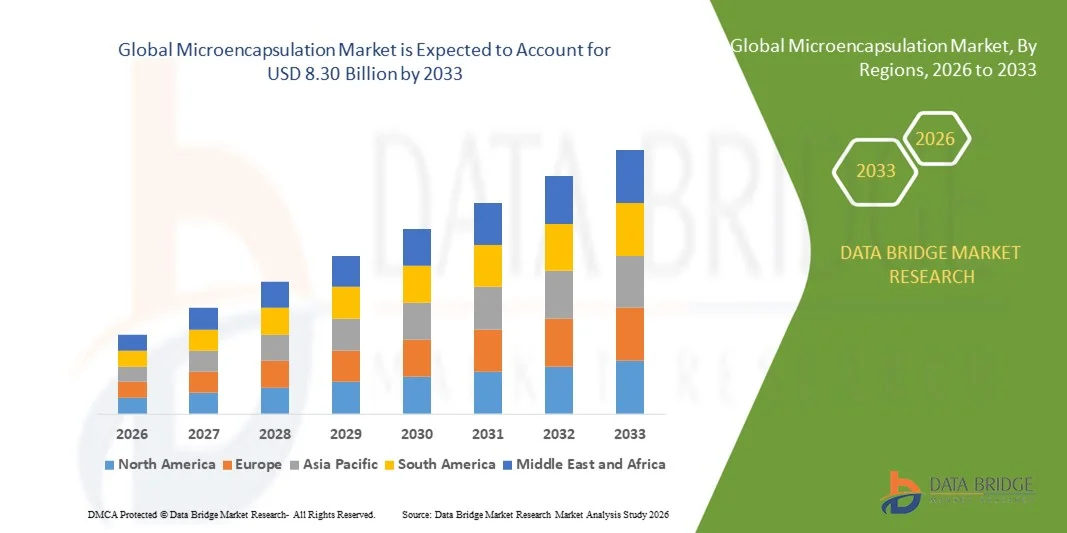
- As per Data Bridge Market Research Analysis the global microencapsulation market size was valued at USD 4.26 billion in 2025 and is expected to reach USD 8.30 billion by 2033, at a CAGR of 8.69% during the forecast period
- The market growth is largely fuelled by the increasing demand for controlled release technologies in food, pharmaceuticals, and cosmetics industries
- Rising adoption of microencapsulation in functional foods, nutraceuticals, and dietary supplements to enhance stability and bioavailability of active ingredients
Market Size and Forecast:
- Market Size (2025): USD 4.26 billion
- Projected Market Size (2033): USD 8.30 billion
- CAGR (2026-2033): 8.69%
How Microencapsulation Market Analysed ?
- The market is witnessing strong growth due to the expanding applications across diverse sectors such as food & beverages, healthcare, agriculture, and textiles
- Technological advancements in encapsulation techniques, such as spray drying, coacervation, and fluid bed coating, are enhancing efficiency and scalability
- North America dominated the microencapsulation market with the largest revenue share of 39.86% in 2025, driven by strong demand from the pharmaceutical, nutraceutical, and food industries. The region’s advanced R&D infrastructure, growing focus on controlled drug delivery systems, and widespread use of functional foods have accelerated the adoption of microencapsulation technologies
- Asia-Pacific region is expected to witness the highest growth rate in the global microencapsulation market, driven by expanding manufacturing capabilities, supportive government initiatives, and increasing applications across agriculture, food, and personal care sectors
- The Pharmaceutical and Healthcare Products segment held the largest market share in 2025, driven by the increasing use of microencapsulation in controlled drug delivery, sustained release formulations, and masking of unpleasant tastes. This segment benefits from rising R&D investments in personalized medicine and biocompatible encapsulation systems, which enhance therapeutic efficiency and patient compliance
How is the Microencapsulation Market Segmented ?
|
Attributes |
Microencapsulation Key Market Insights |
|
Segments Covered |
|
|
Countries Covered |
North America
Europe
Asia-Pacific
Middle East and Africa
South America
|
|
Key Market Players |
|
|
Market Opportunities |
|
|
Value Added Data Infosets |
In addition to the insights on market scenarios such as market value, growth rate, segmentation, geographical coverage, and major players, the market reports curated by the Data Bridge Market Research also include in-depth expert analysis, pricing analysis, brand share analysis, consumer survey, demography analysis, supply chain analysis, value chain analysis, raw material/consumables overview, vendor selection criteria, PESTLE Analysis, Porter Analysis, and regulatory framework. |
What are the Trends of Microencapsulation Market ?
Rising Adoption Of Microencapsulation In Functional Foods And Nutraceuticals
- The demand for functional foods and nutraceuticals is driving the adoption of microencapsulation to enhance ingredient stability, bioavailability, and targeted delivery. This technology allows sensitive nutrients such as vitamins, probiotics, and omega-3 fatty acids to be effectively protected from heat, oxygen, and moisture during processing and storage, improving shelf life and efficacy. As consumer preferences shift toward fortified and health-oriented food products, manufacturers are leveraging encapsulation to maintain the potency of bioactive compounds and ensure consistent product quality across distribution chains
- The increasing consumer focus on health, wellness, and preventive nutrition is encouraging manufacturers to use microencapsulation for controlled release of active compounds. This ensures precise dosage and sustained nutrient delivery, enhancing the performance of fortified food and supplement products. Companies are also exploring encapsulation of natural flavors and colors for cleaner label formulations, aligning with the trend toward transparency and minimal additives. The approach not only improves sensory experience but also boosts consumer trust in product safety and effectiveness
- Technological advancements such as nanoencapsulation and liposome-based encapsulation are further supporting innovation in food and beverage applications. These developments enable manufacturers to improve ingredient compatibility and sensory characteristics without compromising product stability or taste. Continuous innovation in polymer science and emulsification methods is enabling better control over particle size, release kinetics, and bioavailability, expanding the use of encapsulation across a wider range of food matrices
- For instance, in 2024, several global nutraceutical producers launched microencapsulated omega-3 and curcumin supplements that demonstrated significantly higher absorption rates than conventional formulations. These advancements are reshaping the competitive landscape by raising consumer expectations for performance-driven functional products. Such success stories are encouraging new entrants to invest in encapsulation R&D, fostering an ecosystem of innovation and collaboration among food technologists and biotech firms
- While adoption is growing, the success of microencapsulation in functional foods depends on cost-effective production methods and scalable delivery systems. Manufacturers are investing in R&D to optimize encapsulation efficiency and balance functionality with affordability. Partnerships with material science companies and universities are also helping reduce cost barriers and improve process sustainability, ensuring long-term viability in large-scale commercial food operations
What are the Dynamics of Microencapsulation Market ?
Driver
Increasing Demand For Controlled Release And Protection Of Active Ingredients
- The growing need to protect volatile, sensitive, or reactive ingredients is a major driver of the global microencapsulation market. This technology provides controlled release, masking of undesirable tastes, and extended shelf life, making it highly desirable across food, pharmaceutical, and cosmetic applications. By offering precise control over release profiles, it enhances efficacy and product performance, particularly for temperature- or pH-sensitive compounds that require targeted delivery
- In pharmaceuticals, microencapsulation allows precise dosing and sustained drug release, improving patient compliance and therapeutic efficacy. In agriculture, it enables gradual release of fertilizers and pesticides, reducing wastage and environmental impact. Such versatility across industries continues to accelerate its market penetration as stakeholders recognize its potential to reduce resource consumption and improve end-product quality. Governments and regulatory agencies are also promoting sustainable encapsulation technologies to minimize chemical exposure and improve environmental safety
- The rapid growth of personalized nutrition and targeted drug delivery is further propelling the use of microencapsulation. Consumers and healthcare providers are seeking solutions that combine effectiveness, safety, and convenience—characteristics microencapsulation can uniquely offer. As personalized formulations gain traction, encapsulation is becoming a key enabler in tailoring nutrient or drug delivery based on specific biological needs, creating new avenues for innovation and market differentiation
- For instance, in 2023, BASF and Evonik collaborated to develop biodegradable polymer-based microcapsules for drug delivery systems, enhancing release control and biocompatibility. Such partnerships are expanding the technological boundaries of the market and setting new standards for product safety and environmental compliance. Similar initiatives are being observed in food and cosmetic sectors, where bio-based encapsulation materials are emerging as sustainable alternatives to synthetic polymers
- While the demand for controlled-release applications is rising, ongoing efforts are required to standardize production methods and improve cost-efficiency to enable broader industrial adoption. Harmonizing global manufacturing standards will enhance quality consistency and accelerate regulatory approvals, allowing companies to expand their international presence. Research into novel encapsulation agents and automated processes continues to be pivotal in overcoming scalability and cost-related barriers
Restraint/Challenge
High Production Costs And Technical Complexity In Large-Scale Manufacturing
- Despite its advantages, the high cost of raw materials and complex processing technologies limit the widespread use of microencapsulation, particularly among small and medium-scale producers. Sophisticated techniques such as coacervation and spray drying require specialized equipment and technical expertise, increasing initial investment costs. Furthermore, frequent maintenance and quality control expenses add to operational costs, making adoption less feasible for cost-sensitive industries
- The scalability of microencapsulation systems remains a challenge, as maintaining uniform particle size, encapsulation efficiency, and release profiles during mass production is difficult. This variability can affect product performance, especially in pharmaceutical and nutraceutical applications. Large-scale facilities often struggle to replicate lab-scale results, prompting manufacturers to invest heavily in process optimization and automation to achieve consistency without compromising quality
- Limited awareness among end-users and cost-sensitive markets also hinders adoption, as many producers are hesitant to integrate encapsulation due to perceived complexity or lack of immediate returns on investment. This creates a gap between technological potential and commercial implementation. To bridge this, industry associations and academic institutions are increasingly offering technical training and pilot-scale facilities to demonstrate feasibility and build confidence among producers
- For instance, in 2023, several food manufacturers in Latin America reported difficulties in scaling encapsulation processes due to high equipment costs and lack of trained technical staff, slowing innovation across the region. Governments and development agencies have since launched funding initiatives to improve access to encapsulation technology and foster skill development in emerging markets. Such initiatives are expected to reduce the technology gap and encourage broader regional participation
- While the market continues to evolve, addressing cost and scalability challenges through automation, novel materials, and process optimization will be critical for achieving long-term competitiveness and adoption across industries. Manufacturers are focusing on sustainable encapsulating agents and simplified processes to minimize expenses while improving throughput. Collaborative innovation and public-private partnerships are likely to play a vital role in overcoming these barriers and supporting global expansion
What is Scope of Microencapsulation Market ?
The market is segmented on the basis of application, technology, core material, and shell material.
- By Application
On the basis of application, the microencapsulation market is segmented into Pharmaceutical and Healthcare Products, Food and Beverages, Household and Personal Care Products, Agrochemicals, Construction Materials, Textiles, and Others. The Pharmaceutical and Healthcare Products segment held the largest market share in 2025, driven by the increasing use of microencapsulation in controlled drug delivery, sustained release formulations, and masking of unpleasant tastes. This segment benefits from rising R&D investments in personalized medicine and biocompatible encapsulation systems, which enhance therapeutic efficiency and patient compliance.
The Food and Beverages segment is expected to witness the fastest growth from 2026 to 2033, fuelled by the rising demand for functional and fortified food products. Microencapsulation is widely used to protect sensitive ingredients such as probiotics, vitamins, and omega-3 fatty acids, ensuring stability and controlled release during processing and storage. The growing trend toward health-focused and clean-label formulations continues to support strong adoption across the food sector.
- By Technology
On the basis of technology, the microencapsulation market is segmented into Spray Technologies, Emulsion Technologies, Dripping Technologies, and Other Technologies. The Spray Technologies segment dominated the market in 2025 owing to its high efficiency, scalability, and cost-effectiveness in producing uniform microcapsules. It is extensively utilized across pharmaceutical and food industries for encapsulating heat-sensitive and volatile compounds, offering better process control and consistency.
The Emulsion Technologies segment is projected to register significant growth between 2026 and 2033 due to its suitability for encapsulating both hydrophilic and lipophilic compounds. This technique is gaining popularity in cosmetic, food, and agricultural applications for its ability to achieve precise particle size control and stable encapsulation performance, supporting innovation in multifunctional formulations.
- By Core Material
On the basis of core material, the market is categorized into Agricultural Inputs, Food Additives, Pharmaceutical and Healthcare Drugs, Fragrances, Phase Change Materials, and Others. The Pharmaceutical and Healthcare Drugs segment accounted for the largest market share in 2025, driven by the growing use of encapsulation in drug delivery systems for enhanced bioavailability and targeted release. The increasing focus on patient-centric drug formulations and advanced therapeutic delivery platforms continues to propel segment growth.
The Food Additives segment is expected to witness the fastest growth from 2026 to 2033, supported by the demand for stable and controlled-release flavorings, colors, and nutrients. Microencapsulation ensures improved sensory quality and product stability, aligning with the industry’s shift toward fortified and functional food offerings.
- By Shell Material
On the basis of shell material, the microencapsulation market is segmented into Polymers, Gums and Resins, Lipids, Carbohydrates, and Proteins. The Polymers segment led the market in 2025, owing to their superior mechanical strength, chemical resistance, and flexibility in controlling release profiles. Synthetic and biodegradable polymers are widely used across pharmaceuticals, food, and agriculture for developing tailored encapsulation systems that ensure performance reliability.
The Lipids segment is expected to witness the fastest growth from 2026 to 2033, driven by increasing interest in natural and biocompatible encapsulation materials. Lipid-based coatings offer excellent biocompatibility, moisture protection, and sustained release capabilities, making them ideal for nutraceuticals, cosmetics, and functional food applications. The rising shift toward sustainable and clean-label solutions further supports the segment’s rapid growth.
Which Region Holds the Largest Share of the Microencapsulation Market ?
- North America dominated the microencapsulation market with the largest revenue share of 39.86% in 2025, driven by strong demand from the pharmaceutical, nutraceutical, and food industries. The region’s advanced R&D infrastructure, growing focus on controlled drug delivery systems, and widespread use of functional foods have accelerated the adoption of microencapsulation technologies
- Increasing investments by key industry players and a well-established regulatory framework supporting product innovation further strengthen market growth across the region
- The rising preference for value-added and health-oriented food products, coupled with the presence of leading pharmaceutical companies, is enhancing the adoption of encapsulation methods for better ingredient stability and bioavailability. Technological advancements and the growing trend toward personalized nutrition are also driving the expansion of microencapsulation applications across healthcare and food sectors
U.S. Microencapsulation Market Insight
The U.S. microencapsulation market captured the largest revenue share in 2025 within North America, driven by strong demand in the pharmaceutical and nutraceutical sectors. The country’s well-developed healthcare infrastructure and rising consumer preference for functional and fortified food products are key factors fuelling growth. Increasing investments in drug delivery innovations, along with expanding applications in cosmetics and agriculture, are further contributing to market expansion. Moreover, collaboration between biotechnology firms and material science companies is promoting the development of cost-efficient and sustainable encapsulation technologies.
Europe Microencapsulation Market Insight
The Europe microencapsulation market is expected to witness robust growth from 2026 to 2033, primarily driven by the growing demand for sustainable and biodegradable encapsulation materials. Stringent regulatory standards promoting environmental safety and product quality are encouraging innovation across food, pharmaceutical, and agricultural industries. The region’s growing focus on clean-label formulations and organic products is further boosting the use of natural encapsulating agents. In addition, the expansion of nutraceutical and functional beverage segments across countries such as Germany, France, and the U.K. is expected to sustain strong market growth.
U.K. Microencapsulation Market Insight
The U.K. microencapsulation market is projected to register one of the fastest growth rates from 2026 to 2033, supported by the increasing adoption of advanced food technologies and health-oriented product innovations. Rising consumer awareness of nutritional supplements, coupled with a strong focus on sustainable packaging and bio-based materials, is propelling the market. Furthermore, the pharmaceutical industry’s emphasis on controlled drug release and targeted therapies is creating new opportunities for encapsulation applications. Growing collaborations between academic research institutions and industrial players are also driving the development of novel encapsulation systems across the country.
Germany Microencapsulation Market Insight
The Germany microencapsulation market is expected to witness significant growth from 2026 to 2033, driven by increasing demand for high-performance ingredients in pharmaceuticals, food, and cosmetics. The country’s advanced manufacturing infrastructure and commitment to technological innovation support the large-scale production of encapsulated materials. Sustainability remains a key focus area, with German manufacturers increasingly adopting bio-based polymers and environmentally friendly encapsulation techniques. Furthermore, the strong presence of leading chemical and pharmaceutical companies continues to strengthen Germany’s position as a major hub for encapsulation research and commercialization.
Asia-Pacific Microencapsulation Market Insight
The Asia-Pacific microencapsulation market is expected to witness the fastest growth from 2026 to 2033, driven by rapid industrialization, expanding food and pharmaceutical sectors, and growing awareness of product quality. Countries such as China, Japan, and India are at the forefront of adopting encapsulation technologies for functional foods, drug formulations, and agricultural applications. Rising disposable incomes and an increasing preference for fortified and value-added products are further boosting market demand. In addition, government initiatives promoting technological innovation and foreign investments in healthcare manufacturing are enhancing the regional market outlook.
Japan Microencapsulation Market Insight
The Japan microencapsulation market is anticipated to experience strong growth from 2026 to 2033, driven by the country’s advanced technology base and emphasis on product innovation. The growing popularity of dietary supplements, fortified beverages, and skincare products is fuelling demand for encapsulated active ingredients. Japan’s pharmaceutical sector is increasingly utilizing microencapsulation for controlled drug delivery and improved therapeutic outcomes. In addition, the nation’s focus on high-quality, functional, and sustainable solutions is supporting the adoption of advanced encapsulation materials and techniques across multiple industries.
China Microencapsulation Market Insight
The China microencapsulation market accounted for the largest revenue share in the Asia-Pacific region in 2025, supported by strong growth in the food, pharmaceutical, and agricultural sectors. The country’s rapidly expanding middle class, urbanization, and increasing demand for processed and fortified foods are key drivers of market growth. Domestic manufacturers are heavily investing in R&D to develop cost-effective and scalable encapsulation solutions, making the technology more accessible to small and medium enterprises. Moreover, government initiatives promoting food safety and technological innovation are further propelling the adoption of microencapsulation across various end-use industries.
What is the Microencapsulation Market Share ?
The Microencapsulation industry is primarily led by well-established companies, including:
• BASF SE (Germany)
• Syngenta Crop Protection, Inc. (Switzerland)
• DSM (Netherlands)
• Givaudan (Switzerland)
• International Flavors & Fragrances Inc. (U.S.)
• Symrise (Germany)
• Lycored (Israel)
• Koehler Innovative Solutions (Germany)
• Balchem Corporation (U.S.)
• Encapsys, LLC. (U.S.)
• AVEKA, Inc. (U.S.)
• Reed Pacific (Australia)
• Microtek Laboratories, Inc. (U.S.)
• TasteTech (U.K.)
• RONALD T. DODGE COMPANY (U.S.)
• Evonik Industries AG (Germany)
• Bayer AG (Germany)
• 3M (U.S.)
What are the Latest Developments in Microencapsulation Market ?
- In November 2024, Milliken introduced a new microplastic-free polymer technology in Brazil aimed at enhancing agricultural efficiency. This development utilizes advanced microencapsulation techniques to protect active ingredients and enable controlled, targeted release of crop protection products. The technology significantly reduces environmental impact while improving the performance and sustainability of agrochemicals. This innovation is expected to strengthen Milliken’s position in the sustainable agriculture sector and drive growth in the global microencapsulation market

- Interactive Data Analysis Dashboard
- Company Analysis Dashboard for high growth potential opportunities
- Research Analyst Access for customization & queries
- Competitor Analysis with Interactive dashboard
- Latest News, Updates & Trend analysis
- Harness the Power of Benchmark Analysis for Comprehensive Competitor Tracking
Global Microencapsulation Market, Supply Chain Analysis and Ecosystem Framework
To support market growth and help clients navigate the impact of geopolitical shifts, DBMR has integrated in-depth supply chain analysis into its Global Microencapsulation Market research reports. This addition empowers clients to respond effectively to global changes affecting their industries. The supply chain analysis section includes detailed insights such as Global Microencapsulation Market consumption and production by country, price trend analysis, the impact of tariffs and geopolitical developments, and import and export trends by country and HSN code. It also highlights major suppliers with data on production capacity and company profiles, as well as key importers and exporters. In addition to research, DBMR offers specialized supply chain consulting services backed by over a decade of experience, providing solutions like supplier discovery, supplier risk assessment, price trend analysis, impact evaluation of inflation and trade route changes, and comprehensive market trend analysis.
Data collection and base year analysis are done using data collection modules with large sample sizes. The stage includes obtaining market information or related data through various sources and strategies. It includes examining and planning all the data acquired from the past in advance. It likewise envelops the examination of information inconsistencies seen across different information sources. The market data is analysed and estimated using market statistical and coherent models. Also, market share analysis and key trend analysis are the major success factors in the market report. To know more, please request an analyst call or drop down your inquiry.
The key research methodology used by DBMR research team is data triangulation which involves data mining, analysis of the impact of data variables on the market and primary (industry expert) validation. Data models include Vendor Positioning Grid, Market Time Line Analysis, Market Overview and Guide, Company Positioning Grid, Patent Analysis, Pricing Analysis, Company Market Share Analysis, Standards of Measurement, Global versus Regional and Vendor Share Analysis. To know more about the research methodology, drop in an inquiry to speak to our industry experts.
Data Bridge Market Research is a leader in advanced formative research. We take pride in servicing our existing and new customers with data and analysis that match and suits their goal. The report can be customized to include price trend analysis of target brands understanding the market for additional countries (ask for the list of countries), clinical trial results data, literature review, refurbished market and product base analysis. Market analysis of target competitors can be analyzed from technology-based analysis to market portfolio strategies. We can add as many competitors that you require data about in the format and data style you are looking for. Our team of analysts can also provide you data in crude raw excel files pivot tables (Fact book) or can assist you in creating presentations from the data sets available in the report.













