




Global Microplate Systems Market
Market Size in USD Billion
CAGR :
% 
 USD
4.17 Billion
USD
5.76 Billion
2025
2033
USD
4.17 Billion
USD
5.76 Billion
2025
2033
 Forecast Period Forecast Period |
2026 –2033 |
 Market Size (Base Year) Market Size (Base Year) |
USD 4.17 Billion |
 Market Size (Forecast Year) Market Size (Forecast Year) |
USD 5.76 Billion |
 CAGR CAGR |
% |
| Major Markets Players |
|
Microplate Systems Market Size
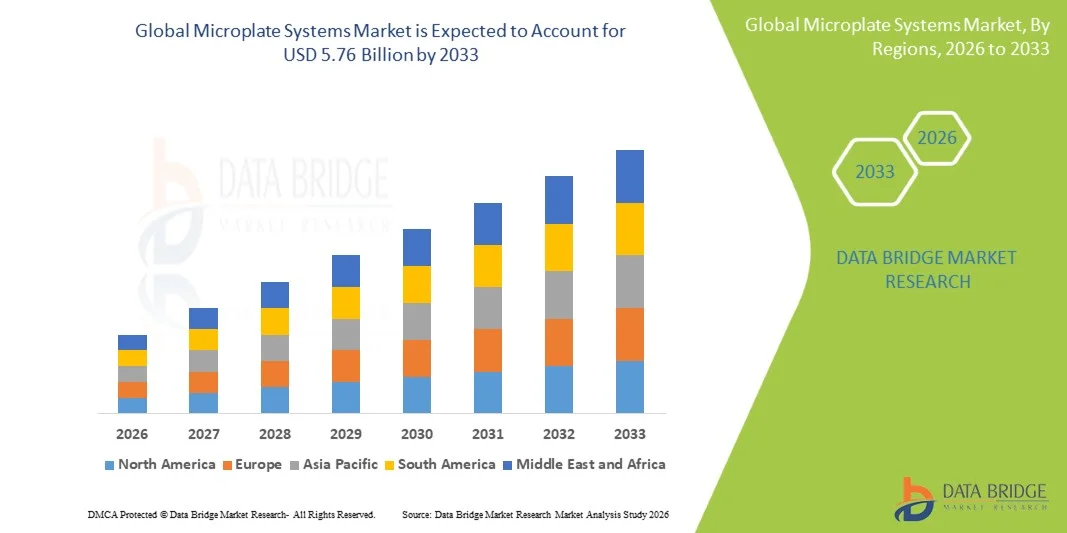
- The global microplate systems market size was valued at USD 4.17 billion in 2025 and is expected to reach USD 5.76 billion by 2033, at a CAGR of 4.13% during the forecast period
- The market growth is largely driven by the increasing adoption of high-throughput screening technologies and automation in life science research, pharmaceutical development, and clinical diagnostics
- Furthermore, the rising demand for efficient laboratory workflows, rapid drug discovery processes, and advanced analytical platforms is establishing microplate systems as essential tools in modern laboratories. These converging factors are accelerating the adoption of microplate technologies, thereby significantly supporting the market’s expansion
Microplate Systems Market Analysis
- Microplate systems, used for high-throughput sample analysis and detection in laboratory workflows, are increasingly essential components of modern life science research, pharmaceutical development, and clinical diagnostics due to their ability to enable rapid screening, automation compatibility, and precise data generation across multiple samples simultaneously
- The escalating demand for microplate systems is primarily fueled by the growing focus on drug discovery, increasing adoption of high-throughput screening technologies, and the rising need for efficient and automated laboratory processes in research institutions and biotechnology companies
- North America dominated the microplate systems market with the largest revenue share of 41.08% in 2025, characterized by strong pharmaceutical and biotechnology research activities, significant investments in life sciences, and the presence of leading laboratory instrument manufacturers, with the U.S. experiencing notable growth in automated microplate platforms driven by expanding genomic and proteomic research initiatives
- Asia-Pacific is expected to be the fastest growing region in the microplate systems market during the forecast period due to expanding biotechnology industries, increasing research funding, and the rapid development of pharmaceutical manufacturing capabilities
- Microplate reader segment dominated the microplate systems market with a market share of 46.5% in 2025, driven by their extensive use in absorbance, fluorescence, and luminescence detection applications across drug discovery, diagnostics, and academic research laboratories
Report Scope and Microplate Systems Market Segmentation
|
Attributes |
Microplate Systems Key Market Insights |
|
Segments Covered |
|
|
Countries Covered |
North America
Europe
Asia-Pacific
Middle East and Africa
South America
|
|
Key Market Players |
|
|
Market Opportunities |
|
|
Value Added Data Infosets |
In addition to the insights on market scenarios such as market value, growth rate, segmentation, geographical coverage, and major players, the market reports curated by the Data Bridge Market Research also include in-depth expert analysis, patient epidemiology, pipeline analysis, pricing analysis, and regulatory framework |
Microplate Systems Market Trends
“Increasing Adoption of Automated High-Throughput Screening Platforms”
- A significant and accelerating trend in the global microplate systems market is the increasing integration of automation technologies and advanced detection systems in laboratory workflows such as drug discovery, genomics, and proteomics research. This technological advancement is significantly improving laboratory productivity and experimental efficiency
- For instance, the Varioskan LUX Multimode Microplate Reader from Thermo Fisher Scientific offers automated detection modes including absorbance, fluorescence, and luminescence, enabling researchers to conduct complex assays quickly while maintaining high accuracy and reproducibility in laboratory environments
- Automation integration in microplate systems enables features such as rapid sample processing, automated data acquisition, and compatibility with robotic liquid handling systems. For instance, some microplate platforms developed by BioTek Instruments support automated plate handling and integrated software that streamlines assay workflows and enhances experimental consistency. Furthermore, automation capabilities offer laboratories the ease of processing hundreds of samples simultaneously, improving throughput and minimizing manual errors
- The seamless integration of microplate systems with laboratory information management systems and robotic platforms facilitates centralized management of experimental workflows and data. Through a unified interface, researchers can manage sample analysis, assay protocols, and data interpretation alongside other automated laboratory instruments, creating an efficient and interconnected research environment
- This trend towards more automated, accurate, and high-capacity laboratory systems is fundamentally reshaping user expectations for research productivity. Consequently, companies such as BMG LABTECH are developing advanced microplate readers with integrated automation features designed to support large-scale screening and complex biological assays
- The demand for microplate systems that offer seamless automation, data integration, and high-throughput screening capabilities is growing rapidly across pharmaceutical, biotechnology, and academic research institutions as laboratories increasingly prioritize efficiency and scalable experimental processes
- Growing adoption of microplate-based assays in clinical diagnostics and molecular biology research is expanding the application scope of microplate systems, particularly in disease detection, biomarker analysis, and precision medicine studies
Microplate Systems Market Dynamics
Driver
“Growing Demand for High-Throughput Screening in Drug Discovery”
- The increasing need for rapid drug discovery and biological analysis, coupled with the expanding pharmaceutical and biotechnology research activities, is a significant driver for the heightened demand for microplate systems
- For instance, in June 2024, PerkinElmer Inc. introduced new automated microplate-based assay technologies designed to enhance high-throughput screening and accelerate drug development workflows in pharmaceutical laboratories. Such strategies by key companies are expected to drive the microplate systems industry growth in the forecast period
- As pharmaceutical companies intensify research into novel therapeutics and biologics, microplate systems enable laboratories to analyze thousands of samples efficiently while maintaining high precision and reliability in experimental outcomes
- Furthermore, the growing popularity of automated laboratory technologies and the demand for faster research results are making microplate systems an integral component of modern laboratory infrastructure, enabling seamless integration with robotic systems and advanced detection instruments
- The capability of microplate platforms to support multiple assay formats, reduce reagent consumption, and deliver rapid analytical results are key factors propelling the adoption of microplate systems in pharmaceutical, biotechnology, and academic laboratories. The expansion of genomics, proteomics, and molecular diagnostics research further contributes to market growth
- Increasing investments in life science research and government funding for biotechnology innovation are further accelerating the adoption of advanced microplate systems in academic and research laboratories worldwide
- The growing number of contract research organizations conducting high-volume biological screening and compound testing is further increasing the demand for high-performance microplate systems to support large-scale research projects
Restraint/Challenge
“High Instrument Cost and Technical Complexity in Advanced Systems”
- Concerns surrounding the high initial investment required for advanced microplate systems, along with their technical complexity, pose a significant challenge to broader market adoption. As these systems incorporate sophisticated detection technologies and automation capabilities, they require substantial capital investment and specialized technical expertise
- For instance, high-performance microplate readers equipped with multimode detection and robotic integration capabilities can be expensive for smaller laboratories and research institutes, limiting adoption in resource-constrained environments
- Addressing these cost and complexity concerns through improved system affordability, modular designs, and simplified user interfaces is crucial for expanding accessibility. Companies such as Agilent Technologies emphasize user-friendly software and scalable platform configurations to help laboratories adopt advanced microplate technologies more efficiently. In addition, the need for skilled personnel to operate and maintain automated laboratory equipment can act as a barrier for smaller research facilities
- While technological advancements continue to improve system performance, the operational complexity associated with integrating microplate systems with robotic platforms and data management software may discourage adoption among laboratories with limited technical infrastructure
- Overcoming these challenges through cost-effective instrument designs, enhanced training programs for laboratory personnel, and the development of simplified automation solutions will be vital for sustained market growth in the global microplate systems industry
- Limited technical expertise and lack of trained laboratory professionals in some emerging markets can slow the effective implementation and operation of advanced microplate platforms in research facilities
- In addition, maintenance costs, calibration requirements, and the need for periodic software updates for automated microplate systems can increase the total cost of ownership, creating adoption barriers for smaller laboratories and academic institutions
Microplate Systems Market Scope
The market is segmented on the basis of product, application, and end users.
- By Product
On the basis of product, the microplate systems market is segmented into microplate reader, microplate washer, and microplate accessories. The microplate reader segment dominated the market with the largest market revenue share of 46.5% in 2025, driven by its critical role in detecting and analyzing biological, chemical, and physical reactions in microplate assays. Microplate readers are widely used in pharmaceutical and biotechnology laboratories for applications such as enzyme-linked immunosorbent assays (ELISA), fluorescence-based assays, and luminescence detection. Their ability to deliver rapid, accurate, and high-throughput analysis makes them essential for drug discovery and molecular biology research. In addition, continuous advancements in multimode readers capable of handling multiple detection technologies have increased their versatility across different research applications. The growing demand for automated and high-throughput laboratory workflows further strengthens the adoption of microplate readers in research institutions and diagnostic laboratories worldwide.
The microplate washer segment is anticipated to witness the fastest growth rate from 2026 to 2033, fueled by the increasing need for precise washing steps in immunoassays and other microplate-based experimental procedures. Microplate washers play an essential role in removing unbound reagents and minimizing background interference during assays, ensuring accurate and reliable results. Their growing use in ELISA testing and clinical diagnostics has significantly contributed to market expansion. Furthermore, the increasing automation of laboratory workflows is driving the demand for advanced microplate washers integrated with programmable wash cycles and compatibility with automated systems. Pharmaceutical companies and research laboratories are increasingly adopting these systems to enhance operational efficiency and maintain high assay reproducibility. As laboratories continue to prioritize automation and improved experimental accuracy, the demand for microplate washers is expected to grow steadily during the forecast period.
- By Application
On the basis of application, the microplate systems market is segmented into drug discovery, clinical diagnostic tests, genomics and proteomics research, and others. The drug discovery segment dominated the market with the largest market revenue share in 2025, driven by the increasing need for high-throughput screening technologies in pharmaceutical and biotechnology research. Microplate systems allow researchers to test thousands of chemical compounds and biological samples simultaneously, significantly accelerating the early stages of drug development. Pharmaceutical companies rely heavily on these systems to identify potential drug candidates, evaluate biological activity, and conduct toxicity testing. In addition, the growing focus on personalized medicine and biologics development has further increased the adoption of microplate-based assays in drug discovery workflows. Their compatibility with automation platforms and robotic systems also supports large-scale experimental screening, making them indispensable tools in modern pharmaceutical research laboratories.
The genomics and proteomics research segment is expected to witness the fastest growth rate from 2026 to 2033, driven by the expanding field of molecular biology and increasing investments in genetic research. Microplate systems are widely used in DNA sequencing, gene expression analysis, protein quantification, and biomarker discovery studies. The rapid advancement of genomic technologies and the increasing focus on precision medicine are further encouraging the use of microplate-based assays for analyzing complex biological samples. Research institutions and biotechnology companies are adopting these systems to support large-scale genomic and proteomic experiments that require high accuracy and throughput. Moreover, government initiatives promoting genetic research and biomedical innovation are creating favorable conditions for the expansion of this segment during the forecast period.
- By End Users
On the basis of end users, the microplate systems market is segmented into biotechnology and pharmaceutical companies, hospital and diagnostic laboratories, and research and academic institutes. The biotechnology and pharmaceutical companies segment dominated the market with the largest market revenue share in 2025, driven by the extensive use of microplate systems in drug discovery, compound screening, and biological assay development. These organizations require high-throughput analytical technologies to accelerate research timelines and improve productivity in laboratory operations. Microplate systems enable pharmaceutical companies to efficiently conduct large-scale testing of chemical compounds and biological samples during early-stage drug development. In addition, the rising number of biotechnology startups and increasing investments in life science innovation have further strengthened the demand for advanced microplate technologies. The integration of automated laboratory equipment within pharmaceutical research facilities has also contributed significantly to the expansion of this segment.
The research and academic institutes segment is expected to witness the fastest growth rate from 2026 to 2033, fueled by the increasing number of scientific research projects in life sciences, molecular biology, and biomedical engineering. Universities and research centers are increasingly adopting microplate systems to conduct experiments involving cell biology, genetics, and biochemical analysis. The availability of government funding and research grants for scientific innovation is encouraging academic institutions to invest in advanced laboratory technologies. Microplate systems provide researchers with the ability to analyze multiple samples simultaneously, making them highly suitable for large-scale experimental studies. As academic research activities continue to expand globally, particularly in emerging economies, the demand for microplate systems in research and educational institutions is expected to grow rapidly during the forecast period.
Microplate Systems Market Regional Analysis
- North America dominated the microplate systems market with the largest revenue share of 41.08% in 2025, characterized by strong pharmaceutical and biotechnology research activities, significant investments in life sciences, and the presence of leading laboratory instrument manufacturers
- Research organizations in the region highly value the efficiency, high-throughput screening capability, and analytical precision offered by microplate systems for applications such as drug discovery, clinical diagnostics, and genomics research
- This widespread adoption is further supported by significant research funding, a well-established laboratory infrastructure, and the growing focus on precision medicine and biomedical innovation, establishing microplate systems as essential analytical tools for pharmaceutical companies, diagnostic laboratories, and academic research institutions
U.S. Microplate Systems Market Insight
The U.S. microplate systems market captured the largest revenue share of 80% in 2025 within North America, fueled by strong investments in pharmaceutical research and the expanding scope of biotechnology innovation. Research organizations are increasingly prioritizing advanced laboratory technologies that enable high-throughput screening and efficient biological analysis. The growing focus on drug discovery, genomics, and precision medicine, combined with the presence of leading pharmaceutical and biotechnology companies, further propels the microplate systems industry. Moreover, the increasing integration of automated laboratory workflows and advanced detection technologies is significantly contributing to the market's expansion.
Europe Microplate Systems Market Insight
The Europe microplate systems market is projected to expand at a substantial CAGR throughout the forecast period, primarily driven by increasing research activities in biotechnology and pharmaceutical development. The rise in biomedical innovation, coupled with the growing demand for advanced laboratory equipment, is fostering the adoption of microplate systems. European research institutions are also drawn to the efficiency, accuracy, and high-throughput capabilities these systems provide. The region is experiencing significant growth across pharmaceutical companies, diagnostic laboratories, and academic research institutes, with microplate systems being incorporated into both new research facilities and upgraded laboratory infrastructures.
U.K. Microplate Systems Market Insight
The U.K. microplate systems market is anticipated to grow at a noteworthy CAGR during the forecast period, driven by increasing investments in life sciences and the expansion of biomedical research initiatives. In addition, the demand for efficient laboratory workflows and advanced analytical technologies is encouraging research institutions and biotechnology companies to adopt microplate systems. The country’s strong academic research environment, alongside its well-developed healthcare and pharmaceutical industries, is expected to continue to stimulate market growth.
Germany Microplate Systems Market Insight
The Germany microplate systems market is expected to expand at a considerable CAGR during the forecast period, fueled by increasing investments in biotechnology research and the demand for technologically advanced laboratory solutions. Germany’s well-established pharmaceutical industry, combined with its emphasis on scientific innovation and precision engineering, promotes the adoption of microplate systems in both research and diagnostic laboratories. The integration of automated laboratory instruments and advanced assay technologies is also becoming increasingly prevalent, with a strong preference for highly accurate and reliable analytical platforms aligning with local research requirements.
Asia-Pacific Microplate Systems Market Insight
The Asia-Pacific microplate systems market is poised to grow at the fastest CAGR of 23% during the forecast period of 2026 to 2033, driven by expanding pharmaceutical manufacturing, increasing research funding, and rapid growth in biotechnology industries in countries such as China, Japan, and India. The region's growing focus on biomedical research and drug discovery, supported by government initiatives promoting scientific innovation, is driving the adoption of microplate systems. Furthermore, as Asia-Pacific emerges as a major hub for pharmaceutical research and contract research organizations, the demand for advanced laboratory technologies is expanding to a wider base of research institutions.
Japan Microplate Systems Market Insight
The Japan microplate systems market is gaining momentum due to the country’s advanced life sciences research infrastructure, rapid technological innovation, and growing demand for high-throughput analytical platforms. The Japanese market places significant emphasis on scientific precision and laboratory automation, and the adoption of microplate systems is driven by the increasing number of research projects in genomics, proteomics, and drug development. The integration of automated laboratory instruments and advanced assay technologies is fueling growth. Moreover, Japan's strong biotechnology sector is likely to spur demand for highly efficient analytical solutions in both academic and industrial laboratories.
India Microplate Systems Market Insight
The India microplate systems market accounted for the largest market revenue share in Asia Pacific in 2025, attributed to the country's expanding pharmaceutical industry, growing biotechnology research activities, and increasing investments in healthcare innovation. India stands as one of the rapidly growing markets for life science research technologies, and microplate systems are becoming increasingly important in pharmaceutical companies, diagnostic laboratories, and research institutes. The push towards advanced biomedical research and the expansion of contract research organizations, alongside government initiatives supporting biotechnology development, are key factors propelling the market in India.
Microplate Systems Market Share
The Microplate Systems industry is primarily led by well-established companies, including:
- Thermo Fisher Scientific Inc. (U.S.)
- Tecan Group Ltd. (Switzerland)
- BMG LABTECH GmbH (Germany)
- PerkinElmer Inc. (U.S.)
- Bio-Rad Laboratories, Inc. (U.S.)
- Promega Corporation (U.S.)
- Berthold Technologies GmbH & Co. KG (Germany)
- Corning Incorporated (U.S.)
- Lonza Group AG (Switzerland)
- Eppendorf SE (Germany)
- Shimadzu Corporation (Japan)
- Dynex Technologies, Inc. (U.S.)
- Awareness Technology, Inc. (U.S.)
- Rayto Life and Analytical Sciences Co., Ltd. (China)
- Mindray Bio-Medical Electronics Co., Ltd. (China)
- Azure Biosystems, Inc. (U.S.)
- Accuris Instruments (U.S.)
- CTK Biotech, Inc. (U.S.)
- Enzo Life Sciences, Inc. (U.S.)
- Labtech International Ltd. (U.K.)
What are the Recent Developments in Global Microplate Systems Market?
- In July 2025, Molecular Devices announced the launch of the SpectraMax iD5e and SpectraMax iD3s Multi-Mode Microplate Readers, designed to enhance research capabilities across drug discovery and multi-omics applications. The new systems provide tunable monochromator-based measurements and advanced features such as SmartInject technology for precise reagent mixing. They also include capabilities such as temperature control and live-cell assay support, enabling researchers to conduct complex biochemical and cellular experiments more efficiently. The launch reflects the growing demand for flexible high-throughput screening tools in life science laboratories
- In June 2024, Thermo Fisher Scientific unveiled new analytical research solutions at the American Society for Mass Spectrometry (ASMS) Conference, aimed at accelerating scientific discovery and improving laboratory productivity. These innovations focus on improving analytical sensitivity, workflow efficiency, and integration of advanced laboratory instruments used in biomedical and pharmaceutical research. Such advancements demonstrate the industry’s ongoing efforts to enhance laboratory technologies that support large-scale biological analysis and precision medicine research
- In February 2024, Thermo Fisher Scientific announced the launch of a new generation of automated microplate reading systems designed to improve throughput and data integration in clinical and life science laboratories. The new systems enable faster detection and analysis of biological samples across multiple assay types, supporting applications such as drug discovery and clinical diagnostics
- In February 2023, PerkinElmer Inc. launched the EnVision Nexus multimode plate reader, its fastest and most sensitive plate reader developed for high-throughput screening applications. The system was designed to accelerate drug discovery by enabling researchers to screen millions of samples with improved accuracy and speed. It also supports automation and integrates with complementary microplates and reagents to enhance assay flexibility. The launch demonstrates the company’s commitment to advancing laboratory technologies that improve productivity and efficiency in biomedical research
- In April 2022, Molecular Devices introduced the SpectraMax Mini Multi-Mode Microplate Reader, a compact system designed for academic and biotechnology laboratories seeking high-performance analysis at a lower cost. The device offers multiple detection modes while maintaining strong sensitivity and productivity for applications such as ELISA, cell-based assays, and biochemical testing. The launch aims to make advanced microplate technologies more accessible to smaller laboratories and research institutions
SKU-
Get online access to the report on the World's First Market Intelligence Cloud

- Interactive Data Analysis Dashboard
- Company Analysis Dashboard for high growth potential opportunities
- Research Analyst Access for customization & queries
- Competitor Analysis with Interactive dashboard
- Latest News, Updates & Trend analysis
- Harness the Power of Benchmark Analysis for Comprehensive Competitor Tracking
Research Methodology
Data collection and base year analysis are done using data collection modules with large sample sizes. The stage includes obtaining market information or related data through various sources and strategies. It includes examining and planning all the data acquired from the past in advance. It likewise envelops the examination of information inconsistencies seen across different information sources. The market data is analysed and estimated using market statistical and coherent models. Also, market share analysis and key trend analysis are the major success factors in the market report. To know more, please request an analyst call or drop down your inquiry.
The key research methodology used by DBMR research team is data triangulation which involves data mining, analysis of the impact of data variables on the market and primary (industry expert) validation. Data models include Vendor Positioning Grid, Market Time Line Analysis, Market Overview and Guide, Company Positioning Grid, Patent Analysis, Pricing Analysis, Company Market Share Analysis, Standards of Measurement, Global versus Regional and Vendor Share Analysis. To know more about the research methodology, drop in an inquiry to speak to our industry experts.
Customization Available
Data Bridge Market Research is a leader in advanced formative research. We take pride in servicing our existing and new customers with data and analysis that match and suits their goal. The report can be customized to include price trend analysis of target brands understanding the market for additional countries (ask for the list of countries), clinical trial results data, literature review, refurbished market and product base analysis. Market analysis of target competitors can be analyzed from technology-based analysis to market portfolio strategies. We can add as many competitors that you require data about in the format and data style you are looking for. Our team of analysts can also provide you data in crude raw excel files pivot tables (Fact book) or can assist you in creating presentations from the data sets available in the report.












