




Global Microsurgery Market
Market Size in USD Billion
CAGR :
% 
 USD
2.78 Billion
USD
4.74 Billion
2025
2033
USD
2.78 Billion
USD
4.74 Billion
2025
2033
 Forecast Period Forecast Period |
2026 –2033 |
 Market Size (Base Year) Market Size (Base Year) |
USD 2.78 Billion |
 Market Size (Forecast Year) Market Size (Forecast Year) |
USD 4.74 Billion |
 CAGR CAGR |
% |
| Major Markets Players |
|
Microsurgery Market Size
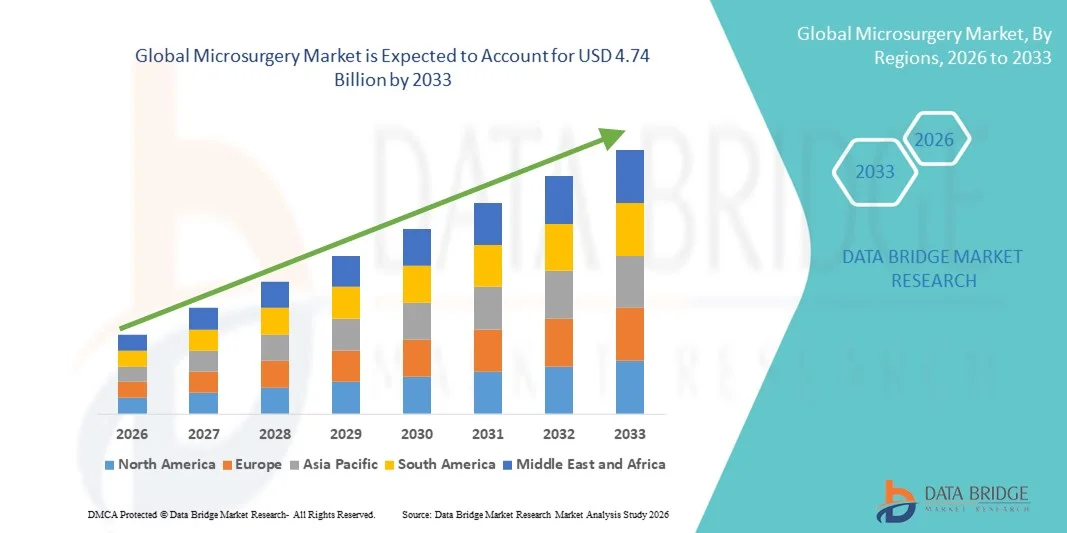
- The global microsurgery market size was valued at USD 2.78 billion in 2025 and is expected to reach USD 4.74 billion by 2033, at a CAGR of 6.90% during the forecast period
- The market growth is largely fueled by the increasing prevalence of chronic diseases, traumatic injuries, and complex surgical conditions requiring high-precision procedures, along with continuous technological advancements in surgical microscopes, micro-instruments, and robotic-assisted systems, leading to enhanced surgical accuracy and improved patient outcomes across hospitals and specialty clinics
- Furthermore, rising demand for minimally invasive procedures, growing adoption of reconstructive and plastic surgeries, and expanding applications in neurosurgery, ophthalmology, oncology, and cardiovascular treatments are establishing microsurgery as a critical component of modern surgical care. These converging factors are accelerating the uptake of Microsurgery solutions, thereby significantly boosting the industry's growth
Microsurgery Market Analysis
- Microsurgery devices and instruments, including operating microscopes, micro-sutures, micro-forceps, and robotic-assisted systems, are increasingly vital in modern surgical procedures due to their ability to enable high-precision interventions in delicate anatomical structures across neurosurgery, ophthalmology, reconstructive, and cardiovascular applications
- The escalating demand for microsurgery solutions is primarily fueled by the rising prevalence of chronic diseases, traumatic injuries, growing demand for minimally invasive procedures, and continuous technological advancements that enhance surgical visualization, dexterity, and patient recovery outcomes
- North America dominated the microsurgery market with the largest revenue share of approximately 38.6% in 2025, characterized by advanced healthcare infrastructure, high healthcare expenditure, early adoption of robotic-assisted surgical technologies, and a strong presence of leading medical device manufacturers, with the U.S. accounting for a substantial share due to increasing volumes of complex surgical procedures
- Asia-Pacific is expected to be the fastest-growing region in the microsurgery market during the forecast period, driven by expanding healthcare infrastructure, rising medical tourism, increasing disposable incomes, and growing demand for advanced surgical treatments in countries such as China, India, and Japan
- The microscope segment accounted for the largest market revenue share of 42.3% in 2025, driven by the critical role of high-precision visualization in delicate microsurgical procedures
Report Scope and Microsurgery Market Segmentation
|
Attributes |
Microsurgery Key Market Insights |
|
Segments Covered |
|
|
Countries Covered |
North America
Europe
Asia-Pacific
Middle East and Africa
South America
|
|
Key Market Players |
|
|
Market Opportunities |
|
|
Value Added Data Infosets |
In addition to the insights on market scenarios such as market value, growth rate, segmentation, geographical coverage, and major players, the market reports curated by the Data Bridge Market Research also include in-depth expert analysis, patient epidemiology, pipeline analysis, pricing analysis, and regulatory framework. |
Microsurgery Market Trends
Technological Advancements in Robotic Assistance and Imaging Integration
- A significant and accelerating trend in the global microsurgery market is the integration of robotic-assisted systems, high-definition 3D visualization platforms, and advanced intraoperative imaging technologies to enhance surgical precision and outcomes
- For instance, robotic-assisted microsurgical platforms are increasingly being utilized in reconstructive and neurosurgical procedures to enable enhanced dexterity, tremor filtration, and motion scaling, thereby improving surgical accuracy in delicate anatomical regions
- The adoption of high-resolution operating microscopes integrated with fluorescence imaging and augmented visualization systems allows surgeons to clearly differentiate tissues, blood vessels, and nerves during complex microsurgical procedures. This significantly reduces the risk of complications and improves procedural success rates
- Furthermore, the development of supermicrosurgery techniques—enabling the anastomosis of extremely small vessels (0.3–0.8 mm)—is expanding the clinical scope of microsurgery, particularly in lymphatic surgery and advanced reconstructive procedures
- The integration of digital surgical planning tools and intraoperative navigation systems facilitates improved preoperative assessment and enhanced procedural accuracy, particularly in plastic surgery, orthopedic reconstruction, ophthalmology, and neurosurgery applications
- This trend toward precision-driven, minimally invasive, and technology-enabled microsurgical solutions is reshaping surgical standards globally, driving demand for advanced instruments, robotic platforms, and visualization systems across hospitals and specialty surgical centers
Microsurgery Market Dynamics
Driver
Rising Prevalence of Chronic Diseases and Increasing Demand for Reconstructive Procedures
- The growing global burden of chronic diseases such as cancer, cardiovascular disorders, diabetes, and trauma-related injuries is a major driver for the Microsurgery market. These conditions often require complex reconstructive and vascular procedures that depend heavily on microsurgical techniques
- For instance, the increasing incidence of breast cancer has significantly boosted the demand for microsurgical breast reconstruction procedures, including free flap surgeries that require precise vascular anastomosis
- In addition, the rise in road accidents, sports injuries, and occupational trauma has increased the need for limb salvage and nerve repair surgeries, further supporting market growth
- The expanding geriatric population is another key growth factor, as elderly patients are more prone to degenerative conditions requiring delicate surgical interventions, including ophthalmic and peripheral nerve microsurgeries
- Improvements in healthcare infrastructure, increased healthcare spending, and growing awareness about advanced reconstructive treatment options are further propelling the adoption of microsurgical procedures globally
Restraint/Challenge
High Procedural Costs and Shortage of Skilled Microsurgeons
- One of the primary challenges in the Microsurgery market is the high cost associated with advanced surgical equipment, including operating microscopes, robotic platforms, and specialized microsurgical instruments
- The overall cost of microsurgical procedures is significantly higher compared to conventional surgical techniques due to longer operation times, sophisticated equipment requirements, and extended hospital stays
- For instance, free flap breast reconstruction procedures can cost substantially more than implant-based reconstruction due to extended surgical time (often 6–8 hours), the need for specialized microsurgical teams, and prolonged post-operative monitoring in intensive care units. Similarly, robotic-assisted microsurgical procedures require high capital investment in robotic systems, which can cost hospitals millions of dollars, thereby increasing overall procedural expenses for patients
- Moreover, microsurgery requires highly specialized training and extensive surgical expertise. The shortage of skilled microsurgeons, especially in emerging economies, restricts the widespread adoption of advanced microsurgical techniques
- The steep learning curve associated with supermicrosurgery and robotic-assisted microsurgical procedures further adds to workforce constraints
Microsurgery Market Scope
The market is segmented on the basis of application, procedure, equipment type, and end user.
- By Application
On the basis of application, the Microsurgery market is segmented into general surgery, neurosurgery, ophthalmology, orthopedic surgery, plastic surgery, oncology, gynecological surgery, oral surgery, and pediatric surgery. The ophthalmology segment dominated the largest market revenue share of 24.8% in 2025, driven by the increasing global prevalence of cataracts, glaucoma, diabetic retinopathy, and age-related macular degeneration. The rising geriatric population significantly contributes to higher surgical volumes, particularly in developed regions. Technological advancements in microsurgical visualization systems and precision instruments have enhanced procedural outcomes in delicate eye surgeries. Growing awareness regarding early diagnosis and treatment of vision disorders further supports demand. Favorable reimbursement policies in high-income countries strengthen segment growth. Increasing adoption of minimally invasive ophthalmic procedures also contributes to dominance. Expansion of specialized eye care centers and improved access to surgical services in emerging economies further accelerate revenue generation.
The neurosurgery segment is anticipated to witness the fastest CAGR of 9.4% from 2026 to 2033, fueled by the rising incidence of brain tumors, spinal disorders, and neurological trauma cases. Increasing demand for minimally invasive brain and spine procedures is accelerating adoption of advanced microsurgical techniques. Technological innovations such as high-definition operating microscopes and robotic-assisted neurosurgery enhance surgical precision. Growing healthcare investments in emerging markets are improving access to specialized neurosurgical care. Rising awareness regarding early treatment of neurological disorders further supports growth. Additionally, increasing research in neurovascular and tumor resection procedures is expected to drive sustained expansion during the forecast period.
- By Procedure
On the basis of procedure, the Microsurgery market is segmented into transplantation, replantation, treatment of infertility, and free tissue transfer. The transplantation segment held the largest market revenue share of 36.5% in 2025, driven by the increasing number of organ transplant procedures globally, including kidney, liver, and heart transplants. Advances in immunosuppressive therapies and surgical precision have improved transplant success rates. Growing prevalence of chronic diseases leading to organ failure significantly contributes to demand. Improved donor management systems and supportive government initiatives in developed regions further strengthen the segment. Rising healthcare infrastructure investments in Asia-Pacific and Latin America also support transplant procedure volumes. Enhanced microsurgical techniques have reduced complications and improved graft survival rates, reinforcing segment dominance.
The free tissue transfer segment is expected to register the fastest CAGR of 10.1% from 2026 to 2033, driven by increasing reconstructive surgeries following trauma and cancer resections. Growing demand for advanced reconstructive procedures in oncology and plastic surgery is accelerating adoption. Technological improvements in vascular anastomosis techniques enhance surgical outcomes. Rising incidence of road accidents and sports injuries also supports demand. Expanding expertise among reconstructive surgeons globally contributes to growth. Additionally, increasing awareness regarding aesthetic reconstruction procedures is anticipated to boost segment expansion during the forecast period.
- By Equipment Type
On the basis of equipment type, the Microsurgery market is segmented into microsurgical instruments, microscope, and micro suture materials. The microscope segment accounted for the largest market revenue share of 42.3% in 2025, driven by the critical role of high-precision visualization in delicate microsurgical procedures. Continuous technological advancements, including 3D visualization, fluorescence imaging, and improved magnification systems, have significantly enhanced surgical accuracy. Hospitals and specialty centers are increasingly investing in advanced operating microscopes to improve clinical outcomes. Growing adoption of minimally invasive procedures across multiple specialties further supports segment dominance. Rising demand for improved ergonomics and digital integration in operating rooms also contributes to higher revenue share.
The micro suture materials segment is projected to witness the fastest CAGR of 8.7% from 2026 to 2033, driven by increasing surgical volumes across specialties. Advancements in bioabsorbable and ultra-fine suture materials improve wound healing and reduce complications. Growing demand for delicate vascular and nerve repair procedures accelerates adoption. Expanding reconstructive and cosmetic surgeries further support segment growth. Additionally, increasing product innovation and material improvements are expected to drive sustained expansion during the forecast period.
- By End User
On the basis of end user, the Microsurgery market is segmented into hospitals, clinics, research organization, ambulatory surgery centers, and academic and research centers. The hospitals segment dominated the largest market revenue share of 54.6% in 2025, attributed to the availability of advanced surgical infrastructure, skilled professionals, and comprehensive postoperative care facilities. Hospitals handle complex microsurgical procedures requiring multidisciplinary expertise. Increasing investments in advanced operating room technologies further strengthen dominance. Favorable reimbursement frameworks and higher patient inflow support sustained revenue generation. Rising incidence of trauma, cancer, and chronic diseases requiring microsurgical intervention also contributes to segment growth.
The ambulatory surgery centers segment is expected to witness the fastest CAGR of 9.9% from 2026 to 2033, driven by the growing preference for outpatient and minimally invasive procedures. These centers offer cost-effective treatment options and reduced hospital stays. Technological advancements enabling safe same-day discharge procedures support growth. Increasing patient demand for faster recovery and lower treatment costs further accelerates adoption. Expanding healthcare infrastructure and supportive regulatory policies promoting outpatient care models are expected to contribute significantly to segment expansion during the forecast period.
Microsurgery Market Regional Analysis
- North America dominated the microsurgery market with the largest revenue share of approximately 38.6% in 2025, characterized by advanced healthcare infrastructure, high healthcare expenditure, early adoption of robotic-assisted surgical technologies, and a strong presence of leading medical device manufacturers
- The region benefits from a high volume of complex surgical procedures, favorable reimbursement frameworks, and continuous technological advancements in surgical microscopes and microsurgical instruments
- Increasing prevalence of chronic diseases and rising demand for minimally invasive surgeries further strengthen market growth
U.S. Microsurgery Market Insight
The U.S. microsurgery market accounted for the largest share within North America in 2025, driven by increasing volumes of complex procedures in neurosurgery, plastic and reconstructive surgery, ophthalmology, ENT, and vascular surgeries. Strong investments in robotic-assisted platforms, image-guided systems, and high-definition surgical visualization technologies support widespread adoption. The presence of key global medical device companies, well-established hospital networks, and favorable reimbursement policies further accelerate market expansion.
Europe Microsurgery Market Insight
Europe microsurgery market holds a significant share in the Microsurgery market and is expected to expand at a steady CAGR during the forecast period, supported by well-established public healthcare systems, increasing demand for advanced surgical procedures, and rising geriatric population. The region benefits from strong regulatory standards, continuous technological innovation, and growing focus on minimally invasive and precision-based surgical techniques. Increasing healthcare investments and cross-border medical collaborations further drive adoption of microsurgical equipment.
U.K. Microsurgery Market Insight
The U.K. microsurgery market is projected to grow at a noteworthy CAGR during the forecast period, supported by rising demand for advanced surgical procedures within neurosurgery, reconstructive surgery, and ophthalmology. Increasing investments in hospital modernization and surgical training programs are enhancing the adoption of advanced surgical microscopes and microsurgical tools. Additionally, growing emphasis on precision surgery and improved patient outcomes continues to stimulate market growth.
Germany Microsurgery Market Insight
The Germany microsurgery market is expected to expand at a considerable CAGR, driven by strong healthcare infrastructure, high healthcare spending, and technological innovation in medical devices. Germany’s emphasis on research and development, along with the presence of leading medical technology manufacturers, supports the integration of advanced microsurgical visualization systems and robotic-assisted platforms. The rising elderly population and increasing demand for complex surgical interventions further contribute to market expansion.
Asia Pacific Microsurgery Market Insight
Asia-Pacific microsurgery market is expected to be the fastest-growing region in the Microsurgery market during the forecast period, driven by expanding healthcare infrastructure, rising medical tourism, increasing disposable incomes, and growing demand for advanced surgical treatments in countries such as China, India, and Japan. Government initiatives to modernize healthcare systems and improve access to specialized surgical care are accelerating the adoption of microsurgical technologies across the region.
China Microsurgery Market Insight
China microsurgery market accounts for a substantial share of the Asia-Pacific Microsurgery market, supported by rapid hospital infrastructure development, a large patient pool, and increasing investments in advanced surgical equipment. The country’s expanding middle class and growing awareness of minimally invasive and precision surgical techniques are further fueling demand.
Japan Microsurgery Market Insight
The Japan microsurgery market is witnessing steady growth owing to its technologically advanced healthcare system, strong focus on precision medicine, and growing geriatric population requiring specialized surgical interventions. Adoption of high-definition surgical microscopes and robotic-assisted microsurgery continues to support market expansion.
Microsurgery Market Share
The Microsurgery industry is primarily led by well-established companies, including:
- Carl Zeiss Meditec AG (Germany)
- Leica Microsystems (Germany)
- Olympus Corporation (Japan)
- Topcon Corporation (Japan)
- Alcon Inc. (Switzerland)
- Stryker Corporation (U.S.)
- Johnson & Johnson (U.S.)
- Medtronic plc (Ireland)
- B. Braun SE(Germany)
- Danaher Corporation (U.S.)
- CONMED Corporation (U.S.)
- Synovis Micro Companies Alliance, Inc. (U.S.)
- KLS Martin Group (Germany)
- MicroSurgical Technology, Inc. (U.S.)
- Peter Lazic GmbH (Germany)
Latest Developments in Global Microsurgery Market
- In October 2023, Micro Medical Devices (MMD), Inc. formed a strategic partnership with Device Technologies to distribute the Symani® Surgical System across Asia-Pacific markets, expanding access to advanced microsurgical robotic assistance in precision-driven surgical procedures in countries such as Singapore, Thailand, Vietnam, Malaysia, Indonesia, Hong Kong, Macau, the Philippines, and New Zealand. This alliance addresses rising demand for robotic-enabled microsurgery in key emerging healthcare markets
- In October 2023, Microsure, a medical robotics company, successfully closed its Series B2 investment round securing nearly USD 40 million (€38 million) to finalize the development of its latest microsurgical robot platform. The funding supports the advancement and commercialization of robotic microsurgical solutions designed to enhance precision and outcomes in delicate surgical procedures
- In May 2024, Sony Group Corporation announced the development of a microsurgery assistance robot, featuring automatic surgical instrument exchange and precision control, set to be unveiled at the IEEE International Conference on Robotics and Automation (ICRA 2024), demonstrating major electronics firms entering the precision surgical robotics space
- In 2024, Zeiss introduced advanced 3D-integrated surgical microscopes, improving visualization accuracy and supporting neurosurgical and reconstructive microsurgical workflows, contributing to higher procedure precision and operational outcomes
- In March 2025, SS Innovations International unveiled India’s first mobile tele-surgical unit integrating the SSI Mantra Surgical Robot, offering telesurgery capabilities with satellite communications and 4K monitoring to bring robotic surgical intervention to rural and remote regions previously lacking advanced healthcare infrastructure
- In July 2025, the Postgraduate Institute of Medical Education & Research (PGIMER), Chandigarh performed India’s first robot-assisted reverse vasectomy using the da Vinci Surgical System, highlighting microsurgical robotics application in reproductive surgery and signaling broader clinical adoption of robotic microsurgery in India
- In October 2025, MMI announced the successful completion of the first neurosurgical cases in a clinical trial of the Symani Surgical System, sponsored by the Jacobs Institute, marking an important milestone in clinical validation of robotic microsurgery for complex neurosurgical procedures
SKU-
Get online access to the report on the World's First Market Intelligence Cloud

- Interactive Data Analysis Dashboard
- Company Analysis Dashboard for high growth potential opportunities
- Research Analyst Access for customization & queries
- Competitor Analysis with Interactive dashboard
- Latest News, Updates & Trend analysis
- Harness the Power of Benchmark Analysis for Comprehensive Competitor Tracking
Research Methodology
Data collection and base year analysis are done using data collection modules with large sample sizes. The stage includes obtaining market information or related data through various sources and strategies. It includes examining and planning all the data acquired from the past in advance. It likewise envelops the examination of information inconsistencies seen across different information sources. The market data is analysed and estimated using market statistical and coherent models. Also, market share analysis and key trend analysis are the major success factors in the market report. To know more, please request an analyst call or drop down your inquiry.
The key research methodology used by DBMR research team is data triangulation which involves data mining, analysis of the impact of data variables on the market and primary (industry expert) validation. Data models include Vendor Positioning Grid, Market Time Line Analysis, Market Overview and Guide, Company Positioning Grid, Patent Analysis, Pricing Analysis, Company Market Share Analysis, Standards of Measurement, Global versus Regional and Vendor Share Analysis. To know more about the research methodology, drop in an inquiry to speak to our industry experts.
Customization Available
Data Bridge Market Research is a leader in advanced formative research. We take pride in servicing our existing and new customers with data and analysis that match and suits their goal. The report can be customized to include price trend analysis of target brands understanding the market for additional countries (ask for the list of countries), clinical trial results data, literature review, refurbished market and product base analysis. Market analysis of target competitors can be analyzed from technology-based analysis to market portfolio strategies. We can add as many competitors that you require data about in the format and data style you are looking for. Our team of analysts can also provide you data in crude raw excel files pivot tables (Fact book) or can assist you in creating presentations from the data sets available in the report.












