


Global Mid Infrared Lasers Market
Market Size in USD Million
CAGR :
% 
 USD
37.41 Million
USD
87.46 Million
2025
2033
USD
37.41 Million
USD
87.46 Million
2025
2033
 Forecast Period Forecast Period |
2026 –2033 |
 Market Size (Base Year) Market Size (Base Year) |
USD 37.41 Million |
 Market Size (Forecast Year) Market Size (Forecast Year) |
USD 87.46 Million |
 CAGR CAGR |
% |
| Major Markets Players |
|
What is the Global Mid-Infrared Lasers Market Size and Growth Rate?
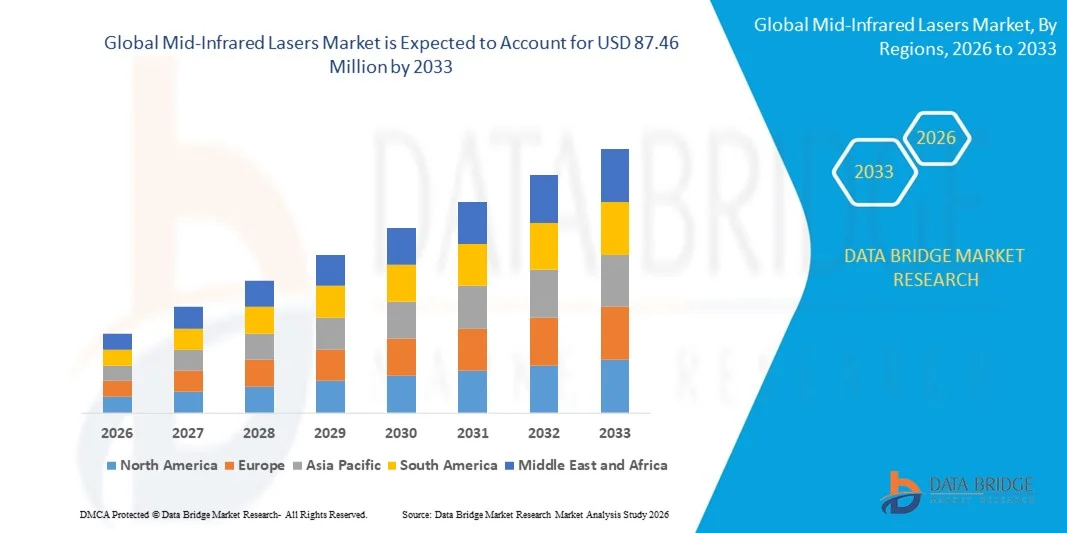
- The global mid-infrared lasers market size was valued at USD 37.41 million in 2025 and is expected to reach USD 87.46 million by 2033, at a CAGR of 11.20% during the forecast period
- Major factors that are expected to boost the growth of the mid-infrared lasers market in the forecast period are the rise in the trend in the remote-controlled advanced security cameras
- Furthermore, the several innovations in the technology sector is further anticipated to propel the growth of the mid-infrared lasers market
What are the Major Takeaways of Mid-Infrared Lasers Market?
- The swift technological advancements in the field of environmental and chemical research is further estimated to further cushion the growth of the mid-infrared lasers market. On the other hand, because of the cryogenics in their cooling operations, the weight of infrared lasers becomes heavy which is further projected to impede the growth of the mid-infrared lasers market
- In addition, the compactness and toughness of the mid infrared Lasers will further provide potential opportunities for the growth of the mid-infrared lasers market in the coming years. However, the delayed acceptance of mid- infrared in specific countries might further challenge the growth of the mid-infrared lasers market in the near future
- North America dominated the mid-infrared lasers market with a 37.41% revenue share in 2025, driven by strong presence of photonics research institutions, defense modernization programs, and advanced industrial sensing infrastructure across the U.S. and Canada
- Asia-Pacific is projected to register the fastest CAGR of 7.36% from 2026 to 2033, driven by expanding semiconductor manufacturing, rapid industrialization, and increasing demand for advanced sensing technologies across China, Japan, India, South Korea, and Southeast Asia
- The Semiconductor Lasers segment dominated the market with a 34.8% share in 2025, primarily driven by strong adoption of quantum cascade lasers (QCLs) and interband cascade lasers (ICLs) for compact and energy-efficient sensing systems
Report Scope and Mid-Infrared Lasers Market Segmentation
|
Attributes |
Mid-Infrared Lasers Key Market Insights |
|
Segments Covered |
|
|
Countries Covered |
North America
Europe
Asia-Pacific
Middle East and Africa
South America
|
|
Key Market Players |
|
|
Market Opportunities |
|
|
Value Added Data Infosets |
In addition to the insights on market scenarios such as market value, growth rate, segmentation, geographical coverage, and major players, the market reports curated by the Data Bridge Market Research also include in-depth expert analysis, pricing analysis, brand share analysis, consumer survey, demography analysis, supply chain analysis, value chain analysis, raw material/consumables overview, vendor selection criteria, PESTLE Analysis, Porter Analysis, and regulatory framework. |
What is the Key Trend in the Mid-Infrared Lasers Market?
Increasing Shift Toward Compact, Tunable, and Application-Specific Mid-Infrared Laser Systems
- The mid-infrared (Mid-IR) lasers market is witnessing strong adoption of compact, high-power, and wavelength-tunable laser sources designed for spectroscopy, environmental monitoring, medical diagnostics, and defense applications
- Manufacturers are introducing quantum cascade lasers (QCLs), interband cascade lasers (ICLs), and fiber-based Mid-IR systems offering improved beam quality, higher efficiency, and precise wavelength control across the 2–20 µm range
- Growing demand for portable, field-deployable gas sensing and chemical detection systems is driving usage across industrial plants, research laboratories, and homeland security operations
- For instance, companies such as IPG Photonics Corporation, Coherent, Inc., Hamamatsu Photonics K.K., and Northrop Grumman are expanding their Mid-IR portfolios with tunable QCL platforms and high-performance sensing modules
- Increasing need for high-sensitivity molecular analysis, non-invasive medical diagnostics, and advanced infrared countermeasure systems is accelerating innovation in compact Mid-IR laser architectures
- As industrial automation and precision sensing expand globally, Mid-Infrared Lasers will remain vital for real-time chemical analysis, security screening, and next-generation photonic applications
What are the Key Drivers of Mid-Infrared Lasers Market?
- Rising demand for high-precision gas sensing, environmental monitoring, and industrial process control solutions that rely on Mid-IR spectral absorption characteristics
- For instance, in 2025, companies such as Thermo Fisher Scientific, EKSPLA, and Alpes Lasers S.A. enhanced their tunable laser and spectroscopy systems to support advanced analytical applications
- Growing adoption in defense and aerospace sectors for infrared countermeasures (IRCM), target designation, and secure communication systems is significantly boosting demand
- Advancements in quantum cascade laser efficiency, thermal management, and miniaturized packaging have strengthened performance, durability, and integration flexibility
- Rising use in medical diagnostics, breath analysis, and non-invasive disease detection is expanding commercial healthcare applications
- Supported by steady investments in photonics research, semiconductor fabrication, and industrial automation infrastructure, the Mid-Infrared Lasers market is expected to witness strong long-term growth
Which Factor is Challenging the Growth of the Mid-Infrared Lasers Market?
- High costs associated with advanced QCL and ICL technologies restrict adoption among small research institutions and cost-sensitive industrial users
- For instance, during 2024–2025, fluctuations in semiconductor material costs and precision fabrication requirements increased production expenses for several global laser manufacturers
- Technical complexity in wavelength tuning, thermal stabilization, and system integration increases the need for specialized engineering expertise
- Limited awareness in emerging markets regarding Mid-IR laser advantages over conventional near-infrared systems slows penetration
- Competition from alternative sensing technologies such as diode lasers, FTIR spectroscopy systems, and solid-state laser platforms creates pricing pressure and limits differentiation
- To address these challenges, companies are focusing on scalable manufacturing, cost-optimized designs, integrated sensing modules, and collaborative R&D initiatives to expand global adoption of Mid-Infrared Lasers
How is the Mid-Infrared Lasers Market Segmented?
The market is segmented on the basis of type, wavelength type, and application.
- By Type
On the basis of type, the mid-infrared lasers market is segmented into Non-linear Lasers, Free-Electron Lasers, Solid-State Lasers, Semiconductor Lasers, Gas Lasers, Free Electron Based Mid-Infrared Lasers, and CO₂ Lasers. The Semiconductor Lasers segment dominated the market with a 34.8% share in 2025, primarily driven by strong adoption of quantum cascade lasers (QCLs) and interband cascade lasers (ICLs) for compact and energy-efficient sensing systems. These lasers offer high tunability, compact footprints, and suitability for integration into portable gas analyzers and medical devices.
The Free-Electron Based Mid-Infrared Laser segment is expected to grow at the fastest CAGR from 2026 to 2033, supported by increasing use in advanced defense research, high-power scientific applications, and accelerator-based photonics systems requiring ultra-high peak power and wide tunability.
- By Wavelength Type
On the basis of wavelength type, the market is segmented into Tunable Mid-Infrared Lasers, Fixed Mid-Infrared Lasers, and Broadband Mid-Infrared Lasers. The Tunable Mid-Infrared Lasers segment dominated the market with a 46.2% share in 2025, owing to rising demand for precise molecular detection and gas sensing applications. Tunable systems enable accurate targeting of specific absorption lines, making them ideal for spectroscopy, environmental monitoring, and industrial emission control.
The Broadband Mid-Infrared Lasers segment is projected to grow at the fastest CAGR from 2026 to 2033, driven by expanding applications in hyperspectral imaging, biomedical diagnostics, and research environments requiring wide spectral coverage for multi-component analysis.
- By Application
On the basis of application, the mid-infrared lasers market is segmented into Noninvasive Medical Diagnostics, Free Space Communication, Laser Scalpel, Spectroscopy, and Remote Sensing. The Spectroscopy segment dominated the market with a 38.5% share in 2025, supported by extensive use in gas detection, chemical analysis, pharmaceutical testing, and environmental monitoring. Mid-IR lasers are highly effective for identifying molecular fingerprints, ensuring high sensitivity and selectivity in analytical processes.
The Noninvasive Medical Diagnostics segment is expected to grow at the fastest CAGR from 2026 to 2033, fueled by increasing research in breath analysis, glucose monitoring, and early disease detection technologies leveraging mid-infrared absorption characteristics for accurate biomarker identification.
Which Region Holds the Largest Share of the Mid-Infrared Lasers Market?
- North America dominated the mid-infrared lasers market with a 37.41% revenue share in 2025, driven by strong presence of photonics research institutions, defense modernization programs, and advanced industrial sensing infrastructure across the U.S. and Canada. High adoption of quantum cascade lasers (QCLs), gas sensing systems, and infrared countermeasure technologies continues to fuel demand across aerospace, homeland security, healthcare diagnostics, and environmental monitoring sectors
- Leading companies in North America are investing in compact, tunable, and high-power Mid-IR laser platforms with improved thermal stability and wavelength precision, strengthening the region’s technological advantage. Continuous funding in defense optics, spectroscopy innovation, and semiconductor laser fabrication supports long-term market expansion
- Strong R&D ecosystems, availability of skilled photonics engineers, and sustained investment in advanced manufacturing infrastructure further reinforce regional market leadership
U.S. Mid-Infrared Lasers Market Insight
The U.S. is the largest contributor in North America, supported by extensive defense applications, robust spectroscopy research, and growing demand for environmental gas monitoring systems. Increasing development of infrared countermeasure (IRCM) systems, industrial emission detection tools, and non-invasive medical diagnostic devices intensifies adoption of high-performance Mid-IR lasers. Presence of major defense contractors, photonics startups, and research laboratories further drives innovation and commercialization. Rising investments in AI-enabled sensing platforms and advanced materials research continue to strengthen domestic market growth.
Canada Mid-Infrared Lasers Market Insight
Canada contributes significantly to regional growth, driven by expanding photonics research clusters and increasing focus on environmental monitoring and industrial safety. Universities and research institutes actively deploy Mid-IR lasers for spectroscopy, atmospheric studies, and chemical detection applications. Government-supported innovation programs and collaborations in aerospace and defense research further enhance market penetration across the country.
Asia-Pacific Mid-Infrared Lasers Market
Asia-Pacific is projected to register the fastest CAGR of 7.36% from 2026 to 2033, driven by expanding semiconductor manufacturing, rapid industrialization, and increasing demand for advanced sensing technologies across China, Japan, India, South Korea, and Southeast Asia. Growing applications in industrial gas detection, automotive LiDAR research, medical diagnostics, and defense modernization are accelerating adoption. Rising investments in photonics fabrication facilities and laser component manufacturing continue to create strong growth opportunities across the region.
China Mid-Infrared Lasers Market Insight
China is the largest contributor to Asia-Pacific due to significant investments in semiconductor laser production, defense technology, and industrial automation. Strong government support for domestic photonics innovation and expanding export capabilities drive widespread adoption in spectroscopy and sensing applications.
Japan Mid-Infrared Lasers Market Insight
Japan shows steady growth supported by precision optics manufacturing, advanced automotive R&D, and strong focus on medical device innovation. High standards in industrial automation and quality control further encourage deployment of reliable Mid-IR laser systems.
India Mid-Infrared Lasers Market Insight
India is emerging as a major growth hub, driven by increasing research activities in spectroscopy, environmental monitoring, and defense electronics. Expanding startup ecosystems and government-backed photonics initiatives support broader market adoption.
South Korea Mid-Infrared Lasers Market Insight
South Korea contributes significantly due to strong semiconductor expertise, advanced display manufacturing, and rising investment in defense optics. Rapid technological innovation and high-performance electronics production continue to support sustained Mid-IR laser market growth.
Which are the Top Companies in Mid-Infrared Lasers Market?
The mid-infrared lasers industry is primarily led by well-established companies, including:
- Coherent, Inc. (U.S.)
- IPG Photonics Corporation (U.S.)
- DRS Daylight Solutions (U.S.)
- Spectra-Physics, Inc. (U.S.)
- Northrop Grumman (U.S.)
- EKSPLA (Lithuania)
- Thermo Fisher Scientific (U.S.)
- Quantum Composers Inc. (U.S.)
- Alpes Lasers S.A. (Switzerland)
- AMS Technologies AG (Germany)
- Powerlase Ltd. (U.K.)
- Block Engineering, LLC. (U.S.)
- Boston Electronics Corporation (U.S.)
- ELUXI Ltd (U.K.)
- Hamamatsu Photonics K.K. (Japan)
- PolarOnyx (U.S.)
- Genia Photonics (Canada)
- Physical Sciences Inc. (U.S.)
- Pranalytica (U.S.)
- Power Technology (U.S.)
What are the Recent Developments in Global Mid-Infrared Lasers Market?
- In February 2021, Hamamatsu Photonics K.K. engineered high-power quantum cascade lasers (QCLs) capable of delivering 2-watt output at an 8.6 micrometers wavelength, enhancing performance for applications in vehicles, transportation machinery, and healthcare diagnostics, thereby strengthening its position in advanced mid-infrared laser innovation
- In January 2021, researchers at EMPA-Swiss Federal Laboratories for Materials Science and Technology introduced a compact and lightweight mid-infrared laser spectrometer designed for balloon-based water vapor measurement, leveraging the small size and efficiency of QCL systems following earlier drone integration success, marking significant progress in portable atmospheric sensing technologies
- In February 2020, Boston Electronics Corporation launched the Affordable Module, recognized as one of the smallest MWIR detection modules available, featuring a newly developed InAsSb detector integrated with a low-noise preamplifier, reinforcing advancements in compact infrared detection solutions for commercial and research applications
SKU-
Get online access to the report on the World's First Market Intelligence Cloud

- Interactive Data Analysis Dashboard
- Company Analysis Dashboard for high growth potential opportunities
- Research Analyst Access for customization & queries
- Competitor Analysis with Interactive dashboard
- Latest News, Updates & Trend analysis
- Harness the Power of Benchmark Analysis for Comprehensive Competitor Tracking
Global Mid Infrared Lasers Market, Supply Chain Analysis and Ecosystem Framework
To support market growth and help clients navigate the impact of geopolitical shifts, DBMR has integrated in-depth supply chain analysis into its Global Mid Infrared Lasers Market research reports. This addition empowers clients to respond effectively to global changes affecting their industries. The supply chain analysis section includes detailed insights such as Global Mid Infrared Lasers Market consumption and production by country, price trend analysis, the impact of tariffs and geopolitical developments, and import and export trends by country and HSN code. It also highlights major suppliers with data on production capacity and company profiles, as well as key importers and exporters. In addition to research, DBMR offers specialized supply chain consulting services backed by over a decade of experience, providing solutions like supplier discovery, supplier risk assessment, price trend analysis, impact evaluation of inflation and trade route changes, and comprehensive market trend analysis.
Research Methodology
Data collection and base year analysis are done using data collection modules with large sample sizes. The stage includes obtaining market information or related data through various sources and strategies. It includes examining and planning all the data acquired from the past in advance. It likewise envelops the examination of information inconsistencies seen across different information sources. The market data is analysed and estimated using market statistical and coherent models. Also, market share analysis and key trend analysis are the major success factors in the market report. To know more, please request an analyst call or drop down your inquiry.
The key research methodology used by DBMR research team is data triangulation which involves data mining, analysis of the impact of data variables on the market and primary (industry expert) validation. Data models include Vendor Positioning Grid, Market Time Line Analysis, Market Overview and Guide, Company Positioning Grid, Patent Analysis, Pricing Analysis, Company Market Share Analysis, Standards of Measurement, Global versus Regional and Vendor Share Analysis. To know more about the research methodology, drop in an inquiry to speak to our industry experts.
Customization Available
Data Bridge Market Research is a leader in advanced formative research. We take pride in servicing our existing and new customers with data and analysis that match and suits their goal. The report can be customized to include price trend analysis of target brands understanding the market for additional countries (ask for the list of countries), clinical trial results data, literature review, refurbished market and product base analysis. Market analysis of target competitors can be analyzed from technology-based analysis to market portfolio strategies. We can add as many competitors that you require data about in the format and data style you are looking for. Our team of analysts can also provide you data in crude raw excel files pivot tables (Fact book) or can assist you in creating presentations from the data sets available in the report.












