


Global Mine Rescue Vehicle Market
Market Size in USD Billion
CAGR :
% 
 USD
636.46 Billion
USD
969.39 Billion
2025
2033
USD
636.46 Billion
USD
969.39 Billion
2025
2033
 Forecast Period Forecast Period |
2026 –2033 |
 Market Size (Base Year) Market Size (Base Year) |
USD 636.46 Billion |
 Market Size (Forecast Year) Market Size (Forecast Year) |
USD 969.39 Billion |
 CAGR CAGR |
% |
| Major Markets Players |
|
Mine Rescue Vehicle Market Size
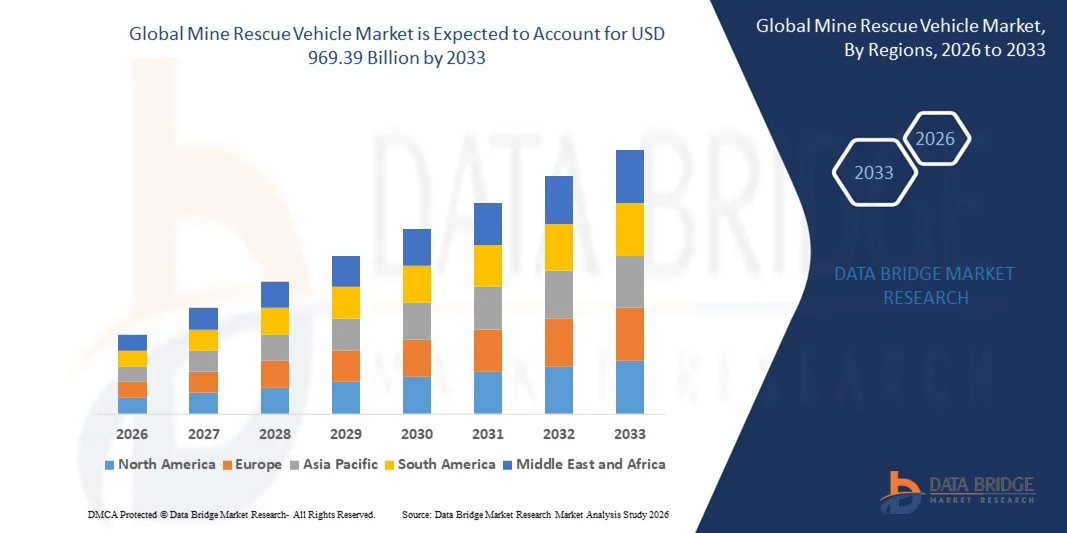
- The global mine rescue vehicle market size was valued at USD 636.46 billion in 2025 and is expected to reach USD 969.39 billion by 2033, at a CAGR of 5.40% during the forecast period
- The market growth is largely fuelled by the increasing focus on miner safety and emergency preparedness due to stringent occupational safety regulations and rising awareness regarding accident prevention in mining operations
- The rising number of underground mining activities across coal, metal, and mineral extraction is driving demand for specialised rescue vehicles equipped with life-support systems and navigation technologies
Mine Rescue Vehicle Market Analysis
- The market is witnessing steady growth due to increasing investments in mining safety infrastructure and the mandatory deployment of rescue equipment to ensure rapid emergency response and regulatory compliance
- Manufacturers are focusing on developing technologically advanced and durable vehicles with enhanced mobility, real-time monitoring, and integrated communication systems to improve operational efficiency and rescue success rates
- North America dominated the mine rescue vehicle market with the largest revenue share in 2025, driven by the strong presence of large-scale mining operations and strict enforcement of miner safety regulations across the region
- Asia-Pacific region is expected to witness the highest growth rate in the global mine rescue vehicle market, driven by rapid mining expansion, increasing demand for minerals, and growing investments in mining safety and emergency preparedness systems
- The Fire and Rescue Truck segment held the largest market revenue share in 2025 driven by its critical role in handling complex mining emergencies such as fires, explosions, and structural collapses. These vehicles are equipped with advanced firefighting systems, rescue tools, and hazard detection technologies, making them essential for ensuring rapid response and improving miner safety in high-risk environments
Report Scope and Mine Rescue Vehicle Market Segmentation
|
Attributes |
Mine Rescue Vehicle Key Market Insights |
|
Segments Covered |
|
|
Countries Covered |
North America
Europe
Asia-Pacific
Middle East and Africa
South America
|
|
Key Market Players |
|
|
Market Opportunities |
|
|
Value Added Data Infosets |
In addition to the market insights such as market value, growth rate, market segments, geographical coverage, market players, and market scenario, the market report curated by the Data Bridge Market Research team includes in-depth expert analysis, import/export analysis, pricing analysis, production consumption analysis, and pestle analysis. |
Mine Rescue Vehicle Market Trends
Rising Emphasis On Miner Safety And Emergency Preparedness
- The increasing focus on miner safety and regulatory compliance is significantly shaping the mine rescue vehicle market, as mining companies prioritise rapid emergency response and workforce protection. Mine rescue vehicles are gaining importance due to their ability to operate in hazardous underground environments, provide medical support, and assist in evacuation without compromising operational continuity. This trend is strengthening adoption across coal, metal, and mineral mining operations, encouraging manufacturers to develop advanced and specialised rescue solutions
- Increasing awareness regarding occupational hazards, mine collapses, and gas explosions has accelerated the demand for technologically advanced rescue vehicles equipped with gas detection, thermal imaging, and life-support systems. Mining operators and safety authorities are actively investing in modern rescue fleets to reduce fatality rates and improve emergency preparedness. This has also led to partnerships between mining companies and equipment manufacturers to enhance safety standards and operational readiness
- Safety regulations and mandatory emergency preparedness standards are influencing procurement decisions, with mining operators emphasising certified, durable, and high-performance rescue vehicles. These factors are helping companies strengthen safety compliance, minimise operational risks, and ensure workforce protection. Manufacturers are increasingly focusing on integrating automation, real-time monitoring, and enhanced communication systems to improve rescue efficiency and reliability in critical situations
- For instance, in 2024, Dräger in Germany and MineARC Systems in Australia expanded their mine rescue vehicle solutions with improved gas monitoring and underground mobility features. These solutions were introduced in response to increasing mining safety requirements, with deployment across coal and metal mining sites. The vehicles were also positioned as critical safety assets, strengthening customer confidence and long-term adoption
- While demand for mine rescue vehicles is increasing, sustained market growth depends on continuous technological advancements, cost efficiency, and the ability to operate effectively in extreme underground environments. Manufacturers are focusing on improving vehicle durability, automation capabilities, and integrated safety systems to enhance operational efficiency and ensure reliable emergency response
Mine Rescue Vehicle Market Dynamics
Driver
Increasing Focus On Mining Safety Regulations And Workforce Protection
- Stringent mining safety regulations and growing emphasis on worker protection are major drivers for the mine rescue vehicle market. Mining companies are increasingly investing in specialised rescue vehicles to ensure compliance with safety standards and enhance emergency preparedness. This trend is also encouraging the development of advanced vehicles with improved navigation, communication, and medical support capabilities, supporting overall safety infrastructure
- Expanding underground mining activities across coal, metal, and mineral sectors are influencing market growth. Mine rescue vehicles enable rapid evacuation, hazard detection, and medical assistance, helping mining operators reduce risks and improve safety outcomes. The increasing depth and complexity of mining operations globally further reinforce the importance of reliable and efficient rescue solutions
- Mining equipment manufacturers and safety solution providers are actively promoting advanced rescue vehicles through product innovation and technology integration. These efforts are supported by regulatory enforcement and growing awareness of emergency response readiness, encouraging mining companies to upgrade their safety fleets. Partnerships between mining firms and equipment providers are also increasing to improve rescue efficiency and operational performance
- For instance, in 2023, Caterpillar Inc. in U.S. and Sandvik AB in Sweden enhanced their underground mining safety vehicle portfolios with improved emergency response and monitoring capabilities. This expansion followed increased mining safety investments and regulatory pressure, improving adoption and strengthening safety compliance. Both companies also highlighted safety efficiency and reliability to support customer requirements and long-term contracts
- Although increasing safety regulations support market growth, wider adoption depends on cost management, technological reliability, and the ability to meet diverse mining environment requirements. Investment in research, product innovation, and safety integration will be essential for sustained growth and competitive positioning
Restraint/Challenge
High Cost And Operational Complexity Of Mine Rescue Vehicles
- The high cost of mine rescue vehicles compared to conventional mining support vehicles remains a key challenge, limiting adoption among small and medium mining operators. Advanced safety systems, specialised engineering, and compliance requirements contribute to higher production and procurement costs. In addition, maintenance and operational expenses further increase the total cost of ownership, affecting purchasing decisions
- Operational complexity and the need for skilled personnel also restrict market growth, as rescue vehicles require trained operators and regular safety readiness checks. Limited technical expertise in certain mining regions can delay adoption and reduce operational efficiency. This also creates challenges in ensuring consistent safety performance across mining sites
- Logistical and operational challenges impact market expansion, as mine rescue vehicles must function effectively in extreme underground conditions such as confined spaces, high temperatures, and hazardous gas environments. Companies must invest in proper training, maintenance, and operational planning to ensure reliability and safety compliance
- For instance, in 2024, mining operators in South Africa and Indonesia reported slower adoption of advanced rescue vehicles due to high acquisition costs and operational challenges. Maintenance requirements and specialised training needs were additional barriers. These factors also encouraged some mining companies to delay fleet modernisation, affecting immediate market penetration and growth potential
- Addressing these challenges will require cost-effective manufacturing, improved training programs, and technological advancements to enhance efficiency and reduce operational complexity. Collaboration between manufacturers, mining companies, and safety organisations will be critical to support adoption and ensure long-term market development
Mine Rescue Vehicle Market Scope
The market is segmented on the basis of vehicle type, capacity, and mine type.
- By Vehicle Type
On the basis of vehicle type, the mine rescue vehicle market is segmented into Passenger Shuttle/Car, Ambulance, and Fire and Rescue Truck. The Fire and Rescue Truck segment held the largest market revenue share in 2025 driven by its critical role in handling complex mining emergencies such as fires, explosions, and structural collapses. These vehicles are equipped with advanced firefighting systems, rescue tools, and hazard detection technologies, making them essential for ensuring rapid response and improving miner safety in high-risk environments.
The Ambulance segment is expected to witness the fastest growth rate from 2026 to 2033, driven by the increasing emphasis on immediate medical assistance and safe evacuation during mining accidents. Mine rescue ambulances are designed with specialised medical equipment, life-support systems, and enhanced mobility features to operate efficiently in challenging mining terrains. These vehicles are increasingly being adopted to improve survival rates and provide timely medical intervention.
- By Capacity
On the basis of capacity, the mine rescue vehicle market is segmented into Light and Medium Duty Mine Rescue Vehicles and Heavy Duty Mine Rescue Vehicles. The Heavy Duty Mine Rescue Vehicles segment held the largest market revenue share in 2025 driven by their ability to operate in extreme mining conditions and transport multiple personnel and heavy rescue equipment. These vehicles are widely used in large-scale mining operations due to their durability, high load capacity, and enhanced operational reliability in hazardous environments.
The Light and Medium Duty Mine Rescue Vehicles segment is expected to witness the fastest growth rate from 2026 to 2033, driven by their flexibility, cost efficiency, and suitability for smaller mining sites. These vehicles are easier to manoeuvre in confined spaces and are increasingly preferred for quick response and routine safety preparedness. Their lower operational costs and efficient performance are supporting adoption across various mining operations.
- By Mine Type
On the basis of mine type, the mine rescue vehicle market is segmented into Surface Mining and Underground Mining. The Underground Mining segment held the largest market revenue share in 2025 driven by the higher risk levels and greater need for specialised rescue operations in underground environments. Rescue vehicles used in underground mining are equipped with advanced navigation, gas detection, and life-support systems to ensure effective emergency response and miner evacuation.
The Surface Mining segment is expected to witness the fastest growth rate from 2026 to 2033, driven by expanding surface mining activities and increasing focus on safety compliance. Surface mine rescue vehicles are designed for rapid mobility across large mining areas and are used for emergency response, medical evacuation, and firefighting. The growing adoption of safety equipment in surface mining operations is contributing to segment growth.
Mine Rescue Vehicle Market Regional Analysis
- North America dominated the mine rescue vehicle market with the largest revenue share in 2025, driven by the strong presence of large-scale mining operations and strict enforcement of miner safety regulations across the region
- Mining operators in the region highly prioritise advanced emergency response systems, specialised rescue vehicles, and integrated safety technologies to ensure workforce protection and regulatory compliance
- This widespread adoption is further supported by advanced mining infrastructure, high safety investment capacity, and increasing focus on reducing accident-related risks, establishing mine rescue vehicles as essential safety assets across mining operations
U.S. Mine Rescue Vehicle Market Insight
The U.S. mine rescue vehicle market captured the largest revenue share in 2025 within North America, fuelled by the presence of extensive coal, metal, and mineral mining activities and strong regulatory oversight. Mining companies are increasingly focusing on improving emergency preparedness and investing in advanced rescue vehicles to enhance operational safety. The growing emphasis on modernising mining safety infrastructure, along with the integration of advanced monitoring and communication technologies, is further supporting market expansion.
Europe Mine Rescue Vehicle Market Insight
Europe mine rescue vehicle market is expected to witness the fastest growth rate from 2026 to 2033, primarily driven by strict mining safety standards and increasing focus on worker protection. The presence of well-established mining equipment manufacturers and technological innovation is encouraging adoption of advanced rescue solutions. In addition, rising investments in mining modernisation and safety compliance are supporting the deployment of specialised rescue vehicles across mining sites.
U.K. Mine Rescue Vehicle Market Insight
The U.K. mine rescue vehicle market is expected to witness the fastest growth rate from 2026 to 2033, driven by increasing emphasis on occupational safety and emergency response readiness. Mining operators are focusing on adopting specialised vehicles equipped with advanced safety and medical systems. In addition, regulatory compliance requirements and growing awareness regarding workforce safety are contributing to increased investment in mine rescue infrastructure.
Germany Mine Rescue Vehicle Market Insight
The Germany mine rescue vehicle market is expected to witness the fastest growth rate from 2026 to 2033, fuelled by strong technological capabilities and increasing demand for advanced mining safety solutions. Germany’s focus on engineering excellence and innovation is encouraging the development and deployment of highly efficient rescue vehicles. The country’s emphasis on industrial safety and operational efficiency is further promoting adoption across mining applications.
Asia-Pacific Mine Rescue Vehicle Market Insight
Asia-Pacific mine rescue vehicle market is expected to witness the fastest growth rate from 2026 to 2033, driven by expanding mining activities, rising mineral demand, and improving safety awareness. Governments and mining companies in the region are increasingly investing in modern safety equipment to reduce accident risks and enhance emergency response capabilities. Furthermore, the region’s growing mining infrastructure and industrial expansion are contributing to increased adoption of mine rescue vehicles.
Japan Mine Rescue Vehicle Market Insight
The Japan mine rescue vehicle market is expected to witness the fastest growth rate from 2026 to 2033 due to increasing adoption of advanced safety technologies and automation in mining operations. Japanese mining companies are focusing on improving safety standards and operational efficiency through modern rescue solutions. The integration of advanced monitoring, communication, and navigation systems is further supporting market growth.
China Mine Rescue Vehicle Market Insight
The China mine rescue vehicle market accounted for the largest market revenue share in Asia-Pacific in 2025, attributed to the country’s extensive coal and mineral mining activities and strong government focus on mining safety. China represents one of the largest mining markets globally, with increasing investments in safety modernisation and emergency preparedness. The presence of large mining companies and rising adoption of advanced rescue technologies are key factors driving market growth in the country.
Mine Rescue Vehicle Market Share
The Mine Rescue Vehicle industry is primarily led by well-established companies, including:
- JCB India Limited (India)
- Caterpillar Inc. (U.S.)
- AB Volvo (Sweden)
- Komatsu Ltd. (Japan)
- CNH Industrial N.V. (U.K.)
- Liebherr-International Deutschland GmbH (Germany)
- Hitachi Construction Machinery Co., Ltd. (Japan)
- Atlas Copco (India) Ltd (India)
- Sandvik AB (Sweden)
- Drägerwerk AG & Co. KGaA (Germany)
- Frontline Fire & Rescue Equipment (U.S.)
- Astec Industries, Inc. (U.S.)
- Baseline Group (U.K.)
- NPK Construction Equipment, Inc. (U.S.)
- Daimler Truck AG (Germany)
- Expat Rescue (U.K.)
SKU-
Get online access to the report on the World's First Market Intelligence Cloud

- Interactive Data Analysis Dashboard
- Company Analysis Dashboard for high growth potential opportunities
- Research Analyst Access for customization & queries
- Competitor Analysis with Interactive dashboard
- Latest News, Updates & Trend analysis
- Harness the Power of Benchmark Analysis for Comprehensive Competitor Tracking
Research Methodology
Data collection and base year analysis are done using data collection modules with large sample sizes. The stage includes obtaining market information or related data through various sources and strategies. It includes examining and planning all the data acquired from the past in advance. It likewise envelops the examination of information inconsistencies seen across different information sources. The market data is analysed and estimated using market statistical and coherent models. Also, market share analysis and key trend analysis are the major success factors in the market report. To know more, please request an analyst call or drop down your inquiry.
The key research methodology used by DBMR research team is data triangulation which involves data mining, analysis of the impact of data variables on the market and primary (industry expert) validation. Data models include Vendor Positioning Grid, Market Time Line Analysis, Market Overview and Guide, Company Positioning Grid, Patent Analysis, Pricing Analysis, Company Market Share Analysis, Standards of Measurement, Global versus Regional and Vendor Share Analysis. To know more about the research methodology, drop in an inquiry to speak to our industry experts.
Customization Available
Data Bridge Market Research is a leader in advanced formative research. We take pride in servicing our existing and new customers with data and analysis that match and suits their goal. The report can be customized to include price trend analysis of target brands understanding the market for additional countries (ask for the list of countries), clinical trial results data, literature review, refurbished market and product base analysis. Market analysis of target competitors can be analyzed from technology-based analysis to market portfolio strategies. We can add as many competitors that you require data about in the format and data style you are looking for. Our team of analysts can also provide you data in crude raw excel files pivot tables (Fact book) or can assist you in creating presentations from the data sets available in the report.












