




Global Mineral Cosmetics Market
Market Size in USD Billion
CAGR :
% 
 USD
4.35 Billion
USD
6.50 Billion
2025
2033
USD
4.35 Billion
USD
6.50 Billion
2025
2033
 Forecast Period Forecast Period |
2026 - 2033 |
 Market Size (Base Year) Market Size (Base Year) |
USD 4.35 Billion |
 Market Size (Forecast Year) Market Size (Forecast Year) |
USD 6.50 Billion |
 CAGR CAGR |
% |
| Major Markets Players |
|
Mineral Cosmetics Market Overview
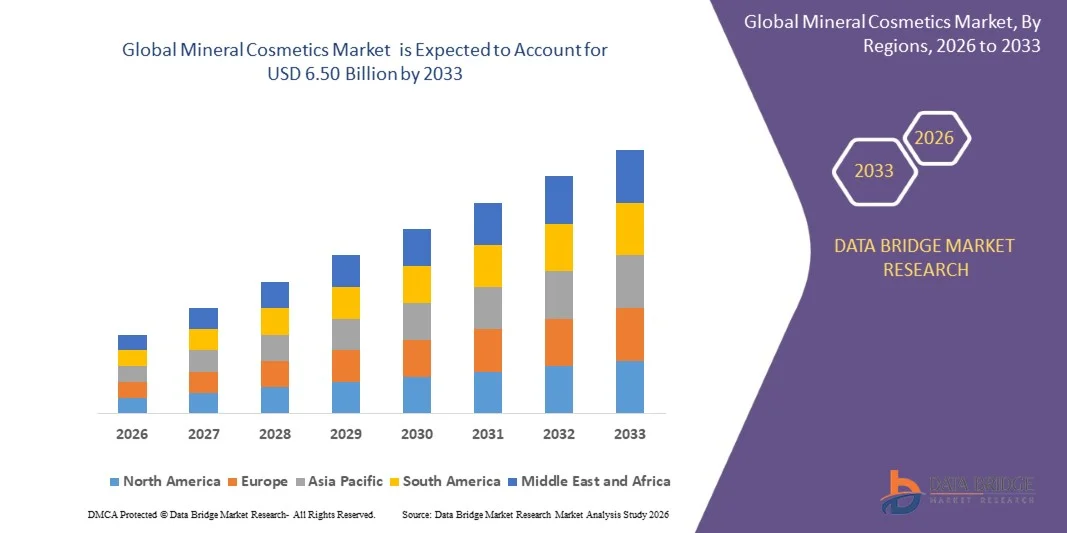
The Mineral Cosmetics Market was valued at USD 4.35 Billion in 2025 and is projected to reach USD 6.50 Billion by 2033, growing at a CAGR of 5.15% from 2026 to 2033. The market is experiencing consistent growth driven by increasing consumer preference for clean-label beauty products, rising awareness regarding skin-friendly cosmetic formulations, and growing demand for natural and chemical-free personal care solutions. Expanding adoption of mineral-based makeup products across face, eye, and lip cosmetic categories, along with continuous product innovation focused on sensitive skin applications, is further supporting market expansion across developed and emerging economies.
The increasing global focus on ingredient transparency, sustainable beauty practices, and wellness-oriented consumer lifestyles, combined with growing concerns regarding the adverse effects of synthetic cosmetic ingredients, is encouraging the adoption of mineral cosmetics worldwide. Mineral-based formulations containing naturally derived ingredients such as zinc oxide, titanium dioxide, and mica are increasingly preferred due to their gentle skin compatibility, UV protection benefits, and non-comedogenic properties. In addition, rising investments in clean beauty product development, expanding e-commerce penetration, and growing influence of social media-driven beauty trends are accelerating demand for mineral cosmetics across diverse consumer segments.
Key Market Trends & Insights
- North America dominated the Mineral Cosmetics Market with the largest revenue share of 35.8% in 2025, supported by strong consumer preference for clean beauty products, high awareness regarding skin-friendly cosmetic formulations, and increasing demand for natural and chemical-free personal care products
- The face cosmetics segment led the market with a 44.5% share in 2025, driven by strong consumer demand for mineral-based foundations, powders, concealers, and BB creams that provide skin-friendly coverage without harsh chemicals
- Asia-Pacific is expected to be the fastest-growing region at a CAGR of 6.38% from 2026 to 2033, fueled by rising disposable incomes, expanding beauty and personal care industries, and increasing awareness regarding natural cosmetic products
- E-commerce isthe fastest-growing distribution channel type, projected to register a CAGR of 12.6% from 2026 to 2033, supported by increasing digitalization of beauty retail and growing consumer reliance on online shopping platforms
- The mica powders segment dominated the type category with a 34.5% revenue share in 2025, led by their extensive use in mineral foundations, blushes, bronzers, and eyeshadows
- Retail distribution accounted for 33.6% of the market in 2025, preferred by strong consumer preference for physically evaluating cosmetic products before purchase
- The organic segment is the fastest-growing category, with a CAGR of 11.2% from 2026 to 2033, driven by increasing consumer preference for natural, sustainable, and environmentally responsible beauty products
Market Size & Forecast
- Global Market Value (2025): USD 4.35 Billion
- Expected Market Value (2033): USD 6.50 Billion
- Forecast CAGR (2026–2033): 5.15%
- Leading Region in 2025: North America
- Fastest Growing Region: Asia-Pacific
Report Scope and Mineral Cosmetics Market Segmentation
|
Attributes |
Mineral Cosmetics Key Market Insights |
|
Segments Covered |
|
|
Countries Covered |
North America · U.S. · Canada · Mexico Europe · Germany · France · U.K. · Netherlands · Switzerland · Belgium · Russia · Italy · Spain · Turkey · Rest of Europe Asia-Pacific · China · Japan · India · South Korea · Singapore · Malaysia · Australia · Thailand · Indonesia · Philippines · Rest of Asia-Pacific Middle East and Africa · Saudi Arabia · U.A.E. · South Africa · Egypt · Israel · Rest of Middle East and Africa South America · Brazil · Argentina · Rest of South America |
|
Key Market Players |
· Mineralissima (Netherlands) · Glo Skin Beauty (U.S.) · Iredale Cosmetics, Inc. (U.S.) · BWX Limited (Australia) · L'Oréal Paris (France) · The Estée Lauder Companies Inc. (U.S.) · AHAVA, Inc. (Israel) · Cover FX (Canada) · AVON Beauty Products India Pvt. Ltd. (India) · Benefit Cosmetics LLC (U.S.) · Burt's Bees (U.S.) · BASF SE (Germany) · Merck KGaA (Germany) · RJ Mineral Cosmetics (Australia) · Mineral Fusion (U.S.) · Youngblood Mineral Cosmetics (U.S.) · Everyday Minerals (U.S.) · SMM Cosmetics (U.S.) · Pinnacle Cosmetics (U.S.) · Lust Minerals (Australia) |
|
Market Opportunities |
· Expansion of Organic and Sustainable Mineral Cosmetic Product Lines · Increasing Penetration of E-Commerce and Direct-to-Consumer Beauty Channels · Growing Demand for Premium Mineral Cosmetics in Emerging Markets |
|
Value Added Data Infosets |
In addition to the insights on market scenarios such as market value, growth rate, segmentation, geographical coverage, and major players, the market reports curated by the Data Bridge Market Research also include in-depth expert analysis, pricing analysis, brand share analysis, consumer survey, demography analysis, supply chain analysis, value chain analysis, raw material/consumables overview, vendor selection criteria, PESTLE Analysis, Porter Analysis, and regulatory framework. |
Mineral Cosmetics Market Trends
Trend: Rising Demand for Clean Beauty Products
Consumers are increasingly shifting toward clean beauty products that contain naturally derived ingredients and avoid synthetic chemicals, preservatives, and artificial fragrances. Mineral cosmetics are gaining popularity due to their perceived safety, skin compatibility, and transparency in ingredient sourcing. Growing awareness regarding sensitive skin conditions and the long-term effects of conventional cosmetic ingredients is further accelerating adoption. The clean beauty movement continues to influence product development strategies across the global cosmetics industry.
In 2024, The Estée Lauder Companies Inc. expanded its clean beauty portfolio through several brands, reflecting the industry's growing focus on naturally derived and skin-friendly cosmetic formulations.
Mineral Cosmetics Market Dynamics
Key Market Driver: Growing Preference for Skin-Friendly Cosmetics
The increasing consumer focus on skincare and wellness is significantly driving demand for mineral cosmetics worldwide. Products formulated with ingredients such as zinc oxide, titanium dioxide, and mica are widely preferred for their gentle properties and suitability for sensitive and acne-prone skin. Dermatologists and skincare professionals increasingly recommend mineral-based formulations due to their non-comedogenic characteristics and lower risk of skin irritation. Rising demand for multifunctional cosmetics that combine beauty enhancement with skin protection is further supporting market growth.
In 2025, Shiseido Company, Limited introduced an advanced mineral sunscreen technology that improved UV protection performance while reducing white cast, highlighting growing industry investment in skin-friendly mineral-based products.
Key Restraint/Challenge: High Cost of Mineral Cosmetics
A major challenge in the Mineral Cosmetics market is the relatively higher cost of products compared to conventional cosmetic alternatives. Premium mineral ingredients, stringent quality standards, sustainable sourcing practices, and specialized manufacturing processes contribute to elevated production costs. These higher prices can limit product adoption among price-sensitive consumers, particularly in developing economies. In addition, maintaining ingredient purity and compliance with clean beauty standards increases operational expenses for manufacturers.
The continued investment by premium beauty companies such as L'Oréal and The Estée Lauder Companies Inc. in advanced mineral and clean beauty formulations demonstrates the substantial development costs associated with this category.
Key Market Opportunity: Expansion of Organic Product Lines
The growing consumer preference for organic and environmentally responsible beauty products is creating significant opportunities for mineral cosmetics manufacturers. Consumers increasingly seek products that combine natural mineral ingredients with certified organic oils and plant-based components. Beauty brands are expanding their portfolios to address rising demand for sustainable, vegan, and ethically sourced cosmetic solutions. The trend is particularly strong among younger consumers who prioritize ingredient transparency and environmental responsibility when making purchasing decisions.
In 2025, EthoSun launched a new range of medical-grade mineral sun care products utilizing non-nano zinc oxide, demonstrating how brands are leveraging clean and organic product innovation to capture emerging growth opportunities in the market.
Mineral Cosmetics Market Scope
The mineral cosmetics market is segmented on the basis of product, type, distribution channel, and category.
- By Product
On the basis of product, the Mineral Cosmetics Market is segmented into Face Cosmetics, Lips Cosmetics, Eye Cosmetics, and Others. The Face Cosmetics segment dominated the market with the largest share of 44.5% in 2025, driven by strong consumer demand for mineral-based foundations, powders, concealers, and BB creams that provide skin-friendly coverage without harsh chemicals. Growing awareness regarding sensitive skin conditions and increasing preference for non-comedogenic formulations have significantly boosted adoption. Mineral face products are widely perceived as safer alternatives to conventional cosmetics due to their natural composition and UV-protective properties. Continuous product innovation and expanding availability across premium and mass-market brands further support segment growth. Rising demand for multifunctional beauty products continues to reinforce its market leadership.
The Eye Cosmetics segment is projected to register the fastest growth at a CAGR of 6.2% from 2026 to 2033, driven by increasing consumer preference for clean-label mascaras, eyeliners, and eyeshadows formulated with mineral ingredients. Growing concerns regarding eye sensitivity and allergic reactions are encouraging consumers to shift toward gentle cosmetic formulations. Manufacturers are introducing advanced pigment technologies that enhance color performance while maintaining natural ingredient profiles. Rising beauty consciousness among younger consumers and increasing influence of social media beauty trends are accelerating demand. Expanding product portfolios and growing availability through online retail channels are further supporting rapid segment expansion.
- By Type
On the basis of type, the Mineral Cosmetics Market is segmented into Iron Oxides, Zinc Oxide, Mica Powders, Titanium Dioxide, Organic Oils, and Others. The Mica Powders segment dominated the market with a share of 34.5% in 2025, supported by their extensive use in mineral foundations, blushes, bronzers, and eyeshadows. Mica provides natural shimmer, smooth texture, and enhanced product spreadability, making it a preferred ingredient across numerous cosmetic applications. Its ability to improve product appearance while maintaining a natural formulation profile strengthens demand among manufacturers. Increasing consumer preference for lightweight and breathable makeup products further supports segment growth. Continuous innovations in ethically sourced and sustainable mica production are reinforcing market dominance.
The Zinc Oxide segment is projected to register the fastest growth at a CAGR of 10.4% from 2026 to 2033, driven by increasing demand for multifunctional cosmetic ingredients offering both skincare and protective benefits. Zinc oxide is widely utilized in mineral cosmetics due to its anti-inflammatory properties and natural sun protection capabilities. Growing consumer awareness regarding skin health and UV protection is accelerating adoption across facial and skincare-focused cosmetic products. Expanding demand for sensitive-skin formulations and clean beauty products is further supporting market growth. Increasing incorporation of zinc oxide into premium cosmetic portfolios is expected to drive substantial expansion over the forecast period.
- By Distribution Channel
On the basis of distribution channel, the Mineral Cosmetics Market is segmented into Retail Distribution, E-Commerce, and Beauty Centre and Spas. The Retail Distribution segment dominated the market with the largest share of 33.6% in 2025, driven by strong consumer preference for physically evaluating cosmetic products before purchase. Supermarkets, specialty beauty stores, and pharmacy chains continue to provide extensive visibility and accessibility for mineral cosmetic brands. In-store product testing and personalized consultation services positively influence purchasing decisions. Established retail networks also enable manufacturers to strengthen brand presence and consumer trust. Continuous expansion of organized retail infrastructure further supports segment leadership.
The E-Commerce segment is projected to register the fastest growth at a CAGR of 12.6% from 2026 to 2033, driven by increasing digitalization of beauty retail and growing consumer reliance on online shopping platforms. Online channels offer broader product selection, competitive pricing, and convenient purchasing experiences. Rising influence of beauty influencers, social media marketing, and virtual product demonstrations is significantly enhancing consumer engagement. Improved logistics networks and faster delivery services are encouraging repeat purchases across various regions. Growing adoption of direct-to-consumer business models is further accelerating segment growth.
- By Category
On the basis of category, the Mineral Cosmetics Market is segmented into Organic and Inorganic. The Inorganic segment dominated the market with a share of 33.2% in 2025, supported by the widespread use of mineral ingredients such as titanium dioxide, zinc oxide, and iron oxides in cosmetic formulations. These ingredients provide superior stability, pigmentation, coverage, and sun protection benefits, making them essential components of mineral cosmetics. Strong regulatory acceptance and extensive commercial availability further contribute to market dominance. Manufacturers continue to rely on inorganic minerals to achieve product performance and consistency standards. Growing demand for long-lasting and multifunctional cosmetic products reinforces segment leadership.
The Organic segment is projected to register the fastest growth at a CAGR of 11.2% from 2026 to 2033, driven by increasing consumer preference for natural, sustainable, and environmentally responsible beauty products. Rising awareness regarding ingredient transparency and clean-label cosmetics is encouraging adoption of organic formulations. Consumers are increasingly seeking products free from synthetic chemicals, preservatives, and artificial additives. Expanding availability of certified organic cosmetic products across developed and emerging markets is supporting demand growth. Continuous investments in sustainable sourcing and green beauty innovations are expected to accelerate segment expansion throughout the forecast period.
Mineral Cosmetics Market Regional Analysis
North America dominated the mineral cosmetics market and accounted for the largest revenue share of 35.8% in 2025, driven by strong consumer preference for clean beauty products, high awareness regarding skin-friendly cosmetic formulations, and increasing demand for natural and chemical-free personal care products. The region benefits from a well-established beauty and personal care industry, extensive product availability, and strong purchasing power among consumers. Growing concerns regarding synthetic ingredients and skin sensitivities are encouraging the adoption of mineral-based cosmetics across various age groups. Manufacturers continue to introduce innovative formulations with multifunctional skincare benefits to strengthen market penetration. In addition, the presence of leading cosmetic brands and robust retail distribution networks continues to reinforce North America’s leadership position in the global market.
U.S. Mineral Cosmetics Market Insight
The U.S. Mineral Cosmetics market is experiencing strong growth driven by rising consumer demand for clean-label beauty products, increasing awareness of ingredient transparency, and expanding adoption of natural cosmetics. Consumers are actively seeking products formulated without parabens, artificial fragrances, and harsh chemicals, which is accelerating demand for mineral-based alternatives. The country’s highly developed beauty industry and strong influence of beauty influencers and digital marketing campaigns are supporting product adoption. Cosmetic manufacturers are investing heavily in product innovation and premium mineral cosmetic ranges to meet evolving consumer preferences. In addition, growing demand for multifunctional cosmetics with skincare benefits is further accelerating market expansion across the U.S.
Canada Mineral Cosmetics Market Insight
The Canada Mineral Cosmetics market is witnessing steady growth supported by increasing preference for sustainable beauty products and growing awareness regarding skin health and wellness. Consumers are increasingly adopting mineral cosmetics due to their perceived safety, natural composition, and suitability for sensitive skin types. The country's expanding clean beauty movement and rising demand for environmentally responsible cosmetic products are encouraging market growth. Beauty brands are focusing on sustainable packaging and ethically sourced ingredients to strengthen consumer trust. In addition, increasing penetration of online beauty retail platforms is further contributing to market expansion in Canada.
Europe Mineral Cosmetics Market Insight
The Europe Mineral Cosmetics market is expanding steadily due to growing consumer preference for organic and natural beauty products, stringent regulations governing cosmetic ingredients, and increasing focus on sustainable personal care solutions. The region benefits from strong awareness regarding product safety and environmental responsibility, encouraging demand for mineral-based formulations. Consumers are increasingly shifting toward cosmetics that provide both aesthetic and skincare benefits. Beauty manufacturers are investing in research and development activities to introduce innovative products with enhanced performance characteristics. Rising popularity of clean beauty trends and premium cosmetic products continues to support regional market growth.
U.K. Mineral Cosmetics Market Insight
The U.K. Mineral Cosmetics market is growing steadily, driven by increasing consumer demand for vegan, cruelty-free, and naturally derived cosmetic products. Beauty-conscious consumers are actively seeking products that align with sustainability and wellness preferences, boosting demand for mineral cosmetics. The country’s well-developed beauty retail sector and growing influence of social media beauty trends are supporting product adoption. Manufacturers are introducing advanced formulations that combine cosmetic coverage with skincare functionality. In addition, rising awareness regarding ingredient transparency and ethical sourcing practices is strengthening market expansion in the U.K.
Germany Mineral Cosmetics Market Insight
The Germany Mineral Cosmetics market is expanding due to strong consumer focus on product quality, increasing demand for skin-friendly cosmetic formulations, and growing preference for environmentally sustainable beauty products. Consumers are highly attentive to ingredient safety and are increasingly choosing mineral-based products over conventional cosmetics. The country's well-established cosmetics industry and strong regulatory framework support the development and commercialization of premium mineral cosmetic products. Growing adoption of natural personal care products among health-conscious consumers is further driving demand. In addition, continuous innovation in clean beauty formulations is accelerating market development in Germany.
Asia-Pacific Mineral Cosmetics Market Insight
The Asia-Pacific Mineral Cosmetics market is expected to register the fastest growth with a CAGR of 6.38% from 2026 to 2033, driven by rising disposable incomes, expanding beauty and personal care industries, and increasing awareness regarding natural cosmetic products. Rapid urbanization and changing consumer lifestyles are encouraging the adoption of premium and skin-friendly beauty products across the region. Countries such as China, India, Japan, and South Korea are witnessing strong growth in clean beauty trends and increasing investments in innovative cosmetic formulations. The expansion of e-commerce platforms and digital beauty marketing strategies is significantly improving product accessibility. In addition, growing demand for cosmetics suitable for sensitive skin is further accelerating regional market expansion.
Japan Mineral Cosmetics Market Insight
The Japan Mineral Cosmetics market is witnessing steady growth supported by strong consumer emphasis on skincare, increasing preference for lightweight cosmetic formulations, and growing demand for products with natural ingredients. Consumers are increasingly seeking cosmetics that provide both beauty enhancement and skin protection benefits. The country’s advanced beauty industry and strong focus on product quality are encouraging manufacturers to develop premium mineral cosmetic offerings. Rising demand for multifunctional cosmetics and anti-aging beauty products is further supporting market growth. In addition, continuous innovation in cosmetic technology is strengthening demand in Japan.
China Mineral Cosmetics Market Insight
The China Mineral Cosmetics market is growing rapidly due to increasing consumer awareness regarding clean beauty products, expanding middle-class population, and rising spending on premium cosmetics. Consumers are increasingly shifting toward natural and skin-friendly cosmetic products as awareness of ingredient safety continues to grow. The country’s rapidly expanding beauty and personal care industry is encouraging manufacturers to launch innovative mineral cosmetic formulations. Strong growth of e-commerce platforms and digital beauty ecosystems is enabling broader product accessibility across urban and semi-urban regions. In addition, rising influence of beauty influencers and social commerce platforms is further driving market growth in China.
Mineral Cosmetics Market Share
The mineral cosmetics industry is primarily led by well-established companies, including:
- Mineralissima (Netherlands)
- Glo Skin Beauty (U.S.)
- Iredale Cosmetics, Inc. (U.S.)
- BWX Limited (Australia)
- L'Oréal Paris (France)
- The Estée Lauder Companies Inc. (U.S.)
- AHAVA, Inc. (Israel)
- Cover FX (Canada)
- AVON Beauty Products India Pvt. Ltd. (India)
- Benefit Cosmetics LLC (U.S.)
- Burt's Bees (U.S.)
- BASF SE (Germany)
- Merck KGaA (Germany)
- RJ Mineral Cosmetics (Australia)
- Mineral Fusion (U.S.)
- Youngblood Mineral Cosmetics (U.S.)
- Everyday Minerals (U.S.)
- SMM Cosmetics (U.S.)
- Pinnacle Cosmetics (U.S.)
- Lust Minerals (Australia)
Latest Developments in Mineral Cosmetics Market
- In September 2025, EthoSun launched its portfolio of medical-grade, mineral-based sun care products, strengthening innovation and premium product positioning within the global mineral sunscreen market. The introduction of its Daily Mineral SPF 50 for Face, which received the 2025 Best in Beauty Award for Best Mineral-Based Sunscreen, enhanced the brand’s visibility and credibility among consumers seeking clean-label sun protection solutions. By utilizing non-nano zinc oxide and emphasizing ingredient transparency, the company aligned with growing consumer demand for environmentally responsible and skin-safe sunscreen products. This development is expected to intensify competition in the premium mineral sunscreen segment while supporting broader adoption of mineral-based formulations worldwide
- In June 2025, Shiseido announced the development of an advanced mineral sunscreen technology in collaboration with Professor Susumu Inasawa from Tokyo University of Agriculture and Technology, contributing to technological advancement in the global mineral sunscreen market. The innovation enables UV scattering agents to disperse more effectively on the skin, significantly reducing the white cast commonly associated with mineral sunscreens while improving user experience. The technology also demonstrated up to 2.2 times greater UV protection compared to conventional formulations, enhancing product performance and efficacy. This breakthrough is expected to accelerate consumer acceptance of mineral sunscreens and encourage further research and development activities across the industry
- In May 2025, Blue Lizard Australian Sunscreen, owned by Crown Laboratories, partnered with The Bentway for its Summer 2025 Sun/Shade program, supporting consumer awareness and market expansion within the global mineral sunscreen market. Through educational initiatives and distribution of complimentary mineral sunscreen samples at community events in Toronto, the company strengthened public engagement around sun protection and skin health. The collaboration increased product exposure among potential consumers and reinforced the benefits of mineral-based sunscreen formulations. This initiative is expected to contribute to greater market penetration and increased adoption of mineral sunscreen products across diverse consumer groups
- In September 2023, Shiseido Company, Limited expanded the presence of its makeup brand NARS Cosmetics in India through a partnership with Shoppers Stop Ltd., supporting growth opportunities in the Mineral Cosmetics Market. The launch included plans to establish 14 stores across New Delhi and Mumbai, targeting premium color cosmetics and skincare consumers. This expansion strengthened the availability of international beauty brands in one of the fastest-growing cosmetic markets and increased competition within the premium beauty segment. The initiative also reflected rising demand for high-quality cosmetic products and reinforced the market’s long-term growth potential in emerging economies
- In March 2023, Revlon Inc. announced plans to invest approximately Rs. 100 crore in the Indian cosmetics market, supporting distribution expansion and customer acquisition strategies within the Mineral Cosmetics Market. The investment focused on strengthening the company’s distribution network, enhancing marketing capabilities, and expanding direct-to-consumer offerings. By improving supply chain infrastructure and building a stronger sales organization, Revlon aimed to increase product accessibility and capture a larger share of the growing premium cosmetics segment. This development highlighted the increasing strategic importance of emerging markets and contributed to heightened competition and innovation across the cosmetics industry
SKU-
Get online access to the report on the World's First Market Intelligence Cloud

- Interactive Data Analysis Dashboard
- Company Analysis Dashboard for high growth potential opportunities
- Research Analyst Access for customization & queries
- Competitor Analysis with Interactive dashboard
- Latest News, Updates & Trend analysis
- Harness the Power of Benchmark Analysis for Comprehensive Competitor Tracking
Research Methodology
Data collection and base year analysis are done using data collection modules with large sample sizes. The stage includes obtaining market information or related data through various sources and strategies. It includes examining and planning all the data acquired from the past in advance. It likewise envelops the examination of information inconsistencies seen across different information sources. The market data is analysed and estimated using market statistical and coherent models. Also, market share analysis and key trend analysis are the major success factors in the market report. To know more, please request an analyst call or drop down your inquiry.
The key research methodology used by DBMR research team is data triangulation which involves data mining, analysis of the impact of data variables on the market and primary (industry expert) validation. Data models include Vendor Positioning Grid, Market Time Line Analysis, Market Overview and Guide, Company Positioning Grid, Patent Analysis, Pricing Analysis, Company Market Share Analysis, Standards of Measurement, Global versus Regional and Vendor Share Analysis. To know more about the research methodology, drop in an inquiry to speak to our industry experts.
Customization Available
Data Bridge Market Research is a leader in advanced formative research. We take pride in servicing our existing and new customers with data and analysis that match and suits their goal. The report can be customized to include price trend analysis of target brands understanding the market for additional countries (ask for the list of countries), clinical trial results data, literature review, refurbished market and product base analysis. Market analysis of target competitors can be analyzed from technology-based analysis to market portfolio strategies. We can add as many competitors that you require data about in the format and data style you are looking for. Our team of analysts can also provide you data in crude raw excel files pivot tables (Fact book) or can assist you in creating presentations from the data sets available in the report.












