


What is the Mobile Computing Devices Market Size and Growth Rate?
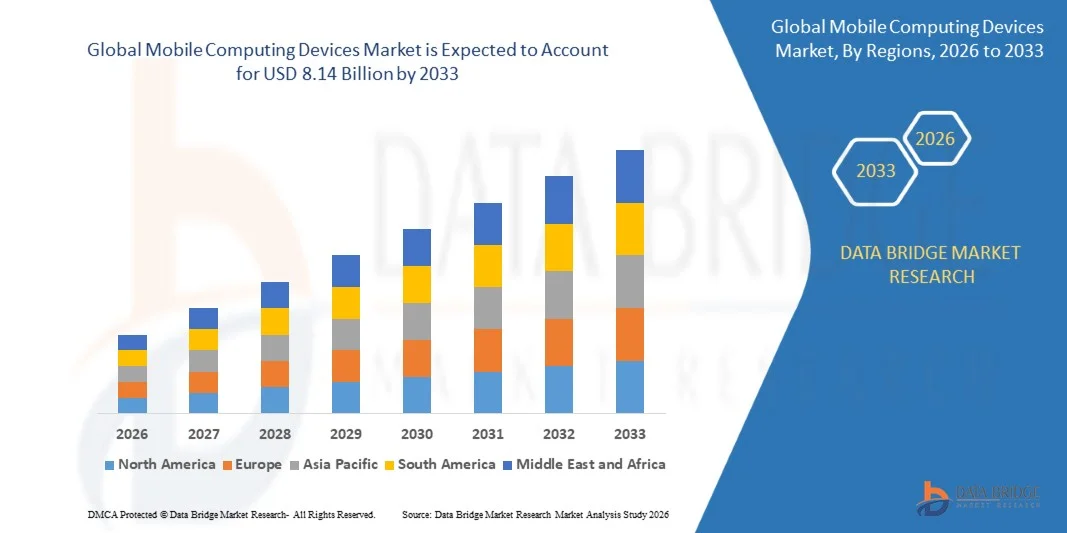
- As per Data Bridge Market Research analysis, the mobile computing devices market was valued at USD 5.64 billion in 2025 and is projected to reach USD 8.14 billion by 2033, growing at a CAGR of 4.70% from 2026 to 2033.
- The market is experiencing consistent growth driven by rising demand for smartphones, tablets, laptops, and other portable computing devices, rapid advancements in processor and display technologies, and increasing adoption of connected and mobile-first computing solutions across consumer and enterprise applications.
- The increasing penetration of 5G networks, high-speed Wi-Fi, cloud computing, remote work, digital education, and mobile commerce, combined with rising smartphone and tablet adoption in emerging economies, is encouraging consumers and businesses to upgrade their computing devices. Enterprises are increasingly deploying mobile computing devices for field services, retail, healthcare, logistics, manufacturing, and other applications that require real-time access to data and business applications.
Market Size & Forecast
- Global Market Value (2025): USD 5.64 Billion
- Expected Market Value (2033): USD 8.14 Billion
- Forecast CAGR (2026–2033): 4.70%
- Leading Region in 2025: North America
- Fastest Growing Region: Asia Pacific
What are the Major Takeaways of the Mobile Computing Devices Market?
- North America dominated the mobile computing devices market with the largest revenue share of 34.8% in 2025, supported by high consumer spending on advanced electronics, strong adoption of smartphones and laptops, widespread 5G connectivity, and the presence of major technology companies driving continuous product innovation.
- Asia-Pacific is expected to be the fastest-growing region at a CAGR of 8.5% from 2026 to 2033, fueled by rapid digitalization, expanding internet and mobile connectivity, increasing disposable incomes, and rising adoption of smartphones, tablets, laptops, and other portable computing devices
- The smartphones segment led the market with a 41.32% share in 2025, driven by their extensive use for communication, entertainment, digital payments, social networking, online shopping, and mobile applications
- Wearable devices are the fastest-growing type, projected to register a CAGR of 9.73%, reflecting the surge in consumer interest in connected and portable technology.
- The android segment dominated the operating system category with a 76% revenue share in 2025, led by its broad availability across smartphones and tablets and its presence across multiple price categories.
- Wi-Fi accounted for 46.83% of the market share in 2025, preferred by widespread deployment across homes, offices, schools, healthcare facilities, retail locations, and public spaces.
- The cellular connectivity segment is the fastest-growing connectivity category, with a CAGR of 9.33%, driven by the rapid expansion of 4G and 5G networks, increasing demand for always-on internet connectivity, rising adoption of connected mobile devices, and growing use of cloud-based applications
Report Scope and Mobile Computing Devices Market Segmentation
|
Attributes |
Mobile Computing Devices Key Market Insights |
|
Segments Covered |
|
|
Countries Covered |
North America
Europe
Asia-Pacific
Middle East and Africa
South America
|
|
Key Market Players |
|
|
Market Opportunities |
|
|
Value Added Data Infosets |
In addition to the market insights such as market value, growth rate, market segments, geographical coverage, market players, and market scenario, the market report curated by the Data Bridge Market Research team includes in-depth expert analysis, import/export analysis, pricing analysis, production consumption analysis, and pestle analysis. |
What is the Key Trend in the Mobile Computing Devices Market?
- AI-enabled mobile computing is increasingly becoming a major product trend, with manufacturers integrating dedicated neural processing units, generative AI, on-device processing, and intelligent assistants into smartphones, laptops, and tablets to deliver faster and more personalized computing experiences.
- For instance, in September 2024, Apple introduced the iPhone 16 series with the A18 chip specifically designed to support Apple Intelligence, including generative AI capabilities, Writing Tools, notification summaries, image generation, and on-device processing through Apple silicon.
- On-device AI processing enables mobile computing devices to perform tasks such as image generation, language processing, real-time translation, intelligent search, and content summarization with reduced dependence on cloud-based processing.
- PC manufacturers are increasingly incorporating dedicated NPUs into laptops and 2-in-1 devices to support AI workloads while improving power efficiency and enabling new productivity features.
- For instance, in May 2024, Microsoft launched Copilot+ PCs featuring NPUs capable of more than 40 trillion operations per second (TOPS), enabling AI functions such as real-time translation, image creation, and other AI workloads directly on compatible devices.
- As manufacturers continue integrating AI processors, generative AI applications, and edge intelligence into portable computing products, AI-enabled devices are expected to become a core differentiating feature, accelerating replacement cycles and strengthening competition across the mobile computing devices market.
What are the Key Drivers of the Mobile Computing Devices Market?
- The rapid expansion of 5G connectivity and high-speed wireless networks has significantly increased demand for mobile computing devices capable of supporting high-bandwidth applications, cloud services, video streaming, mobile gaming, and real-time enterprise connectivity.
- For instance, in July 2024, Qualcomm introduced the Snapdragon 4s Gen 2 Mobile Platform, specifically designed to make 5G smartphones more accessible and reliable, with the company stating that the platform was intended to bring 5G connectivity to billions of smartphone users worldwide.
- Consumers and enterprises are increasingly adopting smartphones, tablets, laptops, and 2-in-1 devices for remote work, digital education, mobile commerce, content creation, and cloud-based productivity, increasing the need for portable and continuously connected computing solutions.
- For instance, in March 2025, Qualcomm launched the X85 5G Modem-RF with an integrated 5G AI Processor, supporting peak download speeds of up to 12.5 Gbps and designed for Android smartphones as well as PCs and other connected mobile devices.
- With mobile connectivity, cloud applications, AI capabilities, and portable productivity becoming increasingly embedded in everyday consumer and enterprise activities, the continued evolution of smartphones, laptops, tablets, and hybrid devices will remain a major driver of market expansion
Which Factors are Challenging the Growth of the Mobile Computing Devices Market?
- Advanced mobile computing devices require substantial investment because manufacturers increasingly integrate high-performance processors, AI accelerators, premium displays, advanced cameras, 5G modems, and sophisticated connectivity technologies, increasing device prices.
- For instance, from June 2025, the European Union implemented new ecodesign requirements for smartphones and tablets, including minimum battery durability of 800 charge cycles at 80% capacity, spare-part availability for up to seven years, and longer software-update requirements, highlighting the growing regulatory and sustainability pressures on mobile-device manufacturers
- These higher prices can restrict adoption among price-sensitive consumers and small businesses, particularly in emerging economies where affordability remains an important consideration when purchasing smartphones, tablets, and laptops.
- Short device replacement cycles and electronic waste can challenge sustainable market expansion, as frequent upgrades increase ownership costs and create growing volumes of discarded smartphones, tablets, laptops, and other mobile computing devices.
- Data privacy and cybersecurity concerns can restrict adoption in enterprise and consumer environments, as mobile computing devices increasingly store sensitive personal, financial, and business information and remain exposed to malware, unauthorized access, data breaches, and insecure networks.
- For instance, in January 2025, Google’s Android Security Bulletin disclosed a critical vulnerability capable of remote code execution on affected Android devices, highlighting the continuing cybersecurity and software-maintenance burden associated with connected mobile computing devices
- The high upfront cost of advanced devices, combined with additional expenses for accessories, upgrades, connectivity plans, and specialized software, continues to create an affordability barrier, particularly for consumers and organizations operating under constrained technology budgets.
How is the Mobile Computing Devices Market Segmented?
The mobile computing devices market is segmented on the basis of type, operating system, connectivity, and end user.
- By Type
On the basis of type, the mobile computing devices market is segmented into smartphones, tablets, laptops, wearable devices, and others. The smartphones segment dominated the market with an estimated 41.32% share in 2025, owing to their extensive use for communication, entertainment, digital payments, social networking, online shopping, and mobile applications. Smartphones have evolved into multifunctional computing platforms with advanced processors, high-resolution displays, sophisticated cameras, 5G connectivity, and artificial intelligence capabilities. Increasing smartphone penetration across emerging economies is further strengthening the segment. Frequent product launches and replacement cycles are also supporting demand for newer devices with enhanced performance and connectivity. The extensive application ecosystem and broad availability across different price categories continue to make smartphones the largest device category.
The wearable devices segment is projected to register the fastest growth at an estimated CAGR of 9.73% during the forecast period, driven by increasing consumer interest in connected and portable technology. Smartwatches, fitness trackers, smart glasses, and other wearable computing products are increasingly used for communication, productivity, navigation, entertainment, and health monitoring. Improvements in sensors, battery efficiency, connectivity, and miniaturized processors are expanding their functionality. Integration with smartphones and cloud platforms is creating increasingly connected device ecosystems. Growing demand for hands-free computing and real-time information access is encouraging adoption among consumers and professionals. Artificial intelligence and advanced sensing capabilities are also expanding wearable applications beyond basic fitness tracking
- By Operating System
On the basis of operating system, the mobile computing devices market is segmented into android, iOS, windows, and others. The android segment dominated the market with 76% in 2025 reflecting its broad availability across smartphones and tablets and its presence across multiple price categories. Android is supported by a large ecosystem of manufacturers, enabling devices ranging from entry-level to premium models. Its flexible ecosystem allows manufacturers considerable freedom in hardware configuration and software customization. The availability of affordable Android smartphones is particularly important in emerging markets. Android's extensive application ecosystem also supports consumer and enterprise applications. Continuous improvements in artificial intelligence, security, multitasking, and connectivity are strengthening the platform.
The iOS segment is projected to experience strong growth at a CAGR of 4.0% during the forecast period, supported by premium smartphone demand and Apple's expanding ecosystem. Integration between iPhones, iPads, Macs, Apple Watches, and other Apple products creates a seamless user experience and supports customer retention. Apple's proprietary processors continue to improve device performance and energy efficiency. The integration of generative artificial intelligence and other intelligent features is creating additional value for users. Apple's emphasis on privacy, security, long-term software support, and ecosystem integration further strengthens its position. These factors are expected to support continued iOS growth in premium mobile computing.
- By Connectivity
On the basis of connectivity, the mobile computing devices market is segmented into Wi-Fi, cellular, bluetooth, and others. The Wi-Fi segment dominated the connectivity category with an estimated 46.83% share of 2025 shipments, supported by widespread deployment across homes, offices, schools, healthcare facilities, retail locations, and public spaces. Wi-Fi provides high-speed connectivity for smartphones, tablets, laptops, and other connected computing devices. The increasing adoption of Wi-Fi 6 and Wi-Fi 7 is improving network capacity, latency, and performance in high-density environments. Remote and hybrid work is further increasing dependence on reliable wireless broadband connectivity. Cloud computing, video conferencing, online education, streaming, and cloud gaming are generating additional demand. Households and enterprises are also connecting increasing numbers of devices simultaneously.
The cellular connectivity segment is projected to be the fastest-growing connectivity category, with an estimated CAGR of 9.33% during the forecast period, driven by expanding 4G and 5G infrastructure. Cellular connectivity enables mobile computing devices to maintain internet access without depending on fixed broadband or local Wi-Fi networks. The increasing deployment of 5G is providing higher data speeds, lower latency, and improved network capacity. These capabilities are particularly valuable for cloud services, video streaming, mobile gaming, real-time enterprise applications, and connected devices. Smartphone manufacturers are also increasingly incorporating advanced 5G modems into mid-range and premium devices. Growing mobile internet adoption in emerging economies is expanding the addressable market for cellular-enabled devices.
- By End User
On the basis of end user, the mobile computing devices market is segmented into consumer, industrial, IT and telecommunications, manufacturing, transportation and logistics, defense and government, BFSI, retail, energy and utilities, healthcare, and others. The consumer segment dominated with an estimated 52.64% share of 2025 revenue, supported by widespread adoption of smartphones, tablets, laptops, and wearable devices. Consumers increasingly use mobile computing devices for communication, entertainment, gaming, digital payments, education, online shopping, and personal productivity. The increasing availability of devices across entry-level, mid-range, and premium price categories supports broad consumer adoption. AI-enabled smartphones and laptops are also encouraging replacement and upgrade activity. Growing digital-service penetration in emerging economies is creating additional demand.
The healthcare segment is projected to register the fastest growth at an estimated CAGR of 9.53% during the forecast period, driven by increasing adoption of mobile computing for clinical workflows, telehealth, remote patient monitoring, and healthcare administration. Tablets and smartphones allow healthcare professionals to access electronic health records, diagnostic information, medical applications, and patient data at the point of care. Wearable devices are increasingly being used to collect continuous physiological and activity data for remote monitoring. The expansion of telemedicine is creating additional demand for portable devices capable of supporting secure video consultations and digital healthcare services. Hospitals are also adopting connected mobile devices to improve communication and operational efficiency. Advances in wireless connectivity, cloud computing, artificial intelligence, and cybersecurity are expanding the capabilities of mobile healthcare computing.
Which Region Holds the Largest Share of the Mobile Computing Devices Market?
- North America dominated the mobile computing devices market with the largest revenue share of 34.8% in 2025, supported by high consumer spending on advanced electronics, strong adoption of smartphones and laptops, widespread 5G connectivity, and the presence of major technology companies driving continuous product innovation.
- The region also benefits from early 5G deployment, high internet penetration, rapid cloud-computing adoption, and strong demand for AI-enabled devices, while leading technology companies continue introducing advanced processors, AI PCs, premium smartphones, and connected computing solutions. Increasing use of mobile devices across healthcare, retail, BFSI, logistics, and professional services further strengthens North America's market leadership.
U.S. Mobile Computing Devices Market Insight
The U.S. mobile computing devices market is witnessing strong growth due to high consumer spending on smartphones, laptops, tablets, and wearable devices, along with rapid adoption of AI-enabled computing technologies. The country’s advanced 5G infrastructure, mature digital ecosystem, and strong presence of technology companies are driving demand across consumer, enterprise, healthcare, retail, and financial applications. In addition, increasing adoption of cloud computing, remote work, digital commerce, and connected-device ecosystems is accelerating demand for advanced mobile computing solutions.
Asia-Pacific Mobile Computing Devices Market Insight
The Asia-Pacific mobile computing devices market is expected to witness rapid growth, driven by expanding smartphone penetration, rising disposable incomes, increasing internet connectivity, and accelerating digitalization across countries such as China, India, Japan, and South Korea. Growing demand for affordable and advanced smartphones, laptops, tablets, and wearable devices is supporting regional market expansion. In addition, increasing 5G deployment, e-commerce adoption, digital payments, remote education, and enterprise mobility initiatives are accelerating the adoption of mobile computing devices across consumer and business applications.
Japan Mobile Computing Devices Market Insight
The Japan mobile computing devices market is witnessing consistent growth due to high technology adoption, strong consumer demand for premium electronic devices, and continuous investment in advanced mobile computing solutions. Consumers and enterprises are increasingly adopting smartphones, laptops, tablets, and wearable devices featuring artificial intelligence, high-speed connectivity, and advanced processors. Moreover, Japan’s mature 5G infrastructure, aging population requiring digital healthcare solutions, and strong focus on smart mobility and connected technologies are further contributing to market growth.
China Mobile Computing Devices Market Insight
The China mobile computing devices market is growing rapidly, driven by high smartphone penetration, expanding 5G infrastructure, strong domestic electronics manufacturing, and increasing demand for AI-enabled devices. Growing adoption of smartphones, tablets, laptops, and wearable technologies across consumer, enterprise, retail, and digital payment applications is significantly boosting market demand. In addition, increasing investments in artificial intelligence, semiconductor technologies, cloud computing, and connected-device ecosystems are strengthening China’s position as one of the largest and most technologically advanced mobile computing markets globally.
U.K. Mobile Computing Devices Market Insight
The U.K. mobile computing devices market is experiencing steady growth, supported by widespread smartphone and laptop adoption, strong digital infrastructure, and increasing demand for connected and AI-enabled computing solutions. Businesses, educational institutions, healthcare providers, and consumers are increasingly utilizing mobile devices for remote collaboration, digital services, cloud applications, and online commerce. Furthermore, continued 5G expansion, growing adoption of AI PCs and smart devices, and increasing focus on cybersecurity and data protection are contributing to market growth in the U.K.
Germany Mobile Computing Devices Market Insight
The Germany mobile computing devices market is expanding steadily due to high enterprise digitization, strong demand for advanced laptops and smartphones, and increasing adoption of connected computing technologies. Manufacturing companies, logistics providers, healthcare organizations, and other industries are increasingly utilizing mobile computing devices to support digital workflows, real-time data access, and workforce mobility. Continuous advancements in 5G, artificial intelligence, cloud computing, and edge technologies, along with Germany’s strong industrial digitalization initiatives, are further driving market growth.
Which are the Top Companies in Mobile Computing Devices Market?
The mobile computing devices industry is primarily led by well-established companies, including:
- Apple Inc. (U.S.)
- SAMSUNG (South Korea)
- Lenovo (China)
- HP Development Company, L.P. (U.S.)
- Dell Inc. (U.S.)
- Microsoft Corporation (U.S.)
- ASUSTeK COMPUTER INC. (Taiwan)
- Acer Inc. (Taiwan)
- Sony Corporation (Japan)
- Huawei Technologies Co., Ltd. (China)
- Xiaomi (China)
- OPPO (China)
- vivo Mobile Communication Co., Ltd. (China)
- realme (China)
- ZTE Corporation (China)
- TCL (China)
- Garmin Ltd. (Switzerland)
- Fujitsu Limited (Japan)
- Amazon.com, Inc. (U.S.)
- Google LLC (U.S.)
What are Latest Developments in Mobile Computing Devices Market?
- In March 2025, Apple introduced the iPad Air powered by the M3 chip, offering 11-inch and 13-inch models designed for Apple Intelligence and enhanced mobile productivity. The M3-powered iPad Air provides up to 60% faster Neural Engine performance for AI workloads compared with the M1 version, while also supporting 5G connectivity and advanced accessories such as the Magic Keyboard and Apple Pencil Pro. The launch demonstrates the convergence of tablet computing, high-performance processors, and on-device AI capabilities.
- In January 2025, Samsung Electronics launched the Galaxy S25 series, introducing the Galaxy S25 Ultra, Galaxy S25+, and Galaxy S25 with enhanced on-device processing and multimodal Galaxy AI capabilities. The devices use a customized Snapdragon 8 Elite Mobile Platform for Galaxy and introduce more context-aware AI interactions, reflecting the increasing integration of artificial intelligence into smartphones. This launch highlights the shift toward AI-powered mobile computing, where smartphones increasingly function as intelligent personal computing platforms.
- In May 2024, Microsoft introduced Copilot+ PCs, establishing a new category of Windows PCs designed specifically for artificial intelligence workloads. These devices feature processors capable of more than 40 trillion operations per second (TOPS), along with features such as Recall, Cocreator, and Live Captions that use on-device AI processing. Microsoft announced that devices from Surface and partners including Acer, ASUS, Dell, HP, Lenovo, and Samsung would support the new category, accelerating the integration of AI into personal computing.
- In June 2023, Apple introduced the 15-inch MacBook Air powered by the M2 chip, expanding its lightweight laptop portfolio with a larger 15.3-inch Liquid Retina display while retaining a thin and fanless design. The device offered up to 18 hours of battery life and significantly higher performance enabled by Apple silicon, demonstrating continued development toward portable devices that combine high computing performance with energy efficiency. The launch further strengthened the trend toward increasingly powerful yet lightweight mobile computing devices for productivity and content creation.
- In October 2021, Microsoft introduced Android apps on Windows 11 through the Windows Subsystem for Android, allowing eligible Windows PCs to run selected Android applications and games through the Amazon Appstore. The capability enabled Android applications to operate alongside Windows applications and supported interaction through mouse, touch, and pen inputs. The development expanded cross-platform functionality between mobile and PC ecosystems and demonstrated the increasing convergence of mobile and traditional computing experiences.

- Interactive Data Analysis Dashboard
- Company Analysis Dashboard for high growth potential opportunities
- Research Analyst Access for customization & queries
- Competitor Analysis with Interactive dashboard
- Latest News, Updates & Trend analysis
- Harness the Power of Benchmark Analysis for Comprehensive Competitor Tracking
Data collection and base year analysis are done using data collection modules with large sample sizes. The stage includes obtaining market information or related data through various sources and strategies. It includes examining and planning all the data acquired from the past in advance. It likewise envelops the examination of information inconsistencies seen across different information sources. The market data is analysed and estimated using market statistical and coherent models. Also, market share analysis and key trend analysis are the major success factors in the market report. To know more, please request an analyst call or drop down your inquiry.
The key research methodology used by DBMR research team is data triangulation which involves data mining, analysis of the impact of data variables on the market and primary (industry expert) validation. Data models include Vendor Positioning Grid, Market Time Line Analysis, Market Overview and Guide, Company Positioning Grid, Patent Analysis, Pricing Analysis, Company Market Share Analysis, Standards of Measurement, Global versus Regional and Vendor Share Analysis. To know more about the research methodology, drop in an inquiry to speak to our industry experts.
Data Bridge Market Research is a leader in advanced formative research. We take pride in servicing our existing and new customers with data and analysis that match and suits their goal. The report can be customized to include price trend analysis of target brands understanding the market for additional countries (ask for the list of countries), clinical trial results data, literature review, refurbished market and product base analysis. Market analysis of target competitors can be analyzed from technology-based analysis to market portfolio strategies. We can add as many competitors that you require data about in the format and data style you are looking for. Our team of analysts can also provide you data in crude raw excel files pivot tables (Fact book) or can assist you in creating presentations from the data sets available in the report.













