




Global Molecular Quality Controls Market
Market Size in USD Million
CAGR :
% 
 USD
228.00 Million
USD
385.92 Million
2025
2033
USD
228.00 Million
USD
385.92 Million
2025
2033
 Forecast Period Forecast Period |
2026 - 2033 |
 Market Size (Base Year) Market Size (Base Year) |
USD 228.00 Million |
 Market Size (Forecast Year) Market Size (Forecast Year) |
USD 385.92 Million |
 CAGR CAGR |
% |
| Major Markets Players |
|
Molecular Quality Controls Market Overview
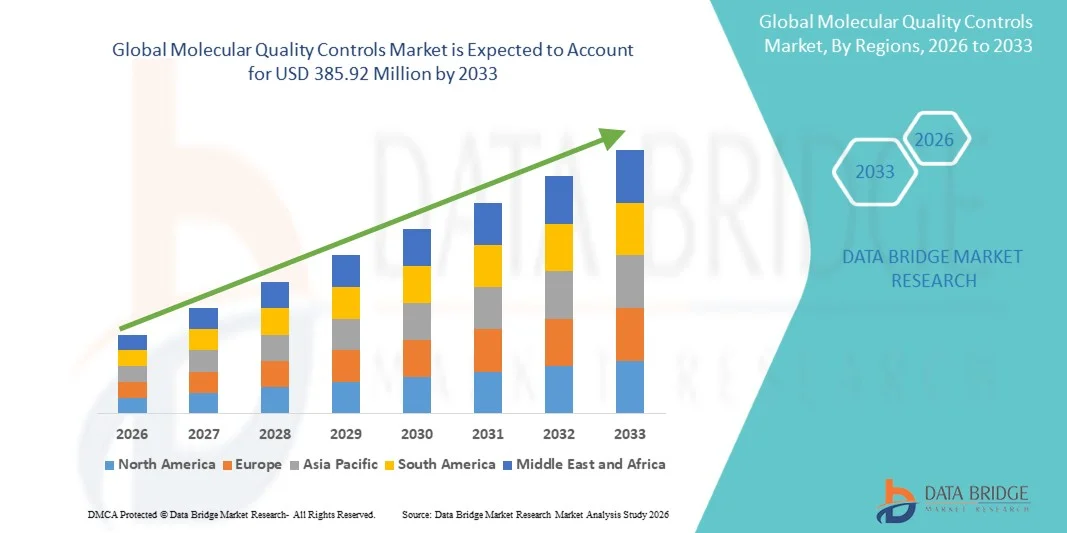
The Molecular Quality Controls Market was valued at USD 228.00 Million in 2025 and is projected to reach USD 385.92 Million by 2033, growing at a CAGR of 6.80% from 2026 to 2033. The Molecular Quality Controls Market is experiencing steady growth driven by the increasing adoption of molecular diagnostic testing, rising prevalence of infectious and genetic diseases, and growing emphasis on ensuring accuracy and reliability in laboratory testing procedures. Rapid advancements in PCR, next-generation sequencing (NGS), and other molecular diagnostic technologies are further accelerating demand for high-quality control materials across clinical laboratories, hospitals, and research institutions.
The increasing volume of molecular testing worldwide, combined with stringent regulatory requirements for laboratory accreditation and quality assurance, is compelling diagnostic laboratories and healthcare providers to adopt advanced molecular quality control solutions. Independent and instrument-specific quality controls are increasingly replacing conventional validation methods in many laboratories, offering improved test accuracy, reproducibility, and compliance with international quality standards. In addition, growing investments in precision medicine, expanding infectious disease surveillance programs, and rising adoption of automated molecular diagnostic platforms are further supporting market growth globally.
Key Market Trends & Insights
- North America dominated the Molecular Quality Controls Market with the largest revenue share of 38.26% in 2025, supported by the strong presence of advanced molecular diagnostic laboratories, high adoption of PCR and NGS technologies, and increasing investments in precision medicine and infectious disease testing across the United States and Canada.
- The Independent Controls segment dominated the market with a share of 57.84% in 2025 due to the increasing demand for unbiased third-party quality assurance solutions across molecular diagnostic laboratories
- Asia-Pacific is expected to be the fastest-growing region at a CAGR of 8.1% from 2026 to 2033, fueled by expanding molecular diagnostic infrastructure, rising prevalence of infectious diseases and cancer, and increasing healthcare investments in China, India, and Japan.
- The Multi-Analyte Controls segment is projected to register the fastest CAGR of 7.8%, reflecting the growing demand for cost-effective, high-throughput molecular testing workflows and multiplex diagnostic platforms.
- The Infectious Diseases segment dominated the application category with a 43.92% revenue share in 2025, led by rising molecular testing volumes for viral and bacterial infections, increasing adoption of PCR-based diagnostics, and expanding disease surveillance programs globally.
- Clinical Laboratories accounted for 46.37% of the market in 2025, preferred due to high molecular testing volumes, stringent quality control requirements, and increasing implementation of accredited diagnostic testing standards.
- The Oncology application segment is expected to witness the fastest growth at a CAGR of 7.9%, driven by increasing adoption of companion diagnostics, expanding cancer biomarker testing, and growing investments in precision oncology and personalized medicine worldwide.
Market Size & Forecast
- Global Market Value (2025): USD 228.00 Million
- Expected Market Value (2033): USD 385.92 Million
- Forecast CAGR (2026–2033): 6.80%
- Leading Region in 2025: North America
- Fastest Growing Region: Asia-Pacific
Report Scope and Molecular Quality Controls Market Segmentation
|
Attributes |
Molecular Quality Controls Key Market Insights |
|
Segments Covered |
|
|
Countries Covered |
North America · U.S. · Canada · Mexico Europe · Germany · France · U.K. · Netherlands · Switzerland · Belgium · Russia · Italy · Spain · Turkey · Rest of Europe Asia-Pacific · China · Japan · India · South Korea · Singapore · Malaysia · Australia · Thailand · Indonesia · Philippines · Rest of Asia-Pacific Middle East and Africa · Saudi Arabia · U.A.E. · South Africa · Egypt · Israel · Rest of Middle East and Africa South America · Brazil · Argentina · Rest of South America |
|
Key Market Players |
• Bio-Rad Laboratories, Inc. (U.S.) |
|
Market Opportunities |
· Growing adoption of precision medicine and companion diagnostics · Emerging healthcare markets · Rising integration of automation, multiplex testing, and next-generation sequencing technologies |
|
Value Added Data Infosets |
In addition to the insights on market scenarios such as market value, growth rate, segmentation, geographical coverage, and major players, the market reports curated by the Data Bridge Market Research also include in-depth expert analysis, geographically represented company-wise production and capacity, network layouts of distributors and partners, detailed and updated price trend analysis and deficit analysis of supply chain and demand. |
Molecular Quality Controls Market Trends
Trend: Increasing Adoption of Multi-Analyte and Third-Party Molecular Quality Controls
Clinical laboratories and diagnostic centers are increasingly adopting multi-analyte and independent molecular quality controls to improve testing accuracy, workflow efficiency, and regulatory compliance across PCR and next-generation sequencing (NGS) platforms. The growing testing volume for infectious diseases, oncology biomarkers, and genetic disorders is accelerating demand for standardized quality control materials that can validate multiple analytes simultaneously. Laboratories are increasingly preferring third-party independent controls over instrument-specific controls due to their ability to provide unbiased assay performance verification across multiple diagnostic systems. In addition, the expansion of multiplex molecular testing panels and syndromic testing platforms is driving demand for advanced quality controls capable of supporting high-throughput diagnostic workflows. According to the World Health Organization, molecular diagnostic testing volumes have significantly increased worldwide following the expansion of infectious disease surveillance and pandemic preparedness programs, further strengthening demand for reliable molecular quality controls.
Molecular Quality Controls Market Dynamics
Key Market Driver: Rising Adoption of Molecular Diagnostics and Precision Medicine
The rapid expansion of molecular diagnostics and precision medicine is a major driver fueling growth in the Molecular Quality Controls Market. Increasing use of PCR, real-time PCR, next-generation sequencing (NGS), and multiplex diagnostic technologies in infectious disease detection, oncology testing, and genetic analysis is creating substantial demand for highly accurate quality control solutions. Clinical laboratories, hospitals, and IVD manufacturers are increasingly implementing stringent quality assurance programs to comply with international accreditation standards and ensure reliable patient test results. According to industry estimates, global molecular diagnostic testing volumes have continued to rise significantly due to increasing prevalence of infectious diseases, cancer, and inherited disorders. In addition, growing investments in personalized medicine and biomarker-based diagnostics are accelerating the adoption of independent and multi-analyte molecular controls across advanced laboratory settings.
Key Restraint/Challenge: High Cost and Complexity of Advanced Molecular Quality Control Solutions
A significant restraint in the Molecular Quality Controls Market is the high cost associated with advanced molecular quality control products and complex laboratory validation procedures. Multi-analyte controls, NGS-compatible controls, and highly characterized third-party controls require sophisticated manufacturing, validation, and storage processes, increasing operational expenses for laboratories and healthcare providers. In addition, maintaining compliance with evolving regulatory standards from organizations such as the U.S. Food and Drug Administration and the Clinical and Laboratory Standards Institute increases the overall cost burden for diagnostic laboratories. Smaller laboratories and healthcare facilities in emerging economies often face challenges related to limited funding, lack of skilled professionals, and inadequate molecular testing infrastructure. The increasing complexity of multiplex molecular assays and rapidly evolving diagnostic technologies also create additional challenges for laboratories attempting to maintain consistent quality assurance across multiple testing platforms.
Key Market Opportunity: Expansion of NGS, Multiplex Testing, and Automated Molecular Diagnostic Platforms
The growing adoption of next-generation sequencing, multiplex PCR testing, and automated molecular diagnostic systems presents a significant opportunity for the Molecular Quality Controls market. Advanced molecular testing platforms require highly standardized and reliable quality control materials to ensure assay sensitivity, specificity, and reproducibility across large-scale testing workflows. Manufacturers are increasingly developing synthetic, multiplexed, and disease-specific molecular controls capable of supporting oncology profiling, infectious disease panels, and genetic testing applications. In addition, increasing integration of artificial intelligence and laboratory automation technologies is improving testing efficiency and driving demand for high-performance quality assurance products. Emerging healthcare markets such as India, China, and Brazil are expected to create strong growth opportunities due to expanding molecular diagnostic infrastructure, rising healthcare investments, and increasing awareness regarding accurate and standardized laboratory testing practices.
Molecular Quality Controls Market Scope
The Molecular Quality Controls market is segmented on the basis of product, analyte type, application, and end user.
- By Product
On the basis of product, the Molecular Quality Controls Market is segmented into Independent Controls and Instrument-Specific Controls. The Independent Controls segment dominated the market with a share of 57.84% in 2025 due to the increasing demand for unbiased third-party quality assurance solutions across molecular diagnostic laboratories. Independent controls are widely adopted because they can validate assay performance across multiple platforms and instruments, ensuring greater testing accuracy and regulatory compliance. Clinical laboratories and diagnostic centers increasingly prefer these controls for PCR, RT-PCR, and next-generation sequencing applications because they help identify analytical errors that may not be detected by manufacturer-specific controls. In addition, growing implementation of laboratory accreditation standards and external quality assessment programs is accelerating demand for independent controls globally. Rising prevalence of infectious diseases and cancer is further increasing molecular testing volumes, strengthening the adoption of high-quality validation materials. The expansion of multiplex diagnostic testing and syndromic panels is also contributing to segment growth. Furthermore, increasing investments in precision medicine and companion diagnostics continue to reinforce the leading position of the Independent Controls segment across global healthcare markets.
The Instrument-Specific Controls segment is expected to witness the fastest CAGR of 7.5% from 2026 to 2033, driven by the increasing adoption of fully integrated molecular diagnostic platforms and automated testing systems. Diagnostic laboratories are increasingly utilizing instrument-specific controls to optimize workflow compatibility and improve operational efficiency. These controls are specifically designed to function with proprietary molecular systems, ensuring consistent performance and minimizing technical variability during testing procedures. In addition, rising installation of automated PCR analyzers and closed-system molecular platforms in hospitals and clinical laboratories is supporting segment growth. Manufacturers are increasingly developing customized controls for high-throughput molecular testing systems to improve assay reliability and simplify laboratory validation processes. The growing focus on rapid infectious disease testing and decentralized diagnostics is further accelerating adoption of instrument-specific controls globally. Increasing demand for streamlined laboratory operations and faster turnaround times is also expected to support strong market expansion during the forecast period.
- By Analyte Type
On the basis of analyte type, the Molecular Quality Controls Market is segmented into Single-Analyte Controls and Multi-Analyte Controls. The Single-Analyte Controls segment dominated the market with a share of 53.16% in 2025 due to its widespread use in routine molecular diagnostic procedures requiring precise validation of individual biomarkers and pathogens. Clinical laboratories and diagnostic centers extensively utilize single-analyte controls for infectious disease testing, genetic analysis, and oncology diagnostics to ensure assay specificity and reproducibility. These controls are particularly preferred in laboratories performing targeted molecular testing with highly standardized workflows. Increasing adoption of PCR-based assays for viral load testing and pathogen detection is significantly contributing to segment growth. In addition, stringent quality assurance requirements from regulatory agencies and laboratory accreditation organizations are driving demand for reliable single-analyte quality control products. The segment also benefits from the growing use of personalized medicine and companion diagnostic assays that require precise biomarker validation. Rising global testing volumes for infectious diseases and hereditary conditions further reinforce the dominance of this segment in the market.
The Multi-Analyte Controls segment is expected to witness the fastest CAGR of 7.8% from 2026 to 2033, driven by increasing adoption of multiplex molecular testing platforms and high-throughput diagnostic workflows. Multi-analyte controls enable simultaneous validation of multiple targets within a single assay, improving laboratory efficiency and reducing operational costs. The growing popularity of syndromic testing panels for respiratory infections, sexually transmitted diseases, and oncology biomarker profiling is significantly supporting segment growth. In addition, advancements in next-generation sequencing and multiplex PCR technologies are increasing the demand for comprehensive quality control materials capable of supporting complex diagnostic assays. Laboratories are increasingly adopting these controls to improve workflow standardization and enhance assay performance across multiple analytes. The rising need for rapid and cost-effective diagnostic solutions, particularly in large clinical laboratories and research institutions, is further accelerating market expansion. Increasing investments in precision diagnostics and personalized medicine are also expected to create substantial opportunities for this segment globally.
- By Application
On the basis of application, the Molecular Quality Controls Market is segmented into Infectious Diseases, Oncology, Genetic Testing, and Other Applications. The Infectious Diseases segment dominated the market with a share of 43.92% in 2025 due to the growing global burden of viral, bacterial, and fungal infections requiring accurate molecular diagnostic testing. Molecular quality controls are extensively used in PCR and RT-PCR assays for detection of infectious pathogens such as influenza, hepatitis, HIV, tuberculosis, and respiratory viruses. Increasing government investments in infectious disease surveillance programs and pandemic preparedness initiatives are significantly driving demand for quality control materials. In addition, rising testing volumes in hospitals, public health laboratories, and diagnostic centers are accelerating segment growth globally. The growing adoption of multiplex infectious disease panels and point-of-care molecular testing systems is further strengthening the need for standardized quality controls. Expanding laboratory accreditation requirements and regulatory focus on assay reliability also continue to support market dominance. Increasing awareness regarding early disease diagnosis and infection control measures further contributes to strong segment growth worldwide.
The Oncology segment is expected to witness the fastest CAGR of 7.9% from 2026 to 2033, driven by the rapid expansion of precision oncology, companion diagnostics, and cancer biomarker testing worldwide. Molecular quality controls are increasingly utilized in next-generation sequencing and liquid biopsy assays to ensure accurate detection of genetic mutations and tumor biomarkers. The growing prevalence of cancer and rising demand for personalized treatment approaches are significantly supporting segment expansion. In addition, increasing investments in genomic research and targeted therapy development are accelerating adoption of advanced molecular testing technologies. Clinical laboratories and oncology centers are increasingly implementing high-sensitivity quality controls to maintain assay reproducibility and regulatory compliance. Technological advancements in multiplex oncology testing panels and genomic profiling solutions are also driving demand for comprehensive molecular control products. Furthermore, increasing adoption of companion diagnostics in pharmaceutical development is expected to create strong growth opportunities for the oncology segment during the forecast period.
- By End User
On the basis of end user, the Molecular Quality Controls Market is segmented into Clinical Laboratories, Hospitals, IVD Manufacturers and Contract Research Organizations, Academic & Research Institutes, and Other End Users. The Clinical Laboratories segment dominated the market with a share of 46.37% in 2025 due to the high volume of molecular diagnostic testing procedures performed in independent and hospital-affiliated laboratories worldwide. Clinical laboratories extensively utilize molecular quality controls to ensure assay accuracy, maintain accreditation compliance, and improve reliability of patient test results. Increasing adoption of PCR, RT-PCR, and next-generation sequencing technologies in infectious disease diagnostics and oncology testing is significantly contributing to segment growth. In addition, stringent regulatory guidelines and quality assurance standards are encouraging laboratories to implement advanced control materials across molecular testing workflows. The growing prevalence of chronic and infectious diseases is further increasing testing volumes and supporting market expansion. Rising investments in automated molecular diagnostic systems and high-throughput laboratory infrastructure are also reinforcing the dominance of this segment globally. Furthermore, increasing demand for accurate and standardized diagnostic testing continues to strengthen adoption of molecular quality control products across clinical laboratories.
The IVD Manufacturers and Contract Research Organizations segment is expected to witness the fastest CAGR of 7.6% from 2026 to 2033, driven by increasing investments in molecular assay development, clinical validation studies, and companion diagnostic research. IVD manufacturers are increasingly utilizing advanced quality controls to ensure analytical accuracy and regulatory compliance during assay development and commercialization processes. Contract research organizations are also adopting molecular control products for clinical trials, biomarker validation, and pharmaceutical research activities. The growing focus on precision medicine and personalized healthcare solutions is accelerating demand for high-quality molecular testing systems and validation materials. In addition, rising collaborations between biotechnology companies, pharmaceutical manufacturers, and diagnostic developers are supporting segment growth globally. Increasing development of multiplex molecular assays and next-generation sequencing applications is further boosting the need for sophisticated quality control solutions. Expanding regulatory requirements for molecular diagnostic product approvals are also expected to drive strong market growth throughout the forecast period.
Molecular Quality Controls Market Regional Analysis
North America dominated the Molecular Quality Controls market and accounted for the largest revenue share of 38.26% in 2025, supported by the strong presence of advanced molecular diagnostic laboratories, high adoption of PCR and NGS technologies, and increasing investments in precision medicine and infectious disease testing across the United States and Canada. The region also benefits from well-established healthcare infrastructure, stringent laboratory quality assurance regulations, and rising adoption of automated molecular diagnostic systems. Increasing demand for accurate clinical testing, growing prevalence of chronic and infectious diseases, and continuous advancements in genomic research are further strengthening North America’s leadership position in the global market.
U.S. Molecular Quality Controls Market Insight
The U.S. Molecular Quality Controls market is witnessing strong growth due to rising adoption of molecular diagnostics, increasing demand for precision medicine, and expanding use of PCR and next-generation sequencing technologies across clinical laboratories and hospitals. The country’s advanced healthcare ecosystem, strong presence of biotechnology and diagnostic companies, and increasing investments in infectious disease surveillance and oncology testing are driving market demand. In addition, stringent regulatory requirements for laboratory accreditation and quality assurance are accelerating the adoption of advanced molecular quality control solutions across diagnostic facilities and research organizations.
Europe Molecular Quality Controls Market Insight
The Europe Molecular Quality Controls market remains a major contributor to global revenue, driven by strong government healthcare support, increasing molecular testing volumes, and growing adoption of advanced diagnostic technologies. The widespread use of molecular assays in infectious disease detection, cancer diagnostics, and genetic testing is supporting market expansion across the region. Increasing investments in precision medicine, laboratory automation, and genomic research, coupled with strict quality assurance regulations, continue to enhance the adoption of Molecular Quality Controls throughout Europe.
U.K. Molecular Quality Controls Market Insight
The U.K. Molecular Quality Controls market is experiencing steady growth, supported by rising investments in molecular diagnostics, increasing prevalence of chronic diseases, and expanding adoption of personalized healthcare solutions. Clinical laboratories and research institutions are increasingly implementing advanced molecular quality assurance programs to improve diagnostic accuracy and regulatory compliance. Furthermore, increasing use of PCR and NGS technologies in infectious disease testing and oncology applications is strengthening demand for high-performance molecular quality control products across the country.
Germany Molecular Quality Controls Market Insight
The Germany Molecular Quality Controls market is expanding steadily due to the country’s advanced healthcare infrastructure, strong biotechnology industry presence, and increasing investments in molecular research and precision diagnostics. Hospitals, diagnostic laboratories, and academic research institutes are increasingly adopting advanced molecular testing technologies for oncology, infectious disease, and genetic testing applications. Continuous advancements in automation, genomic sequencing, and multiplex molecular assays, along with strong regulatory focus on laboratory quality standards, are further driving market growth in Germany.
Asia-Pacific Molecular Quality Controls Market Insight
The Asia-Pacific Molecular Quality Controls market is expected to witness rapid growth, driven by expanding molecular diagnostic infrastructure, rising prevalence of infectious diseases and cancer, and increasing healthcare investments in China, India, and Japan. Growing awareness regarding early disease diagnosis, increasing adoption of PCR and NGS technologies, and improving healthcare accessibility are supporting regional market expansion. In addition, rising government initiatives for disease surveillance, expanding clinical laboratory networks, and growing demand for cost-effective diagnostic solutions are accelerating the adoption of Molecular Quality Controls across healthcare and research sectors.
Japan Molecular Quality Controls Market Insight
The Japan Molecular Quality Controls market is witnessing consistent growth due to rising investments in molecular diagnostics, genomic medicine, and advanced healthcare technologies. Diagnostic laboratories, hospitals, and research institutions are increasingly adopting high-quality molecular controls for infectious disease testing, oncology diagnostics, and genetic analysis. Moreover, increasing integration of automation and next-generation sequencing technologies, along with the country’s strong focus on healthcare innovation and laboratory accuracy, is further contributing to market growth.
China Molecular Quality Controls Market Insight
The China Molecular Quality Controls market is growing rapidly, driven by expanding healthcare infrastructure, rising molecular testing volumes, and increasing government focus on infectious disease management and cancer diagnostics. Growing adoption of PCR-, RT-PCR-, and NGS-based testing platforms across hospitals, diagnostic laboratories, and biotechnology companies is significantly boosting market demand. In addition, increasing investments in precision medicine, rising awareness regarding quality assurance in laboratory testing, and rapid advancements in molecular diagnostic technologies are positioning China as one of the fastest-growing markets for Molecular Quality Controls globally.
Molecular Quality Controls Market Share
The Molecular Quality Controls industry is primarily led by well-established companies, including:
- Bio-Rad Laboratories, Inc. (U.S.)
- Thermo Fisher Scientific Inc. (U.S.)
- F. Hoffmann-La Roche Ltd (Switzerland)
- QIAGEN N.V. (Netherlands)
- Abbott Laboratories (U.S.)
- Bio-Techne Corporation (U.S.)
- Seegene Inc. (South Korea)
- Randox Laboratories Ltd. (U.K.)
- LGC Limited (U.K.)
- ZeptoMetrix Corporation (U.S.)
- Microbiologics, Inc. (U.S.)
- SeraCare Life Sciences, Inc. (U.S.)
- QuidelOrtho Corporation (U.S.)
- Siemens Healthineers AG (Germany)
- Danaher Corporation (U.S.)
- Merck KGaA (Germany)
- Agilent Technologies, Inc. (U.S.)
- Becton, Dickinson and Company (U.S.)
- R-Biopharm AG (Germany)
- Fujirebio Holdings, Inc. (Japan)
Latest Developments in Molecular Quality Controls Market
- In February 2022, Bio-Rad Laboratories, Inc. expanded its Exact Diagnostics molecular quality control portfolio with advanced multi-analyte controls designed for infectious disease and oncology testing applications. The new controls were developed to support PCR and next-generation sequencing workflows with improved assay accuracy, laboratory standardization, and regulatory compliance, strengthening Bio-Rad’s position in the global molecular diagnostics quality assurance market
- In July 2023, Thermo Fisher Scientific Inc. enhanced its molecular diagnostics quality assurance solutions by introducing upgraded quality control products for multiplex PCR and genomic testing platforms. The development focused on improving laboratory workflow efficiency, supporting high-throughput testing, and enabling more accurate validation of infectious disease and precision medicine assays across clinical laboratories worldwide
- In March 2024, QIAGEN N.V. announced the expansion of its molecular diagnostics quality management solutions with advanced controls and assay verification products for syndromic testing and next-generation sequencing applications. The expansion supports growing global demand for standardized molecular testing and strengthens QIAGEN’s presence in precision diagnostics and infectious disease testing markets
- In September 2024, Bio-Rad Laboratories, Inc. highlighted advancements in independent molecular quality control materials and real-time QC data management solutions for infectious disease testing laboratories. The company emphasized automation, assay standardization, and improved analytical monitoring capabilities to help laboratories enhance testing accuracy and operational efficiency
- In January 2025, Siemens Healthineers AG expanded its molecular diagnostics quality assurance portfolio with integrated quality control solutions for automated PCR and molecular testing systems. The upgraded solutions were designed to improve reproducibility, simplify laboratory validation procedures, and support increasing molecular testing volumes across hospitals and diagnostic laboratories globally
- In February 2026, F. Hoffmann-La Roche Ltd introduced next-generation molecular quality control solutions compatible with high-throughput sequencing and precision oncology platforms. The new products provide enhanced multi-analyte verification capabilities, improved assay sensitivity monitoring, and seamless integration with automated molecular diagnostic ecosystems, reinforcing Roche’s leadership in advanced molecular testing and quality assurance technologies
SKU-
Get online access to the report on the World's First Market Intelligence Cloud

- Interactive Data Analysis Dashboard
- Company Analysis Dashboard for high growth potential opportunities
- Research Analyst Access for customization & queries
- Competitor Analysis with Interactive dashboard
- Latest News, Updates & Trend analysis
- Harness the Power of Benchmark Analysis for Comprehensive Competitor Tracking
Research Methodology
Data collection and base year analysis are done using data collection modules with large sample sizes. The stage includes obtaining market information or related data through various sources and strategies. It includes examining and planning all the data acquired from the past in advance. It likewise envelops the examination of information inconsistencies seen across different information sources. The market data is analysed and estimated using market statistical and coherent models. Also, market share analysis and key trend analysis are the major success factors in the market report. To know more, please request an analyst call or drop down your inquiry.
The key research methodology used by DBMR research team is data triangulation which involves data mining, analysis of the impact of data variables on the market and primary (industry expert) validation. Data models include Vendor Positioning Grid, Market Time Line Analysis, Market Overview and Guide, Company Positioning Grid, Patent Analysis, Pricing Analysis, Company Market Share Analysis, Standards of Measurement, Global versus Regional and Vendor Share Analysis. To know more about the research methodology, drop in an inquiry to speak to our industry experts.
Customization Available
Data Bridge Market Research is a leader in advanced formative research. We take pride in servicing our existing and new customers with data and analysis that match and suits their goal. The report can be customized to include price trend analysis of target brands understanding the market for additional countries (ask for the list of countries), clinical trial results data, literature review, refurbished market and product base analysis. Market analysis of target competitors can be analyzed from technology-based analysis to market portfolio strategies. We can add as many competitors that you require data about in the format and data style you are looking for. Our team of analysts can also provide you data in crude raw excel files pivot tables (Fact book) or can assist you in creating presentations from the data sets available in the report.












