




Global Monosodium Glutamate Market
Market Size in USD Billion
CAGR :
% 
 USD
7.94 Billion
USD
11.64 Billion
2025
2033
USD
7.94 Billion
USD
11.64 Billion
2025
2033
 Forecast Period Forecast Period |
2026 - 2033 |
 Market Size (Base Year) Market Size (Base Year) |
USD 7.94 Billion |
 Market Size (Forecast Year) Market Size (Forecast Year) |
USD 11.64 Billion |
 CAGR CAGR |
% |
| Major Markets Players |
|
Monosodium Glutamate Market Overview
The Monosodium Glutamate Market was valued at USD 7.94 billion in 2025 and is projected to reach USD 11.64 billion by 2033, growing at a CAGR of 4.90% from 2026 to 2033. The market is witnessing steady growth driven by rising demand for processed and convenience foods, increasing preference for umami-enhancing food additives, and expanding applications across the food and beverage industry.
The growing urban population, changing dietary habits, and rising consumption of packaged and ready-to-eat meals are further supporting market expansion. In addition, the cost-effectiveness and strong flavor enhancement properties of monosodium glutamate are encouraging its adoption across food processing, catering services, and quick-service restaurants globally.
Key Market Trends & Insights
- North America dominated the monosodium glutamate market with the largest revenue share of 39.85% in 2025, supported by strong consumption of packaged foods, frozen meals, and restaurant chains, along with high adoption of flavor enhancers in processed food formulations and well-established food manufacturing infrastructure.
- Asia-Pacific is expected to be the fastest-growing region, recording a CAGR of 5.60% from 2026 to 2033. Growth is driven by rapid urbanization, rising disposable incomes, strong cultural preference for umami-rich cuisines, and large-scale expansion of food processing and street food industries across emerging economies.
- The Monosodium Glutamate segment held the largest market revenue share of approximately 58.6% in 2025 driven by its extensive usage across processed food manufacturing, seasoning blends, and instant food formulations. Its cost-effectiveness, high flavor enhancement capability, and wide availability make it the most preferred form in large-scale food processing industries.
- The Salted Monosodium Glutamate segment is projected to account for around 26.4% market share in 2025, supported by increasing adoption in household cooking and packaged seasoning mixes, particularly in Asia-Pacific markets. The Special Monosodium Glutamate segment is expected to hold approximately 15% share, driven by its application in premium food formulations, clean-label products, and customized industrial food solutions requiring controlled flavor profiles.
- The Noodles segment held the largest market revenue share of approximately 29.7% in 2025 driven by strong global consumption of instant noodles, particularly in Asia-Pacific where MSG is widely used to enhance umami taste and replicate restaurant-style flavor.
- The Soups and Broth segment accounted for around 21.3% market share in 2025, supported by rising demand for convenient meal solutions and packaged soup products in North America and Europe. Seasonings and Dressings held approximately 18.9% share due to growing use in spice blends and culinary flavor enhancers. Meat Products contributed nearly 15.6% share, driven by processed meat applications, while Catering and Others collectively accounted for about 14.5% share due to institutional foodservice demand and bulk cooking requirements.
- The Food Processors segment held the largest market revenue share of approximately 52.1% in 2025 driven by large-scale adoption of MSG in packaged foods, frozen meals, and seasoning production to ensure consistent taste and cost efficiency.
- The Food Service Sectors segment accounted for around 32.8% share in 2025, supported by strong usage in restaurants, quick-service chains, and catering services requiring standardized flavor output across high-volume operations. The Retail Sector held approximately 15.1% share, driven by household consumption of MSG-based seasoning products and increasing retail penetration of cooking enhancers in emerging markets such as India, China, and Southeast Asia.
Market Size & Forecast
- Global Market Value (2025): USD 7.94 Billion
- Expected Market Value (2033): USD 11.64 Billion
- Forecast CAGR (2026–2033): 4.90%
- Leading Region in 2025: North America
- Fastest Growing Region: Asia-Pacific
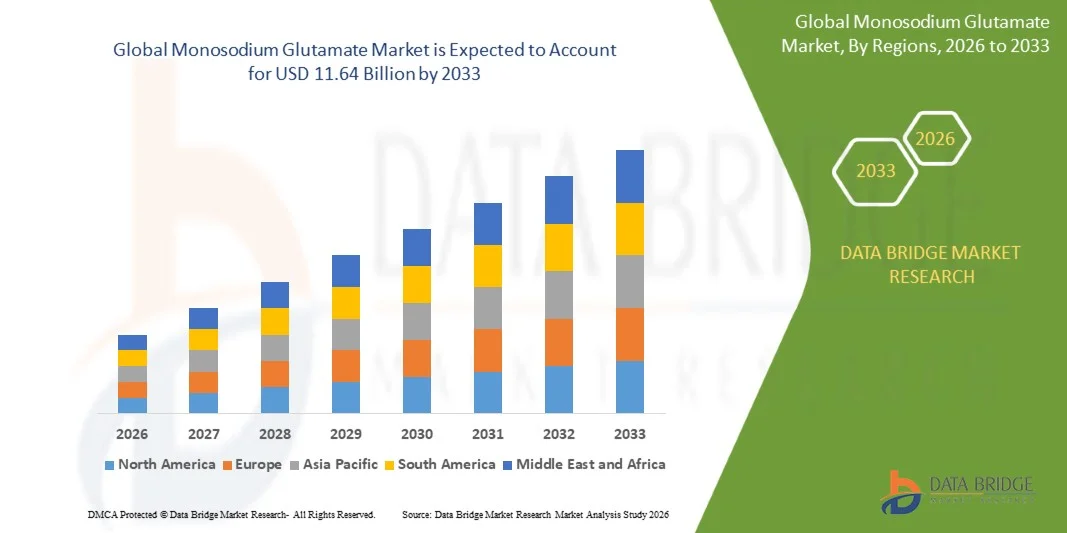
Report Scope and Monosodium Glutamate Market Segmentation
|
Attributes |
Monosodium Glutamate Key Market Insights |
|
Segments Covered |
· By Product: Monosodium Glutamate, Salted Monosodium Glutamate, and Special Monosodium Glutamate · By Application: Catering, Meat Products, Noodles, Soups and Broth, Seasonings and Dressings, and Others · By End User: Food Processors, Food Service Sectors, and Retail Sector |
|
Countries Covered |
North America · U.S. · Canada · Mexico Europe · Germany · France · U.K. · Netherlands · Switzerland · Belgium · Russia · Italy · Spain · Turkey · Rest of Europe Asia-Pacific · China · Japan · India · South Korea · Singapore · Malaysia · Australia · Thailand · Indonesia · Philippines · Rest of Asia-Pacific Middle East and Africa · Saudi Arabia · U.A.E. · South Africa · Egypt · Israel · Rest of Middle East and Africa South America · Brazil · Argentina · Rest of South America |
|
Key Market Players |
• Ajinomoto Co., Inc. (Japan) |
|
Market Opportunities |
• Expansion In Processed And Packaged Food Industry |
|
Value Added Data Infosets |
In addition to the insights on market scenarios such as market value, growth rate, segmentation, geographical coverage, and major players, the market reports curated by the Data Bridge Market Research also include in-depth expert analysis, pricing analysis, brand share analysis, consumer survey, demography analysis, supply chain analysis, value chain analysis, raw material/consumables overview, vendor selection criteria, PESTLE Analysis, Porter Analysis, and regulatory framework. |
Monosodium Glutamate Market Trends
Trend: Rising Demand For Flavor Enhancers In Processed And Convenience Foods
Increasing urbanization, changing dietary patterns, and the growing consumption of ready-to-eat meals are significantly driving the demand for monosodium glutamate as a cost-effective flavor enhancer. The food processing industry is increasingly adopting MSG to improve taste profiles in packaged soups, snacks, noodles, frozen foods, and seasoning blends while maintaining affordability for mass-market consumers.
In modern food manufacturing, companies are incorporating monosodium glutamate to enhance umami taste intensity in low-sodium formulations, supporting healthier product positioning without compromising flavor. For instance in instant noodle production, MSG is widely used to replicate restaurant-style taste consistency across global brands, improving consumer acceptance in emerging and developed markets.
The rapid expansion of quick-service restaurants and centralized food processing chains is also increasing dependency on standardized flavor enhancers to maintain uniform taste across large-scale operations. In addition, Asia-Pacific markets such as China, Japan, and Indonesia continue to dominate consumption due to strong cultural preference for umami-rich cuisines and high processed food penetration. Growing product innovation in clean-label seasoning blends is further expanding MSG usage across hybrid seasoning systems and composite flavor formulations
Monosodium Glutamate Market Dynamics
Key Market Driver: Expanding Processed Food And Foodservice Industry Demand
The global food and beverage industry is witnessing strong growth in packaged, frozen, and ready-to-eat product categories, driven by busy lifestyles, rising disposable incomes, and increasing urban working populations. Monosodium glutamate plays a critical role in enhancing taste intensity in mass-produced food items while ensuring consistent flavor at low cost.
Food manufacturers and restaurant chains are increasingly relying on MSG to maintain standardized taste across large-scale production and multi-location foodservice operations. For instance in instant soups, frozen meals, and snack seasoning blends, MSG is used to replicate savory flavor profiles efficiently without increasing ingredient complexity.
The expansion of quick-service restaurant chains and centralized cloud kitchens is further accelerating demand for flavor enhancers to maintain uniform product quality. Real-world consumption trends in 2024 across major Asia-Pacific foodservice markets indicate strong MSG integration in processed seasoning bases used in noodles, sauces, and ready meals, supporting high-volume food production efficiency
Key Restraint/Challenge: Health Perception Concerns And Clean Label Pressure
Despite regulatory approvals confirming safety in controlled usage levels, monosodium glutamate continues to face consumer perception challenges associated with health concerns and “clean label” food trends. Increasing demand for natural and minimally processed ingredients is prompting food manufacturers to reduce or replace synthetic additives in product formulations.
In addition, stricter labeling regulations in several regions are pushing manufacturers to clearly disclose additive content, influencing purchasing behavior among health-conscious consumers. This has led to reformulation efforts, especially in premium food segments and organic product lines, where companies aim to position “no added MSG” claims as a marketing advantage.
Market surveys across North America and Europe in 2025 indicate a rising preference for clean-label snacks and seasonings, with a notable share of consumers actively avoiding products perceived as containing artificial flavor enhancers, thereby limiting MSG penetration in certain high-margin product categories
Key Market Opportunity: Expansion In Emerging Food Processing And Affordable Nutrition Markets
Growing population density, rapid urban expansion, and increasing demand for affordable nutrition solutions in emerging economies are creating significant opportunities for monosodium glutamate adoption. MSG enables manufacturers to deliver strong taste profiles at low cost, making it highly suitable for mass-market food production in price-sensitive regions.
Food processing companies are increasingly integrating monosodium glutamate in affordable seasoning mixes, packaged meals, and street food supply chains to enhance flavor consistency while maintaining cost efficiency. For instance in Southeast Asia and parts of Africa, MSG is widely used in noodle-based products, spice blends, and processed sauces due to its ability to intensify umami taste with minimal formulation cost.
In addition, expansion of domestic food manufacturing industries and rising investments in packaged food infrastructure are further strengthening demand. Growth in retail penetration of processed food products in India, Indonesia, and Vietnam is also accelerating MSG consumption, supported by increasing adoption in institutional catering, hospitality, and large-scale foodservice operations.
Monosodium Glutamate Market Scope
The market is segmented on the basis of product, application, and end user.
- By Product
On the basis of product, the monosodium glutamate market is segmented into Monosodium Glutamate, Salted Monosodium Glutamate, and Special Monosodium Glutamate. The Monosodium Glutamate segment held the largest market revenue share of approximately 58.6% in 2025 driven by its extensive usage across processed food manufacturing, seasoning blends, and instant food formulations. Its cost-effectiveness, high flavor enhancement capability, and wide availability make it the most preferred form in large-scale food processing industries.
The Salted Monosodium Glutamate segment is projected to account for around 26.4% market share in 2025, supported by increasing adoption in household cooking and packaged seasoning mixes, particularly in Asia-Pacific markets. The Special Monosodium Glutamate segment is expected to hold approximately 15% share, driven by its application in premium food formulations, clean-label products, and customized industrial food solutions requiring controlled flavor profiles.
- By Application
On the basis of application, the monosodium glutamate market is segmented into Catering, Meat Products, Noodles, Soups and Broth, Seasonings and Dressings, and Others. The Noodles segment held the largest market revenue share of approximately 29.7% in 2025 driven by strong global consumption of instant noodles, particularly in Asia-Pacific where MSG is widely used to enhance umami taste and replicate restaurant-style flavor.
The Soups and Broth segment accounted for around 21.3% market share in 2025, supported by rising demand for convenient meal solutions and packaged soup products in North America and Europe. Seasonings and Dressings held approximately 18.9% share due to growing use in spice blends and culinary flavor enhancers. Meat Products contributed nearly 15.6% share, driven by processed meat applications, while Catering and Others collectively accounted for about 14.5% share due to institutional foodservice demand and bulk cooking requirements.
- By End User
On the basis of end user, the monosodium glutamate market is segmented into Food Processors, Food Service Sectors, and Retail Sector. The Food Processors segment held the largest market revenue share of approximately 52.1% in 2025 driven by large-scale adoption of MSG in packaged foods, frozen meals, and seasoning production to ensure consistent taste and cost efficiency.
The Food Service Sectors segment accounted for around 32.8% share in 2025, supported by strong usage in restaurants, quick-service chains, and catering services requiring standardized flavor output across high-volume operations. The Retail Sector held approximately 15.1% share, driven by household consumption of MSG-based seasoning products and increasing retail penetration of cooking enhancers in emerging markets such as India, China, and Southeast Asia.
Monosodium Glutamate Market Regional Analysis
North America Monosodium Glutamate Market Insight
North America dominated the monosodium glutamate market with the largest revenue share of 39.85% in 2025, supported by strong demand from the processed food, frozen meals, and convenience food sectors, along with rising consumer preference for enhanced flavor ingredients. The region benefits from a highly developed food processing industry and widespread use of MSG in packaged snacks, soups, sauces, and ready-to-eat meals. Increasing urban lifestyles, high disposable incomes, and the growing popularity of Asian cuisines further support market expansion. In addition, food manufacturers in the region continue to focus on cost-effective flavor enhancers, strengthening the adoption of monosodium glutamate across both household and foodservice applications.
U.S. Monosodium Glutamate Market Insight
The U.S. monosodium glutamate market captured the largest revenue share in North America in 2025, driven by strong consumption of processed and convenience foods across urban populations. The growing demand for restaurant and fast-food chains, along with increasing incorporation of umami-rich ingredients in packaged food formulations, is boosting market growth. Consumers are also witnessing a gradual normalization of MSG usage due to improved regulatory clarity and food safety awareness. Moreover, the expansion of ethnic cuisines, such as Chinese, Japanese, and Korean food offerings, continues to significantly contribute to the market’s penetration in the country.
Europe Monosodium Glutamate Market Insight
The Europe monosodium glutamate market is expected to witness steady growth from 2026 to 2033, driven by rising demand for processed foods, ready meals, and savory snacks across urban populations. Increasing globalization of food culture and growing acceptance of Asian cuisine are supporting MSG adoption in the region. However, the market is moderately influenced by consumer perception regarding artificial additives, which is encouraging manufacturers to use MSG in controlled and blended formulations. The expanding food processing industry and focus on enhancing taste profiles while maintaining cost efficiency are further supporting market growth.
U.K. Monosodium Glutamate Market Insight
The U.K. monosodium glutamate market is expected to witness notable growth from 2026 to 2033, driven by rising consumption of convenience foods, takeaway meals, and restaurant dining. The growing popularity of Asian and fusion cuisines is increasing the use of umami flavor enhancers in food preparation. In addition, food manufacturers in the U.K. are increasingly incorporating MSG in controlled quantities to improve taste consistency in packaged products. Rising urbanization and busy lifestyles are further supporting demand for ready-to-eat meals, indirectly strengthening market expansion.
Germany Monosodium Glutamate Market Insight
The Germany monosodium glutamate market is expected to grow steadily from 2026 to 2033, supported by the strong presence of the processed food industry and increasing demand for flavor-enhancing ingredients in savory applications. Germany’s well-established packaged food sector utilizes MSG in soups, snacks, and seasoning blends to maintain taste consistency and cost efficiency. In addition, growing exposure to international cuisines is increasing acceptance of umami-based flavor enhancers. However, demand remains balanced due to consumer preference for clean-label products, encouraging manufacturers to optimize MSG usage in food formulations.
Asia-Pacific Monosodium Glutamate Market Insight
The Asia-Pacific monosodium glutamate market is expected to witness the fastest growth rate from 2026 to 2033, supported by high consumption of traditional cuisines that extensively use umami flavor enhancers. The region benefits from large-scale production capabilities, expanding food processing industries, and increasing demand for packaged and street foods. Rapid urbanization, rising disposable incomes, and changing dietary habits are further boosting MSG consumption across households and commercial food services. In addition, strong manufacturing presence in countries such as China, India, Indonesia, and Thailand supports both regional supply and global exports.
Japan Monosodium Glutamate Market Insight
The Japan monosodium glutamate market is expected to grow steadily from 2026 to 2033 due to the country’s strong culinary tradition of umami-rich foods and high acceptance of flavor enhancers. MSG is widely used in soups, sauces, seasoning mixes, and processed foods to enhance taste consistency. The aging population and demand for convenient, ready-to-eat meals further support market growth. Moreover, Japan’s advanced food technology sector continues to integrate MSG in innovative formulations, ensuring balanced flavor profiles in both traditional and modern food products.
China Monosodium Glutamate Market Insight
The China monosodium glutamate market accounted for the largest market revenue share in Asia Pacific in 2025, attributed to high domestic consumption, strong food processing industry presence, and widespread culinary use of umami seasonings. China is one of the largest producers and consumers of MSG globally, supported by extensive manufacturing capacity and cost-efficient production. The rising demand for packaged foods, instant meals, and restaurant dining further strengthens market growth. In addition, the expansion of domestic food brands and export-oriented production continues to reinforce China’s dominance in the global MSG market.
Monosodium Glutamate Market Share
The Monosodium Glutamate industry is primarily led by well-established companies, including:
• Ajinomoto Co., Inc. (Japan)
• Cargill, Incorporated (U.S.)
• McCormick & Company, Inc. (U.S.)
• COFCO International (Switzerland)
• Fufeng Group Shandong (China)
• MEIHUA HOLDINGS GROUP CO., LTD (China)
• Ningxia Eppen Biotech Co., Ltd (China)
• Henan Lotus Flower Gourmet Powder Co., Ltd. (China)
• Shandong Qilu Biotechnology Group Co., Ltd. (China)
• Shandong Xinle Monosodium Glutamate Limited Company (China)
• FUJIAN PROVINCE JIANYANG WUYI MSG CO., LTD. (China)
• The Great American Spice Company (U.S.)
• Sunrise Nutrachem Group (China)
• Vedan Int'l (Taiwan)
• Gremount International Company Limited (China)
Latest Developments in Monosodium Glutamate Market
- In August, 2024, Marubeni Corporation expanded its investment by acquiring additional shares in AIG Asia Ingredients Corporation, a Vietnam-based food ingredients supplier, to strengthen its presence in the fast-growing Southeast Asian market, enhance innovation capabilities through its R&D center, and support rising demand for convenience and health-focused food solutions, positively impacting regional ingredient supply chains and competitive market expansion
- In April, 2024, Glanbia PLC announced the acquisition of Flavor Producers LLC for an initial consideration of USD 300 million, a U.S.-based natural and organic flavor platform, aiming to strengthen its Nutritional Solutions business, expand clean-label and organic flavor offerings, and enhance its service to FMCG companies and emerging brands, thereby accelerating growth in the natural ingredients and flavor innovation market
- In February, 2024, Ajinomoto Co., Inc. expanded its corporate venture capital arm by establishing a new headquarters in the United States, with the development focusing on increasing investments in U.S. and global food and technology companies, strengthening its innovation pipeline across food, medical, cosmetic, and electronic materials, and enhancing long-term strategic growth in the global monosodium glutamate and specialty ingredients market
- In October, 2023, Ningxia Eppen Biotech Co., Ltd invested USD 600 million in an amino acid production facility in Brazil, targeting an annual output of around 350 thousand tons of amino acids including MSG along with 200 thousand tonnes of by-products, aiming to expand global manufacturing capacity, improve supply chain efficiency, create employment opportunities, and strengthen the company’s position in the international amino acids and MSG market
- In September, 2023, Kerry Ingredients implemented an innovative flavoring technology combining monosodium glutamate with natural extracts, focusing on improving taste optimization and clean-label formulations, which enhanced product development capabilities and supported growing demand for balanced flavor solutions across processed food applications
- In August, 2023, Mei Ah Foodstuffs International collaborated with a food delivery platform to launch ready-to-eat meals incorporating Ajinomoto MSG, aiming to improve flavor consistency and consumer convenience, which contributed to expanding the acceptance of MSG-based seasoning in quick-service and ready meal segments
SKU-
Get online access to the report on the World's First Market Intelligence Cloud

- Interactive Data Analysis Dashboard
- Company Analysis Dashboard for high growth potential opportunities
- Research Analyst Access for customization & queries
- Competitor Analysis with Interactive dashboard
- Latest News, Updates & Trend analysis
- Harness the Power of Benchmark Analysis for Comprehensive Competitor Tracking
Global Monosodium Glutamate Market, Supply Chain Analysis and Ecosystem Framework
To support market growth and help clients navigate the impact of geopolitical shifts, DBMR has integrated in-depth supply chain analysis into its Global Monosodium Glutamate Market research reports. This addition empowers clients to respond effectively to global changes affecting their industries. The supply chain analysis section includes detailed insights such as Global Monosodium Glutamate Market consumption and production by country, price trend analysis, the impact of tariffs and geopolitical developments, and import and export trends by country and HSN code. It also highlights major suppliers with data on production capacity and company profiles, as well as key importers and exporters. In addition to research, DBMR offers specialized supply chain consulting services backed by over a decade of experience, providing solutions like supplier discovery, supplier risk assessment, price trend analysis, impact evaluation of inflation and trade route changes, and comprehensive market trend analysis.
Research Methodology
Data collection and base year analysis are done using data collection modules with large sample sizes. The stage includes obtaining market information or related data through various sources and strategies. It includes examining and planning all the data acquired from the past in advance. It likewise envelops the examination of information inconsistencies seen across different information sources. The market data is analysed and estimated using market statistical and coherent models. Also, market share analysis and key trend analysis are the major success factors in the market report. To know more, please request an analyst call or drop down your inquiry.
The key research methodology used by DBMR research team is data triangulation which involves data mining, analysis of the impact of data variables on the market and primary (industry expert) validation. Data models include Vendor Positioning Grid, Market Time Line Analysis, Market Overview and Guide, Company Positioning Grid, Patent Analysis, Pricing Analysis, Company Market Share Analysis, Standards of Measurement, Global versus Regional and Vendor Share Analysis. To know more about the research methodology, drop in an inquiry to speak to our industry experts.
Customization Available
Data Bridge Market Research is a leader in advanced formative research. We take pride in servicing our existing and new customers with data and analysis that match and suits their goal. The report can be customized to include price trend analysis of target brands understanding the market for additional countries (ask for the list of countries), clinical trial results data, literature review, refurbished market and product base analysis. Market analysis of target competitors can be analyzed from technology-based analysis to market portfolio strategies. We can add as many competitors that you require data about in the format and data style you are looking for. Our team of analysts can also provide you data in crude raw excel files pivot tables (Fact book) or can assist you in creating presentations from the data sets available in the report.












