




Global Nanowires Market
Market Size in USD Billion
CAGR :
% 
 USD
2.63 Billion
USD
16.33 Billion
2025
2033
USD
2.63 Billion
USD
16.33 Billion
2025
2033
 Forecast Period Forecast Period |
2026 –2033 |
 Market Size (Base Year) Market Size (Base Year) |
USD 2.63 Billion |
 Market Size (Forecast Year) Market Size (Forecast Year) |
USD 16.33 Billion |
 CAGR CAGR |
% |
| Major Markets Players |
|
Nanowires Market Size
- The global nanowires market size was valued at USD 2.63 billion in 2025 and is expected to reach USD 16.33 billion by 2033, at a CAGR of 25.60% during the forecast period
- The market growth is largely fueled by the increasing adoption of nanotechnology in electronics, energy storage, and semiconductor applications, leading to the development of high-performance, miniaturized, and flexible devices
- Furthermore, rising industrial and consumer demand for energy-efficient, durable, and high-conductivity materials for sensors, displays, batteries, and flexible electronics is driving the widespread uptake of nanowires, thereby significantly boosting the market’s expansion
Nanowires Market Analysis
- Nanowires are ultra-thin, high-aspect-ratio structures made from metals, semiconductors, or oxides, providing exceptional electrical, thermal, and mechanical properties that enable their integration into advanced electronic, energy, and sensing devices
- The escalating demand for nanowires is primarily fueled by the push for miniaturization in electronics, the growth of flexible and wearable devices, and increasing requirements for high-performance conductive materials across consumer electronics, renewable energy, and industrial sectors
- North America dominated the nanowires market with a share of 36.2% in 2025, due to growing adoption of advanced electronics, flexible devices, and wearable technology across the region
- Asia-Pacific is expected to be the fastest growing region in the nanowires market during the forecast period due to rapid industrialization, technological advancements, and rising investments in nanotechnology in countries such as China, Japan, and South Korea
- Metal nanowires segment dominated the market with a market share of 43.3% in 2025, due to their exceptional electrical conductivity, flexibility, and compatibility with various electronic and optoelectronic devices. Industries widely adopt metal nanowires for transparent conductive films and flexible electronics due to their ability to replace conventional materials such as indium tin oxide while enhancing device performance
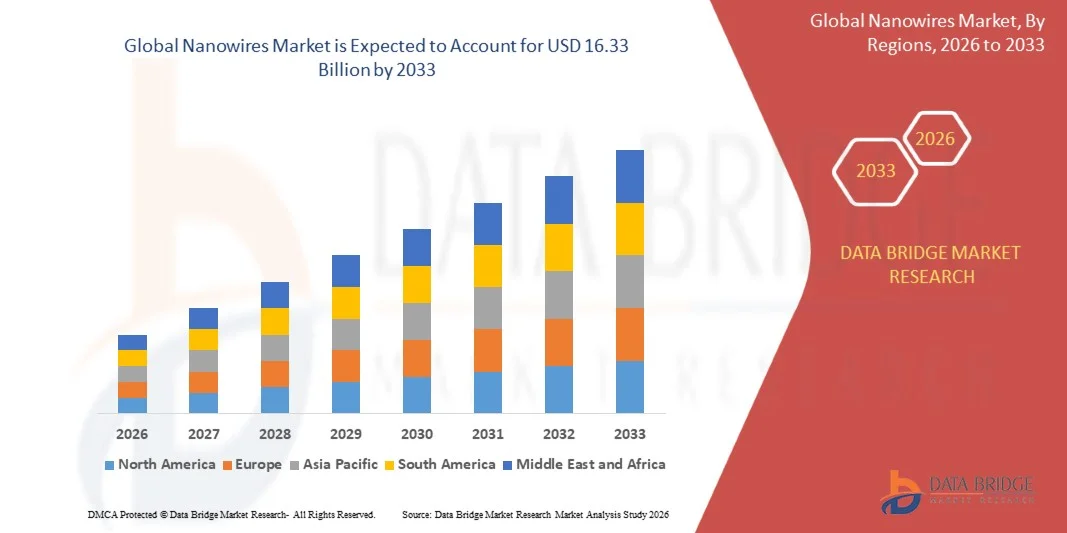
Report Scope and Nanowires Market Segmentation
|
Attributes |
Nanowires Key Market Insights |
|
Segments Covered |
|
|
Countries Covered |
North America
Europe
Asia-Pacific
Middle East and Africa
South America
|
|
Key Market Players |
|
|
Market Opportunities |
|
|
Value Added Data Infosets |
In addition to the insights on market scenarios such as market value, growth rate, segmentation, geographical coverage, and major players, the market reports curated by the Data Bridge Market Research also include import export analysis, production capacity overview, production consumption analysis, price trend analysis, climate change scenario, supply chain analysis, value chain analysis, raw material/consumables overview, vendor selection criteria, PESTLE Analysis, Porter Analysis, and regulatory framework. |
Nanowires Market Trends
“Rising Adoption of Nanowires in Flexible Electronics”
- A significant trend in the nanowires market is the increasing use of nanowire materials in flexible and wearable electronic devices, driven by the demand for lightweight, bendable, and high-performance components in consumer electronics and medical devices. This trend is enhancing the development of next-generation displays, sensors, and energy-harvesting systems that require both miniaturization and flexibility
- For instance, companies such as Samsung Electronics and Nanosys are developing nanowire-based flexible displays and thin-film transistors that are integrated into foldable smartphones and wearable devices. These innovations improve device durability and enable novel form factors for consumer electronics
- The integration of nanowires in photodetectors and light-emitting devices is growing, supporting applications in advanced imaging, optical sensors, and communication systems. This adoption is positioning nanowires as critical materials for high-resolution, low-power optoelectronic solutions
- In the energy sector, nanowire-based solar cells and batteries are being deployed to enhance energy conversion efficiency and storage density. This is driving research and commercialization of portable and flexible energy solutions that align with renewable energy initiatives
- Industries focused on healthcare and biosensing are leveraging nanowire technology for wearable diagnostic devices and high-sensitivity sensors. These applications enable real-time monitoring, improved signal detection, and miniaturized device designs suitable for personalized medicine
- The market is witnessing strong growth in electronic systems requiring ultra-thin, conductive, and transparent components where nanowires offer superior electrical and mechanical properties. This rising incorporation of nanowires is reinforcing the trend toward flexible, compact, and energy-efficient electronics across consumer, healthcare, and industrial sectors
Nanowires Market Dynamics
Driver
“Increasing Demand for High-Performance, Miniaturized Electronic Devices”
- The growing demand for smaller, faster, and more energy-efficient electronic devices is driving the adoption of nanowire materials, which offer excellent electrical conductivity, mechanical flexibility, and high surface area. These properties make nanowires suitable for advanced transistors, sensors, and memory devices
- For instance, Intel and Quantum Solutions are exploring silicon and metal oxide nanowires in next-generation transistors and memory modules to achieve higher device density and faster operation. These applications help enhance processing power while reducing device size and energy consumption
- The expansion of wearable and flexible electronics is further fueling the need for high-performance nanowires that can maintain conductivity under bending and stretching. This trend is accelerating research into durable and scalable nanowire solutions
- The increasing integration of nanowires in optoelectronic and photonic systems is enabling miniaturized sensors and imaging devices that improve performance without increasing footprint. This shift supports smarter, more compact consumer electronics and industrial automation tools
- Advancements in nanowire synthesis and device fabrication techniques are making it feasible to incorporate these materials in commercial products at higher volumes. This technological progress is facilitating the development of sophisticated electronics with improved functionality and energy efficiency
Restraint/Challenge
“High Manufacturing Costs and Scalability Constraints”
- The nanowires market faces challenges due to the complex fabrication processes required to produce uniform, defect-free nanowires at commercial scales. These processes involve advanced lithography, chemical vapor deposition, or solution-based synthesis, which increase production costs
- For instance, Nanosys and Applied Materials face high capital expenditure and specialized equipment requirements for large-scale nanowire production, limiting cost efficiency and rapid market expansion. These factors impact pricing and adoption in cost-sensitive consumer electronics segments
- Maintaining consistent quality, alignment, and integration of nanowires into flexible substrates adds technical complexity that prolongs production timelines and increases labor intensity
- The reliance on rare or high-purity materials such as indium, gallium, and cadmium for certain nanowire types exposes manufacturers to supply chain volatility and pricing fluctuations
- The market continues to encounter difficulties in scaling high-precision nanowire fabrication while preserving performance and durability, which restricts broader commercialization. These challenges collectively necessitate process optimization and cost-reduction strategies to meet growing demand without compromising device reliability
Nanowires Market Scope
The market is segmented on the basis of product type, synthesis, and application.
- By Product Type
On the basis of product type, the nanowires market is segmented into metal nanowires, semiconductor nanowires, oxide nanowires, multi-segment nanowires, and semiconductor quantum wires. The metal nanowires segment dominated the largest market revenue share of 43.3% in 2025, driven by their exceptional electrical conductivity, flexibility, and compatibility with various electronic and optoelectronic devices. Industries widely adopt metal nanowires for transparent conductive films and flexible electronics due to their ability to replace conventional materials such as indium tin oxide while enhancing device performance. Their scalability in manufacturing and integration into diverse substrates further strengthens demand. The market also sees strong traction because metal nanowires enable lightweight, energy-efficient solutions in wearable and smart devices.
The semiconductor nanowires segment is anticipated to witness the fastest growth rate from 2026 to 2033, fueled by increasing use in next-generation electronics, high-performance transistors, and quantum computing applications. Semiconductor nanowires offer tunable electrical and optical properties, making them ideal for sensors, light-emitting devices, and energy-efficient transistors. Their nanoscale size allows for high-density integration in circuits, which is driving adoption in both research and commercial applications. The versatility in fabrication methods and compatibility with existing semiconductor technologies further accelerates market growth.
- By Synthesis
On the basis of synthesis, the nanowires market is segmented into spontaneous growth, template-based systems, electro-spinning, and lithography. The template-based system segment dominated the largest market revenue share in 2025, due to its ability to produce uniform nanowires with precise dimensions and controlled morphology. Industries favor this method for high-yield production of nanowires in applications such as sensors, energy devices, and nanoelectronics. The reproducibility and scalability offered by template-based synthesis enhance adoption in both laboratory and industrial settings. In addition, the technique allows for multi-material nanowire fabrication, meeting growing demand for multifunctional devices.
The electro-spinning segment is expected to witness the fastest growth from 2026 to 2033, driven by its cost-effectiveness and adaptability in producing continuous nanowire fibers for advanced applications. Electro-spinning enables the creation of highly flexible, lightweight, and mechanically robust nanowires, which are critical for wearable electronics, nanogenerators, and filtration devices. For instance, companies such as Elmarco are advancing scalable electro-spinning systems for high-performance nanowire production. Its ease of integration with other synthesis methods also supports rapid innovation and commercialization.
- By Application
On the basis of application, the nanowires market is segmented into field effect transistors, magnetic devices, chemical biological sensors, logic gates, nanogenerators, and solar cells. The chemical biological sensors segment dominated the largest market revenue share in 2025, owing to the high sensitivity, selectivity, and miniaturization capabilities of nanowire-based sensing platforms. Nanowire sensors are widely used in medical diagnostics, environmental monitoring, and industrial process control due to their fast response and low detection limits. Their compatibility with lab-on-a-chip systems and integration with microelectronics further drives adoption. In addition, growing demand for real-time monitoring solutions enhances the uptake of nanowire sensors across multiple industries.
The nanogenerators segment is projected to witness the fastest growth from 2026 to 2033, fueled by rising interest in energy harvesting technologies for wearable and portable electronics. Nanowires in piezoelectric and triboelectric nanogenerators efficiently convert mechanical energy into electrical energy, supporting self-powered devices. For instance, companies such as Zhejiang University spin-offs are developing flexible nanowire-based nanogenerators for sustainable electronics. The potential for integration into smart textiles, medical implants, and IoT devices further propels market expansion in this application segment.
Nanowires Market Regional Analysis
- North America dominated the nanowires market with the largest revenue share of 36.2% in 2025, driven by growing adoption of advanced electronics, flexible devices, and wearable technology across the region
- Consumers and industries in the region highly value the superior electrical conductivity, flexibility, and miniaturization capabilities offered by nanowires for applications such as sensors, transistors, and transparent conductive films
- This widespread adoption is further supported by strong R&D investments, technologically advanced manufacturing infrastructure, and the presence of key market players, establishing nanowires as a preferred solution for both industrial and consumer electronics
U.S. Nanowires Market Insight
The U.S. nanowires market captured the largest revenue share in North America in 2025, fueled by growing demand for high-performance electronic devices and energy-efficient solutions. Companies such as IBM are leveraging nanowires in next-generation semiconductor devices to enhance processing speed and energy efficiency. The market is further propelled by the rising adoption of wearable electronics, flexible displays, and lithium-ion battery innovations. Moreover, increasing collaboration between academic institutions and industries is accelerating commercialization and deployment of nanowire-based technologies. The integration of nanowires in photovoltaic cells and sensors is also contributing significantly to market growth.
Europe Nanowires Market Insight
The Europe nanowires market is projected to expand at a substantial CAGR during the forecast period, driven by stringent regulations for energy efficiency and sustainable electronics manufacturing. Siemens is exploring nanowire-enabled sensors for industrial automation and smart energy systems. The growth is supported by increasing urbanization and industrial digitalization, fostering demand for high-performance nanomaterials. European consumers and industries are also focusing on eco-friendly and energy-saving electronic devices. The region is witnessing significant application growth across electronics, renewable energy, and biomedical devices, establishing nanowires as a critical material for technological advancement.
Germany Nanowires Market Insight
The Germany nanowires market is expected to grow at a considerable CAGR, fueled by strong R&D capabilities and the adoption of advanced manufacturing technologies. Bosch is integrating nanowires in sensor technologies for automotive and industrial applications. Germany’s focus on innovation, sustainability, and smart manufacturing is promoting the adoption of nanowires in both industrial and consumer sectors. The integration of nanowires into energy storage, photovoltaics, and IoT devices is increasing rapidly. Local regulations encouraging energy efficiency and high-performance electronics further support market expansion.
Asia-Pacific Nanowires Market Insight
The Asia-Pacific nanowires market is poised to grow at the fastest CAGR during 2026–2033, driven by rapid industrialization, technological advancements, and rising investments in nanotechnology in countries such as China, Japan, and South Korea. Samsung is utilizing nanowires in flexible displays and next-generation batteries. Government initiatives promoting smart electronics and digital infrastructure are fueling market adoption. APAC’s emergence as a hub for electronics manufacturing is enhancing the affordability and availability of nanowire-based solutions. Increasing consumer awareness and the rising middle-class demand for advanced electronic devices are further boosting market growth.
Japan Nanowires Market Insight
The Japan nanowires market is gaining traction due to high technological expertise, strong industrial infrastructure, and demand for miniaturized and high-performance devices. Sony is deploying nanowires in sensor arrays and energy storage devices. The market is supported by the country’s emphasis on robotics, IoT, and consumer electronics innovations. Integration of nanowires with flexible electronics, wearable devices, and advanced sensors is driving adoption. Japan’s focus on sustainable and energy-efficient solutions is also encouraging the use of nanowires in industrial and consumer applications.
China Nanowires Market Insight
The China nanowires market accounted for the largest revenue share in Asia-Pacific in 2025, attributed to rapid industrialization, urbanization, and technological adoption. Huawei is employing nanowires in advanced communication devices and batteries. The expanding electronics manufacturing sector, combined with government-backed nanotechnology programs, is accelerating market growth. China’s growing middle-class and demand for high-performance consumer electronics are driving adoption. The availability of cost-effective nanowire production facilities and local manufacturers strengthens China’s position as a key market in the APAC region.
Nanowires Market Share
The nanowires industry is primarily led by well-established companies, including:
- American Elements (U.S.)
- Novarials Corporation (U.S.)
- C3Nano, Inc. (U.S.)
- OneD Material, Inc. (U.S.)
- Cambrios Technologies Corporation (U.S.)
- Nanocomposix Inc. (U.S.)
- PlasmaChem GmbH (Germany)
- Sisco Research Laboratories Pvt. Ltd. (India)
- NanoTechLabs, Inc. (U.S.)
- Minnesota Wire & Cable Company (U.S.)
- Innova Dynamics Inc. (U.S.)
- 3M (U.S.)
- Nanostructured & Amorphous Materials, Inc. (U.S.)
- Kemix Pty Ltd (Australia)
Latest Developments in Global Nanowires Market
- In September 2025, researchers published new findings on enhancing the mechanical resilience of silver nanowires for flexible electronics, improving their durability and reliability in devices such as flexible displays, solar cells, and sensors. This advancement positively impacts the market by addressing one of the main limitations of nanowire-based products—mechanical fragility—thereby encouraging wider adoption in commercial applications. Improved durability reduces maintenance costs and extends product lifespan, making nanowire solutions more attractive to manufacturers and consumers. The research also opens new possibilities for high-performance wearable electronics and energy devices, further fueling the global nanowires market expansion
- In April 2025, DuPont unveiled its expanded silver nanowire portfolio at major electronics and automotive exhibitions in South Korea, showcasing applications in transparent heaters, smart surfaces, advanced driver assistance systems, and EMI shielding. This development strengthens market adoption by demonstrating the versatility of nanowires across multiple high-growth sectors. By presenting real-world applications to manufacturers and OEMs, DuPont is driving confidence in the technology and accelerating its integration into next-generation automotive and consumer electronic products. The expanded portfolio enables manufacturers to meet evolving performance demands while reducing production costs, boosting overall market growth
- In January 2025, the Government of India facilitated the transfer of indigenous silver nanowire-based conductive ink technology to local startups, enabling domestic production of advanced inks for flexible electronics, sensors, and display technologies. This development strengthens the regional market by reducing import dependence and promoting local manufacturing capabilities. Startups now have access to high-quality, cost-effective nanowire materials, which supports the growth of India’s electronics and semiconductor ecosystem. The technology transfer also encourages innovation, allowing manufacturers to develop new flexible and wearable devices, enhancing the competitiveness of the national nanowires market on a global scale
- In August 2024, DuPont completed the acquisition of nanowire technology and business assets from C3Nano Inc., securing advanced silver nanowire materials, formulations, and flexible ink capabilities. This acquisition consolidates DuPont’s position in the global nanowires market and expands its ability to supply high-performance nanowire solutions for transparent and flexible films. The move is expected to enhance production efficiency, streamline R&D, and increase market reach by combining proprietary technologies with existing manufacturing networks. It also signals growing industry consolidation, which can lead to faster innovation cycles and wider deployment of nanowire-based technologies across electronics, displays, and energy devices
- In November 2023, Materic launched its Direct Silver™ silver nanowires product, introducing a high-purity nanowire solution optimized for flexible electronics, transparent conductive electrodes, sensors, and solar cells. This launch significantly strengthens the nanowires market by providing manufacturers with reliable, high-performance materials that accelerate the commercialization of advanced printed electronics. The product enhances the quality and efficiency of next-generation devices, enabling broader adoption in consumer electronics, renewable energy, and industrial applications. The availability of such cutting-edge nanowires also encourages innovation in design and functionality, positioning Materic as a key player in the rapidly growing nanowire segment
SKU-
Get online access to the report on the World's First Market Intelligence Cloud

- Interactive Data Analysis Dashboard
- Company Analysis Dashboard for high growth potential opportunities
- Research Analyst Access for customization & queries
- Competitor Analysis with Interactive dashboard
- Latest News, Updates & Trend analysis
- Harness the Power of Benchmark Analysis for Comprehensive Competitor Tracking
Global Nanowires Market, Supply Chain Analysis and Ecosystem Framework
To support market growth and help clients navigate the impact of geopolitical shifts, DBMR has integrated in-depth supply chain analysis into its Global Nanowires Market research reports. This addition empowers clients to respond effectively to global changes affecting their industries. The supply chain analysis section includes detailed insights such as Global Nanowires Market consumption and production by country, price trend analysis, the impact of tariffs and geopolitical developments, and import and export trends by country and HSN code. It also highlights major suppliers with data on production capacity and company profiles, as well as key importers and exporters. In addition to research, DBMR offers specialized supply chain consulting services backed by over a decade of experience, providing solutions like supplier discovery, supplier risk assessment, price trend analysis, impact evaluation of inflation and trade route changes, and comprehensive market trend analysis.
Research Methodology
Data collection and base year analysis are done using data collection modules with large sample sizes. The stage includes obtaining market information or related data through various sources and strategies. It includes examining and planning all the data acquired from the past in advance. It likewise envelops the examination of information inconsistencies seen across different information sources. The market data is analysed and estimated using market statistical and coherent models. Also, market share analysis and key trend analysis are the major success factors in the market report. To know more, please request an analyst call or drop down your inquiry.
The key research methodology used by DBMR research team is data triangulation which involves data mining, analysis of the impact of data variables on the market and primary (industry expert) validation. Data models include Vendor Positioning Grid, Market Time Line Analysis, Market Overview and Guide, Company Positioning Grid, Patent Analysis, Pricing Analysis, Company Market Share Analysis, Standards of Measurement, Global versus Regional and Vendor Share Analysis. To know more about the research methodology, drop in an inquiry to speak to our industry experts.
Customization Available
Data Bridge Market Research is a leader in advanced formative research. We take pride in servicing our existing and new customers with data and analysis that match and suits their goal. The report can be customized to include price trend analysis of target brands understanding the market for additional countries (ask for the list of countries), clinical trial results data, literature review, refurbished market and product base analysis. Market analysis of target competitors can be analyzed from technology-based analysis to market portfolio strategies. We can add as many competitors that you require data about in the format and data style you are looking for. Our team of analysts can also provide you data in crude raw excel files pivot tables (Fact book) or can assist you in creating presentations from the data sets available in the report.












