What is the Natural Spirits Market Size and Growth Rate?
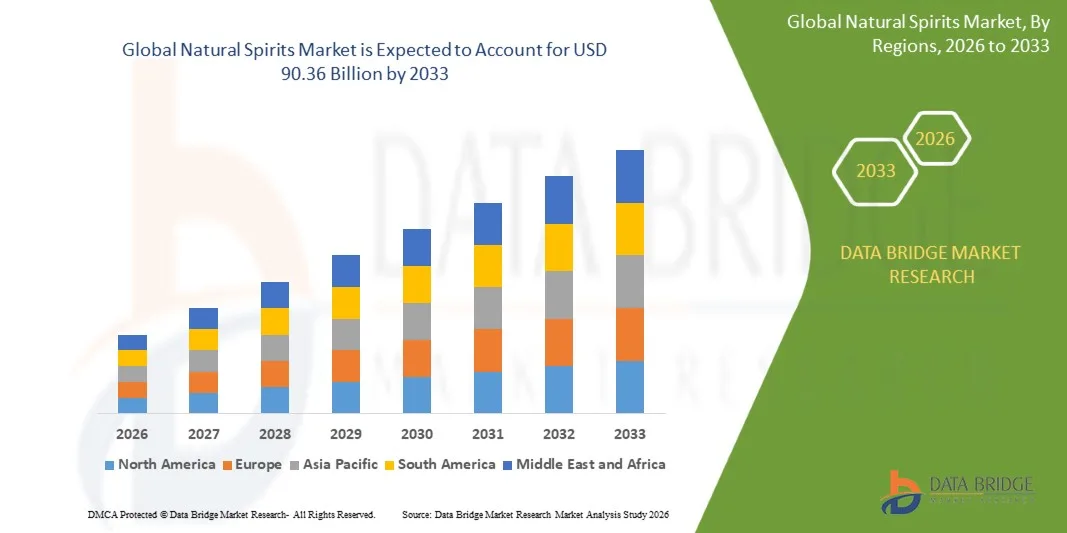
- As per Data Bridge Market Research analysis, the natural spirits market was valued at USD 28.53 billion in 2025 and is projected to reach USD 90.36 billion by 2033, growing at a CAGR of 15.50% from 2026 to 2033, across premium and craft beverage channels.
- The market is experiencing rapid growth driven by rising demand for additive-free and organic beverages, increasing consumer interest in transparency and provenance, and expanding applications across cocktails, premium home consumption, hospitality, gifting, and ready-to-drink formats.
- The increasing shift toward premiumization, clean-label drinking, and mindful consumption, combined with growing interest in organic agave, grain, and botanical sourcing, is supporting market adoption. Natural spirits are being enjoyed across craft cocktails, neat pours, home bars, and premium gifting, offering consumers transparent ingredients, traceable production, and flavor purity through additive-free spirits and organic alcoholic beverages brands.
Market Size & Forecast
- Global Market Value (2025): USD 28.53 Billion
- Expected Market Value (2033): USD 90.36 Billion
- Forecast CAGR (2026–2033): 15.50%
- Leading Region in 2025: North America
- Fastest Growing Region: Asia-Pacific
What are the Major Takeaways of the Natural Spirits Market?
- North America dominated the natural spirits market with the largest revenue share of 36.20% in 2025, supported by strong premium and craft demand, established distilleries, and rising consumer interest in additive-free and organic labels across the region.
- Asia-Pacific is expected to be the fastest-growing region at a CAGR of 18.40% from 2026 to 2033, fueled by rising disposable income, expanding premium drinking culture, and growing interest in natural and organic products.
- The additive-free segment led the market with a 42.7% share in 2025, driven by consumer demand for transparency and authentic flavor.
- Organic is the fastest-growing claim type, projected to register a CAGR of 17.4%, reflecting the surge in demand for certified, sustainable spirits.
- The whiskey segment dominated the product category with a 29.4% revenue share in 2025, led by strong premium and craft appeal.
- Cocktails and mixed drinks accounted for 41.3% of the market share in 2025, preferred by increasing premium bar and home mixology.
- The at-home consumers segment is the fastest-growing end-user category, with a CAGR of 16.6%, driven by increasing premium home drinking.
Report Scope and Natural Spirits Market Segmentation
|
Attributes |
Natural Spirits Key Market Insights |
|
Segments Covered |
|
|
Countries Covered |
North America
Europe
Asia-Pacific
Middle East and Africa
South America
|
|
Key Market Players |
|
|
Market Opportunities |
|
|
Value Added Data Infosets |
In addition to the insights on market scenarios such as market value, growth rate, segmentation, geographical coverage, and major players, the market reports curated by the Data Bridge Market Research also include in-depth expert analysis, pricing analysis, brand share analysis, consumer survey, demography analysis, supply chain analysis, value chain analysis, raw material/consumables overview, vendor selection criteria, PESTLE Analysis, Porter Analysis, and regulatory framework. |
What is the Key Trend in the Natural Spirits Market?
- Brands are increasingly shifting toward additive-free, organic, and traceable production, combining estate-grown ingredients, minimal processing, sustainability certifications, and transparent labeling to meet growing consumer expectations for authenticity and cleaner drinking occasions.
- For instance, in June 2024, according to BevNET, MXCO Polanco launched as a B Corp certified organic and additive-free tequila made from 100% organic blue agave from Jalisco’s volcanic soils, reflecting growing interest in purity and certification.
- Ready-to-drink cocktails and convenient formats are expanding the category, as consumers look for premium, lower-effort drinking experiences with recognizable ingredients.
- Large spirits companies are also investing in craft, organic, and premium brands to capture growth, even as overall spirits demand remains under pressure in some markets.
- For instance, in May 2024, Uncle Nearest acquired Square One Organic Spirits, a female-owned boutique organic spirits company that makes Square One Organic Vodka, expanding its premium portfolio.
- As consumers seek transparency, sustainability, and moderation, natural spirits are expected to evolve from a niche segment into a mainstream premium category across bars, retail, and online channels worldwide.
What are the Key Drivers of the Natural Spirits Market?
- Rising consumer interest in transparent ingredients, organic farming, and additive-free production is increasing demand for natural spirits that emphasize provenance, purity, and craft quality.
- For instance, in February 2026, according to Zacks, Diageo’s spirits ready-to-drink portfolio grew net sales 17% organically in the first half of fiscal 2026, as consumers looked for convenience and moderation, supporting premium and cleaner innovation.
- Premiumization and craft distilling continue to attract consumers who trade up to smaller-batch, higher-quality spirits, creating opportunities for brands that can credibly communicate natural credentials.
- For instance, in October 2022, Pernod Ricard acquired majority stakes in Código 1530, an ultra-premium tequila, and Skrewball, a super-premium whiskey, accelerating its commitment to premium and alternative spirit brands.
- With health-conscious consumers and younger drinkers seeking quality over quantity, natural and organic labels offer brands a way to stand out in a crowded premium spirits landscape.
What Factors are Challenging the Growth of the Natural Spirits Market?
- Natural and organic production can involve higher raw material costs, lower yields, certification expenses, and limited scale, while consumers may find claims such as natural and additive-free difficult to verify.
- For instance, in August 2026, according to Diageo, fiscal 2026 organic net sales declined 2.0%, with U.S. Spirits down 11.5%, reflecting softer spirits demand and competitive intensity in a key premium market.
- Regulation of labels and certifications varies by country, and small producers can struggle with documentation, testing, and compliance costs when seeking organic or additive-free recognition.
- Alcohol consumption is shifting in some markets, with moderation, price sensitivity, and alternatives such as non-alcoholic spirits and cannabis-based drinks competing for the same occasions.
- For instance, in August 2026, according to Pernod Ricard, organic sales fell 3.9% in fiscal 2026, with sales down 14% in the U.S. and 19% in China, highlighting how weak consumer confidence can affect premium spirits categories.
- The combination of higher production costs, certification complexity, shifting drinking habits, and economic pressure can constrain expansion among small and mid-sized brands, particularly where consumers trade down to conventional spirits.
How is the Natural Spirits Market Segmented?
The natural spirits market is segmented on the basis of product, claim, application, and end user.
- By Product
On the basis of product, the natural spirits market is segmented into whiskey, vodka, tequila, gin, rum, and others. The whiskey segment dominated the market with 29.4% share in 2025, supported by strong premium and craft appeal and a long tradition of grain-to-glass production. Whiskey made from organic or locally sourced grains offers consumers provenance, aging character, and collectability. It is widely consumed neat, on the rocks, and in classic cocktails. Improvements in sustainable distilling, small-batch maturation, and transparent labeling are further strengthening demand. Collaboration with farms and cooperages also enables clearer origin stories across premium whiskey brands.
The tequila segment is projected to register the fastest growth at a CAGR of 17.8% from 2026 to 2033, driven by increasing demand for additive-free and organic agave spirits. 100% agave tequilas highlight cooked agave flavor, terroir, and traditional production methods. Their applications include sipping, margaritas, and premium cocktails. Increasing interest in sustainability certifications and additive-free claims is creating additional demand across brands, bars, and retailers. Improvements in agave cultivation and distillery efficiency are enhancing quality. Certification programs and craft producers are also expanding commercial use.
- By Claim
On the basis of claim, the natural spirits market is segmented into additive-free, organic, and craft & small-batch. The additive-free segment dominated the market with 42.7% share in 2025, supported by strong consumer demand for transparency, purity, and authentic flavor. Additive-free spirits avoid added sugars, flavorings, and colorings, offering a clearer picture of base ingredients and distillation quality. Their availability across multiple categories expands the potential customer base. Consumers and bartenders choose them to showcase natural flavor in cocktails and neat serves. The segment also benefits from strong storytelling and increasing educational efforts.
The organic segment is projected to register the fastest growth at a CAGR of 17.4% from 2026 to 2033, supported by increasing demand for certified, sustainable, and environmentally responsible spirits. Organic certification covers farming practices and ingredient sourcing, appealing to consumers concerned about pesticides and sustainability. Brands are increasingly adding organic and B Corp credentials. Producers are partnering with organic farms and investing in lower-impact distilling. Clear certification marks further strengthen the segment’s attractiveness. Higher costs and limited supply remain important considerations for expansion.
- By Application
On the basis of application, the natural spirits market is segmented into cocktails & mixed drinks, neat & on-the-rocks, ready-to-drink cocktails, and others. The cocktails and mixed drinks segment dominated the application category with 41.3% share in 2025, supported by increasing premium bar and home mixology. Bartenders and consumers seek high-quality base spirits that deliver clean flavor and consistent performance. Craft cocktail culture is increasing the use of additive-free and organic spirits. Growth in premium on-trade and at-home entertaining further strengthens demand. Brands are also seeking partnerships with bars, restaurants, and mixologists to build credibility and trial across occasions.
The ready-to-drink cocktails segment is projected to register the fastest growth at a CAGR of 19.1% from 2026 to 2033, driven by increasing demand for convenient, premium, and portion-controlled drinks. RTD cocktails allow consumers to enjoy craft-style drinks without preparation, using recognizable spirits and natural mixers. Brands in North America, Europe, and Asia-Pacific are expanding RTD portfolios. Rising interest in moderation and variety is creating additional opportunities. Premium positioning makes natural and organic claims particularly attractive. Supportive retail distribution can further improve adoption across regions.
- By End User
On the basis of end user, the natural spirits market is segmented into bars & restaurants, at-home consumers, hotels & resorts, events & festivals, corporate & gifting, and others. The bars and restaurants segment dominated the end-user category with 41.5% share in 2025, supported by increasing requirements for premium back-bar and cocktail menus. Bartenders rely on high-quality spirits to deliver signature serves and highlight provenance. The segment includes craft cocktail bars, fine dining, and neighborhood venues. Increasing demand for premium experiences is creating further opportunities. Menu positioning also makes brand story, price, and consistency important considerations in purchase decisions.
The at-home consumers segment is projected to register the fastest growth at CAGR of 16.6% from 2026 to 2033, driven by increasing premium home drinking, e-commerce, and interest in home mixology. Consumers are trading up to premium bottles and RTD cocktails for entertaining and everyday enjoyment. Brands are expanding online, subscription, and direct-to-consumer programs. Closer engagement with consumers through education and social media is accelerating adoption. Gifting occasions are further supporting demand. Price, authenticity, and availability remain important considerations for growth.
Which Region Holds the Largest Share of the Natural Spirits Market?
- North America dominated the natural spirits market with the largest revenue share of 36.20% in 2025, supported by strong premium and craft demand, established distilleries, and rising consumer interest in additive-free and organic labels across the region.
- The region also benefits from a vibrant craft distilling scene, strong premium cocktail culture, and the presence of leading spirits companies, along with growing demand for organic and additive-free products. Increasing e-commerce, retail innovation, and brand acquisitions continue to strengthen North America’s position in the global market.
U.S. Natural Spirits Market Insight
The U.S. natural spirits market is witnessing consistent growth due to rising investments in craft distilling, organic brands, and premium RTD cocktails. Distillers, retailers, and bars are increasingly focusing on transparency and provenance. Moreover, a large premium spirits market and continued brand acquisitions, supported by strong distribution and e-commerce growth, are further contributing to market growth in the U.S., even as overall spirits demand moderates.
Mexico Natural Spirits Market Insight
The Mexico natural spirits market is growing steadily, driven by tequila and mezcal heritage, rising interest in additive-free and organic agave spirits, and strong export demand. Growing use of traditional production methods and certification programs is boosting market demand. In addition, the country’s agave growers, distilleries, and premium brands are positioning Mexico as an important market across North America, supported by rising global interest in authentic Mexican spirits.
Asia-Pacific Natural Spirits Market Insight
The Asia-Pacific natural spirits market is expected to witness rapid growth, driven by rising disposable income, expanding premium drinking culture, and increasing interest in natural and organic products across countries such as India, Japan, Australia, and Singapore. Growing urban populations, cocktail bars, and travel retail are supporting regional market expansion. In addition, the region’s younger consumers and growing awareness of health and provenance are accelerating demand for premium natural spirits.
China Natural Spirits Market Insight
China’s natural spirits market is dominated by traditional baijiu, supported by cultural heritage, domestic consumption, and premium gifting occasions. However, changing consumer preferences and economic pressures are reshaping demand. Younger consumers increasingly favor whisky, flavored spirits, cocktails, and lower-alcohol beverages. Manufacturers are introducing innovative products, smaller packaging, and modern marketing strategies to attract new customers. Despite declining traditional spirits consumption, premiumization, digital distribution, and expanding lifestyle-oriented drinking occasions create opportunities for established producers and international brands.
India Natural Spirits Market Insight
The India natural spirits market is expanding steadily due to the country’s growing premium consumer base, expanding craft distilling, and rising interest in provenance and natural ingredients. Distillers, importers, and bars are increasingly utilizing local grains and botanicals. Continuous advancements in premium whisky, gin, and rum, along with growing urban consumption and tourism, are further driving market growth in the country.
Which are the Top Companies in Natural Spirits Market?
The natural spirits industry is primarily led by well-established companies, including:
- Diageo plc (U.K.)
- Pernod Ricard SA (France)
- Bacardi Limited (Bermuda)
- Davide Campari-Milano N.V. (Italy)
- Brown-Forman Corporation (U.S.)
- Suntory Holdings Limited (Japan)
- Thai Beverage Public Company Limited (Thailand)
- Rémy Cointreau SA (France)
- Sazerac Company, Inc. (U.S.)
- Heaven Hill Distilleries, Inc. (U.S.)
- William Grant & Sons Ltd. (U.K.)
- The Edrington Group Ltd. (U.K.)
- Mast-Jägermeister SE (Germany)
- Uncle Nearest, Inc. (U.S.)
- Square One Organic Spirits (U.S.)
- Becle, S.A.B. de C.V. (Mexico)
- MGP Ingredients, Inc. (U.S.)
- La Martiniquaise-Bardinet (France)
- Radico Khaitan Limited (India)
- Allied Blenders and Distillers Private Limited (India)
What are Latest Developments in Natural Spirits Market?
- In August 2026, Pernod Ricard reported fiscal 2026 organic sales down 3.9%, with sales down 14% in the U.S. and 19% in China, while excluding those two markets organic sales rose 0.5%, and the company said it expects fiscal 2027 organic net sales to be broadly stable while completing its restructuring program early.
- In August 2026, Diageo reported fiscal 2026 organic net sales down 2.0%, with volume down 0.4% and price/mix down 1.6%, North America down 8.5%, Europe up 3.4%, and Africa up 13.3%, and guided to broadly flat organic net sales in fiscal 2027 as it focuses on premium innovation and efficiency.
- In May 2024, Uncle Nearest, a U.S. whiskey brand, acquired Square One Organic Spirits, a female-owned boutique organic spirits company that makes Square One Organic Vodka, expanding its premium portfolio with an organic spirits brand and strengthening its presence in the clean-label alcohol segment.
- In June 2024, MXCO Polanco was introduced as an organic and additive-free tequila made from 100% organic blue agave from Jalisco’s volcanic soils, certified as a B Corp and carbon natural, as new craft brands sought to differentiate themselves through sustainability and ingredient transparency.
- In October 2022, Pernod Ricard acquired majority ownership positions in Código 1530 and Skrewball and invested EUR 238 million in building a new carbon-neutral Jefferson’s distillery in Kentucky, while Diageo completed the acquisition of Don Papa Rum, strengthening premium spirits portfolios for both companies.
- Interactive Data Analysis Dashboard
- Company Analysis Dashboard for high growth potential opportunities
- Research Analyst Access for customization & queries
- Competitor Analysis with Interactive dashboard
- Latest News, Updates & Trend analysis
- Harness the Power of Benchmark Analysis for Comprehensive Competitor Tracking
Global Natural Spirits Market, Supply Chain Analysis and Ecosystem Framework
To support market growth and help clients navigate the impact of geopolitical shifts, DBMR has integrated in-depth supply chain analysis into its Global Natural Spirits Market research reports. This addition empowers clients to respond effectively to global changes affecting their industries. The supply chain analysis section includes detailed insights such as Global Natural Spirits Market consumption and production by country, price trend analysis, the impact of tariffs and geopolitical developments, and import and export trends by country and HSN code. It also highlights major suppliers with data on production capacity and company profiles, as well as key importers and exporters. In addition to research, DBMR offers specialized supply chain consulting services backed by over a decade of experience, providing solutions like supplier discovery, supplier risk assessment, price trend analysis, impact evaluation of inflation and trade route changes, and comprehensive market trend analysis.
Data collection and base year analysis are done using data collection modules with large sample sizes. The stage includes obtaining market information or related data through various sources and strategies. It includes examining and planning all the data acquired from the past in advance. It likewise envelops the examination of information inconsistencies seen across different information sources. The market data is analysed and estimated using market statistical and coherent models. Also, market share analysis and key trend analysis are the major success factors in the market report. To know more, please request an analyst call or drop down your inquiry.
The key research methodology used by DBMR research team is data triangulation which involves data mining, analysis of the impact of data variables on the market and primary (industry expert) validation. Data models include Vendor Positioning Grid, Market Time Line Analysis, Market Overview and Guide, Company Positioning Grid, Patent Analysis, Pricing Analysis, Company Market Share Analysis, Standards of Measurement, Global versus Regional and Vendor Share Analysis. To know more about the research methodology, drop in an inquiry to speak to our industry experts.
Data Bridge Market Research is a leader in advanced formative research. We take pride in servicing our existing and new customers with data and analysis that match and suits their goal. The report can be customized to include price trend analysis of target brands understanding the market for additional countries (ask for the list of countries), clinical trial results data, literature review, refurbished market and product base analysis. Market analysis of target competitors can be analyzed from technology-based analysis to market portfolio strategies. We can add as many competitors that you require data about in the format and data style you are looking for. Our team of analysts can also provide you data in crude raw excel files pivot tables (Fact book) or can assist you in creating presentations from the data sets available in the report.