

Global Natural Surfactant Market
Market Size in USD Billion
CAGR :
% 
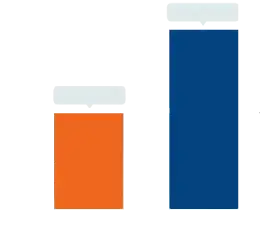 USD
34.56 Billion
USD
62.56 Billion
2025
2033
USD
34.56 Billion
USD
62.56 Billion
2025
2033
 Forecast Period Forecast Period |
2026 –2033 |
 Market Size (Base Year) Market Size (Base Year) |
USD 34.56 Billion |
 Market Size (Forecast Year) Market Size (Forecast Year) |
USD 62.56 Billion |
 CAGR CAGR |
% |
| Major Markets Players |
|
What is the Global Natural Surfactant Market Size and Growth Rate?
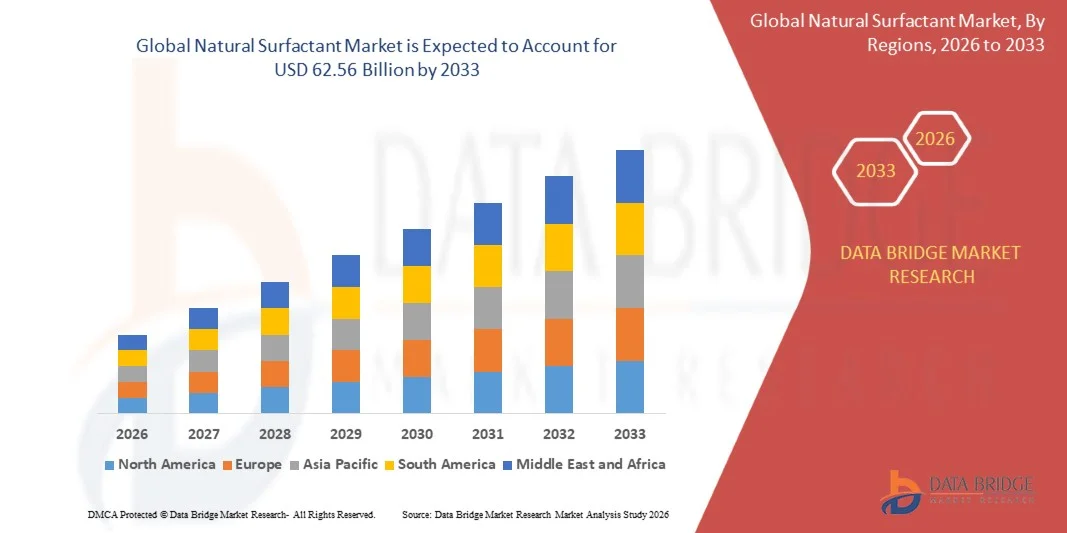
- The global natural surfactant market size was valued at USD 34.56 billion in 2025 and is expected to reach USD 62.56 billion by 2033, at a CAGR of 7.70% during the forecast period
- The factors such as increasing demand for emulsion polymerization, increasing demand from various applications and rising personal care sectors are the root cause fueling up the market growth rate
- In addition, the factors such as increasing focus on environmental regulations, growing awareness on hygiene and growth in liquid soap along with reduced prices of raw material associated with lesser production cost will further carve the way for the growth of market
What are the Major Takeaways of Natural Surfactant Market?
- Increase in the usage of surfactant in detergent industry and strict regulations on using conventional surfactants will also foster the market growth. However, the time-consuming and expensive legislative requirements impedes the growth of the natural surfactant market
- The increasing demand for sustainable green surfactant and bio-based surfactants products are estimated to generate numerous opportunities for the market. On the flip side, the consumers’ unwillingness to pay a bio-premium along with instability in raw material prices pose as a major challenge to the growth of the natural surfactant market
- Europe dominated the natural surfactant market with a 41.30% revenue share in 2025, driven by strong regulatory emphasis on sustainability, increasing demand for biodegradable ingredients, and widespread adoption of eco-friendly formulations across personal care, home care, and industrial applications
- Asia-Pacific is projected to register the fastest CAGR of 8.49% from 2026 to 2033, driven by rapid industrialization, expanding personal care and home care industries, and increasing adoption of sustainable chemicals across China, Japan, India, South Korea, and Southeast Asia
- The Anionic surfactants segment dominated the market with a 38.6% share in 2025, as they are widely used in detergents, cleaners, and personal care products due to their excellent foaming, cleansing, and cost-effective properties
Report Scope and Natural Surfactant Market Segmentation
|
Attributes |
Natural Surfactant Key Market Insights |
|
Segments Covered |
|
|
Countries Covered |
North America
Europe
Asia-Pacific
Middle East and Africa
South America
|
|
Key Market Players |
|
|
Market Opportunities |
|
|
Value Added Data Infosets |
In addition to the insights on market scenarios such as market value, growth rate, segmentation, geographical coverage, and major players, the market reports curated by the Data Bridge Market Research also include in-depth expert analysis, pricing analysis, brand share analysis, consumer survey, demography analysis, supply chain analysis, value chain analysis, raw material/consumables overview, vendor selection criteria, PESTLE Analysis, Porter Analysis, and regulatory framework. |
What is the Key Trend in the Natural Surfactant Market?
“Increasing Shift Toward Bio-Based, Sustainable, and Green Natural Surfactants”
- The natural surfactants market is witnessing strong adoption of bio-based and renewable raw materials such as plant oils, sugar-based compounds, and microbial fermentation products to replace petrochemical-derived surfactants
- Manufacturers are introducing eco-friendly, biodegradable, and low-toxicity formulations that comply with stringent environmental regulations and sustainability goals across personal care, home care, and industrial applications
- Growing demand for clean-label and sustainable products is driving usage across cosmetics, detergents, agrochemicals, and food processing industries
- For instance, companies such as BASF SE, Evonik Industries, Croda International Plc, and Clariant are expanding their portfolios with plant-based surfactants and fermentation-derived ingredients
- Increasing need for low environmental impact, regulatory compliance, and consumer safety is accelerating the shift toward green and sustainable surfactant solutions
- As sustainability becomes a core industry focus, natural surfactants will remain essential for eco-friendly formulation development, regulatory compliance, and green chemistry innovation
What are the Key Drivers of Natural Surfactant Market?
- Rising demand for sustainable and biodegradable ingredients in personal care, home care, and industrial formulations is a major factor driving market growth
- For instance, in 2025, companies such as Dow, Solvay, and Kao Corporation expanded investments in green surfactant production and bio-based innovations
- Growing adoption of natural and organic products across cosmetics, food processing, and agriculture sectors is boosting demand globally across the U.S., Europe, and Asia-Pacific
- Advancements in biotechnology, enzymatic synthesis, and fermentation processes have improved product performance, scalability, and cost-efficiency
- Rising use of eco-friendly detergents, emulsifiers, and wetting agents in multiple industries is creating demand for high-performance natural surfactants
- Supported by increasing environmental awareness, regulatory pressure, and sustainability initiatives, the Natural Surfactants market is expected to witness strong long-term growth
Which Factor is Challenging the Growth of the Natural Surfactant Market?
- High costs associated with bio-based raw materials, production processes, and formulation complexity restrict adoption compared to conventional synthetic surfactants
- For instance, during 2024–2025, fluctuations in agricultural feedstock prices and supply chain disruptions impacted production costs for several global manufacturers
- Performance limitations in certain applications, such as foaming, stability, and shelf life, create challenges in replacing synthetic alternatives
- Limited availability of raw materials and scalability constraints in emerging markets slow widespread adoption
- Competition from low-cost synthetic surfactants and established petrochemical-based products creates pricing pressure and limits market penetration
- To address these challenges, companies are focusing on process optimization, cost reduction strategies, innovation in bio-based chemistry, and strategic partnerships, which will enhance global adoption of natural surfactants
How is the Natural Surfactant Market Segmented?
The market is segmented on the basis of product and application.
• By Product
On the basis of product, the natural surfactant market is segmented into Anionic, Cationic, Non-Ionic Surfactants, Amphoteric, Silicone Surfactant, and Others. The Anionic surfactants segment dominated the market with a 38.6% share in 2025, as they are widely used in detergents, cleaners, and personal care products due to their excellent foaming, cleansing, and cost-effective properties. These surfactants are derived from natural oils and fats, making them suitable for eco-friendly formulations. Their strong performance in removing dirt and grease drives high demand across household and industrial applications.
The Non-Ionic surfactants segment is expected to grow at the fastest CAGR from 2026 to 2033, driven by increasing demand for mild, biodegradable, and low-toxicity surfactants in personal care, pharmaceuticals, and food processing. Their stability across a wide pH range and compatibility with other ingredients make them ideal for advanced formulations. Rising focus on sustainability and green chemistry further accelerates adoption of non-ionic surfactants globally.
• By Application
On the basis of application, the market is segmented into Household Detergents, Personal Care, Lubricant and Fuel Additive, Industrial and Institutional Cleaners, Food Processing, Oilfield Chemicals, Agricultural Chemicals, Textiles, Emulsion Polymerization, Paints and Coatings, Construction, and Others. The Household Detergents segment dominated the market with a 34.2% share in 2025, supported by high consumption of eco-friendly cleaning products and increasing demand for biodegradable ingredients in laundry and dishwashing applications. Natural surfactants are widely used due to their effective cleaning performance, low environmental impact, and compatibility with sustainable formulations.
The Personal Care segment is projected to grow at the fastest CAGR from 2026 to 2033, driven by rising consumer preference for natural, organic, and chemical-free products in skincare, haircare, and cosmetics. Increasing awareness regarding skin safety, clean-label products, and regulatory restrictions on synthetic chemicals is boosting demand. Expanding use of natural surfactants in shampoos, body washes, and facial cleansers is expected to drive long-term market growth.
Which Region Holds the Largest Share of the Natural Surfactant Market?
- Europe dominated the natural surfactant market with a 41.30% revenue share in 2025, driven by strong regulatory emphasis on sustainability, increasing demand for biodegradable ingredients, and widespread adoption of eco-friendly formulations across personal care, home care, and industrial applications. Stringent environmental regulations and policies promoting green chemistry continue to fuel demand for natural surfactants across cosmetics, detergents, food processing, and agriculture sectors
- Leading companies in Europe are introducing advanced bio-based surfactants derived from renewable sources, fermentation processes, and plant-based feedstocks, strengthening the region’s sustainability leadership. Continuous investment in green innovation, circular economy initiatives, and environmentally compliant production technologies drives long-term market expansion
- Strong regulatory frameworks, high consumer awareness regarding sustainability, and well-established chemical manufacturing infrastructure further reinforce regional market leadership
Germany Natural Surfactant Market Insight
Germany is the largest contributor in Europe, supported by a strong chemical manufacturing base, advanced R&D capabilities, and increasing adoption of bio-based ingredients across industrial and consumer applications. Growing demand for sustainable cleaning agents, cosmetics, and specialty chemicals drives market growth. Presence of major chemical companies, innovation hubs, and strict environmental standards further accelerates adoption of natural surfactants
France Natural Surfactant Market Insight
France contributes significantly to regional growth, driven by rising demand for organic and natural personal care products, expanding cosmetics industry, and increasing focus on sustainable formulations. Manufacturers are increasingly integrating plant-based surfactants in skincare, haircare, and luxury cosmetic products. Government regulations and consumer preference for clean-label products strengthen market penetration across the country
Asia-Pacific Natural Surfactant Market
Asia-Pacific is projected to register the fastest CAGR of 8.49% from 2026 to 2033, driven by rapid industrialization, expanding personal care and home care industries, and increasing adoption of sustainable chemicals across China, Japan, India, South Korea, and Southeast Asia. Rising disposable income, urbanization, and growing awareness regarding eco-friendly products are accelerating demand. Expansion of manufacturing capabilities and increasing investments in green chemistry further boost market growth
China Natural Surfactant Market Insight
China is the largest contributor to Asia-Pacific due to strong chemical manufacturing capacity, increasing investments in sustainable production, and rising demand for eco-friendly detergents and personal care products. Government initiatives promoting environmental protection and green chemicals drive adoption. Competitive pricing and large-scale production capabilities further support domestic and export market growth
Japan Natural Surfactant Market Insight
Japan shows steady growth supported by advanced technology in specialty chemicals, high demand for premium personal care products, and strong focus on product quality and sustainability. Increasing use of natural surfactants in cosmetics, pharmaceuticals, and food processing drives market expansion. Innovation in formulation technologies and eco-friendly solutions supports long-term growth
India Natural Surfactant Market Insight
India is emerging as a major growth hub, driven by expanding FMCG sector, rising demand for natural and organic products, and increasing government initiatives promoting sustainable manufacturing. Growing use of natural surfactants in detergents, personal care, and agricultural applications fuels adoption. Increasing investments in chemical manufacturing and rising consumer awareness further accelerate market growth
South Korea Natural Surfactant Market Insight
South Korea contributes significantly due to strong demand for advanced personal care products, rapid growth of the cosmetics industry, and increasing focus on sustainable ingredients. Rising adoption of natural surfactants in skincare, haircare, and industrial applications supports market expansion. Technological innovation, strong manufacturing capabilities, and growing export demand reinforce long-term growth
Which are the Top Companies in Natural Surfactant Market?
The natural surfactant industry is primarily led by well-established companies, including:
- 3M (U.S.)
- Akzo Nobel N.V. (Netherlands)
- BASF SE (Germany)
- Indorama Ventures Public Company Limited (Thailand)
- Bayer AG (Germany)
- Stepan Company (U.S.)
- Evonik Industries (Germany)
- Croda International Plc (U.K.)
- Kao Corporation (Japan)
- Dow (U.S.)
- DuPont (U.S.)
- Air Products Inc (U.S.)
- Lonza (Switzerland)
- Huntsman International LLC (U.S.)
- Clariant (Switzerland)
- Sasol (South Africa)
- India Glycols Limited (India)
- Solvay (Belgium)
- Enaspol A.S (Czech Republic)
What are the Recent Developments in Global Natural Surfactant Market?
- In June 2023, BASF SE announced plans to expand its manufacturing capabilities for bio-based alkyl polyglucosides (APGs) across Asia-Pacific and North America by establishing new production lines at its Bangpakong, Thailand, and Cincinnati, Ohio facilities to meet rising demand for sustainable non-ionic surfactants used in personal care, home care, and industrial applications, thereby strengthening global supply resilience and reinforcing its leadership in eco-friendly surfactant production
- In June 2023, BASF SE confirmed the launch of new production lines in Bangpakong, Thailand, and Cincinnati, Ohio to address increasing global demand for bio-based and biodegradable surfactants across multiple industries, thereby enhancing production capacity and supporting the transition toward sustainable chemical solutions
- In February 2022, Clariant introduced its Vita range of 100% bio-based surfactants and polyethylene glycols (PEGs), developed using renewable plant-based carbon sources such as bio-ethanol derived from sugarcane and corn to replace fossil-based ingredients across personal care, agriculture, and industrial applications, thereby accelerating decarbonization and promoting sustainable value chains
- In February 2022, Clariant unveiled its Vita portfolio of fully bio-based surfactants and PEGs aimed at reducing reliance on fossil carbon and offering low-carbon alternatives with identical performance for diverse end-use industries, thereby supporting climate change mitigation and advancing green chemistry adoption
SKU-
Get online access to the report on the World's First Market Intelligence Cloud

- Interactive Data Analysis Dashboard
- Company Analysis Dashboard for high growth potential opportunities
- Research Analyst Access for customization & queries
- Competitor Analysis with Interactive dashboard
- Latest News, Updates & Trend analysis
- Harness the Power of Benchmark Analysis for Comprehensive Competitor Tracking
Global Natural Surfactant Market, Supply Chain Analysis and Ecosystem Framework
To support market growth and help clients navigate the impact of geopolitical shifts, DBMR has integrated in-depth supply chain analysis into its Global Natural Surfactant Market research reports. This addition empowers clients to respond effectively to global changes affecting their industries. The supply chain analysis section includes detailed insights such as Global Natural Surfactant Market consumption and production by country, price trend analysis, the impact of tariffs and geopolitical developments, and import and export trends by country and HSN code. It also highlights major suppliers with data on production capacity and company profiles, as well as key importers and exporters. In addition to research, DBMR offers specialized supply chain consulting services backed by over a decade of experience, providing solutions like supplier discovery, supplier risk assessment, price trend analysis, impact evaluation of inflation and trade route changes, and comprehensive market trend analysis.
Research Methodology
Data collection and base year analysis are done using data collection modules with large sample sizes. The stage includes obtaining market information or related data through various sources and strategies. It includes examining and planning all the data acquired from the past in advance. It likewise envelops the examination of information inconsistencies seen across different information sources. The market data is analysed and estimated using market statistical and coherent models. Also, market share analysis and key trend analysis are the major success factors in the market report. To know more, please request an analyst call or drop down your inquiry.
The key research methodology used by DBMR research team is data triangulation which involves data mining, analysis of the impact of data variables on the market and primary (industry expert) validation. Data models include Vendor Positioning Grid, Market Time Line Analysis, Market Overview and Guide, Company Positioning Grid, Patent Analysis, Pricing Analysis, Company Market Share Analysis, Standards of Measurement, Global versus Regional and Vendor Share Analysis. To know more about the research methodology, drop in an inquiry to speak to our industry experts.
Customization Available
Data Bridge Market Research is a leader in advanced formative research. We take pride in servicing our existing and new customers with data and analysis that match and suits their goal. The report can be customized to include price trend analysis of target brands understanding the market for additional countries (ask for the list of countries), clinical trial results data, literature review, refurbished market and product base analysis. Market analysis of target competitors can be analyzed from technology-based analysis to market portfolio strategies. We can add as many competitors that you require data about in the format and data style you are looking for. Our team of analysts can also provide you data in crude raw excel files pivot tables (Fact book) or can assist you in creating presentations from the data sets available in the report.