




Global Neglected Tropical Disease Market
Market Size in USD Billion
CAGR :
% 
 USD
1.63 Billion
USD
2.54 Billion
2025
2033
USD
1.63 Billion
USD
2.54 Billion
2025
2033
 Forecast Period Forecast Period |
2026 - 2033 |
 Market Size (Base Year) Market Size (Base Year) |
USD 1.63 Billion |
 Market Size (Forecast Year) Market Size (Forecast Year) |
USD 2.54 Billion |
 CAGR CAGR |
% |
| Major Markets Players |
|
Neglected Tropical Disease Market Overview
The Neglected Tropical Disease Market was valued at USD 1.63 billion in 2025 and is projected to reach USD 2.54 billion by 2033, growing at a CAGR of 5.75% from 2026 to 2033. The Global Neglected Tropical Disease (NTD) market is witnessing steady growth driven by increasing global health initiatives, rising funding from governments and international organizations, and expanding focus on eliminating infectious diseases in low- and middle-income countries. The growing burden of diseases such as dengue, leishmaniasis, Chagas disease, lymphatic filariasis, and schistosomiasis is further accelerating demand for effective diagnostics, vaccines, and treatment solutions.
The increasing involvement of organizations such as the World Health Organization (WHO), Bill & Melinda Gates Foundation, and various public–private partnerships is significantly strengthening disease surveillance, prevention programs, and mass drug administration (MDA) campaigns. In addition, advancements in vaccine development, improved diagnostic technologies, and enhanced access to affordable therapeutics are enabling better disease control and elimination strategies. Large-scale government-led eradication programs and rising investment in tropical disease research are further supporting market expansion across endemic regions in Africa, Asia-Pacific, and Latin America.
Key Market Trends & Insights
- North America dominated the global Neglected Tropical Disease (NTD) market with the largest revenue share of 34.18% in 2025, supported by strong funding from government health agencies, advanced research infrastructure, and significant contributions from organizations such as the CDC, NIH, and global NGOs headquartered in the region. The dominance is further driven by high investment in vaccine and drug development for tropical and vector-borne diseases, along with strong public–private partnerships focused on global disease eradication programs. In addition, increasing participation of North American pharmaceutical and biotechnology companies in large-scale clinical trials, diagnostics development, and global health initiatives continues to reinforce the region’s leadership in the NTD market.
- The Drugs segment dominated the market with a share of 63.45% in 2025, driven by widespread use of anti-parasitic, anti-bacterial, and antiviral medications in large-scale Mass Drug Administration (MDA) programs.
- The Asia-Pacific region is expected to be the fastest-growing market, registering a CAGR of 7.4% from 2026 to 2033, fueled by rising government investments in disease elimination programs, improving healthcare infrastructure, and increasing awareness of neglected tropical diseases in countries such as India, China, and Indonesia. Expanding vaccination coverage, strengthening public health surveillance systems, and growing collaborations with global health organizations are accelerating regional growth. In addition, rapid urbanization and improved access to diagnostic and treatment facilities are further supporting market expansion.
- The Leishmaniasis segment dominated the disease category with a 14.28% revenue share in 2025, owing to its high prevalence in tropical and subtropical regions, particularly in South Asia, East Africa, and Latin America. Increasing deployment of vector control programs, rising availability of amphotericin B-based treatments, and global eradication initiatives are driving segment leadership.
- The Soil-Transmitted Helminthiases segment is expected to register the fastest CAGR of 7.1% from 2026 to 2033, driven by large-scale deworming programs targeting school-aged children and vulnerable populations. Strong WHO-backed mass treatment campaigns and increasing focus on preventive healthcare in developing nations are further accelerating growth.
- The Vaccines segment is expected to witness the fastest CAGR of 7.0% from 2026 to 2033, supported by increasing R&D investments in vaccine development for diseases such as dengue and rabies. Advancements in recombinant vaccine technologies and rising public-private partnerships are further strengthening this segment’s growth outlook.
Market Size & Forecast
- Global Market Value (2025): USD 1.63 Billion
- Expected Market Value (2033): USD 2.54 Billion
- Forecast CAGR (2026–2033): 5.75%
- Leading Region in 2025: North America
- Fastest Growing Region: Asia-Pacific
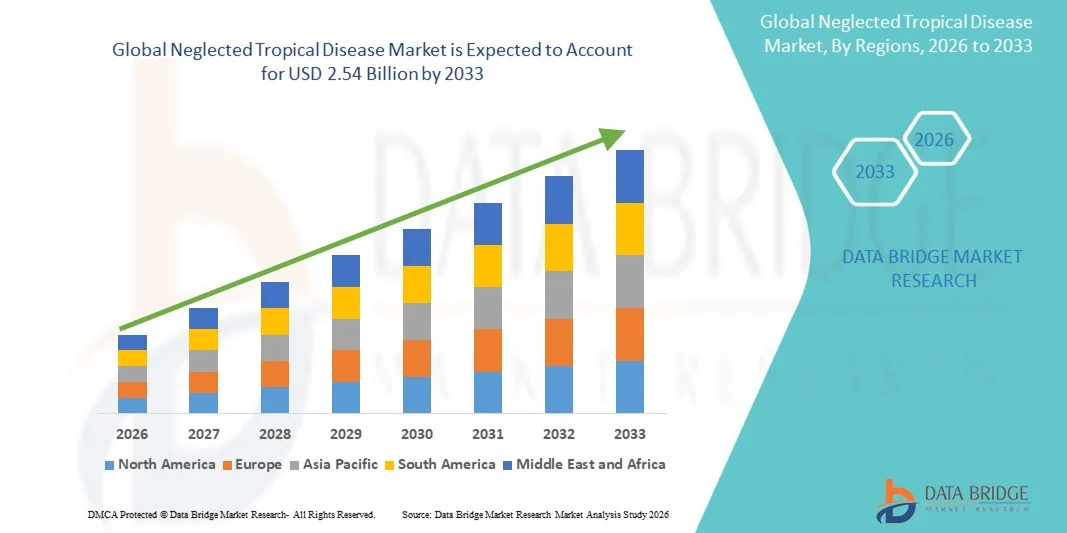
Report Scope and Neglected Tropical Disease Market Segmentation
|
Attributes |
Neglected Tropical Disease Key Market Insights |
|
Segments Covered |
|
|
Countries Covered |
North America · U.S. · Canada · Mexico Europe · Germany · France · U.K. · Netherlands · Switzerland · Belgium · Russia · Italy · Spain · Turkey · Rest of Europe Asia-Pacific · China · Japan · India · South Korea · Singapore · Malaysia · Australia · Thailand · Indonesia · Philippines · Rest of Asia-Pacific Middle East and Africa · Saudi Arabia · U.A.E. · South Africa · Egypt · Israel · Rest of Middle East and Africa South America · Brazil · Argentina · Rest of South America |
|
Key Market Players |
• Novartis AG (Switzerland) |
|
Market Opportunities |
· Expansion of Mass Drug Administration (MDA) and Global Eradication Programs · Growing Investment in Vaccine and Novel Drug Development · Improved Diagnostic Access and Strengthening Healthcare Infrastructure in Endemic Regions |
|
Value Added Data Infosets |
In addition to the insights on market scenarios such as market value, growth rate, segmentation, geographical coverage, and major players, the market reports curated by the Data Bridge Market Research also include in-depth expert analysis, geographically represented company-wise production and capacity, network layouts of distributors and partners, detailed and updated price trend analysis and deficit analysis of supply chain and demand. |
Neglected Tropical Disease Market Trends
Trend: Rising Global Momentum in Disease Elimination & Mass Drug Administration Programs
The Neglected Tropical Disease Market is witnessing strong growth driven by large-scale disease elimination initiatives led by the World Health Organization (WHO), national governments, and global health alliances. Programs such as the WHO 2030 NTD Roadmap aim to eliminate at least one NTD in 100 countries, significantly increasing demand for anti-parasitic drugs, vaccines, and diagnostic tools. For instance, more than 1.7 billion people globally require preventive treatment for NTDs annually, highlighting the massive scale of intervention programs. Countries across Africa and South Asia are actively implementing Mass Drug Administration (MDA) campaigns for diseases like lymphatic filariasis and soil-transmitted helminthiases, where treatment coverage in some regions exceeds 60–75% of at-risk populations. Increasing participation of pharmaceutical companies such as GSK and Merck (MSD) in donation-based drug programs further strengthens global access and treatment penetration.
Neglected Tropical Disease Market Dynamics
Key Market Driver: Rising Disease Burden and Expansion of Global Health Funding
The increasing prevalence of neglected tropical diseases continues to drive market growth, particularly in low- and middle-income countries. According to WHO estimates, over 1 billion people are affected by one or more NTDs globally, with high concentrations in sub-Saharan Africa, South Asia, and Latin America. Diseases such as dengue (with over 4–5 million cases annually reported in peak outbreak years) and leishmaniasis remain major public health challenges. Growing funding from organizations such as the Bill & Melinda Gates Foundation (over USD 2 billion committed to global health programs annually), WHO, and the World Bank is supporting large-scale treatment and elimination programs. Pharmaceutical companies including Sanofi (rabies vaccine programs) and Novartis (anti-leprosy drug donations) are actively contributing to global treatment access, significantly accelerating market demand.
KeyRestraint/Challenge: Limited Healthcare Infrastructure and Underreporting of Disease Cases
A major challenge in the NTD market is weak healthcare infrastructure in endemic regions, leading to underdiagnosis and underreporting of cases. In many rural areas of Africa and Asia-Pacific, diagnostic coverage for diseases like Chagas disease and human African trypanosomiasis remains below 40–50%, limiting early treatment intervention. In additiion, fragmented surveillance systems and lack of trained healthcare professionals hinder effective disease tracking and control. Financial constraints also restrict access to advanced diagnostics and treatments, as per-capita healthcare spending in some endemic countries remains below USD 100 per year. Furthermore, reliance on donor-funded programs creates sustainability challenges, making long-term disease elimination difficult without continuous international support.
The persistence of environmental factors such as poor sanitation, vector proliferation, and climate change further exacerbates disease transmission cycles, especially for vector-borne NTDs like dengue and leishmaniasis.
Key Market Opportunity: Expansion of Vaccine Development and Digital Disease Surveillance Systems
A significant opportunity in the NTD market lies in accelerating vaccine development and strengthening digital surveillance systems for early outbreak detection. For example, the WHO prequalified dengue vaccine (CYD-TDV) and ongoing development of second-generation dengue vaccines highlight growing innovation in preventive care. Similarly, rabies elimination programs supported by Gavi and WHO aim for “Zero human deaths from dog-mediated rabies by 2030”, creating strong demand for vaccine distribution infrastructure.
In addition, digital health platforms and AI-based epidemiological modeling are transforming disease surveillance. Countries like India and Brazil are deploying real-time reporting systems for dengue outbreaks, improving response times by up to 30–40% in outbreak containment efforts. Expansion of cloud-based health data systems and mobile health (mHealth) tools is further enabling remote monitoring in rural regions. Combined with rising investment in public–private partnerships and increasing pharmaceutical pipeline activity (over 20+ NTD-focused vaccine candidates currently in development globally), this creates a strong long-term growth opportunity for the market.
Neglected Tropical Disease Market Scope
The Neglected Tropical Disease market is segmented on the basis of disease type and product type.
- By Disease
On the basis of disease, the Neglected Tropical Disease Market is segmented into Dengue, Rabies, Trachoma, Buruli Ulcer, Yaws, Leprosy, Chagas Disease, Human African Trypanosomiasis, Leishmaniases, Soil-Transmitted Helminthiases, and Others. The Leishmaniases segment dominated the market with a revenue share of 14.28% in 2025, due to its high prevalence in tropical and subtropical regions, particularly in South Asia, East Africa, and Latin America. Increasing incidence of visceral and cutaneous leishmaniasis cases, limited early-stage diagnosis, and reliance on amphotericin B and antimonial drugs are key factors driving demand. Government-supported vector control programs and WHO-backed elimination initiatives are further strengthening treatment adoption. In addition, rising awareness programs and expanding access to diagnostic tools in endemic regions are supporting market dominance.
The Soil-Transmitted Helminthiases segment is expected to register the fastest CAGR of 7.3% from 2026 to 2033, driven by large-scale deworming programs targeting school-aged children and high-risk populations across developing countries. WHO-supported preventive chemotherapy campaigns are reaching over 800 million children annually in endemic regions, significantly boosting treatment volumes. Rising investments in sanitation improvement, hygiene awareness, and public health infrastructure are further supporting disease reduction efforts. In addition, low-cost albendazole and mebendazole distribution programs are expanding rapidly across Africa and Asia-Pacific, accelerating segment growth. Increasing government participation in mass treatment campaigns is also reinforcing long-term market expansion.
- By Product
On the basis of product, the Neglected Tropical Disease Market is segmented into Drugs and Vaccines. The Drugs segment dominated the market with a share of 63.45% in 2025, driven by widespread use of anti-parasitic, anti-bacterial, and antiviral medications in large-scale Mass Drug Administration (MDA) programs. Global health agencies such as WHO, UNICEF, and national governments continue to rely heavily on pharmaceutical interventions for diseases like lymphatic filariasis, trachoma, and leprosy. Strong donation programs by companies such as GSK (albendazole donations) and Merck/MSD (ivermectin donation program) are significantly improving global access to essential medicines. In addition, rising availability of low-cost generic drugs is ensuring large-scale treatment coverage across endemic regions.
The Vaccines segment is expected to witness the fastest CAGR of 7.1% from 2026 to 2033, driven by increasing R&D investment in preventive immunization for diseases such as dengue and rabies. The growing pipeline of NTD vaccines, with 20+ candidates currently under clinical development globally, is strengthening future growth potential. Expansion of immunization programs supported by Gavi, WHO, and public–private partnerships is further accelerating adoption. For example, rabies elimination initiatives targeting “zero human deaths by 2030” are boosting vaccine deployment in Asia and Africa. Advancements in recombinant and vector-based vaccine technologies are also improving efficacy and scalability, supporting long-term market expansion.
Neglected Tropical Disease Market Regional Analysis
North America dominated the Neglected Tropical Disease (NTD) market and accounted for the largest revenue share of 34.18% in 2025, supported by strong funding from government health agencies, advanced biomedical research infrastructure, and significant contributions from organizations such as the CDC, NIH, and major global health foundations. The region benefits from substantial investments in tropical disease research, vaccine development, drug discovery programs, and global disease surveillance initiatives. In addition, the presence of leading pharmaceutical and biotechnology companies actively engaged in NTD-related clinical trials and treatment development is strengthening market growth. Growing public-private partnerships focused on disease elimination, increasing support for international health programs, and advancements in diagnostic technologies continue to reinforce North America’s leadership position in the global NTD market.
U.S. Neglected Tropical Disease Market Insight
The U.S. Neglected Tropical Disease market is witnessing strong growth due to increasing investments in infectious disease research, vaccine innovation, and global health initiatives. Federal agencies such as the CDC and NIH continue to allocate substantial funding toward tropical disease surveillance, treatment development, and outbreak preparedness. The presence of major pharmaceutical companies and research institutions engaged in dengue, leishmaniasis, Chagas disease, and rabies research is driving innovation across the market. In additiion, growing collaborations with international organizations and increasing participation in disease eradication programs are accelerating the development and commercialization of advanced NTD therapeutics and vaccines.
Europe Neglected Tropical Disease Market Insight
The Europe Neglected Tropical Disease market remains a major contributor to global revenue, driven by strong government support, robust healthcare systems, and extensive participation in global disease control initiatives. European countries continue to invest heavily in infectious disease research, vaccine development, and public health surveillance programs. The region benefits from active involvement in WHO-led elimination campaigns and increasing funding for neglected disease research through academic institutions and public health organizations. Furthermore, growing collaborations between pharmaceutical companies and non-governmental organizations are expanding access to treatment and diagnostics across endemic regions worldwide.
U.K. Neglected Tropical Disease Market Insight
The U.K. Neglected Tropical Disease market is experiencing steady growth, supported by strong investments in tropical medicine research and international public health programs. Leading research institutions and universities are actively engaged in developing innovative treatments and diagnostic technologies for diseases such as leishmaniasis, dengue, and Chagas disease. In addition, the country's continued support for global health partnerships and disease elimination initiatives is contributing to market expansion. Increasing funding for vaccine research and infectious disease surveillance is further positioning the U.K. as a key contributor to advancements in the NTD sector.
Germany Neglected Tropical Disease Market Insight
The Germany Neglected Tropical Disease market is expanding steadily due to the country's advanced healthcare infrastructure, strong pharmaceutical industry, and growing focus on infectious disease research. German research organizations and biotechnology companies are increasingly involved in developing novel therapeutics, vaccines, and diagnostic solutions targeting neglected tropical diseases. Government support for global health initiatives and increasing participation in international disease control programs are further supporting market growth. In additiion, advancements in molecular diagnostics and epidemiological monitoring systems are enhancing disease detection and management capabilities across the region.
Asia-Pacific Neglected Tropical Disease Market Insight
The Asia-Pacific Neglected Tropical Disease market is expected to witness rapid growth and is projected to register the fastest CAGR of 7.4% from 2026 to 2033, driven by rising government investments in disease elimination programs, improving healthcare infrastructure, and increasing awareness of neglected tropical diseases across the region. Countries such as India, China, Indonesia, Bangladesh, and the Philippines continue to face a significant burden of dengue, leprosy, soil-transmitted helminthiases, and other tropical diseases, creating strong demand for effective treatment and prevention strategies. Expanding vaccination coverage, strengthening public health surveillance systems, and increasing collaboration with international health organizations are accelerating regional market growth. In additiion, improved access to diagnostics and healthcare services is further supporting market expansion.
Japan Neglected Tropical Disease Market Insight
The Japan Neglected Tropical Disease market is witnessing consistent growth due to increasing investments in vaccine research, infectious disease preparedness, and advanced healthcare technologies. Japanese pharmaceutical companies and research institutions are actively participating in the development of novel therapies and preventive solutions for tropical diseases. The country's strong focus on biotechnology innovation and global health partnerships is supporting ongoing research initiatives. Moreover, increasing collaboration with international organizations and academic institutions is enhancing Japan’s contribution to global NTD control and elimination efforts.
China Neglected Tropical Disease Market Insight
The China Neglected Tropical Disease market is growing rapidly, driven by expanding healthcare infrastructure, rising government spending on infectious disease control, and increasing focus on public health improvement. The country has strengthened disease surveillance systems and implemented large-scale prevention and treatment programs targeting dengue, soil-transmitted helminthiases, and other endemic diseases. Growing investments in vaccine development, diagnostic technologies, and biotechnology research are significantly boosting market growth. In addition, increasing collaborations between Chinese healthcare institutions, pharmaceutical companies, and global health organizations are positioning China as one of the fastest-growing markets for Neglected Tropical Disease solutions globally.
Neglected Tropical Disease Market Share
The Neglected Tropical Disease industry is primarily led by well-established companies, including:
- Novartis AG (Switzerland)
- Sanofi S.A. (France)
- GlaxoSmithKline plc (U.K.)
- Merck & Co., Inc. (U.S.)
- Johnson & Johnson (U.S.)
- Pfizer Inc. (U.S.)
- Bayer AG (Germany)
- Abbott Laboratories (U.S.)
- Eisai Co., Ltd. (Japan)
- Bristol Myers Squibb (U.S.)
- AstraZeneca plc (U.K.)
- Takeda Pharmaceutical Company Limited (Japan)
- Boehringer Ingelheim (Germany)
- Roche Holding AG (Switzerland)
- Gilead Sciences, Inc. (U.S.)
- Amgen Inc. (U.S.)
- Zydus Lifesciences Ltd. (India)
- Sun Pharmaceutical Industries Ltd. (India)
- Dr. Reddy’s Laboratories Ltd. (India)
- Cipla Ltd. (India)
- BASF SE (Germany)
- Novavax, Inc. (U.S.)
- Serum Institute of India Pvt. Ltd. (India)
- Inovio Pharmaceuticals, Inc. (U.S.)
- Emergent BioSolutions Inc. (U.S.)
- Vaxart, Inc. (U.S.)
- Moderna, Inc. (U.S.)
- CSL Limited (Australia)
- Biocon Ltd. (India)
- Shionogi & Co., Ltd. (Japan)
- Ipsen S.A. (France)
- F. Hoffmann-La Roche Ltd. (Switzerland)
Latest Developments in Neglected Tropical Disease Market
- In January 2021, the World Health Organization (WHO) officially launched the “Ending the Neglect to Attain the Sustainable Development Goals: A Road Map for Neglected Tropical Diseases 2021–2030,” establishing global targets to reduce by 90% the number of people requiring NTD interventions and achieve the elimination of at least one NTD in 100 countries by 2030. The roadmap introduced a comprehensive framework emphasizing country ownership, cross-sector collaboration, and innovation in diagnostics, therapeutics, and disease surveillance
- In January 2022, leading pharmaceutical companies and global health organizations expanded long-standing medicine donation programs for neglected tropical diseases, strengthening access to preventive chemotherapy for millions of people affected by lymphatic filariasis, onchocerciasis, trachoma, and soil-transmitted helminthiases. These initiatives supported large-scale mass drug administration campaigns across Africa, Asia-Pacific, and Latin America
- In January 2023, the WHO released its Global Report on Neglected Tropical Diseases 2023, reporting that the number of people requiring NTD interventions declined by 80 million between 2020 and 2021. The report also highlighted that eight countries had eliminated at least one NTD during 2022, demonstrating continued progress toward the objectives of the WHO NTD Roadmap 2021–2030
- In May 2023, the European Commission approved Takeda’s QDENGA (TAK-003) dengue vaccine for use in endemic and non-endemic settings, representing a significant advancement in the prevention of dengue fever, one of the world’s most widespread neglected tropical diseases. The approval expanded access to preventive vaccination strategies and strengthened global dengue control efforts
- In December 2023, WHO reported significant progress in preventive chemotherapy programs for neglected tropical diseases, with hundreds of millions of people receiving treatment through large-scale drug administration initiatives targeting lymphatic filariasis, schistosomiasis, trachoma, and soil-transmitted helminthiases. The update also highlighted continued expansion of donated medicine programs supporting NTD elimination efforts globally
- In May 2024, the WHO released its Global Report on Neglected Tropical Diseases 2024, highlighting that 50 countries had successfully eliminated at least one NTD as of the end of 2023. The report also noted that approximately 848 million people received treatment for at least one NTD and emphasized growing investments in surveillance systems, diagnostics, and integrated disease-control strategies
- In May 2024, the WHO announced that noma (cancrum oris), a severe gangrenous disease primarily affecting vulnerable children, had been officially added to the list of Neglected Tropical Diseases. This designation increased global attention, funding opportunities, research efforts, and public health interventions aimed at improving prevention, diagnosis, and treatment of the disease
SKU-
Get online access to the report on the World's First Market Intelligence Cloud

- Interactive Data Analysis Dashboard
- Company Analysis Dashboard for high growth potential opportunities
- Research Analyst Access for customization & queries
- Competitor Analysis with Interactive dashboard
- Latest News, Updates & Trend analysis
- Harness the Power of Benchmark Analysis for Comprehensive Competitor Tracking
Research Methodology
Data collection and base year analysis are done using data collection modules with large sample sizes. The stage includes obtaining market information or related data through various sources and strategies. It includes examining and planning all the data acquired from the past in advance. It likewise envelops the examination of information inconsistencies seen across different information sources. The market data is analysed and estimated using market statistical and coherent models. Also, market share analysis and key trend analysis are the major success factors in the market report. To know more, please request an analyst call or drop down your inquiry.
The key research methodology used by DBMR research team is data triangulation which involves data mining, analysis of the impact of data variables on the market and primary (industry expert) validation. Data models include Vendor Positioning Grid, Market Time Line Analysis, Market Overview and Guide, Company Positioning Grid, Patent Analysis, Pricing Analysis, Company Market Share Analysis, Standards of Measurement, Global versus Regional and Vendor Share Analysis. To know more about the research methodology, drop in an inquiry to speak to our industry experts.
Customization Available
Data Bridge Market Research is a leader in advanced formative research. We take pride in servicing our existing and new customers with data and analysis that match and suits their goal. The report can be customized to include price trend analysis of target brands understanding the market for additional countries (ask for the list of countries), clinical trial results data, literature review, refurbished market and product base analysis. Market analysis of target competitors can be analyzed from technology-based analysis to market portfolio strategies. We can add as many competitors that you require data about in the format and data style you are looking for. Our team of analysts can also provide you data in crude raw excel files pivot tables (Fact book) or can assist you in creating presentations from the data sets available in the report.












