




Global Nerve Regeneration And Repair Market
Market Size in USD Billion
CAGR :
% 
 USD
10.70 Billion
USD
59.30 Billion
2025
2033
USD
10.70 Billion
USD
59.30 Billion
2025
2033
 Forecast Period Forecast Period |
2026 –2033 |
 Market Size (Base Year) Market Size (Base Year) |
USD 10.70 Billion |
 Market Size (Forecast Year) Market Size (Forecast Year) |
USD 59.30 Billion |
 CAGR CAGR |
% |
| Major Markets Players |
|
Nerve Regeneration and Repair Market Size
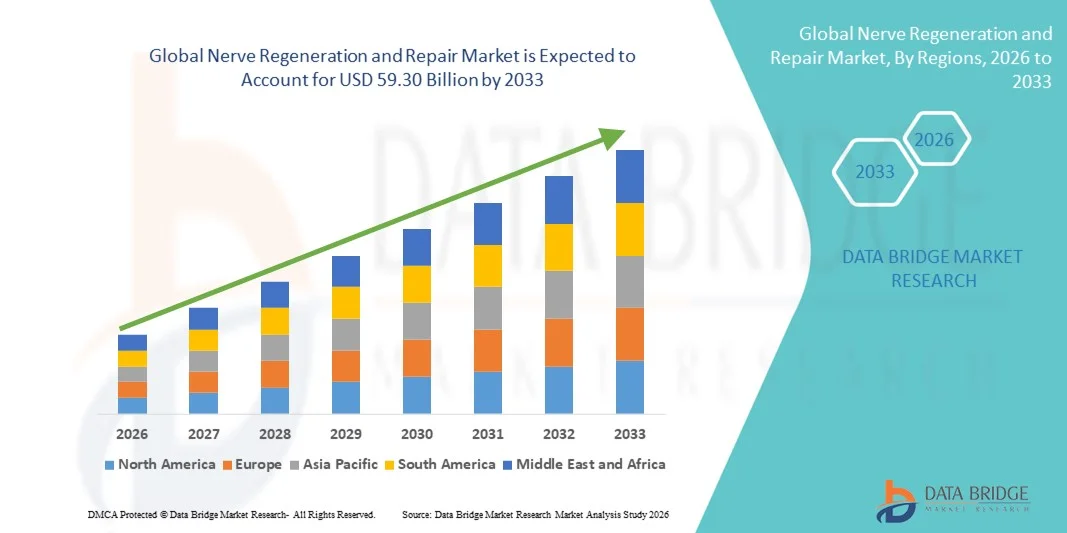
- The global nerve regeneration and repair market size was valued at USD 10.70 billion in 2025 and is expected to reach USD 59.30 billion by 2033, at a CAGR of 23.87% during the forecast period
- The market growth is primarily driven by increasing advancements in biomedical technologies and rising adoption of innovative nerve regeneration therapies, including bioengineered scaffolds, stem cell treatments, and neurotrophic factor-based interventions. These technological developments are enabling more effective and faster nerve repair, improving patient outcomes across both surgical and non-surgical settings
- Furthermore, growing awareness among healthcare providers and patients about the benefits of early intervention, coupled with the rising prevalence of nerve injuries and neuropathic conditions, is propelling demand for nerve regeneration and repair solutions. These combined factors are accelerating the adoption of advanced therapies, thereby substantially driving the growth of the Nerve Regeneration and Repair market
Nerve Regeneration and Repair Market Analysis
- Nerve Regeneration and Repair devices and therapies, including biomaterials, scaffolds, and neurostimulation systems, are increasingly vital components in both peripheral and central nervous system injury management due to their ability to enhance functional recovery and accelerate healing
- The escalating demand for these solutions is primarily fueled by rising incidences of nerve injuries, neurodegenerative disorders, and traumatic accidents, along with growing adoption of minimally invasive and patient-specific therapies
- North America dominated the nerve regeneration and repair market with the largest revenue share of 38.5% in 2025, characterized by advanced healthcare infrastructure, strong presence of key players, and high adoption of innovative nerve repair technologies, with the U.S. experiencing substantial growth driven by new clinical applications, research initiatives, and technological innovations
- Asia-Pacific is expected to be the fastest-growing region in the nerve regeneration and repair market during the forecast period, accounting for a CAGR of 12.8%, due to increasing healthcare expenditure, growing awareness of nerve repair therapies, and expanding geriatric population
- The Neurostimulation and Neuromodulation Devices segment dominated the largest market revenue share of 56.4% in 2025, driven by increasing adoption in chronic pain management, peripheral neuropathy, and functional neurosurgeries
Report Scope and Nerve Regeneration and Repair Market Segmentation
|
Attributes |
Nerve Regeneration and Repair Key Market Insights |
|
Segments Covered |
|
|
Countries Covered |
North America
Europe
Asia-Pacific
Middle East and Africa
South America
|
|
Key Market Players |
|
|
Market Opportunities |
|
|
Value Added Data Infosets |
In addition to the insights on market scenarios such as market value, growth rate, segmentation, geographical coverage, and major players, the market reports curated by the Data Bridge Market Research also include in-depth expert analysis, patient epidemiology, pipeline analysis, pricing analysis, and regulatory framework. |
Nerve Regeneration and Repair Market Trends
Enhanced Convenience Through Innovative Therapies
- A significant and accelerating trend in the global nerve regeneration and repair market is the development of minimally invasive procedures and targeted therapeutic approaches, improving patient outcomes and reducing recovery times
- For instance, in March 2025, Medtronic launched an advanced nerve repair scaffold designed for peripheral nerve injuries, offering enhanced precision and integration with existing surgical procedures. This innovation is expected to improve success rates in complex nerve repair surgeries
- Another notable trend is the increasing use of regenerative biomaterials and bioengineered grafts that promote faster nerve regeneration and functional recovery. These materials are being adopted in both clinical and research settings to treat peripheral and central nerve injuries
- Furthermore, there is growing emphasis on personalized regenerative therapies tailored to individual patient needs, leveraging advancements in cell therapy, gene therapy, and biomaterials to optimize outcomes
- Research into neurotrophic factors, growth-promoting agents, and scaffold-based delivery systems is expanding rapidly, allowing clinicians to address nerve damage with more precise and effective interventions
- The demand for comprehensive rehabilitation programs that combine surgical repair with advanced physiotherapy and neurostimulation techniques is also increasing across hospitals and specialized clinics globally
Nerve Regeneration and Repair Market Dynamics
Driver
Rising Incidence of Nerve Injuries and Neurodegenerative Conditions
- The increasing prevalence of peripheral nerve injuries, diabetic neuropathy, and neurodegenerative diseases is a primary driver for the Nerve Regeneration and Repair market
- For instance, in January 2025, Stryker reported an uptick in the adoption of its nerve repair kits in U.S. trauma centers, driven by rising cases of sports injuries and accidents requiring precise nerve reconstruction
- Advancements in clinical research and therapeutic development are encouraging the adoption of novel nerve repair techniques and devices
- The growing aging population and increased prevalence of chronic diseases further emphasize the need for effective nerve regeneration solutions, particularly in developed regions with advanced healthcare infrastructure
- Investment in specialized training and surgical centers for nerve repair is expanding, which supports broader market adoption and improved patient outcomes
Restraint/Challenge
High Treatment Costs and Limited Reimbursement
- The relatively high cost of nerve regeneration procedures and therapies, especially advanced biomaterials and cell-based treatments, poses a challenge for widespread adoption
- For instance, patients in developing regions often face financial barriers to accessing autologous or allogenic nerve repair therapies due to limited insurance coverage
- Limited reimbursement policies and inconsistent healthcare funding across countries restrict the adoption of cutting-edge nerve repair solutions in certain markets
- Complex regulatory approvals for new regenerative therapies can delay market entry, impacting the availability of innovative solutions to patients
- Addressing cost-effectiveness, improving clinical evidence, and streamlining regulatory pathways are critical to overcoming these adoption barriers
Nerve Regeneration and Repair Market Scope
The market is segmented on the basis of product, indication, application, and end user.
- By Product
On the basis of product, the Nerve Regeneration and Repair market is segmented into Neurostimulation and Neuromodulation Devices and Biomaterials. The Neurostimulation and Neuromodulation Devices segment dominated the largest market revenue share of 56.4% in 2025, driven by increasing adoption in chronic pain management, peripheral neuropathy, and functional neurosurgeries. Hospitals and specialty clinics favor these devices due to established clinical efficacy and predictable outcomes. Integration with advanced monitoring systems enhances procedural precision. Continuous technological innovations in implantable stimulators support sustained adoption. Reimbursement coverage for neuromodulation therapies strengthens market stability. High prevalence of neuropathic pain and failed back surgery syndrome drives demand. Collaboration between device manufacturers and hospitals ensures reliable supply chains. Established physician familiarity with these devices reinforces preference. Their compatibility with minimally invasive procedures reduces recovery time. Strong clinical evidence supporting efficacy drives physician confidence. Overall, neurostimulation and neuromodulation devices maintain dominance due to their proven therapeutic benefits and extensive market penetration.
The Biomaterials segment is anticipated to witness the fastest CAGR of 12.8% from 2026 to 2033, fueled by rising innovations in nerve conduits, scaffolds, and synthetic graft materials. Biomaterials enable regeneration in complex nerve injuries and support bridging of large nerve gaps. Increased research funding for regenerative therapies accelerates development pipelines. Hospitals and research centers adopt biomaterials for improved surgical outcomes and reduced complications. Growth in stem cell-based adjunct therapies enhances biomaterial utilization. Expansion of preclinical and clinical studies validates performance and safety. Rising incidence of peripheral nerve injuries globally drives adoption. Enhanced biocompatibility and functional recovery potential attract clinicians. Manufacturing improvements reduce costs and improve accessibility. Integration with patient-specific regenerative protocols supports personalized treatment. Overall, biomaterials are positioned as the fastest-growing product segment due to technological advances and expanding clinical applications.
- By Indication
On the basis of indication, the market is segmented into Failed Back Surgery Syndrome, Parkinson’s disease, Urinary Incontinence, Epilepsy, Gastroparesis, and Nerve Repair & Grafting. The Failed Back Surgery Syndrome segment dominated with 27.9% revenue share in 2025, owing to high prevalence of post-surgical neuropathic pain and the need for advanced neuromodulation therapies. Patients increasingly prefer implantable devices for long-term pain management. Hospitals adopt standardized procedural protocols to optimize outcomes. Strong insurance reimbursement supports therapy adoption. Ongoing clinical trials strengthen confidence in device efficacy. Physician familiarity and training programs drive widespread utilization. Favorable regulatory approvals encourage expanded use. Proven long-term benefits reduce hospital readmissions. Integration with digital monitoring platforms improves patient care. Multi-center collaborations enhance device adoption. Overall, failed back surgery syndrome remains the leading indication due to clinical evidence, prevalence, and therapeutic demand.
The Parkinson’s Disease segment is expected to witness the fastest CAGR of 11.9% from 2026 to 2033, driven by increasing prevalence of neurodegenerative disorders and demand for deep brain stimulation (DBS) therapies. Hospitals and specialized neurology centers invest in advanced DBS and neuromodulation equipment. Technological improvements enhance device precision and patient safety. Rising awareness of therapeutic options among patients drives adoption. Expansion of private neurology networks accelerates treatment access. Positive clinical outcomes in motor and non-motor symptom management strengthen confidence. Government and private funding for neurodegenerative research further supports growth. Integration with wearable monitoring devices enhances post-operative care. Clinical guideline endorsements encourage broader implementation. Overall, Parkinson’s disease represents the fastest-growing indication segment due to technological advances and rising disease burden.
- By Application
On the basis of application, the market is segmented into Neurostimulation and Neuromodulation Surgeries, Neurorrhaphy, Nerve Grafting, and Stem Cell Therapy. The Neurostimulation and Neuromodulation Surgeries segment dominated with 48.6% revenue share in 2025, driven by high adoption in chronic pain management, functional restoration, and movement disorder treatments. Hospitals and specialized surgical centers prefer minimally invasive techniques that reduce recovery times. Established reimbursement frameworks support widespread use. Strong physician expertise and clinical experience reinforce dominance. Integration with advanced surgical navigation systems improves outcomes. Robust clinical evidence supports therapeutic efficacy. Ongoing R&D in device miniaturization strengthens procedural adoption. Multi-disease applicability enhances market penetration. Hospital procurement programs ensure consistent supply. Expansion of outpatient surgical services increases procedural volumes. Overall, neurostimulation surgeries maintain market leadership due to proven efficacy, clinical familiarity, and high adoption rates.
The Stem Cell Therapy segment is projected to register the fastest CAGR of 13.2% from 2026 to 2033, fueled by advancements in autologous and allogeneic stem cell applications for peripheral nerve repair. Rising clinical research in regenerative medicine supports adoption in hospitals and specialty centers. Stem cell therapies improve functional recovery and reduce long-term disability. Collaboration between biotech firms and clinical institutions accelerates therapeutic development. Favorable government and private funding for regenerative trials supports expansion. Increasing awareness among physicians and patients drives therapy uptake. Technological improvements in cell delivery and scaffold integration enhance treatment efficacy. Emerging markets are investing in infrastructure for advanced regenerative therapies. Clinical success stories strengthen trust and adoption rates. Overall, stem cell therapy represents the fastest-growing application segment due to innovation, rising adoption, and expanding clinical evidence.
- By End User
On the basis of end user, the market is segmented into Hospitals & Clinics and Ambulatory Surgical Centers. The Hospitals & Clinics segment dominated with 71.2% revenue share in 2025, driven by availability of specialized neurology departments, advanced surgical infrastructure, and comprehensive patient care. High patient volumes and multi-disciplinary treatment approaches support adoption of complex nerve regeneration procedures. Hospitals benefit from reimbursement coverage, structured procurement frameworks, and established physician expertise. Integration of advanced surgical devices and neuromodulation systems enhances procedural efficiency. Collaboration with research institutions supports clinical trials. Strong insurance support enables higher treatment affordability. Continuous training programs reinforce staff expertise. Advanced diagnostic capabilities improve treatment planning. Overall, hospitals and clinics maintain dominance due to infrastructure, expertise, and patient volume.
The Ambulatory Surgical Centers segment is expected to witness the fastest CAGR of 12.5% from 2026 to 2033, fueled by rising preference for outpatient minimally invasive procedures and cost-effective care models. Expansion of specialty centers in urban and suburban regions supports treatment access. Patients increasingly prefer shorter hospital stays and quicker recovery times. Integration with telehealth and remote monitoring enhances post-operative care. Growing adoption of neuromodulation and regenerative therapies accelerates center utilization. Emerging reimbursement models favor outpatient surgical settings. Technological advancements reduce procedure complexity and time. Training programs for specialized surgeons increase procedural efficiency. Overall, ambulatory surgical centers represent the fastest-growing end-user segment due to convenience, cost-effectiveness, and growing patient preference.
Nerve Regeneration and Repair Market Regional Analysis
- North America dominated the nerve regeneration and repair market with the largest revenue share of 38.5% in 2025, characterized by advanced healthcare infrastructure, strong presence of key players, and high adoption of innovative nerve repair technologies, with the U.S. experiencing substantial growth driven by new clinical applications, research initiatives, and technological innovations
- Healthcare providers in the region are increasingly adopting advanced nerve conduits, bioengineered grafts, and regenerative therapies to improve surgical precision and patient recovery outcomes
- This strong market position is further supported by high healthcare expenditure, favorable reimbursement frameworks, and extensive investment in clinical research and development activities focused on nerve repair solutions
U.S. Nerve Regeneration and Repair Market Insight
The U.S. nerve regeneration and repair market captured the largest revenue share in 2025 within North America, fueled by rapid technological advancements and increasing clinical adoption of regenerative medicine approaches. Rising incidence of peripheral nerve injuries, trauma cases, and neurodegenerative disorders is driving demand for effective treatment options. In addition, strong government and private funding for neuroscience research, combined with the presence of leading biotechnology and medical device companies, continues to accelerate innovation and commercialization of advanced nerve repair therapies.
Europe Nerve Regeneration and Repair Market Insight
The Europe nerve regeneration and repair market is projected to expand at a substantial CAGR throughout the forecast period, primarily driven by increasing prevalence of neurological disorders and strong regulatory support for advanced medical technologies. Growing investment in healthcare modernization and regenerative medicine research across the region is supporting the adoption of nerve repair solutions. Furthermore, rising awareness regarding early diagnosis and timely surgical intervention is contributing to steady market growth across hospitals and specialty clinics.
U.K. Nerve Regeneration and Repair Market Insight
The U.K. nerve regeneration and repair market is anticipated to grow at a noteworthy CAGR during the forecast period, driven by increasing research initiatives in neuroscience and regenerative medicine. Rising cases of traumatic injuries and age-related neurological conditions are supporting demand for advanced nerve repair therapies. In addition, government-backed healthcare programs and funding for clinical trials are encouraging the development and adoption of innovative treatment approaches in the country.
Germany Nerve Regeneration and Repair Market Insight
The Germany nerve regeneration and repair market is expected to expand at a considerable CAGR during the forecast period, fueled by strong healthcare infrastructure and emphasis on medical innovation. Germany’s advanced hospital systems and research institutions are actively adopting bioresorbable nerve conduits and tissue-engineered grafts. The country’s focus on precision medicine and high standards of clinical care further supports the integration of advanced nerve regeneration technologies into mainstream treatment protocols.
Asia-Pacific Nerve Regeneration and Repair Market Insight
The Asia-Pacific nerve regeneration and repair market is expected to be the fastest-growing region during the forecast period, accounting for a CAGR of 12.8%, due to increasing healthcare expenditure, growing awareness of nerve repair therapies, and expanding geriatric population. Rapid improvements in healthcare infrastructure and rising investments in regenerative medicine research across emerging economies are driving regional growth. Increasing accessibility to advanced surgical procedures and improved reimbursement policies are further strengthening market expansion.
Japan Nerve Regeneration and Repair Market Insight
The Japan nerve regeneration and repair market is gaining momentum due to the country’s rapidly aging population and strong focus on advanced medical technologies. Growing adoption of regenerative therapies and increasing clinical research targeting neurodegenerative diseases are contributing to market growth. Furthermore, high healthcare spending and emphasis on innovation support continued expansion in nerve repair treatment options.
China Nerve Regeneration and Repair Market Insight
The China nerve regeneration and repair market accounted for the largest market revenue share in Asia-Pacific in 2025, attributed to rising healthcare investments, expanding hospital infrastructure, and increasing awareness of advanced treatment solutions. Growing prevalence of nerve injuries due to trauma and chronic diseases, combined with government support for biotechnology and regenerative medicine development, is propelling market growth in the country.
Nerve Regeneration and Repair Market Share
The Nerve Regeneration and Repair industry is primarily led by well-established companies, including:
- Medtronic (Ireland)
- Boston Scientific (U.S.)
- NeuroPace (U.S.)
- Abbott (U.S.)
- Bioventus (U.S.)
- Axogen (U.S.)
- Globus Medical (U.S.)
- Stryker (U.S.)
- Integra LifeSciences (U.S.)
- Nexstim (Finland)
- Stimwave (U.S.)
- Nervive (Germany)
- AxoGen (U.S.)
- Vericel (U.S.)
- Neuralstem (U.S.)
- Bioness (U.S.)
- ReNeuron (U.K.)
- CollPlant (Israel)
- Cytomedix (U.S.)
- TISSUEGRAFT (Germany)
Latest Developments in Global Nerve Regeneration and Repair Market
- In March 2022, Integra LifeSciences introduced the NeuraGen 3D Nerve Guide Matrix in the U.S., a resorbable implant designed to support more complete functional recovery following mid‑gap peripheral nerve repair by providing an optimized environment for nerve regrowth
- In July 2022, Checkpoint Surgical expanded its intraoperative nerve care solutions with the launch of the Checkpoint Edge Nerve Cutting Kit, strengthening its portfolio of nerve protection and repair instruments used during surgery
- In June 2024, AxoGen launched the Avive+ Soft Tissue Matrix, a multi‑layer amniotic membrane allograft designed to act as a soft‑tissue barrier in nerve repair procedures, helping to protect regenerating nerves and separate them from surrounding tissues during the healing process
- In April 2025, Orthocell Limited received U.S. FDA 510(k) clearance for its Remplir™ nerve repair device, a collagen wrap used in surgical nerve repair to enhance nerve regeneration, and soon after completed the first surgical use of Remplir in the U.S. market for a peripheral nerve injury repair procedure
- In April 2025, NurExone Biologic Inc. presented breakthrough preclinical data on facial nerve regeneration at the International Society for Extracellular Vesicles (ISEV) Annual Meeting, showing that its exosome‑based therapy (ExoPTEN) promotes functional recovery in a preclinical facial nerve injury model, expanding potential therapeutic avenues beyond spinal and optic nerve indications
- In August 2025, NervGen Pharma reported positive preclinical results for NVG‑291‑R — a rodent analogue of its lead neurorestorative candidate — demonstrating significant functional recovery and axonal regeneration across models of peripheral nerve injury and blast‑induced sensorineural hearing loss in Department of Defense‑sponsored studies
SKU-
Get online access to the report on the World's First Market Intelligence Cloud

- Interactive Data Analysis Dashboard
- Company Analysis Dashboard for high growth potential opportunities
- Research Analyst Access for customization & queries
- Competitor Analysis with Interactive dashboard
- Latest News, Updates & Trend analysis
- Harness the Power of Benchmark Analysis for Comprehensive Competitor Tracking
Research Methodology
Data collection and base year analysis are done using data collection modules with large sample sizes. The stage includes obtaining market information or related data through various sources and strategies. It includes examining and planning all the data acquired from the past in advance. It likewise envelops the examination of information inconsistencies seen across different information sources. The market data is analysed and estimated using market statistical and coherent models. Also, market share analysis and key trend analysis are the major success factors in the market report. To know more, please request an analyst call or drop down your inquiry.
The key research methodology used by DBMR research team is data triangulation which involves data mining, analysis of the impact of data variables on the market and primary (industry expert) validation. Data models include Vendor Positioning Grid, Market Time Line Analysis, Market Overview and Guide, Company Positioning Grid, Patent Analysis, Pricing Analysis, Company Market Share Analysis, Standards of Measurement, Global versus Regional and Vendor Share Analysis. To know more about the research methodology, drop in an inquiry to speak to our industry experts.
Customization Available
Data Bridge Market Research is a leader in advanced formative research. We take pride in servicing our existing and new customers with data and analysis that match and suits their goal. The report can be customized to include price trend analysis of target brands understanding the market for additional countries (ask for the list of countries), clinical trial results data, literature review, refurbished market and product base analysis. Market analysis of target competitors can be analyzed from technology-based analysis to market portfolio strategies. We can add as many competitors that you require data about in the format and data style you are looking for. Our team of analysts can also provide you data in crude raw excel files pivot tables (Fact book) or can assist you in creating presentations from the data sets available in the report.












