Global Neurorehabilitation Devices Market
Market Size in USD Billion
CAGR :
% 
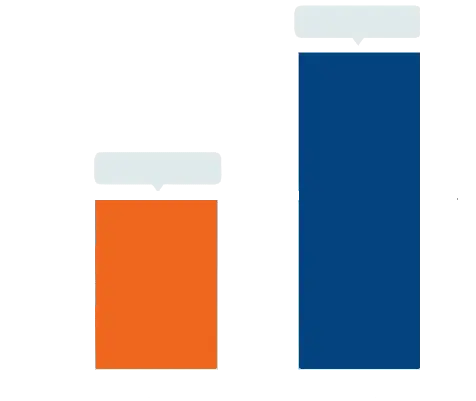 USD
2.79 Billion
USD
7.48 Billion
2025
2033
USD
2.79 Billion
USD
7.48 Billion
2025
2033
 Forecast Period Forecast Period |
2026 –2033 |
 Market Size (Base Year) Market Size (Base Year) |
USD 2.79 Billion |
 Market Size (Forecast Year) Market Size (Forecast Year) |
USD 7.48 Billion |
 CAGR CAGR |
% |
| Major Markets Players |
|
Global Neurorehabilitation Devices Market Segmentation, By Product Type (Neurorobotic Systems, Wearable Devices, Brain-computer Interface, and Brain Stimulators), Application (Stroke, Multiple Sclerosis, Parkinson’s Disease, Cerebral Palsy, Brain and Spinal Cord Injury, and Others), End User (Rehabilitation Centers, Hospitals and Clinics, Home Care, and Others) - Industry Trends and Forecast to 2033
Neurorehabilitation Devices Market Size
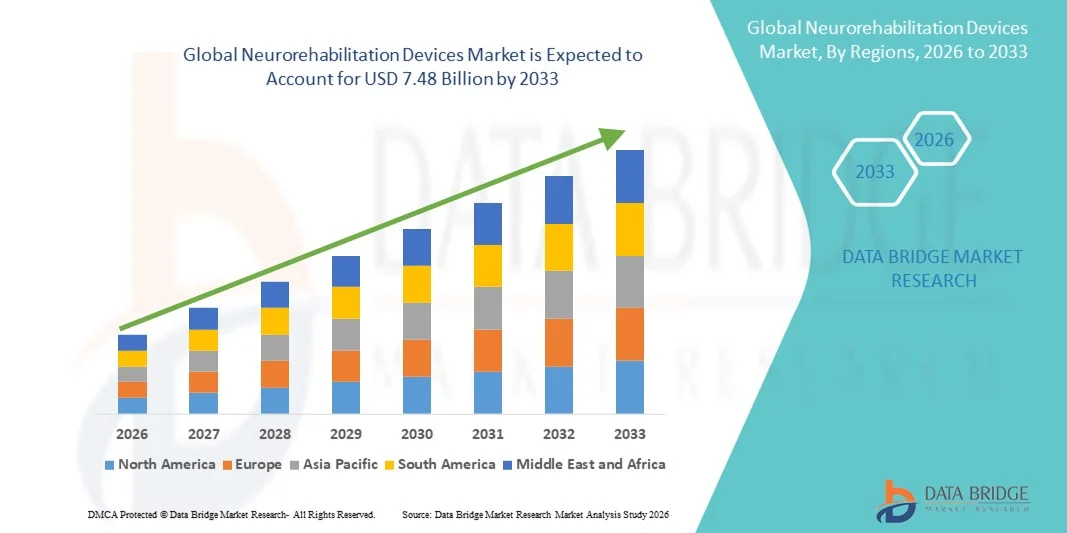
- The global neurorehabilitation devices market size was valued at USD 2.79 billion in 2025 and is expected to reach USD 7.48 billion by 2033, at a CAGR of 13.12% during the forecast period
- The market growth is largely fueled by the increasing prevalence of neurological disorders, rising geriatric population, and growing awareness about advanced rehabilitation therapies, leading to higher adoption of neurorehabilitation solutions in both clinical and home care settings
- Furthermore, rising demand for patient-centric, technologically advanced, and portable rehabilitation devices, coupled with innovations such as robotic-assisted therapy, virtual reality (VR), and wearable sensors, is accelerating the uptake of Neurorehabilitation Devices solutions, thereby significantly boosting the industry's growth
Neurorehabilitation Devices Market Analysis
- Neurorehabilitation devices, encompassing robotic-assisted systems, virtual reality (VR) platforms, wearable sensors, and conventional therapy equipment, are increasingly vital components in both clinical and home care settings due to their ability to enhance patient recovery, track progress, and enable personalized rehabilitation programs
- The escalating demand for neurorehabilitation devices is primarily fueled by the rising prevalence of neurological disorders, growing geriatric population, and increasing awareness of advanced rehabilitation therapies, as well as a preference for patient-centric, technology-enabled recovery solutions
- North America dominated the neurorehabilitation devices market with the largest revenue share of 42.5% in 2025, characterized by high healthcare expenditure, well-established rehabilitation centers, and a strong presence of key industry players, with the U.S. experiencing substantial growth in Neurorehabilitation Devices adoption, driven by innovations from both established medtech companies and startups focusing on AI, robotics, and VR-based rehabilitation solutions
- Asia-Pacific is expected to be the fastest growing region in the neurorehabilitation devices market during the forecast period due to increasing geriatric population, rising prevalence of neurological disorders, and growing investments in advanced healthcare infrastructure
- The Stroke segment accounted for the largest market revenue share of 41.3% in 2025, due to the high global incidence of ischemic and hemorrhagic strokes
Report Scope and Neurorehabilitation Devices Market Segmentation
|
Attributes |
Neurorehabilitation Devices Key Market Insights |
|
Segments Covered |
|
|
Countries Covered |
North America
Europe
Asia-Pacific
Middle East and Africa
South America
|
|
Key Market Players |
• Hocoma AG (Switzerland) |
|
Market Opportunities |
|
|
Value Added Data Infosets |
In addition to the insights on market scenarios such as market value, growth rate, segmentation, geographical coverage, and major players, the market reports curated by the Data Bridge Market Research also include in-depth expert analysis, patient epidemiology, pipeline analysis, pricing analysis, and regulatory framework. |
Neurorehabilitation Devices Market Trends
Increasing Adoption of Advanced Neurorehabilitation Devices
- A significant and accelerating trend in the global neurorehabilitation devices market is the growing preference for technologically advanced rehabilitation solutions that enhance patient recovery, improve outcomes, and reduce hospitalization time
- For instance, in 2024, Hocoma AG launched the Lokomat FreeD module, a robotic-assisted gait therapy system that allows for individualized movement training, highlighting the trend toward personalized rehabilitation devices
- Manufacturers are increasingly developing devices with enhanced portability, sensor-based feedback systems, and gamification features to improve patient engagement and adherence to therapy programs
- The rising prevalence of neurological disorders, including stroke, spinal cord injury, multiple sclerosis, and cerebral palsy, is further driving the adoption of innovative rehabilitation technologies
- In addition, increasing awareness among healthcare providers regarding evidence-based therapies and the benefits of early intervention is fueling demand for advanced neurorehabilitation devices
- Consequently, companies are focusing on integrating virtual reality, robotics, and sensor-driven feedback mechanisms to enhance therapy effectiveness and patient outcomes
Neurorehabilitation Devices Market Dynamics
Driver
Rising Prevalence of Neurological Disorders and Aging Population
- The increasing incidence of neurological conditions, particularly among the aging population, is a major driver for the Neurorehabilitation Devices market
- For instance, in 2025, Bionik Laboratories reported a significant increase in demand for its InMotion robotic therapy systems in rehabilitation centers across North America, driven by growing post-stroke patient volumes
- The increasing number of stroke cases, spinal injuries, and neurodegenerative diseases worldwide is encouraging healthcare facilities to invest in advanced rehabilitation solutions
- Technological advancements in robotic therapy, wearable sensors, and virtual reality-based rehabilitation systems are enabling better recovery outcomes, shorter therapy durations, and improved patient adherence
- Furthermore, the growing number of rehabilitation centers and outpatient therapy clinics is creating additional opportunities for device adoption
- These factors are collectively expected to drive substantial growth in the Neurorehabilitation Devices market during the forecast period
Restraint/Challenge
High Costs and Limited Reimbursement Policies
- The high cost of advanced neurorehabilitation devices remains a key restraint, particularly for smaller clinics and developing regions where healthcare budgets are limited
- For instance, several rehabilitation centers in Southeast Asia delayed adoption of robotic-assisted therapy devices due to the high capital expenditure and lack of government reimbursement programs
- Reimbursement challenges and insufficient insurance coverage for advanced rehabilitation treatments limit patient access and slow market penetration
- Furthermore, specialized training is required for clinicians to operate sophisticated neurorehabilitation devices, which can increase operational costs and hinder adoption
- In addition, a lack of awareness about innovative rehabilitation technologies in certain regions may result in slower uptake of advanced systems
- Overcoming these challenges through cost optimization, expanding insurance coverage, and providing clinician training programs will be crucial for sustained growth in the Neurorehabilitation Devices market
Neurorehabilitation Devices Market Scope
The market is segmented on the basis of product type, application, and end user.
- By Product Type
On the basis of product type, the Neurorehabilitation Devices market is segmented into Neurorobotic Systems, Wearable Devices, Brain-computer Interface (BCI), and Brain Stimulators. The Neurorobotic Systems segment dominated the largest market revenue share of 38.6% in 2025, driven by its proven effectiveness in enhancing motor recovery in stroke and spinal cord injury patients. Hospitals and rehabilitation centers increasingly adopt robotic-assisted therapies due to their high precision, repetitive motion training, and integration with digital monitoring systems. These systems provide real-time performance feedback, allow customized therapy protocols, and reduce human error during rehabilitation. Advanced neurorobotic platforms such as exoskeletons and end-effector devices support both upper and lower limb rehabilitation. The segment benefits from rising R&D investment, government funding in neurorehabilitation, and technological advances such as AI-assisted adaptive training. The aging population, increasing incidence of neurological disorders, and preference for evidence-based rehabilitation strategies further strengthen demand. Clinicians also favor neurorobotic systems for standardized outcome measurements and integration with hospital EMR systems. North America and Europe remain key markets, with Asia-Pacific witnessing gradual adoption due to growing healthcare infrastructure.
The Wearable Devices segment is anticipated to witness the fastest CAGR of 22.1% from 2026 to 2033, driven by its portability, affordability, and ability to provide continuous monitoring outside clinical settings. Wearables such as exosuits, smart gloves, and sensor-equipped garments enable home-based therapy, reducing dependence on in-clinic sessions and lowering healthcare costs. Integration with mobile applications and cloud-based data analytics allows clinicians to track patient progress remotely and adjust therapy intensity dynamically. The segment’s growth is further fueled by technological advancements in lightweight materials, battery life, and sensor precision. Rising patient awareness about home-based rehabilitation and increasing government support for digital health initiatives also boost adoption. Additionally, collaborations between tech startups and rehabilitation equipment providers are accelerating innovation. Asia-Pacific and Latin America are emerging as high-growth regions due to increased adoption of tele-rehabilitation and rising prevalence of neurological disorders.
- By Application
On the basis of application, the market is segmented into Stroke, Multiple Sclerosis, Parkinson’s Disease, Cerebral Palsy, Brain and Spinal Cord Injury, and Others. The Stroke segment accounted for the largest market revenue share of 41.3% in 2025, due to the high global incidence of ischemic and hemorrhagic strokes. Neurorehabilitation devices for stroke patients focus on restoring motor function, improving coordination, and enhancing neuroplasticity. Robotic-assisted therapies, wearable sensors, and BCI systems are widely used in clinical protocols. The segment benefits from extensive clinical evidence, reimbursement coverage in developed countries, and dedicated stroke rehabilitation centers. Increasing awareness about post-stroke recovery, government initiatives promoting early rehabilitation, and growing investment in advanced rehabilitation technologies further drive demand. North America dominates the stroke rehabilitation market, while Asia-Pacific is witnessing a surge in adoption due to rising stroke prevalence and healthcare modernization.
The Cerebral Palsy segment is expected to witness the fastest CAGR of 23.0% from 2026 to 2033, driven by the growing use of wearable devices, BCI solutions, and robotic exoskeletons to support motor function improvement in children and adults. Advances in pediatric rehabilitation technologies, including gamified therapy and adaptive devices, enhance engagement and long-term adherence. Emerging markets such as India, China, and Latin America are experiencing increased adoption due to improved healthcare access, awareness programs, and partnerships with rehabilitation technology providers. The segment is also supported by rising private investment in pediatric rehabilitation clinics and government schemes for children with disabilities.
- By End User
On the basis of end user, the market is segmented into Rehabilitation Centers, Hospitals and Clinics, Home Care, and Others. The Rehabilitation Centers segment dominated the largest market revenue share of 44.5% in 2025, owing to the high availability of specialized equipment, trained therapists, and structured therapy programs. These centers are primary adopters of neurorobotic systems and advanced BCIs due to their capacity to handle complex, high-cost devices and provide intensive therapy sessions. The segment benefits from insurance coverage, government funding, and strategic collaborations with device manufacturers. Rehabilitation centers also leverage research partnerships to integrate innovative technologies into clinical workflows, ensuring better patient outcomes. Developed regions such as North America and Europe maintain strong demand, supported by established healthcare infrastructure and high prevalence of neurological disorders.
The Home Care segment is expected to witness the fastest CAGR of 21.9% from 2026 to 2033, driven by rising patient preference for home-based rehabilitation, telemedicine integration, and wearable device adoption. Devices designed for home use are becoming increasingly sophisticated, enabling remote monitoring, progress tracking, and clinician-guided therapy sessions. Growth in this segment is also fueled by the increasing geriatric population, the burden of chronic neurological conditions, and the expansion of digital health platforms. Tele-rehabilitation, insurance reimbursement for home care devices, and lower therapy costs compared to inpatient care further accelerate market adoption globally, particularly in Asia-Pacific and Latin America.
Neurorehabilitation Devices Market Regional Analysis
- North America dominated the neurorehabilitation devices market with the largest revenue share of 42.5% in 2025
- Characterized by high healthcare expenditure, well-established rehabilitation centers
- Strong presence of key industry players
U.S. Neurorehabilitation Devices Market Insight
The U.S. neurorehabilitation devices market captured the majority share within North America, driven by substantial adoption of Neurorehabilitation Devices. Growth is fueled by innovations from both established medtech companies and startups focusing on AI, robotics, and VR-based rehabilitation solutions. The country’s advanced healthcare infrastructure, high patient awareness, and supportive government initiatives further contribute to market expansion.
Europe Neurorehabilitation Devices Market Insight
The Europe neurorehabilitation devices market is projected to expand at a substantial CAGR throughout the forecast period, supported by increasing healthcare awareness, rising neurological disorder prevalence, and government initiatives promoting advanced rehabilitation services. Growth is further fueled by modernization of rehabilitation centers and integration of advanced technologies in therapeutic practices.
U.K. Neurorehabilitation Devices Market Insight
The U.K. neurorehabilitation devices market is anticipated to grow at a noteworthy CAGR during the forecast period, driven by the increasing demand for post-stroke rehabilitation and neurological disorder management. Investments in AI-driven and robotic-assisted rehabilitation solutions, along with robust healthcare infrastructure, are expected to support market expansion.
Germany Neurorehabilitation Devices Market Insight
The Germany neurorehabilitation devices market is expected to expand at a considerable CAGR during the forecast period, fueled by a well-developed healthcare system, high patient awareness, and the adoption of technologically advanced rehabilitation solutions. Germany’s emphasis on innovation and digital healthcare integration is contributing to significant market growth.
Asia-Pacific Neurorehabilitation Devices Market Insight
The Asia-Pacific neurorehabilitation devices market is expected to be the fastest-growing region during the forecast period, driven by a rapidly aging population, rising prevalence of neurological disorders, and increasing investments in advanced healthcare infrastructure. Countries such as China and India are witnessing expanding rehabilitation centers and growing adoption of AI-, robotics-, and VR-based therapeutic solutions.
Japan Neurorehabilitation Devices Market Insight
The Japan neurorehabilitation devices market is gaining momentum due to the country’s aging population, high prevalence of neurological disorders, and strong focus on technological innovation in healthcare. The demand for AI-assisted and robotic rehabilitation solutions is contributing significantly to market growth.
China Neurorehabilitation Devices Market Insight
The China neurorehabilitation devices market accounted for the largest market revenue share in Asia Pacific in 2025, supported by increasing healthcare expenditure, rapid urbanization, and strong government initiatives to improve neurological rehabilitation services. The expansion of rehabilitation centers and adoption of advanced therapeutic technologies are key growth drivers.
Neurorehabilitation Devices Market Share
The Neurorehabilitation Devices industry is primarily led by well-established companies, including:
• Hocoma AG (Switzerland)
• Medtronic (Ireland)
• ReWalk Robotics Ltd. (Israel)
• Fa. TechMed (Germany)
• AlterG, Inc. (U.S.)
• Tyromotion GmbH (Austria)
• BrainQ Technologies (Israel)
• Globus Medical, Inc. (U.S.)
• NeuroRecovery Technologies (U.S.)
• Argo Medical Technologies (U.K.)
• Cyberdyne Inc. (Japan)
• Indego (U.S.)
• Axel Technologies (U.S.)
• Viva Rehabilitation Solutions (Germany)
• Blackfynn Neurotechnology (U.S.)
• Songbird Neurorehabilitation (China)
• Reha Technology (Italy)
• Yaskawa Electric Corporation (Japan)
• Sanbio Inc. (Japan)
Latest Developments in Global Neurorehabilitation Devices Market
- In March 2023, SiYi Intelligence, a leading Chinese intelligent rehabilitation solution provider, raised USD 15 billion in a Series A funding round led by Chengdu Bio‑town Equity Investment Fund and Tao Capital to accelerate R&D and develop integrated digital neurorehabilitation platforms. This substantial funding round underlines investor confidence in neurorehabilitation technologies and supports expansion of AI‑driven clinical and home therapy solutions aimed at improving patient outcomes and expanding market reach
- In October 2023, Ekso Bionics — a key exoskeleton and rehabilitation technology provider — launched an innovative exoskeleton device designed specifically for neurorehabilitation with advanced AI‑driven personalization, enhancing mobility training and adaptive therapy protocols. The launch marked a major step in commercializing next‑generation robotics for clinical rehabilitation applications, helping therapists and patients achieve better functional outcomes
- In January 2024, Ekso Bionics introduced its GaitCoach software for its EksoNR neurorehabilitation exoskeleton platform, improving therapist guidance, patient feedback, and gait analysis during clinical sessions, demonstrating continued evolution of device ecosystems rather than hardware alone
- In February 2024, Neuralink — a prominent brain‑computer interface (BCI) company — received FDA clearance for its second human implant trial participant, expanding human applications of BCI for controlling external devices and laying groundwork for future neurorehabilitation use cases that combine thought‑driven interaction with assistive technologies
- In March 2025, Synchron unveiled an enhanced version of its AI‑powered Brain‑Computer Interface incorporated with Nvidia technology and consumer‑focused interfaces such as Apple Vision Pro, enabling individuals with paralysis to control multiple devices through neural signals — a breakthrough that has significant implications for neurorehabilitation use beyond motor rehab into daily life integration
- In June 2025, Paradromics reported the first successful temporary human implantation of its Connexus brain implant at the University of Michigan, designed to record neural signals that could translate intention into communication or device control — a key milestone toward clinical neurorehabilitation applications for speech, movement, and interaction
- In July 2025, UW Medicine and CorTec GmbH implanted a novel flexible electrode array in a stroke survivor’s motor cortex aimed at facilitating neuroplasticity and movement restoration, representing a pioneering clinical step for neurorehabilitation research that may shape future therapeutic implants and device‑enabled recovery strategies
SKU-
Get online access to the report on the World's First Market Intelligence Cloud

- Interactive Data Analysis Dashboard
- Company Analysis Dashboard for high growth potential opportunities
- Research Analyst Access for customization & queries
- Competitor Analysis with Interactive dashboard
- Latest News, Updates & Trend analysis
- Harness the Power of Benchmark Analysis for Comprehensive Competitor Tracking
Research Methodology
Data collection and base year analysis are done using data collection modules with large sample sizes. The stage includes obtaining market information or related data through various sources and strategies. It includes examining and planning all the data acquired from the past in advance. It likewise envelops the examination of information inconsistencies seen across different information sources. The market data is analysed and estimated using market statistical and coherent models. Also, market share analysis and key trend analysis are the major success factors in the market report. To know more, please request an analyst call or drop down your inquiry.
The key research methodology used by DBMR research team is data triangulation which involves data mining, analysis of the impact of data variables on the market and primary (industry expert) validation. Data models include Vendor Positioning Grid, Market Time Line Analysis, Market Overview and Guide, Company Positioning Grid, Patent Analysis, Pricing Analysis, Company Market Share Analysis, Standards of Measurement, Global versus Regional and Vendor Share Analysis. To know more about the research methodology, drop in an inquiry to speak to our industry experts.
Customization Available
Data Bridge Market Research is a leader in advanced formative research. We take pride in servicing our existing and new customers with data and analysis that match and suits their goal. The report can be customized to include price trend analysis of target brands understanding the market for additional countries (ask for the list of countries), clinical trial results data, literature review, refurbished market and product base analysis. Market analysis of target competitors can be analyzed from technology-based analysis to market portfolio strategies. We can add as many competitors that you require data about in the format and data style you are looking for. Our team of analysts can also provide you data in crude raw excel files pivot tables (Fact book) or can assist you in creating presentations from the data sets available in the report.