


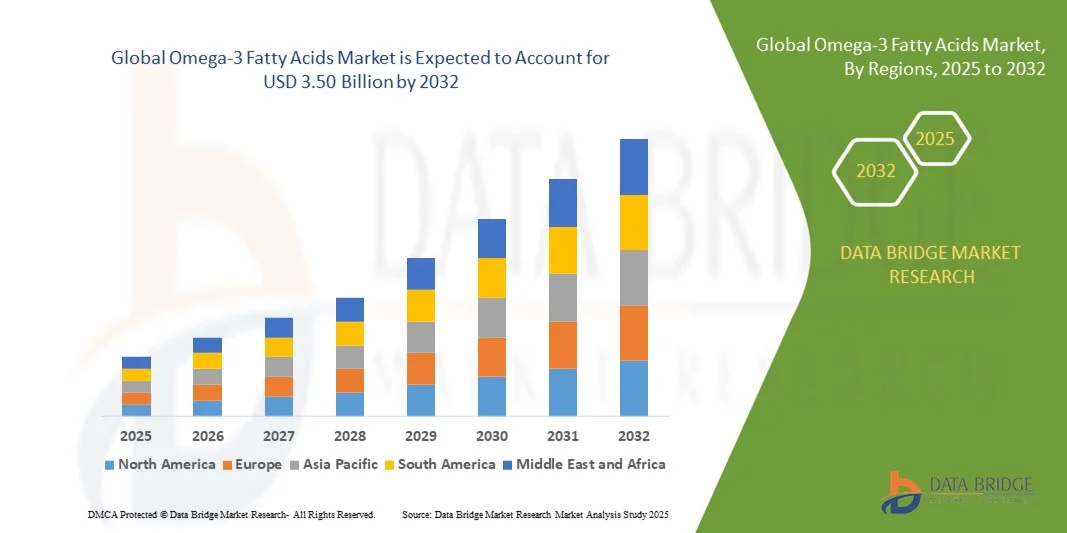
What is the Global Omega-3 Fatty Acids Market Size and Growth Rate?
- The global Omega-3 fatty acids market size was valued at USD 1.99 billion in 2024 and is expected to reach USD 3.50 billion by 2032, at a CAGR of 7.26% during the forecast period
- Rising personal disposable income and growing awareness about maintaining a healthy lifestyle are the major factors fostering the growth of the market. Changing lifestyle, rising prevalence of chronic disorders and ever-rising global population are other important factors acting as market growth determinants
- Improving distribution channel, growth in the application by functional food industry and surge in the initiatives by the government to spread awareness on how to prevent diseases will further induce growth in the market value
What are the Major Takeaways of Omega-3 Fatty Acids Market?
- The ability of omega-3 fatty acids to prevent degenerative conditions in cats and dogs will further carve the way for the growth of market
- However, rising regarding the lack of sustainable nature of marine fisheries will pose a major challenge to the growth of the market
- North America dominated the Omega-3 Fatty Acids market with the largest revenue share of 43.32% in 2024, driven by rising health awareness, increasing preventive healthcare initiatives, and the widespread adoption of dietary supplements
- The Asia-Pacific Omega-3 Fatty Acids market is poised to grow at the fastest CAGR of 10.69% from 2025 to 2032, driven by increasing health awareness, rising disposable incomes, and urbanization in countries such as China, Japan, and India
- The DHA segment dominated the market with the largest revenue share of 45% in 2024, driven by its widespread use in infant nutrition, cognitive health supplements, and maternal health products
Report Scope and Omega-3 Fatty Acids Market Segmentation
|
Attributes |
Omega-3 Fatty Acids Key Market Insights |
|
Segments Covered |
|
|
Countries Covered |
North America
Europe
Asia-Pacific
Middle East and Africa
South America
|
|
Key Market Players |
|
|
Market Opportunities |
|
|
Value Added Data Infosets |
In addition to the insights on market scenarios such as market value, growth rate, segmentation, geographical coverage, and major players, the market reports curated by the Data Bridge Market Research also include in-depth expert analysis, pricing analysis, brand share analysis, consumer survey, demography analysis, supply chain analysis, value chain analysis, raw material/consumables overview, vendor selection criteria, PESTLE Analysis, Porter Analysis, and regulatory framework. |
What is the Key Trend in the Omega-3 Fatty Acids Market?
Personalized Nutrition and Digital Health Integration
- A significant trend in the global Omega-3 Fatty Acids market is the increasing adoption of personalized nutrition solutions supported by digital health platforms and AI-based dietary recommendations. Consumers are now seeking tailored supplementation based on individual health data, lifestyle, and nutritional needs
- For instance, companies such as Cargill and DSM are leveraging AI and health apps to provide personalized omega-3 intake recommendations, enabling users to optimize cardiovascular, cognitive, and joint health outcomes
- AI integration in omega-3 solutions allows real-time tracking of consumption patterns, suggests optimal dosages, and alerts users to potential deficiencies. Personalized digital dashboards enhance adherence and transparency in supplementation
- The integration of omega-3 supplements with wellness apps and wearable devices facilitates holistic health management, allowing consumers to monitor heart rate, inflammation markers, and cognitive metrics in conjunction with their omega-3 intake
- This trend toward personalized, tech-enabled nutrition is reshaping user expectations, prompting manufacturers to develop more user-centric and adaptive omega-3 products
- The demand for digital-integrated, personalized omega-3 solutions is increasing across healthcare, fitness, and preventive wellness sectors, as consumers prioritize convenience, efficacy, and data-driven insights
What are the Key Drivers of Omega-3 Fatty Acids Market?
- Rising awareness of the health benefits of omega-3 fatty acids for heart health, brain function, and inflammation reduction is a major driver. Consumers increasingly seek preventive healthcare through diet and supplementation
- For instance, in 2024, Lonza expanded its omega-3 portfolio to include higher-concentration EPA/DHA formulations, enabling more effective cardiovascular support. Such strategic product innovations are expected to drive market growth
- Increasing adoption of fortified foods, beverages, and functional supplements with omega-3s is broadening consumer access and usage
- Growing integration with health apps and personalized nutrition platforms promotes consistent intake and education about optimal dosages, encouraging higher adoption
- The convenience of capsule, liquid, and chewable omega-3 formats, along with compatibility with multi-supplement regimens, further drives uptake in both clinical and lifestyle applications
Which Factor is Challenging the Growth of the Omega-3 Fatty Acids Market?
- High production costs and supply chain challenges for marine-derived omega-3s, including fish oil and krill oil, remain significant growth barriers. Variability in raw material quality and sustainability concerns affects consistency
- For instance, price fluctuations in fish oil have made some premium formulations less accessible to cost-sensitive consumers, particularly in emerging regions
- Limited consumer awareness of proper dosing, potential allergen concerns, and the availability of counterfeit or low-potency products can reduce trust and adoption
- Plant-based omega-3 alternatives (ALA-rich oils) often face bioavailability challenges, limiting their perceived effectiveness compared to EPA/DHA, creating hesitancy among health-conscious users
- Overcoming these challenges requires investment in sustainable sourcing, quality assurance, and consumer education to ensure product efficacy, affordability, and long-term market growth
How is the Omega-3 Fatty Acids Market Segmented?
The market is segmented on the basis of type, source, manufacturing process and application.
- By Type
On the basis of type, the Omega-3 Fatty Acids market is segmented into Docosahexaenoic Acid (DHA), Eicosapentaenoic Acid (EPA), and Alpha-Linolenic Acid (ALA). The DHA segment dominated the market with the largest revenue share of 45% in 2024, driven by its widespread use in infant nutrition, cognitive health supplements, and maternal health products. DHA is highly preferred due to its critical role in brain and eye development, making it a key component in dietary supplements and infant formulas.
The EPA segment is expected to witness the fastest CAGR of 18% from 2025 to 2032, fueled by growing adoption for cardiovascular health, anti-inflammatory benefits, and functional foods. Increasing consumer awareness regarding heart health and rising preventive healthcare initiatives are driving demand for EPA-rich formulations. In addition, advancements in purification and encapsulation technologies have improved stability and bioavailability, further boosting adoption of EPA and DHA supplements across clinical and consumer nutrition markets.
- By Source
On the basis of source, the Omega-3 Fatty Acids market is segmented into Marine and Plant. The marine segment dominated the market with a revenue share of 52% in 2024, due to the high potency of EPA and DHA found in fish oil, krill oil, and algae-derived products. Marine sources are widely preferred for their bioavailability, clinically proven benefits, and inclusion in infant formulas, pharmaceuticals, and dietary supplements.
The plant segment is expected to witness the fastest CAGR of 19% during 2025–2032, driven by rising demand for vegan, vegetarian, and sustainable omega-3 sources such as flaxseed, chia, and camelina oils. Growing health-conscious consumer trends, combined with environmental and ethical concerns, are boosting plant-based omega-3 adoption. Innovations in extraction and conversion processes, such as algal and microalgae-based DHA, are further enhancing plant-derived omega-3 efficacy and expanding their application in supplements and fortified food products.
- By Manufacturing Process
On the basis of manufacturing process, the Omega-3 Fatty Acids market is segmented into Concentration Process, Fish Oil Processing, Decontamination, and Others. The concentration process segment dominated the market with a 48% revenue share in 2024, owing to its ability to produce highly purified and potent EPA and DHA formulations suitable for pharmaceutical and clinical applications. Concentrated omega-3 products allow precise dosage control, better stability, and improved efficacy, which drives demand among supplement manufacturers and healthcare providers.
The fish oil processing segment is expected to witness the fastest CAGR of 17% from 2025 to 2032, fueled by increasing industrial-scale production and consumer demand for high-quality omega-3 oils. Technological advancements in extraction, molecular distillation, and deodorization techniques are enhancing product quality while reducing contaminants such as heavy metals, making fish oil processing a preferred method for both dietary supplements and functional foods.
- By Application
On the basis of application, the Omega-3 Fatty Acids market is segmented into Dietary Supplements, Functional Food and Beverages, Pharmaceuticals, Infant Formula, Clinical Nutrition, Pet Foods and Supplements, and Others. The dietary supplements segment dominated the market with the largest revenue share of 50% in 2024, driven by growing health awareness, rising preventive healthcare trends, and widespread accessibility of capsules, soft gels, and liquid formulations.
The functional food and beverages segment is expected to witness the fastest CAGR of 20% from 2025 to 2032, fueled by increasing fortification of foods with EPA and DHA, such as dairy products, bakery items, juices, and snacks. Consumer demand for convenient, ready-to-consume omega-3 products and integration with personalized nutrition programs is boosting adoption. In addition, regulatory approvals for fortified foods, rising R&D investments, and product innovations supporting heart, brain, and joint health are further accelerating growth across multiple application sectors.
Which Region Holds the Largest Share of the Omega-3 Fatty Acids Market?
- North America dominated the Omega-3 Fatty Acids market with the largest revenue share of 43.32% in 2024, driven by rising health awareness, increasing preventive healthcare initiatives, and the widespread adoption of dietary supplements
- Consumers in the region highly value high-quality, clinically tested omega-3 formulations, including DHA, EPA, and ALA, for cardiovascular, cognitive, and joint health
- The market growth is further supported by high disposable incomes, strong retail penetration, and the presence of leading global omega-3 manufacturers, establishing North America as the critical market for both supplement and functional food applications
U.S. Omega-3 Fatty Acids Market Insight
The U.S. Omega-3 Fatty Acids market captured the largest revenue share of 81% in 2024 within North America, fueled by increasing consumer focus on preventive health and wellness. Rising adoption of dietary supplements, fortified foods, and functional beverages is driving demand. In addition, the growing popularity of personalized nutrition and clinically validated omega-3 products is accelerating market growth. Regulatory support, coupled with strong distribution networks across pharmacies, online retail, and health stores, further reinforces U.S. market dominance.
Europe Omega-3 Fatty Acids Market Insight
The Europe Omega-3 Fatty Acids market is projected to expand at a substantial CAGR during the forecast period, driven by rising health-consciousness and aging populations. Governments are encouraging preventive health measures, including the consumption of omega-3 supplements. Increasing demand for functional foods, fortified beverages, and pharmaceutical-grade formulations further supports adoption. Markets in Germany, France, and the U.K. are seeing consistent growth, with strong R&D capabilities and the presence of key players enhancing product availability and innovation across the region.
U.K. Omega-3 Fatty Acids Market Insight
The U.K. Omega-3 Fatty Acids market is anticipated to grow at a moderate CAGR, supported by increasing consumer interest in heart, brain, and eye health. Rising awareness of supplement efficacy, coupled with robust retail and e-commerce infrastructure, is driving market penetration. Government initiatives promoting preventive healthcare and nutritional education also contribute to demand. High-quality formulations and transparent labeling are encouraging consumer trust, making the U.K. a key regional market within Europe.
Germany Omega-3 Fatty Acids Market Insight
The Germany Omega-3 Fatty Acids market is expected to expand at a notable CAGR due to rising health awareness and the preference for premium, clinically tested supplements. Germany’s strong pharmaceutical and nutraceutical industries, combined with high consumer purchasing power, promote adoption of omega-3 formulations for cardiovascular, cognitive, and joint health. The integration of omega-3s into functional foods, beverages, and infant nutrition is also driving growth, making Germany a critical hub for research-driven product launches and high-quality manufacturing.
Which Region is the Fastest Growing in the Omega-3 Fatty Acids Market?
The Asia-Pacific Omega-3 Fatty Acids market is poised to grow at the fastest CAGR of 10.69% from 2025 to 2032, driven by increasing health awareness, rising disposable incomes, and urbanization in countries such as China, Japan, and India. Rapid adoption of functional foods, fortified beverages, and dietary supplements is fueling demand. Government initiatives promoting nutrition, coupled with growing manufacturing capacity and availability of affordable omega-3 products, are expanding access. Rising prevalence of lifestyle-related diseases is further driving the need for preventive nutrition solutions.
Japan Omega-3 Fatty Acids Market Insight
The Japan Omega-3 Fatty Acids market is gaining traction due to the country’s aging population, high health consciousness, and preference for preventive nutrition. DHA and EPA supplements are particularly popular for cognitive, cardiovascular, and maternal health applications. Integration of omega-3s into functional foods and beverages is also rising. Consumers are increasingly seeking high-quality, clinically validated formulations, driving market growth in both retail and pharmaceutical channels.
China Omega-3 Fatty Acids Market Insight
The China Omega-3 Fatty Acids market accounted for the largest revenue share in Asia-Pacific in 2024, attributed to rising disposable incomes, growing urban middle class, and increasing health awareness. Rapid adoption of dietary supplements, fortified foods, and functional beverages is driving demand. Domestic manufacturers, supported by government initiatives promoting nutrition and preventive health, are expanding production capacity. Affordable omega-3 products, combined with strong retail and e-commerce networks, are making supplements widely accessible, propelling China as a key growth market in the Asia-Pacific region.
Which are the Top Companies in Omega-3 Fatty Acids Market?
The Omega-3 fatty acids industry is primarily led by well-established companies, including:
- Lonza (Switzerland)
- BASF SE (Germany)
- Evonik Industries AG (Germany)
- Cargill, Incorporated (U.S.)
- DSM (Netherlands)
- Epax (Norway)
- Croda International Plc (U.K.)
- Amway (U.S.)
- Sanofi (France)
- Unilever (U.K.)
- Nestlé (Switzerland)
- Reckitt Benckiser Group plc (U.K.)
- VivoMega (U.S.)
- Omega Protein Corporation (U.S.)
- ARISTA INDUSTRIES (U.S.)
- Polaris Inc. (U.S.)
- Pharma Marine AS (Norway)
- Merck KGaA (Germany)
- Nordic Naturals, Inc. (U.S.)
- Corbion NV (Netherlands)
What are the Recent Developments in Global Omega-3 Fatty Acids Market?
- In March 2023, Epax announced an investment of USD 40 million in molecular distillation technology for enhancing the processing of highly concentrated omega-3, aiming to improve purity and potency, which is expected to strengthen their market position and production efficiency
- In May 2023, Nuseed Global introduced Nuseed Nutriterra, a plant-based oil enriched with omega-3, specifically developed for the human nutrition and dietary supplement markets, supporting the growing consumer shift towards plant-based, sustainable nutritional solutions
- In July 2021, Neptune Wellness Solutions Inc., a diversified health and wellness company focused on plant-based and sustainable lifestyle brands, launched Forest Remedies’ Multi Omega 3-6-9 gummies and soft gels with Ahiflower as a key ingredient, enabling consumers to meet their daily omega nutrient requirements conveniently
- In February 2021, India-based start-up OZiva launched new vegan Omega-3 multivitamins, designed to address the increasing demand for plant-based dietary supplements, further supporting the growth of clean-label and plant-based nutrition options
- In March 2020, Wiley Companies introduced its first omega-3 concentrate in powdered form for food and beverage applications, formulated without fishy taste or odor, ensuring an appealing sensory experience for consumers while expanding product versatility

- Interactive Data Analysis Dashboard
- Company Analysis Dashboard for high growth potential opportunities
- Research Analyst Access for customization & queries
- Competitor Analysis with Interactive dashboard
- Latest News, Updates & Trend analysis
- Harness the Power of Benchmark Analysis for Comprehensive Competitor Tracking
Table of Content
1 INTRODUCTION
1.1 OBJECTIVES OF THE STUDY
1.2 MARKET DEFINITION
1.3 OVERVIEW OF GLOBAL OMEGA-3 FATTY ACIDS MARKET
1.4 CURRENCY AND PRICING
1.5 LIMITATION
1.6 MARKETS COVERED
2 MARKET SEGMENTATION
2.1 KEY TAKEAWAYS
2.2 ARRIVING AT THE GLOBAL OMEGA-3 FATTY ACIDS MARKET SIZE
2.2.1 VENDOR POSITIONING GRID
2.2.2 TECHNOLOGY LIFE LINE CURVE
2.2.3 MARKET GUIDE
2.2.4 COMPANY POSITIONING GRID
2.2.5 COMAPANY MARKET SHARE ANALYSIS
2.2.6 MULTIVARIATE MODELLING
2.2.7 DEMAND AND SUPPLY-SIDE VARIABLES
2.2.8 CONSUMPTION TREND OF END PRODUCTS
2.2.9 TOP TO BOTTOM ANALYSIS
2.2.10 STANDARDS OF MEASUREMENT
2.2.11 VENDOR SHARE ANALYSIS
2.2.12 DATA POINTS FROM KEY PRIMARY INTERVIEWS
2.2.13 DATA POINTS FROM KEY SECONDARY DATABASES
2.3 GLOBAL OMEGA-3 FATTY ACIDS MARKET: RESEARCH SNAPSHOT
2.4 ASSUMPTIONS
3 MARKET OVERVIEW
3.1 DRIVERS
3.2 RESTRAINTS
3.3 OPPORTUNITIES
3.4 CHALLENGES
4 EXECUTIVE SUMMARY
5 PREMIUM INSIGHTS
5.1 VALUE CHAIN ANALYSIS
5.2 SUPPLY CHAIN ANALYSIS
5.3 IMPORT-EXPORT ANALYSIS
5.4 PORTER’S FIVE FORCES ANALYSIS
5.4.1 BARGAINING POWER OF SUPPLIERS
5.4.2 BARGAINING POWER OF BUYERS/CONSUMERS
5.4.3 THREAT OF NEW ENTRANTS
5.4.4 THREAT OF SUBSTITUTE PRODUCTS
5.4.5 INTENSITY OF COMPETITIVE RIVALRY
5.5 RAW MATERIAL SOURCING ANALYSIS
5.6 OVERVIEW OF TECHNOLOGICAL INNOVATIONS
5.7 INDUSTRY TRENDS AND FUTURE PERSPECTIVE
5.8 GROWTH STRATEGIES ADOPTED BY KEY MARKET PLAYERS
5.9 FACTORS INFLUENCING PURCHASING DECISION OF END-USERS
6 IMPACT OF ECONOMIC SLOW DOWN ON MARKET
6.1 IMPACT ON PRICE
6.2 IMPACT ON SUPPLY CHAIN
6.3 IMPACT ON SHIPMENT
6.4 IMPACT ON COMPANY’S STRATEGIC DECISIONS
7 REGULATORY FRAMEWORK AND GUIDELINES
8 PRICING INDEX (PRICE AT B2B END & PRICES AT FOB)
9 PRODUCTION CAPACITY OF KEY MANUFACTURERES
10 BRAND OUTLOOK
10.1 COMPARATIVE BRAND ANALYSIS
10.2 PRODUCT VS BRAND OVERVIEW
11 GLOBAL OMEGA-3 FATTY ACIDS MARKET, BY TYPE, (2022-2031) (USD MILLION) (KILO TONS)
11.1 OVERVIEW
11.2 ALPHA-LINOLENIC ACID (ALA)
11.3 EICOSAPENTAENOIC ACID (EPA)
11.4 DOCOSAHEXAENOIC ACID (DHA)
11.5 EICOSAPENTAENOIC ACID (EPA)+ DOCOSAHEXAENOIC ACID (DHA)
12 GLOBAL OMEGA-3 FATTY ACIDS MARKET, BY SOURCE, (2022-2031) (USD MILLION)
12.1 OVERVIEW
12.2 MARINE BASED
12.2.1 TUNA OIL
12.2.2 MENHADEN OIL
12.2.3 SALMON OIL
12.2.4 HOKI OIL
12.2.5 POLLOCK OIL
12.2.6 COD LIVER OIL
12.2.7 MUSSEL OIL
12.2.8 CALANUS OIL
12.2.9 KRILL OIL
12.2.10 MACKEREL OIL
12.2.11 SARDINE OIL
12.2.12 OTHERS
12.3 ALGAE -BASED
12.3.1 OMEGA-3 FATTY ACID
12.3.2 MACROALGAL
12.4 PLANT-BASED
12.4.1 WALNUT
12.4.2 PUMPKINSEEDS
12.4.3 SOYBEAN
12.4.4 CANOLA
12.4.5 FLAXSEED
12.4.6 CHIA SEED
12.4.7 HEMP SEED
12.4.8 OTHERS
13 GLOBAL OMEGA-3 FATTY ACIDS MARKET, BY FORM, (2022-2031) (USD MILLION)
13.1 OVERVIEW
13.2 DRY
13.3 LIQUID
14 GLOBAL OMEGA-3 FATTY ACIDS MARKET, BY CATEGORY, (2022-2031) (USD MILLION)
14.1 OVERVIEW
14.2 ORGANIC
14.3 CONVENTIONAL
15 GLOBAL OMEGA-3 FATTY ACIDS MARKET, BY NATURE, (2022-2031) (USD MILLION)
15.1 OVERVIEW
15.2 PURE
15.3 BLENDED
16 GLOBAL OMEGA-3 FATTY ACIDS MARKET, BY FUNCTION, (2022-2031) (USD MILLION)
16.1 OVERVIEW
16.2 BRAIN & MENTAL HEALTH
16.3 IMMUNE SYSTEM
16.4 VISION
16.5 SKIN HEALTH
16.6 BONE HEALTH
16.7 CARDIOVASCULAR HEALTH
16.8 ANTI CANCER
16.9 LUNG HEALTH
16.1 BLOOD VESSEL HEALTH
16.11 BONE HEALTH
16.12 WOMAN HEALTH
16.13 ANTI-CHOLESTEROL
16.14 OTHERS
17 GLOBAL OMEGA-3 FATTY ACIDS MARKET, BY APPLICATION, (2022-2031) (USD MILLION)
17.1 OVERVIEW
17.2 FOOD PRODUCTS
17.2.1 FOOD PRODUCTS, BY APPLICATION
17.2.1.1. BAKERY PRODUCTS
17.2.1.1.1. CAKES AND PASTRIES
17.2.1.1.2. COOKIES AND BISCUITS
17.2.1.1.3. BREADS AND ROLLS
17.2.1.1.4. DONUTS
17.2.1.1.5. OTHERS
17.2.1.2. CHOCOLATES AND CONFECTIONARY
17.2.1.2.1. CHOCOLATES
17.2.1.2.2. GUMMIES/JELLIES
17.2.1.2.3. HARD CANDIES
17.2.1.2.4. SUGAR CONFECTIONARY
17.2.1.2.5. OTHERS
17.2.1.3. PROCESSED FOOD
17.2.1.3.1. PASTA
17.2.1.3.2. NOODLES
17.2.1.3.3. EXTRUDED SNACKS
17.2.1.3.4. SOUPS AND SAUCES
17.2.1.3.5. OTHERS
17.2.1.4. BREAKFAST CEREALS
17.2.1.5. INSTANT FOOD
17.2.1.6. MEAT AND POULTRY PRODUCTS
17.2.1.7. DRESSINGS AND SEASONINGS
17.2.1.8. INFANT FORMULA
17.2.1.9. SPORTS NUTRITION
17.2.1.9.1. SPORTS NUTRITION BARS
17.2.1.9.2. SPORTS PROTEIN POWDERS
17.2.1.9.3. OTHERS
17.2.1.10. CEREAL BARS
17.2.1.11. DAIRY PRODUCTS
17.2.1.11.1. ICE CREAM
17.2.1.11.2. BUTTER
17.2.1.11.3. YOUGUT
17.2.1.11.4. PUDDING
17.2.1.11.5. CHEESE
17.2.1.11.6. MILK
17.2.1.11.7. CREAM
17.2.1.11.8. OTHERS
17.2.1.12. DAIRY ALTERNATIVE PRODUCTS
17.2.1.13. FROZEN FOOD
17.2.1.14. OTHERS
17.2.2 FOOD PRODUCTS, BY TYPE
17.2.2.1. ALPHA-LINOLENIC ACID (ALA)
17.2.2.2. DOCOSAHEXAENOIC ACID (DHA)
17.2.2.3. EICOSAPENTAENOIC ACID (EPA)
17.3 BEVERAGES
17.3.1 BEVERAGES, APPLICATION
17.3.1.1. ALCOHOLIC BEVERAGES
17.3.1.1.1. WINE
17.3.1.1.2. BEER
17.3.1.1.3. SPIRIT DRINKS
17.3.1.1.4. OTHERS
17.3.1.2. NON-ALCOHOLIC BEVERAGES
17.3.1.2.1. CARBONATED DRINKS
17.3.1.2.2. SPORTS & ENERGY DRINKS
17.3.1.2.3. SMOOTHIES
17.3.1.2.4. RTD COFFEE & TEA
17.3.1.2.5. OTHERS
17.3.2 BEVERAGES, BY TYPE
17.3.2.1. ALPHA-LINOLENIC ACID (ALA)
17.3.2.2. DOCOSAHEXAENOIC ACID (DHA)
17.3.2.3. EICOSAPENTAENOIC ACID (EPA)
17.4 NUTRACEUTICALS AND DIETARY SUPPLEMENTS
17.4.1 NUTRACEUTICALS AND DIETARY SUPPLEMENTS, BY TYPE
17.4.1.1. ALPHA-LINOLENIC ACID (ALA)
17.4.1.2. DOCOSAHEXAENOIC ACID (DHA)
17.4.1.3. EICOSAPENTAENOIC ACID (EPA)
17.5 COSMETICS AND PERSONAL CARE
17.5.1 COSMETICS AND PERSONAL CARE, APPLICATION
17.5.1.1. SKIN CARE
17.5.1.1.1. SUN SCREEN LOTION
17.5.1.1.2. SERUM
17.5.1.1.3. MOISTURIZER
17.5.1.1.4. SCRUB
17.5.1.1.5. LIP CARE CREAM
17.5.1.1.6. OTHERS
17.5.1.2. HAIR CARE
17.5.1.2.1. SHAMPOO
17.5.1.2.2. CONDITIONER
17.5.1.2.3. HAIR OIL AND SERUM
17.5.1.2.4. OTHERS
17.5.1.3. SOAPS AND BODY WASH
17.5.1.4. OTHERS
17.5.2 COSMETICS AND PERSONAL CARE, BY TYPE
17.5.2.1. ALPHA-LINOLENIC ACID (ALA)
17.5.2.2. DOCOSAHEXAENOIC ACID (DHA)
17.5.2.3. EICOSAPENTAENOIC ACID (EPA)
17.6 ANIMAL FEED
17.6.1 ANIMAL FEED, APPLICATION
17.6.1.1. RUMINANTS
17.6.1.2. POULTRY
17.6.1.3. SWINE
17.6.1.4. PETS
17.6.1.5. AQUATIC ANIMAL
17.6.1.6. OTHERS
17.6.2 ANIMAL FEED, BY TYPE
17.6.2.1. ALPHA-LINOLENIC ACID (ALA)
17.6.2.2. DOCOSAHEXAENOIC ACID (DHA)
17.6.2.3. EICOSAPENTAENOIC ACID (EPA)
17.7 PHARMACEUTICALS
17.7.1 PHARMACEUTICALS, BY TYPE
17.7.1.1. ALPHA-LINOLENIC ACID (ALA)
17.7.1.2. DOCOSAHEXAENOIC ACID (DHA)
17.7.1.3. EICOSAPENTAENOIC ACID (EPA)
17.8 OTHERS
18 GLOBAL OMEGA-3 FATTY ACIDS MARKET, BY GEOGRAPHY, (2022-2031) (USD MILLION) (KILO TONS)
GLOBAL OMEGA-3 FATTY ACIDS MARKET, (ALL SEGMENTATION PROVIDED ABOVE IS REPRESENTED IN THIS CHAPTER BY COUNTRY)
18.1 NORTH AMERICA
18.1.1 U.S.
18.1.2 CANADA
18.1.3 MEXICO
18.2 EUROPE
18.2.1 GERMANY
18.2.2 U.K.
18.2.3 ITALY
18.2.4 FRANCE
18.2.5 SPAIN
18.2.6 SWITZERLAND
18.2.7 NETHERLANDS
18.2.8 BELGIUM
18.2.9 RUSSIA
18.2.10 DENMARK
18.2.11 SWEDEN
18.2.12 POLAND
18.2.13 TURKEY
18.2.14 REST OF EUROPE
18.3 ASIA-PACIFIC
18.3.1 JAPAN
18.3.2 CHINA
18.3.3 SOUTH KOREA
18.3.4 INDIA
18.3.5 AUSTRALIA
18.3.6 SINGAPORE
18.3.7 THAILAND
18.3.8 INDONESIA
18.3.9 MALAYSIA
18.3.10 PHILIPPINES
18.3.11 NEW ZEALAND
18.3.12 VIETNAM
18.3.13 REST OF ASIA-PACIFIC
18.4 SOUTH AMERICA
18.4.1 BRAZIL
18.4.2 ARGENTINA
18.4.3 REST OF SOUTH AMERICA
18.5 MIDDLE EAST AND AFRICA
18.5.1 SOUTH AFRICA
18.5.2 UAE
18.5.3 SAUDI ARABIA
18.5.4 OMAN
18.5.5 QATAR
18.5.6 KUWAIT
18.5.7 REST OF MIDDLE EAST AND AFRICA
19 GLOBAL OMEGA-3 FATTY ACIDS MARKET, COMPANY LANDSCAPE
19.1 COMPANY SHARE ANALYSIS: GLOBAL
19.2 COMPANY SHARE ANALYSIS: NORTH AMERICA
19.3 COMPANY SHARE ANALYSIS: EUROPE
19.4 COMPANY SHARE ANALYSIS: ASIA-PACIFIC
19.5 COMPANY SHARE ANALYSIS: MIDDLE EAST AND AFRICA
19.6 MERGERS & ACQUISITIONS
19.7 NEW PRODUCT DEVELOPMENT & APPROVALS
19.8 EXPANSIONS & PARTNERSHIP
19.9 REGULATORY CHANGES
20 GLOBAL OMEGA-3 FATTY ACIDS MARKET, SWOT & DBMR ANALYSIS
21 GLOBAL OMEGA-3 FATTY ACIDS MARKET, COMPANY PROFILES
21.1 CARGILL, INCORPORATED
21.1.1 COMPANY OVERVIEW
21.1.2 REVENUE ANALYSIS
21.1.3 PRODUCT PORTFOLIO
21.1.4 RECENT DEVELOPMENTS
21.2 PELAGIA AS
21.2.1 COMPANY OVERVIEW
21.2.2 REVENUE ANALYSIS
21.2.3 PRODUCT PORTFOLIO
21.2.4 RECENT DEVELOPMENTS
21.3 CRODA INTERNATIONAL PLC
21.3.1 COMPANY OVERVIEW
21.3.2 REVENUE ANALYSIS
21.3.3 PRODUCT PORTFOLIO
21.3.4 RECENT DEVELOPMENTS
21.4 ROYAL DSM
21.4.1 COMPANY OVERVIEW
21.4.2 REVENUE ANALYSIS
21.4.3 PRODUCT PORTFOLIO
21.4.4 RECENT DEVELOPMENTS
21.5 OLVEA FISH OILS
21.5.1 COMPANY OVERVIEW
21.5.2 REVENUE ANALYSIS
21.5.3 PRODUCT PORTFOLIO
21.5.4 RECENT DEVELOPMENTS
21.6 OMEGA PROTEIN CORPORATION
21.6.1 COMPANY OVERVIEW
21.6.2 REVENUE ANALYSIS
21.6.3 PRODUCT PORTFOLIO
21.6.4 RECENT DEVELOPMENTS
21.7 GC RIEBER OILS
21.7.1 COMPANY OVERVIEW
21.7.2 REVENUE ANALYSIS
21.7.3 PRODUCT PORTFOLIO
21.7.4 RECENT DEVELOPMENTS
21.8 LUHUA BIOMARINE (SHANDONG) CO., LTD.
21.8.1 COMPANY OVERVIEW
21.8.2 REVENUE ANALYSIS
21.8.3 PRODUCT PORTFOLIO
21.8.4 RECENT DEVELOPMENTS
21.9 PHARMA MARINE AS
21.9.1 COMPANY OVERVIEW
21.9.2 REVENUE ANALYSIS
21.9.3 PRODUCT PORTFOLIO
21.9.4 RECENT DEVELOPMENTS
21.1 POLARIS
21.10.1 COMPANY OVERVIEW
21.10.2 REVENUE ANALYSIS
21.10.3 PRODUCT PORTFOLIO
21.10.4 RECENT DEVELOPMENTS
21.11 EVONIK
21.11.1 COMPANY OVERVIEW
21.11.2 REVENUE ANALYSIS
21.11.3 PRODUCT PORTFOLIO
21.11.4 RECENT DEVELOPMENTS
21.12 BASF SE
21.12.1 COMPANY OVERVIEW
21.12.2 REVENUE ANALYSIS
21.12.3 PRODUCT PORTFOLIO
21.12.4 RECENT DEVELOPMENTS
21.13 GOLDEN OMEGA
21.13.1 COMPANY OVERVIEW
21.13.2 REVENUE ANALYSIS
21.13.3 PRODUCT PORTFOLIO
21.13.4 RECENT DEVELOPMENTS
21.14 CORBION
21.14.1 COMPANY OVERVIEW
21.14.2 REVENUE ANALYSIS
21.14.3 PRODUCT PORTFOLIO
21.14.4 RECENT DEVELOPMENTS
21.15 SOLUTEX
21.15.1 COMPANY OVERVIEW
21.15.2 REVENUE ANALYSIS
21.15.3 PRODUCT PORTFOLIO
21.15.4 RECENT DEVELOPMENTS
21.16 NISSUI
21.16.1 COMPANY OVERVIEW
21.16.2 REVENUE ANALYSIS
21.16.3 PRODUCT PORTFOLIO
21.16.4 RECENT DEVELOPMENTS
21.17 HUATAI BIOPHARM INC.
21.17.1 COMPANY OVERVIEW
21.17.2 REVENUE ANALYSIS
21.17.3 PRODUCT PORTFOLIO
21.17.4 RECENT DEVELOPMENTS
21.18 KD NUTRA
21.18.1 COMPANY OVERVIEW
21.18.2 REVENUE ANALYSIS
21.18.3 PRODUCT PORTFOLIO
21.18.4 RECENT DEVELOPMENTS
21.19 KINOMEGA BIOPHARM INC
21.19.1 COMPANY OVERVIEW
21.19.2 REVENUE ANALYSIS
21.19.3 PRODUCT PORTFOLIO
21.19.4 RECENT DEVELOPMENTS
21.2 AKER BIOMARINE
21.20.1 COMPANY OVERVIEW
21.20.2 REVENUE ANALYSIS
21.20.3 PRODUCT PORTFOLIO
21.20.4 RECENT DEVELOPMENTS
21.21 CHAMBIO CO., LTD.
21.21.1 COMPANY OVERVIEW
21.21.2 REVENUE ANALYSIS
21.21.3 PRODUCT PORTFOLIO
21.21.4 RECENT DEVELOPMENTS
21.22 BIZEN CHEMICAL CO.LTD
21.22.1 COMPANY OVERVIEW
21.22.2 REVENUE ANALYSIS
21.22.3 PRODUCT PORTFOLIO
21.22.4 RECENT DEVELOPMENTS
21.23 WILEY COMPANIES
21.23.1 COMPANY OVERVIEW
21.23.2 REVENUE ANALYSIS
21.23.3 PRODUCT PORTFOLIO
21.23.4 RECENT DEVELOPMENTS
21.24 STEPAN COMPANY
21.24.1 COMPANY OVERVIEW
21.24.2 REVENUE ANALYSIS
21.24.3 PRODUCT PORTFOLIO
21.24.4 RECENT DEVELOPMENTS
21.25 CLOVER CORPORATION LIMITED
21.25.1 COMPANY OVERVIEW
21.25.2 REVENUE ANALYSIS
21.25.3 PRODUCT PORTFOLIO
21.25.4 RECENT DEVELOPMENTS
21.26 CELLANA INC.
21.26.1 COMPANY OVERVIEW
21.26.2 REVENUE ANALYSIS
21.26.3 PRODUCT PORTFOLIO
21.26.4 RECENT DEVELOPMENTS
21.27 BIOSEARCH LIFE
21.27.1 COMPANY OVERVIEW
21.27.2 REVENUE ANALYSIS
21.27.3 PRODUCT PORTFOLIO
21.27.4 RECENT DEVELOPMENTS
21.28 BRUDYTECHNOLOGY
21.28.1 COMPANY OVERVIEW
21.28.2 REVENUE ANALYSIS
21.28.3 PRODUCT PORTFOLIO
21.28.4 RECENT DEVELOPMENTS
21.29 NATURMEGA
21.29.1 COMPANY OVERVIEW
21.29.2 REVENUE ANALYSIS
21.29.3 PRODUCT PORTFOLIO
21.29.4 RECENT DEVELOPMENTS
21.3 ALIMENTOS MARINOS SA DE CV
21.30.1 COMPANY OVERVIEW
21.30.2 REVENUE ANALYSIS
21.30.3 PRODUCT PORTFOLIO
21.30.4 RECENT DEVELOPMENTS
NOTE: THE COMPANIES PROFILED IS NOT EXHAUSTIVE LIST AND IS AS PER OUR PREVIOUS CLIENT REQUIREMENT. WE PROFILE MORE THAN 100 COMPANIES IN OUR STUDY AND HENCE THE LIST OF COMPANIES CAN BE MODIFIED OR REPLACED ON REQUEST
22 RELATED REPORTS
23 QUESTIONNAIRE
24 ABOUT DATA BRIDGE MARKET RESEARCH

Global Omega 3 Fatty Acids Market, Supply Chain Analysis and Ecosystem Framework
To support market growth and help clients navigate the impact of geopolitical shifts, DBMR has integrated in-depth supply chain analysis into its Global Omega 3 Fatty Acids Market research reports. This addition empowers clients to respond effectively to global changes affecting their industries. The supply chain analysis section includes detailed insights such as Global Omega 3 Fatty Acids Market consumption and production by country, price trend analysis, the impact of tariffs and geopolitical developments, and import and export trends by country and HSN code. It also highlights major suppliers with data on production capacity and company profiles, as well as key importers and exporters. In addition to research, DBMR offers specialized supply chain consulting services backed by over a decade of experience, providing solutions like supplier discovery, supplier risk assessment, price trend analysis, impact evaluation of inflation and trade route changes, and comprehensive market trend analysis.
Data collection and base year analysis are done using data collection modules with large sample sizes. The stage includes obtaining market information or related data through various sources and strategies. It includes examining and planning all the data acquired from the past in advance. It likewise envelops the examination of information inconsistencies seen across different information sources. The market data is analysed and estimated using market statistical and coherent models. Also, market share analysis and key trend analysis are the major success factors in the market report. To know more, please request an analyst call or drop down your inquiry.
The key research methodology used by DBMR research team is data triangulation which involves data mining, analysis of the impact of data variables on the market and primary (industry expert) validation. Data models include Vendor Positioning Grid, Market Time Line Analysis, Market Overview and Guide, Company Positioning Grid, Patent Analysis, Pricing Analysis, Company Market Share Analysis, Standards of Measurement, Global versus Regional and Vendor Share Analysis. To know more about the research methodology, drop in an inquiry to speak to our industry experts.
Data Bridge Market Research is a leader in advanced formative research. We take pride in servicing our existing and new customers with data and analysis that match and suits their goal. The report can be customized to include price trend analysis of target brands understanding the market for additional countries (ask for the list of countries), clinical trial results data, literature review, refurbished market and product base analysis. Market analysis of target competitors can be analyzed from technology-based analysis to market portfolio strategies. We can add as many competitors that you require data about in the format and data style you are looking for. Our team of analysts can also provide you data in crude raw excel files pivot tables (Fact book) or can assist you in creating presentations from the data sets available in the report.













